
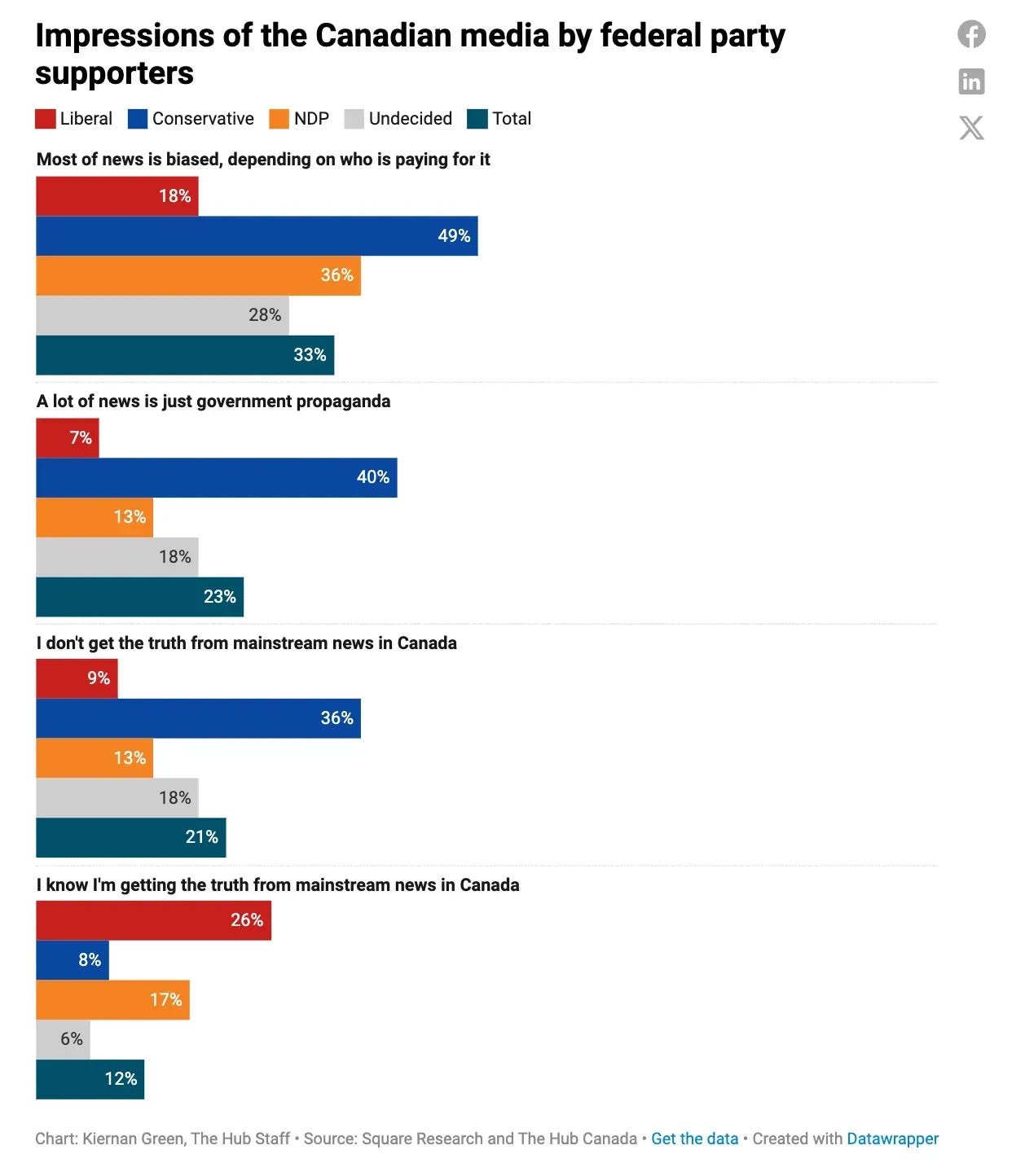
Canadians increasingly distrust the media, and one of the most persistent complaints is that political journalists treat Conservatives more harshly than Liberals.
Conservative leaders are often portrayed as angry, divisive, or dangerous. Their motives are examined closely, their language is scrutinized, and their mistakes can dominate coverage for days. Liberal leaders, critics argue, are more often presented as serious public servants confronting complicated problems, even when their governments are failing.
Is that perception accurate, or is it simply what political partisans see when coverage is unfavourable to their side?
Robert Fife, one of Canada’s most experienced political journalists, offered a surprisingly direct answer.
“There is an unfair bias against the Conservatives in Ottawa,” the longtime Globe and Mail journalist said. “I think that’s probably true. And it’s always been the case, generally speaking.”
Coming from someone who has spent nearly five decades covering federal politics, that acknowledgment matters. But Fife’s broader answer was more complicated than a simple indictment of Canadian journalism.
He believes bias may exist. He also believes Conservatives can make genuine political mistakes—and that Pierre Poilievre’s current difficulties cannot be dismissed as a media invention.
Different Standards for Different Leaders
The question arose from comparing media coverage of Pierre Poilievre and Mark Carney.
Poilievre has faced years of combative interviews. Journalists frequently interrupt him, challenge his framing, question his character, and examine whether his political approach is too divisive. Even interviews ostensibly about policy can become arguments about his tone, temperament, or suitability for office.
Carney’s treatment has often felt different.
His challenges are more frequently described as complex. His decisions are framed within the difficult economic and geopolitical circumstances facing Canada. Where Poilievre is sometimes asked whether he is the problem, Carney is often asked how he plans to solve the problem.
This does not necessarily mean every interviewer is consciously favouring Liberals. Bias can be cultural rather than coordinated. Political journalists often live in the same cities, attend similar universities, consume the same media, and move within overlapping professional and social circles.
A newsroom does not need to receive instructions from a political party to develop a shared worldview.
Bias can emerge through the assumptions journalists carry into interviews: which policies seem reasonable, which political movements appear threatening, whose anger is considered legitimate, and which leaders are granted the benefit of the doubt.
Fife’s answer suggests that Conservatives have legitimate grounds to question whether the political press applies the same instincts to every party.
Bias Does Not Make Every Criticism Wrong
At the same time, Fife rejected the idea that media hostility fully explains Poilievre’s difficulties.
He argued that Poilievre made serious strategic errors, including failing to build relationships with prominent centre-right Conservatives such as Ontario Premier Doug Ford and Nova Scotia Premier Tim Houston. He also pointed to Poilievre’s strained relationship with Jean Charest and the broader conflict between different factions of the Conservative movement.
In Fife’s assessment, Poilievre did not sufficiently broaden his coalition after losing the election. Rather than showing a more conciliatory side and repairing relationships, he continued with a combative political style that may appeal to loyal supporters but risks alienating the voters and political allies he needs.
Fife also said the internal fighting within the Conservative Party is real—not merely a narrative created by hostile reporters. He cited his own conversations with Conservative MPs and the public disagreements unfolding on social media.
That distinction is essential.
Media bias can influence how a political crisis is described, amplified, or interpreted. But it cannot automatically make the underlying crisis imaginary.
It is possible for journalists to scrutinize Poilievre unfairly while also reporting accurately that he faces internal opposition. Both can be true.
Why Carney Received More Patience
Fife also defended some of the more favourable coverage Carney has received.
He described Carney’s early record as significant, pointing to movement on resource development, Indigenous investment opportunities, defence spending, tax policy, and major infrastructure and energy files.
From Fife’s perspective, Carney has moved rapidly and accomplished enough to earn some initial benefit of the doubt.
But he did not suggest that this favourable period would last indefinitely.
The larger tests will come as promised projects move from announcements to implementation and large amounts of public money begin flowing. Fife warned that expensive government programs can produce waste, boondoggles, favouritism, or corruption even when the prime minister is not personally involved in wrongdoing.
Carney will eventually face more aggressive coverage, Fife argued, particularly once journalists can compare his promises with measurable outcomes.
That is a reasonable journalistic principle. A new government may initially be covered through what it intends to do. Over time, it must be judged by what it has actually delivered.
The risk is that journalists may grant Liberal leaders more time, patience, and interpretive generosity than they would extend to Conservatives.
The Problem With Political Homogeneity
Bias is not always visible through incorrect facts. It often appears through emphasis.
Which controversy leads the news? Which comment is treated as disqualifying? Which leader is interpreted charitably?
Which policy failure is described as a difficult trade-off, and which is presented as evidence of incompetence?
Journalists can report accurate details while still producing an unbalanced overall picture. If one political leader is persistently examined through the lens of suspicion while another is approached through the lens of complexity, audiences will notice.
This may help explain why many Conservatives have stopped trusting traditional media. They do not necessarily believe every report is fabricated. They believe the standards, tone, and intensity of scrutiny are uneven.
That loss of trust has consequences.
When people conclude that established outlets are hostile to them, they retreat into partisan alternatives that confirm their existing beliefs. The public becomes divided between media ecosystems, each presenting a different version of reality.
Journalistic bias then becomes more than a question of fairness to one political party. It contributes to polarization and weakens the possibility of a shared national conversation.
The Answer Is More Accountability, Not Less
The solution is not for journalists to stop scrutinizing Conservatives.
Poilievre should be questioned about his leadership, internal party divisions, policy proposals, political rhetoric, and relationships with other conservative leaders. Those are legitimate subjects of public interest.
The answer is to bring the same intensity to everyone else.
Carney should face equally serious questions about public spending, corporate influence, economic performance, government transparency, Indigenous consultation, resource development, and whether his announcements are producing results.
Journalists should examine Liberal divisions as seriously as Conservative divisions. They should challenge progressive orthodoxies as readily as populist claims. They should remain sceptical of every government, not merely the governments or politicians they find personally objectionable.
Fife has built his career around the belief that political power must be held accountable. That principle loses its force when accountability is applied selectively.
So, Is There a Bias?
Fife’s answer was candid: probably yes.
There is reason to believe Conservatives face a degree of unfair bias within Ottawa’s political and media culture. The tone of coverage, the assumptions brought into interviews, and the willingness to view Conservative motivations suspiciously all deserve examination.
But acknowledging bias does not require a
ccepting every Conservative defence of Poilievre or dismissing every critical story as partisan journalism.
Poilievre can be treated unfairly and still make mistakes. Carney can receive favourable coverage and still have genuine accomplishments. The Conservative Party can face a real internal struggle even when the media appears eager to write its leader’s political obituary.
A trustworthy press must be capable of holding all of those ideas at once.
The standard should not be whether coverage helps the Liberals or Conservatives. It should be whether journalists are applying the same curiosity, scepticism, fairness, and willingness to challenge power—regardless of who holds it.
Comments
Nothing yet. Say the first thing.
Sign in to join the conversation.