
Good morning everyone. Today’s update centers on serious potential corruption by the Trump family. A foreign businessman with red flags including an active UK money laundering investigation and no known ties to Trump funneled $100 million through Trump’s crypto company. As much as $75 million of that went directly to Trump and his sons, raising real money laundering concerns. This comes just after Capital One closed more than 300 of Trump’s accounts over similar concerns. Meanwhile, gamers are effectively running parts of America’s air traffic control system, another major Taylor Farms recall is underway, and more.
I want to pause briefly this Monday morning to acknowledge something. We hear about possible corruption constantly, and too often nothing happens. Part of the reason is the sheer volume of these stories. We report one, then move on to the next before anyone can absorb it. I won’t let that happen here.
Here’s the news:
Trump Crypto Concerns:
Guren “Bobby” Zhou, a failed British hardwood flooring retailer who once ran a collapsed crypto startup and came under money laundering investigation in the UK, funneled $100 million into President Trump’s crypto company, World Liberty Financial, through a new firm called Aqua 1. Under World Liberty’s policy, as much as $75 million of that money went to a company controlled by Trump and his three sons, also benefiting the family of Steve Witkoff, the administration’s special peace envoy. Zhou stayed largely quiet about the investment, surfacing only briefly on an X audio stream as “Mr. Bobby” to say he was “very proud to be a major player” in Trump’s crypto venture. The source of Zhou’s sudden wealth remains unexplained, and experts say the combination of his business failures, an active money laundering probe, and the sheer size of the transaction should have triggered anti-money laundering documentation requirements, though World Liberty says it “maintains a compliance program that meets or exceeds industry standards.”
Zhou’s history is littered with failed ventures and inflated claims: his hardwood flooring chain in Wales and Italy collapsed into bankruptcy in 2018 without repaying $5 million owed to his father’s company, and his metaverse crypto startup, Caduceus, burned through millions before becoming worthless by 2024, leaving investors and even employees who’d taken token-based pay with nothing. Along the way, Zhou repeatedly claimed partnerships with major institutions and celebrities, including China Merchants Securities (UK), the Bin Zayed Group of Abu Dhabi’s royal family, rugby Hall of Famer Lawrence Dallaglio, and cricket legend Ian Botham, several of whom told the Times these claims were “unauthorized and materially false” or that they’d never done business with him. A former employee, Sara Enzen, said of Caduceus’s spent funds, “We had nothing to show for that money, apart from Bobby’s lifestyle.” After his UK visa was denied in early 2024 due to the money laundering arrest, Zhou relocated to Abu Dhabi and quickly built a new web of companies, including Web3Port, which announced a $10 million World Liberty investment just days after Trump’s January 2025 inauguration.
Web3Port later renamed part of itself Aqua 1, which then announced the $100 million World Liberty purchase without disclosing any connection to Zhou or Web3Port; blockchain analytics firm Arkham Intelligence later traced the funding wallets back to entities it linked to Web3Port and Aqua 1. Around the same time, federal prosecutors in Northern California opened an investigation into a separate token offering for which Web3Port had served as market maker, and in September, two of Zhou’s longtime employees were charged in the UK money laundering case, though Zhou himself has not been charged and it’s unclear whether extradition will be sought. Despite this, Zhou continued marketing himself as “one of the largest strategic investors” in Trump-backed crypto, appearing at conferences with claims of new partnerships, including one involving retired general Wesley Clark, who told the Times his team ran a background check, found the money laundering investigation, and declined to work with Zhou. An expert on financial crime noted that the Trump family’s involvement should have triggered heightened scrutiny since anti-money laundering laws classify them as “politically exposed persons,” while the White House maintains Trump “has no conflicts of interest and only acts in the best interests of the American public.”
Iran:
Trump signaled a shift toward “low-keying” negotiations with Iran and emphasizing economic pressure instead, telling Axios “we are just watching Iran with its huge inflation and the fact they have no money,” while Tehran said it isn’t currently engaging in talks with Washington. Analyst David Sanger told CNN that as the war enters its sixth month, Trump appears to be looking for any way to open the Strait of Hormuz, “declare that he’s won his victory and leave,” noting Iran senses the same desperation since the US is “running out of munitions... running out of options, and fundamentally, running out of patience.” Iran’s national security chief, Mohammad Bagher Zolghadr, laid out six conditions over the weekend for reopening Hormuz, including a permanent end to the war, lifting the US naval blockade, withdrawing US forces, compensation for war damages, and unfreezing Iranian assets, before stepping down to become an adviser to Supreme Leader Khamenei. He was replaced by Mohsen Rezaei, a veteran IRGC commander who told CNN in June he’s willing to “turn a page” with the US but has also threatened to “give another dimension to the war by attacking other American bases” and warned Iran’s “land power is many times greater than our missiles” if the US attempts a ground invasion.
The US naval blockade has brought oil exports at Kharg Island, the terminal handling nearly all of Iran’s crude, to a near standstill, with shipping analysts at Windward reporting the western terminal has seen no loadings for 22 straight days and no departures at all since July 31, leaving 17 tankers anchored nearby with their positions hidden. Iranian state media, which once touted Kharg as “a successful model of resilience,” has shifted to emphasizing merely keeping infrastructure operational rather than citing export volumes. Oil prices ticked up Monday, with Brent crude rising to $84.03 a barrel and WTI to $78.49, after Iran said a near-final agreement with Oman to manage Hormuz navigation would not be enough to actually reopen the waterway, through which about one-fifth of global oil supply and LNG trade normally flows. Iranian officials, including Foreign Minister Abbas Araghchi, say talks with Oman over new shipping routes are in their “final stages” and proceeding “smoothly and constructively,” but insist the arrangement is bilateral with Oman and separate from US demands.
The regional conflict expanded sharply over the weekend as Houthi rebels intensified attacks tied to their alliance with Iran: Houthi strikes on Yemen’s Marib province killed at least two civilians and wounded 14 on Friday, the group claimed a “large-scale” attack on Saudi forces and the Sahn al-Jinn military base, and Saudi Arabia, Pakistan and Turkey signed a NATO-style mutual defense pact the same day. On Sunday, the Houthis claimed attacks on Saudi Aramco’s Jazan refinery, causing a fire with no reported injuries, and on Saudi forces in the port city of Mocha, which Yemeni government forces said they “thwarted.” UN special envoy for Yemen Hans Grundberg said he’s “deeply concerned,” calling this “the most significant intensification of military activity since the 2022 UN-brokered truce” and warning it sharply raises the risk of Yemen returning to full-scale conflict. Saudi Arabia’s oil exports through the Red Sea and Bab al-Mandeb strait, which have become a crucial alternative route to Hormuz, are now themselves threatened by the Houthi attacks.
The current standoff traces back to the collapse of a June ceasefire memorandum of understanding, which unraveled after Iran fired on three commercial vessels near Hormuz on July 7, prompting US retaliatory strikes that Trump called “punishment.” Iran responded by launching attacks on roughly 85 US military targets in Bahrain and Kuwait, Trump declared the ceasefire “over” at the NATO summit, and both sides exchanged further strikes through mid-July, with Iran briefly closing the strait entirely on July 12 after firing a warning shot at a vessel. By July 13, Trump said he would reinstate the naval blockade, and Iranian strikes had killed at least two people according to Iranian media. That breakdown set the stage for today’s impasse, where Iran’s fresh list of demands largely mirrors the terms from the failed June agreement but with a noticeably tougher tone, suggesting Tehran may be trying to extract more concessions before allowing shipping through Hormuz to fully resume.
Other news:
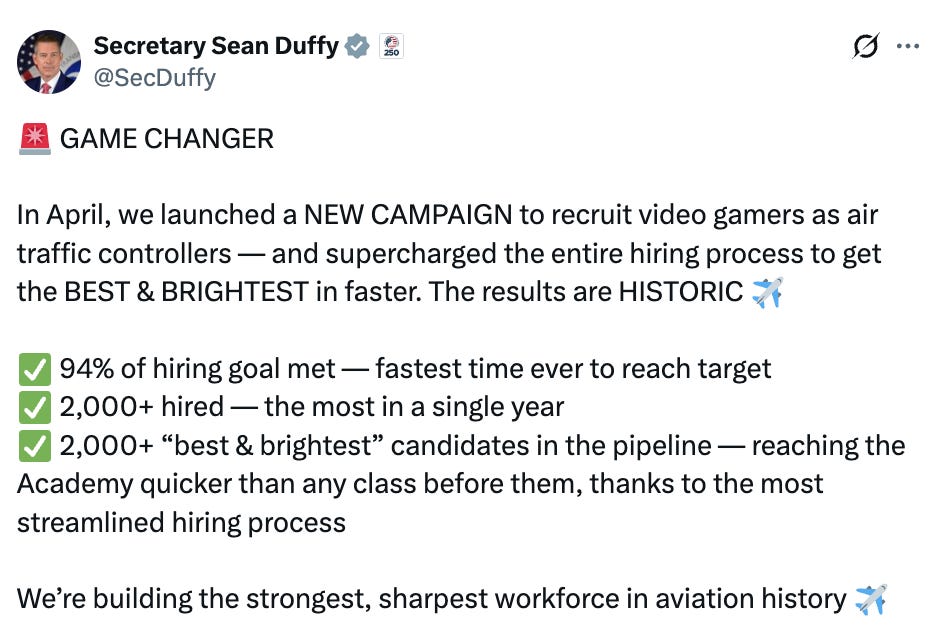
The Secretary of Transportation has turbocharged an effort to hire gamers as air traffic controllers.
In a CNN interview with Jake Tapper, National Economic Council Director Kevin Hassett faced pushback over his claim that the U.S. currently has “the strongest job market in your lifetime.” When Tapper asked what metric supported that, Hassett pointed broadly to the economy “booming” without citing specifics. Tapper then noted that job losses occurred in a third of the months during Trump’s second term and that 2 million jobs were created in Biden’s final 18 months in office, asking whether Hassett was really arguing his numbers were better. Hassett disputed Tapper’s figures but didn’t offer a rebuttal on the spot, saying only that he’d “follow up by email.”
White House chief of staff Susie Wiles reportedly found out about Trump’s controversial ICE director pick, Richard “Lance” Schroyer, via Truth Social on June 27 while attending her daughter Caroline’s wedding in Charlottesville, Virginia, according to sources who spoke to PunchUp. Sources say Homeland Security Secretary Markwayne Mullin secured the pick by visiting Trump at the White House on a Saturday when Wiles and other senior staff, including Stephen Miller and Tom Homan, were absent, and that both Miller and Homan were similarly “blindsided.” Schroyer, 54, a longtime friend of Mullin’s with 29 years of Oklahoma law enforcement experience, has faced backlash over his thin resume and past child support allegations (a dispute later dropped by his ex-wife), while a White House spokeswoman denied the team was blindsided, saying Trump “has always been the decision maker” on nominations. Despite public support from senators like Rick Scott, Bernie Moreno, and Josh Hawley, Schroyer’s confirmation remains stalled, with no hearing date set and his formal nomination only reaching the Senate on July 20, leaving the ICE director post unconfirmed as it has been for every occupant since 2017.
Taylor Farms recalled prepared foods containing jalapenos, including salsas and guacamole, from retailers such as Walmart, Kroger, Whole Foods, Target, Trader Joe’s, and Hannaford across roughly 20 states, after learning that supplier Coast Citrus Distributors was recalling the fresh peppers over salmonella concerns. The CDC and FDA are investigating the outbreak, which has sickened 345 people across 27 states and led to 36 hospitalizations, with restaurants like Chipotle and Qdoba among those that received the tainted jalapenos and have since stopped using them. Taylor Farms said it’s no longer sourcing from the implicated farm in Sinaloa, Mexico, and reports no known illnesses linked to the recalled items, while Walmart confirmed it pulled the products and blocked sales at registers and online. This comes as Taylor Farms already faces separate scrutiny over a cyclosporiasis outbreak tied to its central Mexico lettuce, one of the largest foodborne illness outbreaks in recent U.S. history, which has driven a double-digit drop in iceberg lettuce sales and hurt restaurant traffic at chains like Chipotle and Sweetgreen.
Royal Navy K3 Scout surveillance drones used by British special forces, including the Special Boat Service, were found to be secretly transmitting “heartbeat” data to an IP address in China through Chinese-made camera components, forcing the Ministry of Defence to strip all internet connectivity from the devices. The £12m fleet, supplied by British defense contractor Kraken Technology Group from a third-party camera maker that had given security assurances, had been in use since March and was slated for a future UK mission to secure freedom of navigation in the Strait of Hormuz; a defense source said the breach represents “a major failure to check origins of components” and that confidence in the platform has been lost. Officials are also concerned the drones, whose cameras reportedly stayed active even when switched off, may have recorded sensitive meetings among senior special forces staff at SBS headquarters in Poole.
The MoD insists no sensitive data or systems were compromised, and Kraken said an audit found no evidence information was shared outside intended channels, but the Conservatives are demanding an urgent audit of military equipment for hidden Chinese components, with shadow security minister Alicia Kearns warning “we should not be surprised, we should be furious that we still haven’t woken up to the realities of the threat we face.” The revelation lands amid a broader pattern of Chinese supply-chain security scares in the UK, including last year’s Huawei 5G ban precursor concerns, MI5’s espionage warnings to MPs, and the SBS’s recent ban on Chinese-made electric cars, even as the Labour government pursues a diplomatic and trade reset with Beijing.
A Politico investigation found that a July 8, 2025 ICE memo redefining “detention authority” has triggered more than 16,000 judicial rulings against ICE’s detention tactics over the past year, with 469 federal judges concluding the policy illegally denies bond hearings to longtime U.S. residents, compared to just 54 judges (mostly Trump appointees) who’ve sided with the administration. The policy strips due process from immigrants who’ve lived in the U.S. for years, even those with no criminal records who attend all check-ins, treating them as if they’d just crossed the border; cases include Yair Vargas Torres, separated from his Chicago family for 50 days after being shuttled through three states, and Remir Gutierrez Montiel, detained for two months in Indiana despite telling agents “I’m not going to run.”
The surge has overwhelmed courts nationwide, especially in Minnesota during “Operation Metro Surge,” where Judge Patrick Schiltz said he’d “never seen anything like this” and judges from neighboring states had to be pulled in to handle the caseload, while San Antonio’s Judge Fred Biery saw his court’s annual lawsuit volume jump from 1,500 to 4,000 by May. The Justice Department has dismissed the losses as the work of “activist judges” and expects vindication at the Supreme Court, which may soon need to resolve a split after two appeals courts sided with the administration and six ruled against it, even as judges report the government defying or stretching court orders in cases involving pregnant women, retroactive warrants, and unconstitutional bond hearings. Attorneys and judges describe the human toll as severe, with immigration lawyer Kelli Stump saying “families are scared” and “I cry a lot,” and judges like Schiltz and Biery reporting a rise in death threats even as ICE ramps arrests back up, prompting Stump to warn, “We can’t continue this madness. It’s not sustainable.”
UEFA, CONCACAF and the AFC accused FIFA president Gianni Infantino of a “fundamental breach of trust” in an “open letter to the football family” released Monday, following his failed plan to sell an interest in the World Cup to private equity investors. The letter, co-signed by UEFA president Aleksander Čeferin, AFC president Salman Bin Ibrahim Al-Khalifa, CONCACAF president Victor Montagliani and three general secretaries, argued that “when trust is broken through deception, when an individual places himself above the collective that entrusted him with authority, that duty has been abandoned.” The confederations criticized FIFA’s response as inadequate, noting that only one elected official attended a crisis meeting in Morocco last Wednesday, where senior FIFA staff “reaffirmed their full support” for Infantino, and said FIFA is treating the episode “as a failure of communication, when what football witnessed was a failure of judgment.” Norway’s soccer federation has called for Infantino to resign, and the English Football Association has withdrawn support for his re-election next March, while UEFA had previously threatened to boycott the World Cup and other FIFA competitions before the plan was scrapped. The letter closed by urging FIFA toward “leadership that serves football, not seeks to command it,” saying the sport “belongs to no individual and no institution.”
Typhoon Dolphin, the strongest storm to hit China this year, made landfall in Zhejiang province Sunday evening with sustained winds over 90 mph before weakening to a tropical storm, flooding streets in Shanghai and drenching eastern provinces including Anhui, Jiangsu, and Shandong. Suburban Shanghai districts like Jiading and Qingpu remained waterlogged Monday morning, with residents wading through knee-high water, while Shanghai’s two airports canceled 943 flights, cutting capacity by nearly 40%. A video posted on TikTok showed powerful winds flipping a truck in Wenzhou, though it’s unclear what happened to the driver. Dolphin traveled more than 3,700 miles before landfall, giving it a lifecycle three times longer than a typical typhoon and an unusually large cloud system, with state broadcaster CCTV comparing its potential impact to 2023’s Typhoon Doksuri, which caused record rainfall in Beijing. The storm is now forecast to push inland toward Hubei and Henan, with Beijing, Tianjin, and Hebei bracing for additional rain into Thursday as authorities in the capital prepare to activate flood control measures.
The U.K. and France are bracing for a fifth heat wave of the season, with Météo-France warning of temperatures approaching 40°C (104°F) in southeastern France from Tuesday and the U.K. issuing an amber heat health alert for most of England as temperatures climb to 36°C (96.8°F) later this week. Western Europe’s average temperature for June-July hit a record 21.62°C (70.92°F), topping the previous 2022 record, while global sea surface temperatures also hit an all-time July high, partly fueled by developing El Niño conditions; scientists say 2026 could still become the hottest year on record despite currently ranking third. Climate expert Samantha Burgess said persistent high-pressure systems trapped heat over western Europe, worsening drought and creating a reinforcing cycle between heat and dryness. France has been hit especially hard, recording its hottest day ever on June 23 at 44.3°C (111.7°F), at least 5,700 excess deaths in June alone, and a historic wildfire in the southwest that forced 220,000 people to evacuate, one of Europe’s largest evacuation efforts since World War II. The U.K., meanwhile, has seen more than 2,800 excess deaths from two earlier heat waves in May and June, with half of England and all of Wales now in drought.
A Ukrainian drone attack on the Russian city of Nizhnekamsk in Tatarstan killed 13 people, including a child, and wounded 75 others on Monday, with Ukraine’s military saying it struck a Taneco oil refinery and started a fire there. Russian officials didn’t confirm the target, but Nizhnekamsk is a major oil refining hub roughly 750 miles east of the Ukrainian border, home to two refineries and a petrochemical plant, and part of an almost-daily campaign by Ukraine against Russian oil facilities that has caused fuel shortages and strained Russian refining capacity. President Volodymyr Zelenskyy said the strikes are meant to pressure Vladimir Putin into negotiations to end the more than four-year-old invasion, warning late Sunday that “every Russian strike will be met with our response” and that the war “will be felt more and more at their own home.” Ukraine’s domestically built long-range drones have reportedly reached as far as Siberia, about 1,200 miles from the border, while Russia continues to strike Ukraine with missiles, glide bombs, and drones, including two hits in under 24 hours on a WHO warehouse in Dnipro that destroyed roughly $500,000 in emergency medical supplies, though no casualties were reported there.
A man was arrested Sunday afternoon after an alleged burglary at a Hidden Hills property owned by Kim Kardashian, though authorities noted it isn’t her primary residence. Los Angeles County sheriff’s deputies responded around 3:45 p.m. after security reported the incident and said the suspect was seen driving a vehicle away from the property. When deputies arrived, they found a man inside the home and took him into custody without incident, booking him into LA County Jail on suspicion of burglary; his identity hasn’t been released. Hidden Hills is an affluent, gated community on the western edge of the San Fernando Valley near Calabasas.
See you soon.
— Aaron
Comments
Nothing yet. Say the first thing.
Sign in to join the conversation.