
Good morning, everyone. Right now, the war in Iran looks like the straw breaking the camel’s back financially. Republican offices are getting flooded with constituent calls, and Republican senators are openly complaining that this war has dragged on far longer than they bargained for.
It comes as I’m publishing even more exclusive messages showing horrific conditions aboard US aircraft carriers in the Middle East, and Congress is now demanding an investigation, in part because of our reporting. Karoline Leavitt is out, and Scott Jennings or Kari Lake may be in. Stay tuned.
Our next paid subscriber live is tonight at 7:35 PM EST. Link here.
I’ve received a flood of messages and attacks from people close to the White House for exposing the conditions our troops are living through. I’ve also received a flood of messages from military families thanking me and sharing even more information. I won’t stop. This story is too important, and it deserves to be on the front page everywhere.
Here’s the news:
Right now, GOP voters are revolting over the war in Iran. Senate Republicans are getting flooded with Republican voter complaints over Trump’s war on Iran as it stretches into its sixth month with no end in sight, despite Trump initially promising in February it would last only weeks, according to the Daily Beast. Sen. Shelley Moore Capito said her phone “has not stopped ringing” with fed-up constituents, describing a clear “fatigue factor” as people tire of the open-ended commitment, while Sen. John Cornyn criticized the White House’s lack of clear objectives and called attaching a public deadline to the operation a blunder from the start, noting “the enemy always gets a vote.” Iran’s repeated closures of the Strait of Hormuz have pushed gas prices to just above $4 a gallon, roughly a dollar higher than when fighting began, with only 35% of Americans approving of the campaign and two-thirds expecting prices to keep climbing, per Ipsos polling. Trump’s own messaging has been inconsistent, at times claiming the war was already over and at others suggesting it could last “forever,” telling Axios last week simply that “we are low-keying it... it always works out.”
Congress demands answers over treatment of troops:
After our extensive reporting yesterday exposing some of the conditions troops are experiencing in the Middle East, lawmakers, including Sen. Richard Blumenthal and Rep. Seth Moulton, are demanding answers after Stars and Stripes and Navy Times reported multiple attempts by USS Abraham Lincoln crew members to jump overboard during a deployment that has stretched past 250 days with no port call in over 200. At a San Diego town hall, roughly 200 family members raised concerns about mental health and safety with Acting Navy Secretary Hung Cao and Vice Adm. Joseph Cahill, and one spouse tearfully described getting a message from her husband saying “he hopes he doesn’t wake up tomorrow.”
Rep. Mike Levin relayed accounts of moldy showers, broken toilets, weeks without hot water, and meals reduced to half a cup of rice and two tortillas, saying the ship’s doctor warned sailors need to reach port soon “or people are going to start losing their minds.” The Navy told CNN it has “not observed an increase in suicidal ideations or attempts aboard the ship” and pointed to available religious, medical, and mental health support, a claim that directly conflicts with what families and sailors described at the town hall.
I have more exclusive messages this morning from someone on the USS Abraham Lincoln showing the horrific conditions:

Here is another:
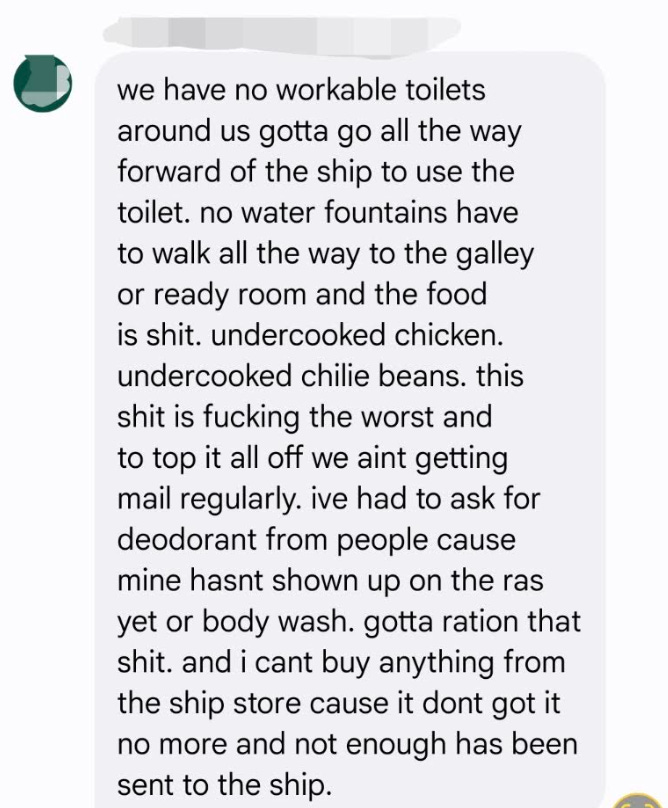
Navy Times spoke with Annabelle Loma, whose husband allegedly attempted to jump overboard and now fears a dishonorable discharge that could end his 13-year career over what she calls simple burnout; she says she hasn’t heard from Navy representatives in weeks while raising their three children alone. A separate sailor’s wife told Navy Times her husband physically stopped a shipmate from going overboard in another incident. Blumenthal’s letter to Defense Secretary Pete Hegseth cited “widespread reports” of supply shortages, water contamination, plumbing issues, deck safety concerns, and mail disruptions that left care packages lost for months. Moulton called the reports “horrific” and tied them to broader leadership failures, saying Trump has “made fun of troops for mental health issues” while Hegseth is “more focused on testosterone tests than actually keeping our troops alive,” and confirmed the House Armed Services Committee will investigate.
The Lincoln’s ordeal echoes the USS Gerald R. Ford, which broke the record for longest carrier deployment since Vietnam earlier this year and suffered a 30-hour laundry-room fire that displaced roughly 600 sailors from their bunks, part of a wider pattern of Navy-wide burnout and rising attrition among aviation personnel, according to earlier reporting from CNN. Retired Navy Captain Armen Kurdian told CNN that overboard and suicide attempts aren’t unheard of during long deployments, though he didn’t dispute that this one has been especially grueling. Officials at the town hall declined to give a return date for the Lincoln, citing operational security, even as Blumenthal warned that today’s deployment pace risks creating “tomorrow’s readiness crisis.” The story lands alongside a July CNN poll showing 73% of Americans think Trump hasn’t focused enough on the country’s top problems, and 67% believe his Iran military decisions have hurt the US.
Leavitt Replacement:
Karoline Leavitt’s Wednesday announcement that she’s leaving as White House press secretary set off speculation over her replacement, with insiders naming Alina Habba and Breitbart’s Matthew Boyle as early front-runners, alongside longer-shot names like Taylor Budowich, Steven Cheung, Katie Miller, Anna Kelly, and Monica Crowley. A White House source told the Post that Trump has not yet decided on a successor, and betting markets on Kalshi swung wildly as gamblers weighed the odds, briefly boosting Jason Miller and Rachel Campos-Duffy before Spencer Pratt took the lead. Leavitt, widely praised by journalists for her crisp delivery, said she’s stepping down to spend more time with her two young children, Niko and newborn Vivi, while Trump called her one of the best press secretaries in history and said she’ll remain a close outside adviser. With no immediate successor named, the White House may lean on senior officials like JD Vance, Marco Rubio, or Scott Bessent to handle briefings in the interim, as they have in the past. Leavitt departs at the end of August, becoming the shortest-tenured press secretary of Trump’s second term after being the youngest ever to hold the job.
Insiders told the Daily Mail that Karoline Leavitt’s decision to quit as White House press secretary had been building for months, with sources saying Trump repeatedly called her during her roughly 11-week maternity leave asking when she’d return, and that burnout set in almost immediately once she was back, given she “never got any sleep” while trying not to let her performance slip. One source said Trump “did everything he could to keep her,” while another described her spending weeks trying to figure out how to step down “politely” and “with his blessing” without upsetting him. Leavitt gave birth to her daughter Vivian on May 1 and returned to the podium by July 16; her exit follows an appearance on Lara Trump’s Fox News show just two weeks earlier where she credited the president with “empowering” working mothers. The Daily Beast notes her departure also comes amid fresh reporting that Trump slipped off Air Force One via a catering truck after May’s NATO summit in Turkey over a credible Iranian assassination threat, traveling instead with aide Natalie Harp, Dan Scavino, and Walt Nauta while Rubio, Bessent, and the press pool flew on what’s now called the “decoy” plane.
Trump Assassination Plot:
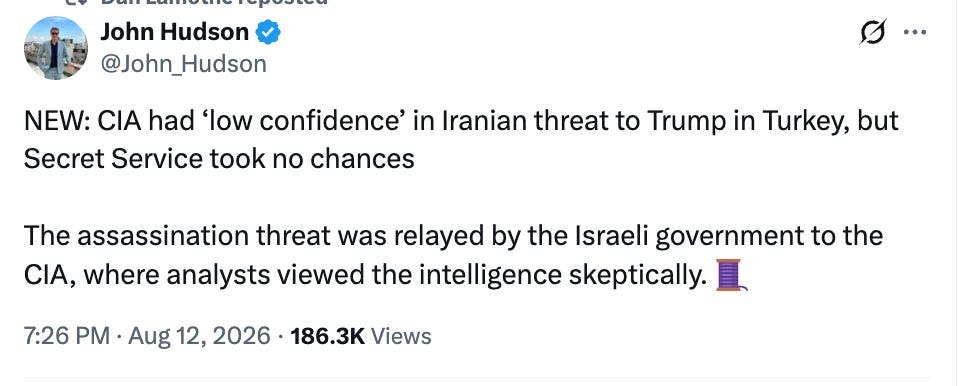
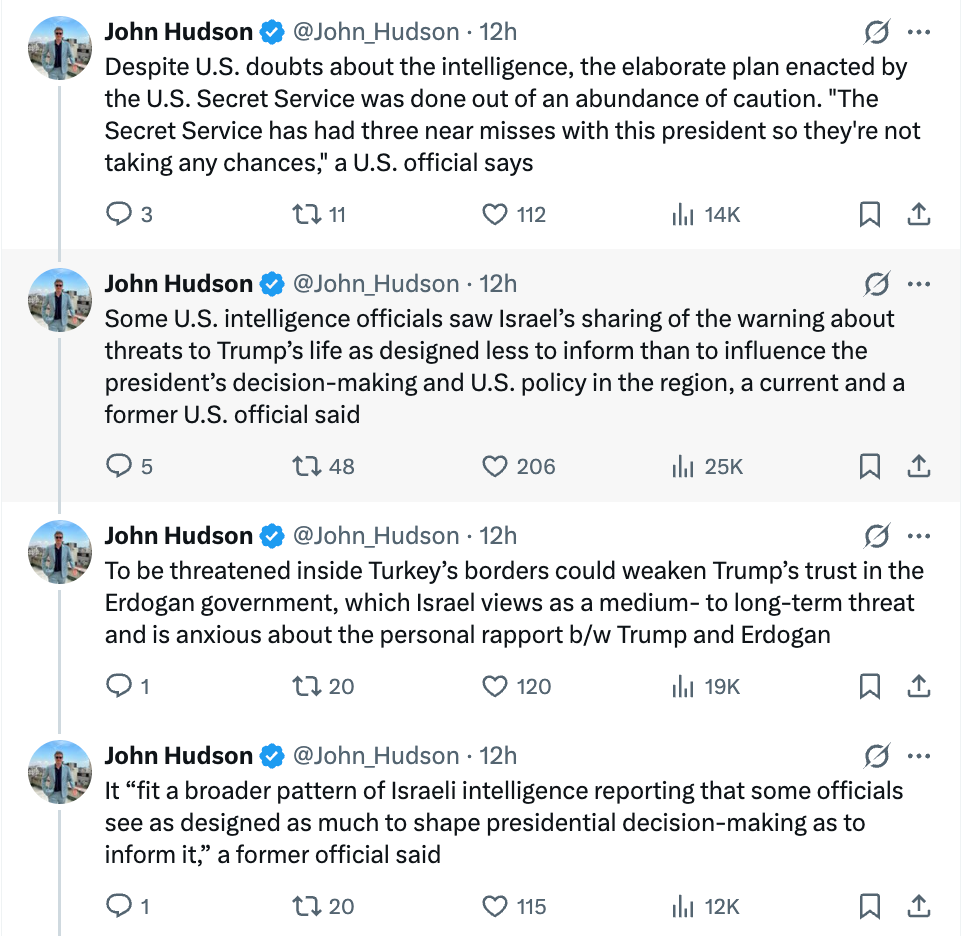
The CIA had only “low confidence” in an alleged Iranian threat to assassinate Trump in Turkey, a warning that was relayed to the agency by the Israeli government and viewed skeptically by CIA analysts, according to the Washington Post’s John Hudson. Despite that skepticism, the Secret Service enacted an elaborate protective plan out of “abundance of caution,” with a US official telling the Post that “the Secret Service has had three near misses with this president so they’re not taking any chances.”
Some US intelligence officials reportedly suspected Israel’s sharing of the threat was intended less to inform than to influence Trump’s decision-making and US policy in the region, a pattern a former official said fits broader Israeli intelligence reporting. Officials also worried the episode could weaken Trump’s trust in Turkey’s Erdogan government, which Israel reportedly views as a medium- to long-term threat given the personal rapport between the two leaders.
Concerns about Iran targeting Trump and senior US officials have been elevated since the 2020 US killing of Quds Force commander Qasem Soleimani, and have grown further since Iran’s supreme leader was killed in February along with scores of other top officials, per the Washington Post’s reporting. Trump has survived three known assassination attempts dating back to his 2024 campaign, though the Post notes there is no known link between any of those suspects and Iran.
Other news:
The Trump Administration has quietly gutted a rule designed to prevent money laundering and tax fraud. The Treasury Department officially repealed the Biden-era requirement that American companies and individuals report beneficial ownership information to FinCEN, finalizing a rule first proposed in March 2025 and published in the Federal Register on Tuesday, per The Hill. The rule also exempts Americans with FinCEN IDs from updating their information and eliminates the requirement for foreign companies to report Americans who helped them register in the US, though foreign entities must still report beneficial ownership for foreign individuals. Treasury Secretary Scott Bessent called the move “a victory for common sense” that cuts red tape for small businesses without compromising national security, while the GAO had recommended in May that Treasury address the risks posed by such exemptions, a recommendation Treasury disagreed with.
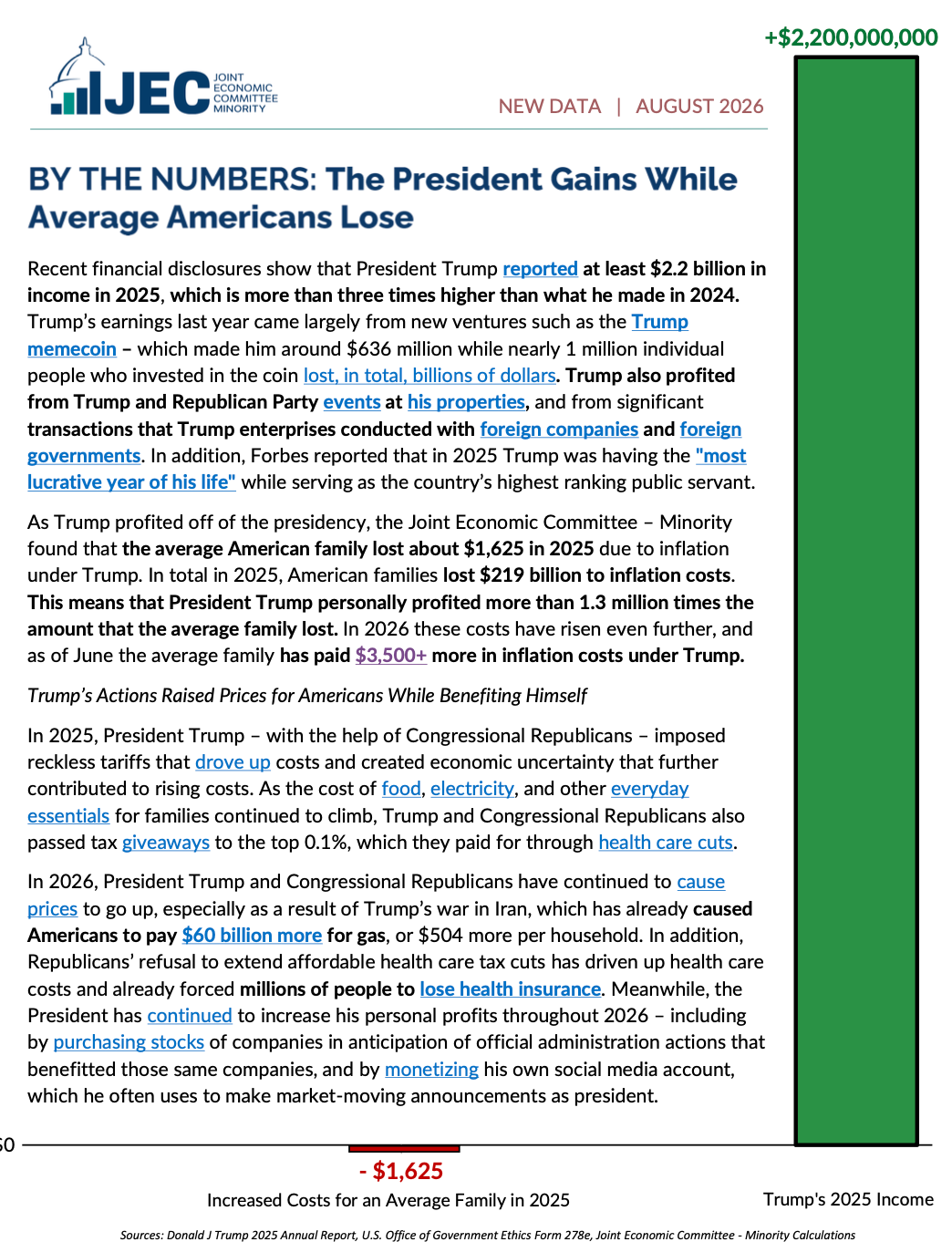
A new Joint Economic Committee Minority report finds Trump reported at least $2.2 billion in income in 2025, more than triple his 2024 earnings, largely from ventures like the Trump memecoin, party events at his own properties, and transactions with foreign companies and governments. Meanwhile, the average American family lost about $1,625 to inflation that same year, adding up to $219 billion in losses nationwide, meaning Trump personally profited more than 1.3 million times what the typical family lost. Sen. Maggie Hassan, the committee’s ranking member, said Trump “has prioritized his own financial gain while hardworking families have been left to shoulder rising costs” from his tariffs and the Iran war. Those costs have kept climbing in 2026, with families now paying over $3,500 more due to inflation as of June, even as Trump continues profiting from stock trades tied to administration actions and his own social media posts.
Rep. Max Miller was sued by his ex-wife, Emily Moreno, on behalf of their 2-year-old daughter after a sensitive image of the child was accidentally released when Miller and his attorney, Aaron Minc, shared a Dropbox link following an August 2 livestream meant to rebut her domestic abuse allegations; the image was publicly viewable for about a day before being removed. Minc took responsibility, saying he “missed the last three pages of a 40+ page document” and calling it “completely unintentional,” while Miller told CNN’s Jake Tapper he wasn’t defending the release but pushed back when Tapper called it “shockingly reckless.” Moreno’s attorney, Subodh Chandra, said the child was made “collateral damage to her father’s political ambition” and that they intend to hold Miller and his team “fully accountable,” with the suit seeking $150,000 in damages for each time the image was downloaded. The lawsuit adds to mounting pressure on Miller, who is already facing a House Ethics Committee investigation and a competitive reelection fight following his ex-wife’s broader abuse allegations, which include a claim that he once held a gun to her.
The Trump administration is facing accusations of “bullying and intimidation” after Stephen Wheeler, a CFPB data scientist since 2022 and chair of the agency’s union organizing committee, was placed on administrative leave earlier this month without any specific violations or investigation details provided to the union, according to the Guardian. Wheeler had been visibly active in union efforts, including sitting behind OMB Director Russell Vought during July congressional testimony and speaking to NPR about forced staff relocations, and called the probe “a fishing expedition” that amounts to “bullying and intimidation for union activity and protected speech.” It’s the second such case at the agency: employee Alexis Goldstein was placed on leave in February 2025 and fired in February 2026 after confronting Elon Musk’s DOGE staffers over unauthorized access to sensitive consumer and bank data, and her grievance is still awaiting arbitration amid what the union says are agency-caused delays.
Greenland’s government forced Texas-based Greenland Energy to postpone drilling in the Arctic’s Jameson Land region, contradicting a May prediction from Trump’s Greenland envoy, Louisiana Governor Jeff Landry, that Americans could be “extracting crude by as early as next year,” per the Guardian. Authorities said days before drilling was set to begin that “the necessary regulatory process cannot be completed” in time, citing officials’ concerns about assessing environmental and social impact on a protected wetland home to rare birds and muskoxen; drilling could now start as late as winter 2027. The delay followed a “strong warning” from Greenland after the company brought drilling equipment ashore without permission in July, and CEO Robert Price had falsely told a community meeting that Greenland had granted landing permission; the company’s stock fell more than a third on the news.
Bulldozers have begun clearing land inside Big Bend National Park for a $1.72 billion border barrier project, part of Trump’s larger $46.5 billion border wall push, despite the park seeing only about 1% of unauthorized crossing apprehensions nationally. CBP says it won’t build the same 30-foot walls seen elsewhere, but critics, including retired park superintendent Bob Krumenaker, warn the plan could still become “the biggest desecration of the national park system” since the Hetch Hetchy dam a century ago, and call it “purely political.” Local opposition spans an unusual coalition: Republican Terrell County Sheriff Thaddeus Cleveland, a 26-year Border Patrol veteran, argues the region’s natural terrain is already an effective barrier and favors radar towers and drones over roads and vehicle barriers, while Sen. John Cornyn and Texas Land Commissioner Dawn Buckingham have separately pushed back against the construction. The work followed a February waiver of environmental, historic preservation, and wildlife protection laws by then-DHS Secretary Kristi Noem, and has drawn tearful protests from residents and visitors worried about damage to the Rio Grande, wildlife, and some of the darkest night skies in the Lower 48. Gov. Greg Abbott, who once said in 2016 he didn’t want a wall through Big Bend, has stayed largely silent this time, with critics saying statewide Republicans are avoiding Trump’s signature border security issue.
The Trump administration finalized a rule Tuesday ending gender-affirming care coverage through Medicaid and CHIP, set to take effect October 13 unless legal challenges delay or block it, a move critics say will make it harder for vulnerable children to access healthcare and reflects anti-transgender ideology rather than evidence, per the Guardian. The proposal drew nearly 35,000 public comments, about 90% opposed, and HHS leaned on the UK’s widely criticized Cass Review while omitting a more recent Dutch government report finding gender-affirming care safe and effective; NWLC senior counsel Ma’ayan Anafi called it “an incredibly dangerous rule” whose “primary function” is stigma rather than science. HHS spokesperson Emily Hilliard defended the rule on cost grounds, saying “America’s children will not be subjected to life-altering interventions on the taxpayer’s dime without reliable evidence of safety and clinical benefit.” Children on Medicaid and CHIP would get up to six months to taper off medications if the rule takes effect, and Anafi warned the policy compounds existing barriers facing Medicaid-enrolled youth, who are more likely to be low-income, people of color, or disabled, calling it “harm upon harm upon harm.”
Ukrainian defense firm Fire Point says its first ballistic missile, the short-range FP-7, will be ready this fall pending battle-testing launches required for certification, CTO Iryna Terekh told POLITICO, while the longer-range FP-9, capable of reaching Moscow with an 855-kilometer range, is also targeted for a fall debut “if no one interferes with our work.” Both missiles underpin Freyja, Europe’s first common anti-ballistic system, with Fire Point supplying missiles and launchers while allies handle radars and other components, though President Zelenskyy cautioned that mass deployment still depends on international cooperation outside Ukraine’s control. The effort comes as Ukraine faces a growing shortage of Patriot interceptors and the Pentagon scrambles to rebuild its own stocks after reportedly burning through missiles early in the US war against Iran, prompting Trump to walk back an earlier offer to let Ukraine produce its own PAC-3s. Terekh said she’d instead prefer a narrower deal allowing Ukraine to produce homing heads, the guidance system she called the “critical and most hard-to-produce component,” while Ukrainian military intelligence says Russia is actively conducting reconnaissance to disrupt Ukraine’s missile production.
Temporary Protected Status for Ukrainian refugees is set to expire October 19, following a Supreme Court ruling last month that let the Trump administration end TPS for Haitian and Syrian refugees, and Ukrainians now fear they’re next even as the war back home continues, according to KJZZ. Anna Ivashchenko, who fled Kyiv in 2022 and now helps resettle refugees in Arizona, said “there’s no extension, no renewal” for TPS or the paused United for Ukraine parole program, leaving her and others unsure whether they’ll be able to stay despite working and paying taxes. Scottsdale judge and Ukrainian-American Bar Association member Orest Jejna said Ukrainians on TPS or U for U are stuck in “a significant crisis” and “quagmire,” while advocate Olya Johnson said displaced Ukrainians, many highly educated and skilled, are losing jobs “not because of the performance” but because companies can no longer legally employ them. DHS told KJZZ a renewal decision would come at an “appropriate time” but declined to elaborate on what Ukrainians should do in the meantime, leaving Ivashchenko, who has nothing to return to in Ukraine, still hoping to stay and rebuild her life in the US.
See you soon.
— Aaron
Comments
Nothing yet. Say the first thing.
Sign in to join the conversation.