
Good morning, everyone. As promised, our Sunday tradition continues: another weekly good news update.
Share one piece of good news from your week in the comments, and pass this along so someone else can join in too.
Here’s mine. We just beat Fox News for the second straight week in a row. And because of what we’re building together, I got to appear on MS Now this morning. Watch the highlights here.
Let that sink in for a second. We built this with nothing. No billionaire investment. No platform handed to us. No name recognition to open doors. It hasn’t been easy. I face threats and attacks every single day for doing this work. But I keep showing up, because this was never just about sharing news. We are building a community, and communities like this one are exactly what’s going to outlast the old media machine.
None of this happens without you. So if this community matters to you, if beating Fox News matters to you, if a media landscape that answers to people instead of billionaires matters to you, this is the moment to back it. Subscribe. Gift a subscription to someone who needs to see this. Upgrade your membership.
This is ours to build. Let’s keep going.
Here’s the good news:
Barley, a golden retriever from Long Island, New York, lost her playful spark after starting epilepsy medication, but everything changed when her owners brought home a four-day-old Pekin duckling named Louie, who instantly bonded with her and helped restore her joyful spunk and wagging tail, turning the unlikely pair into inseparable best friends.
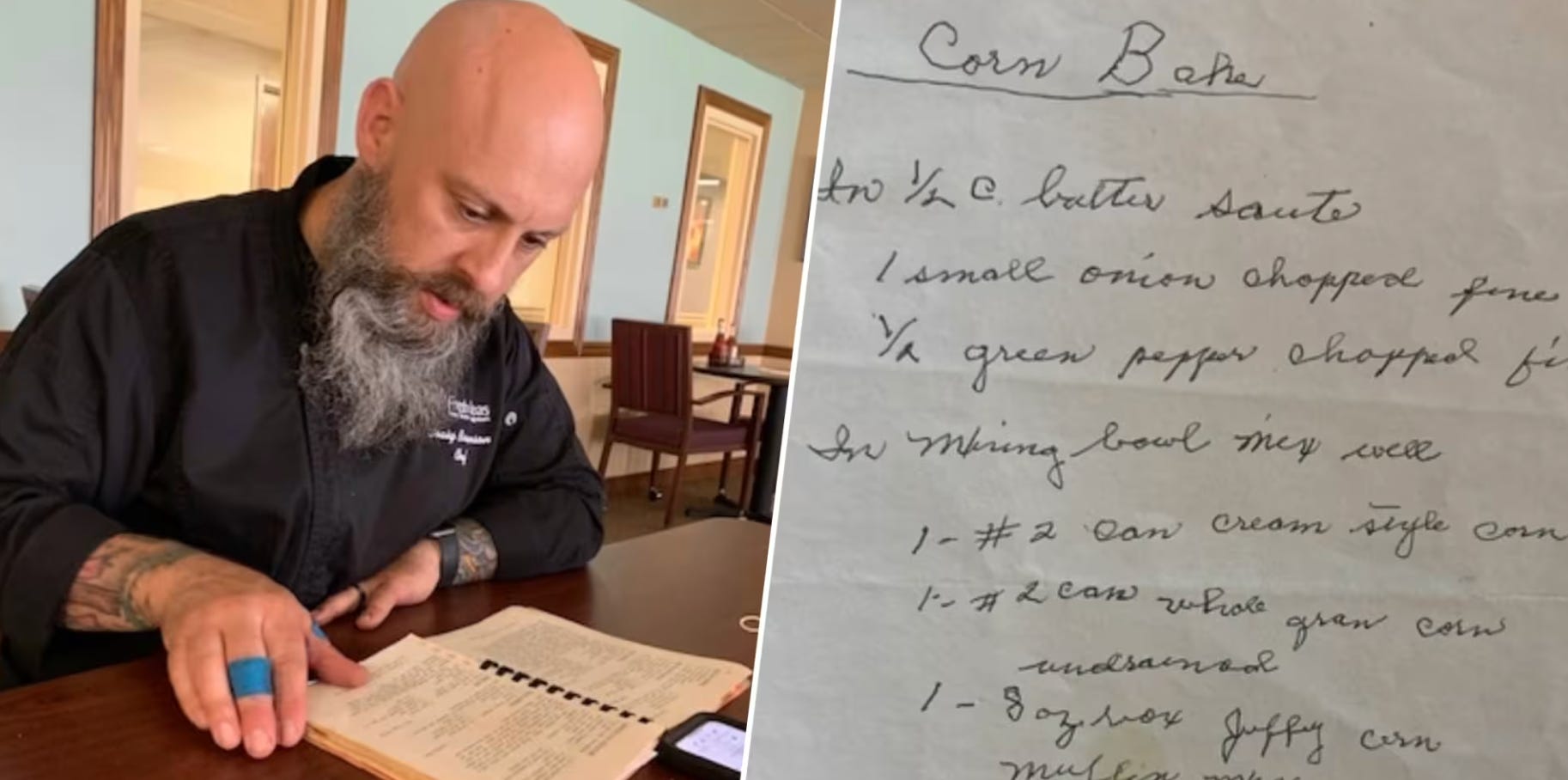
Chef Craig Bowerson, working at The Cedars nursing home in McPherson, Kansas, faced a 75% dissatisfaction rate with his menu until he changed his approach during COVID lockdown, when he started spending more time with residents and learned many were former homemakers with fond food memories from their family cooking days. Instead of dictating the menu, he began asking residents directly, “How would you make the food?”, collecting recipes for dishes like spaghetti, lasagna, and chicken cordon bleu, and within a week had gathered several hundred recipes, dropping the dissatisfaction rate to nearly zero. Some recipes came from memory, old magazine clippings, or family staples over a century old, and Bowerson even tracked down dishes tied to a resident with dementia named Bill by contacting the Chamber of Commerce in Winnetka, Illinois, where Bill’s father had worked as a chef. One standout dish, a chili mac recipe reverse-engineered from a resident’s wife’s six-item shopping list, became a permanent menu staple after weeks of testing, with cheese added at the resident’s request. Bowerson said the shift taught him a deeper lesson: “When you start getting that personal connection, you realize you’re a guest in their house.”
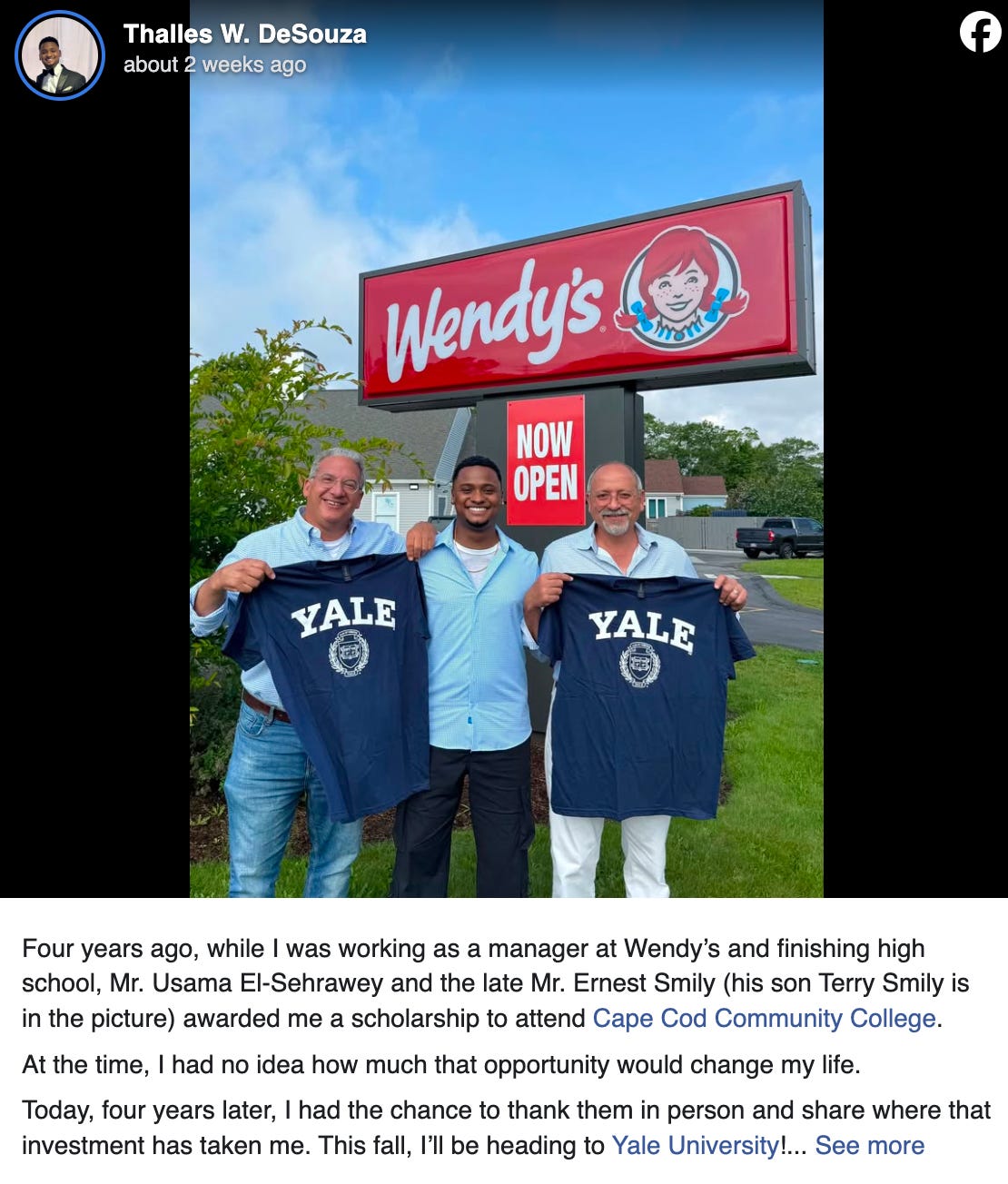
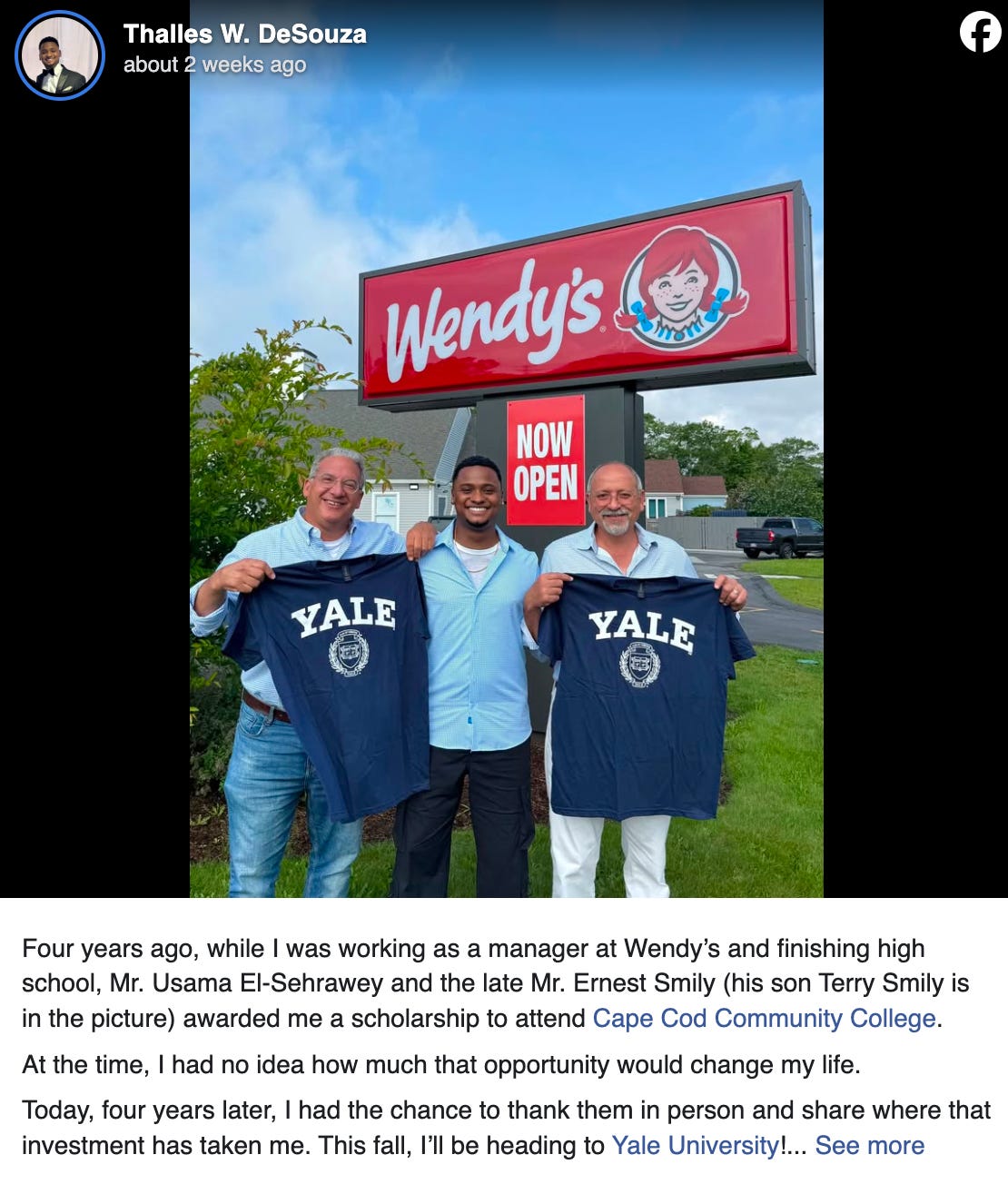
Thalles Winner DeSouza, who moved to the U.S. from Brazil in 2016, worked at a Cape Cod Wendy’s during high school and was promoted to shift manager, planning to leave for a higher-paying construction job after graduation. His boss, franchise owner Usama El-Sehrawey, convinced him to stay by promising that he and business partner Ernest Smily would set aside extra money for every hour he worked and pay his college tuition directly once he enrolled. With that support, DeSouza earned straight A’s at Cape Cod Community College, started a religious club, became student body president, then transferred to Bunker Hill Community College before ultimately getting into Yale, where he starts this fall majoring in political science with a human rights minor on a pre-law track. DeSouza thanked his former bosses in a viral July 28 Facebook post, writing “sometimes all it takes is one person who believes in you,” though El-Sehrawey insisted DeSouza’s own effort deserves the credit, calling himself “a small tool to help direct him a little bit and encourage him.” Now 23, DeSouza reflected on watching peers get jobs, marry, and build businesses while he was still in community college, and offered advice to others: “Just keep going, right? Continue, persevere, and it doesn’t matter how long it takes.”
89-year-old Mary Story of Tulsa, Oklahoma, became an unlikely internet sensation after her granddaughter Natalie Lauren Sims posted a TikTok showing a framed photo of Michael B. Jordan hanging on her wall among family portraits, with Story explaining she kept it simply because “it’s such a nice picture.” The video went viral within about 24 hours, prompting Jordan’s team to reach out to the family while he was on a promo run in London, first sending Story a gift of David Yurman jewelry featuring an amethyst, her birthstone. Jordan later surprised her with a FaceTime call, thanking her for including him in her family collage and calling her family “beautiful,” while Story greeted him warmly as “your granny” and showed him exactly where his photo hangs on the wall. During the call, Jordan also expressed interest in visiting Tulsa someday, hinting he might stop by to meet the family in person.
Andrew Beaver, a 37-year-old real estate investor, started out single-handedly clearing illegally dumped trash from Houston's Sunnyside neighborhood, tackling abandoned lots, alleyways, and ditches on his own. His daily cleanup efforts caught on and grew into Clean the Block, a nonprofit movement that now rallies roughly 100 volunteers working to restore the neighborhood and rebuild community pride.
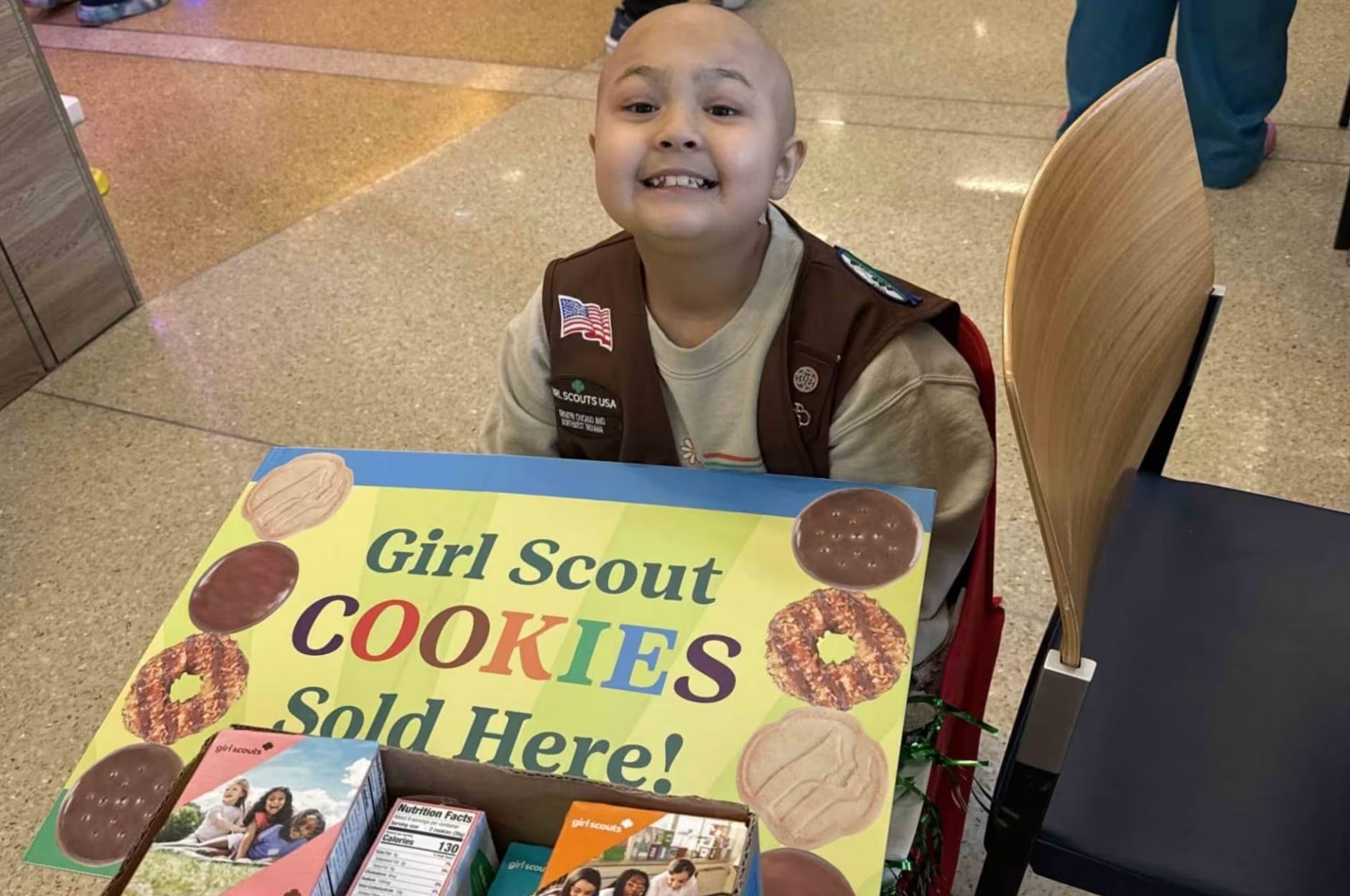
Eight-year-old Emma Mongado of New Lenox, Illinois, was diagnosed with B-cell leukemia about a year ago and, while undergoing chemotherapy at Ann & Robert H. Lurie Children’s Hospital of Chicago, turned the hospital’s Center for Cancer and Blood Disorders into her own Girl Scout cookie booth to keep some normalcy during treatment. With help from her parents, Emma pulled a wagon of cookies through the hospital, selling to patients, staff, and visitors, and posted a sign outside her inpatient room reading “Girl Scout Cookies sold here.” She blew past her original goal of 500 boxes, then set and hit a new target of 750, and after learning other local troops were struggling to sell their inventory, she sold an additional 143 boxes on their behalf, bringing her season total to 893 boxes despite enduring more than 20 lumbar punctures during treatment. Child life specialist Emily Irwin made her a handmade “Last Chemo Stay” patch after Emma finished her final inpatient chemo stay, which she added to her Girl Scout sash. Emma is now in maintenance treatment with far fewer hospital visits, and her mother Judy says she’s been consistently positive throughout, with Emma’s own advice to others being simply to “keep going and stay strong.”
A new UNAIDS report, released ahead of the 26th International AIDS Conference in Rio de Janeiro, shows new HIV infections and AIDS-related deaths have fallen to their lowest levels in more than 30 years, with seven countries, Benin, Eswatini, Kenya, Lesotho, Nepal, Rwanda, and Zimbabwe, cutting new infections by nearly 80% since 2010, and 11 countries hitting the “95-95-95” treatment targets for diagnosis, treatment access, and viral suppression. UNAIDS said the world is nearing an “HIV prevention revolution,” pointing to monthly and six-month injectable prevention drugs entering the market and monthly pills in late-stage trials. The report highlighted lenacapavir, a twice-yearly prevention injection that showed a 100% success rate in the Purpose 1 trial, recording zero infections among 3,200 young female participants, with UNITAID, the Global Fund, and partners now working to roll it out to 3 million people by 2028. Brazil, Ethiopia, Uganda, and South Africa were cited for expanding access to prevention medicines and negotiating better drug pricing. UNAIDS Executive Director Winnie Byanyima said ending AIDS remains achievable but urged governments and partners to remobilize behind the goals set in this year’s UN Political Declaration on HIV and AIDS.
NFL training camps around the league, including the Bills, Lions, Patriots, and Bengals, have been pausing practice for dog adoption days, giving players, coaches, and staff a chance to meet rescue dogs and puppies looking for homes right on the field.
17-year-old Joey Charney has taken over cooking for his family of nine to 11 people, including his parents and seven siblings ages 11 to 25, after his mother Jennifer was diagnosed with Stage 3 breast cancer roughly a decade ago, a diagnosis that has since progressed to Stage 4 and left her unable to walk for the past two years. Joey started cooking about two years ago, a month after his mom lost her mobility, initially inspired by a meal train friends organized before he felt compelled to take over the kitchen himself, and began filming his cooking shortly after. Since posting his first video on Instagram in December 2025, he’s built a following of over 102,000 people across just 32 videos, with fans praising him as an “amazing caregiver” as he prepares dishes like burgers, chicken soup, and pork tenderloin. His mother says he’s been “so helpful,” noting he handles meal planning and grocery shopping largely on his own, something that took her years to master. Joey, who’s eyeing culinary colleges like the Napa branch of the Culinary Institute of America, says he enjoys getting cooking tips from professional chefs in his comments section and sees it as a head start on skills he’ll need for his future career.

Loggerhead sea turtle nests along Georgia’s Atlantic coast surpassed 4,110 last week, the highest count since tracking began in 1989 and nearly double the original recovery goal, breaking the previous record of 4,071 set in 2022. Georgia’s Department of Natural Resources calls it a “slow but steady rebound” for the species, which has been listed as threatened since 1978, with nest counts climbing about 4% annually since the early 1990s despite a low of just 358 nests in 2004. Officials credit daily beach patrols by the Georgia Sea Turtle Cooperative and the use of “turtle excluder” devices in shrimp trawler nets since 1990 for the resurgence. Biologist Mark Dodd noted loggerheads don’t reproduce until age 30 to 35, so progress is inherently slow, and while numbers may now plateau, continued protections could push nesting to levels not seen since the 1950s.
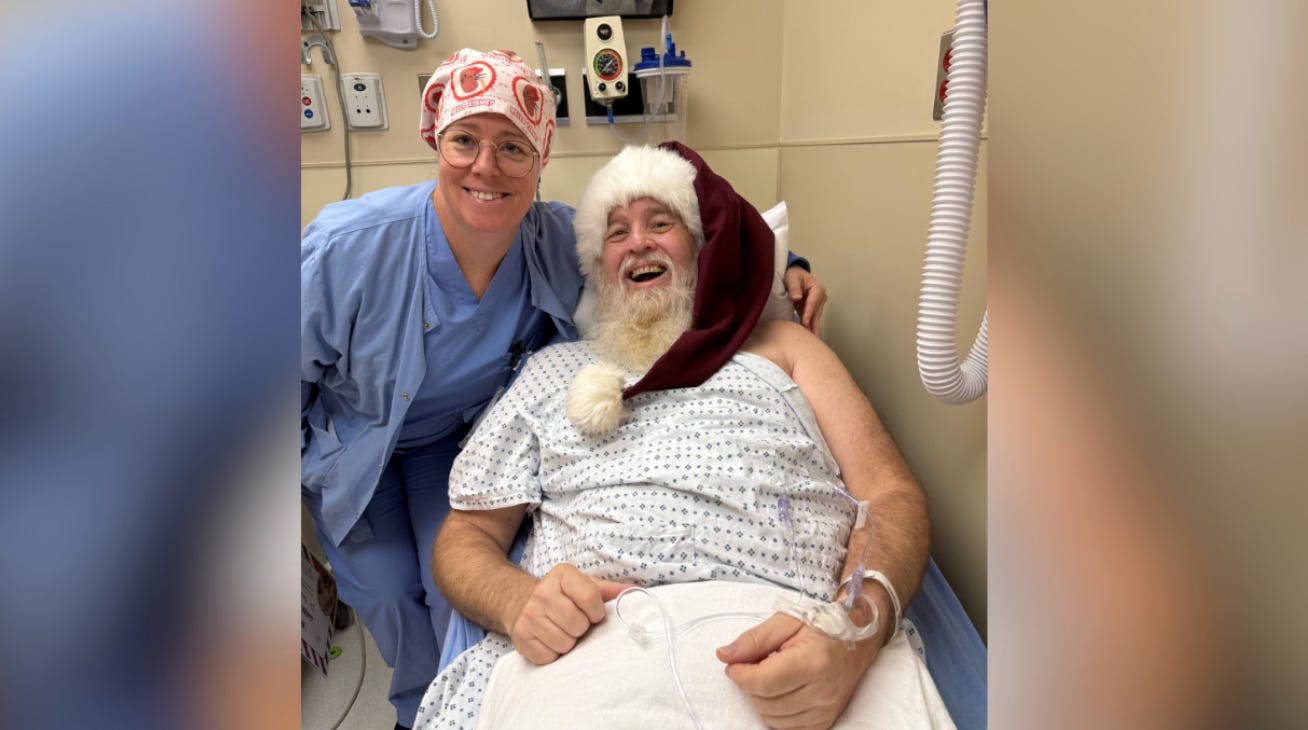
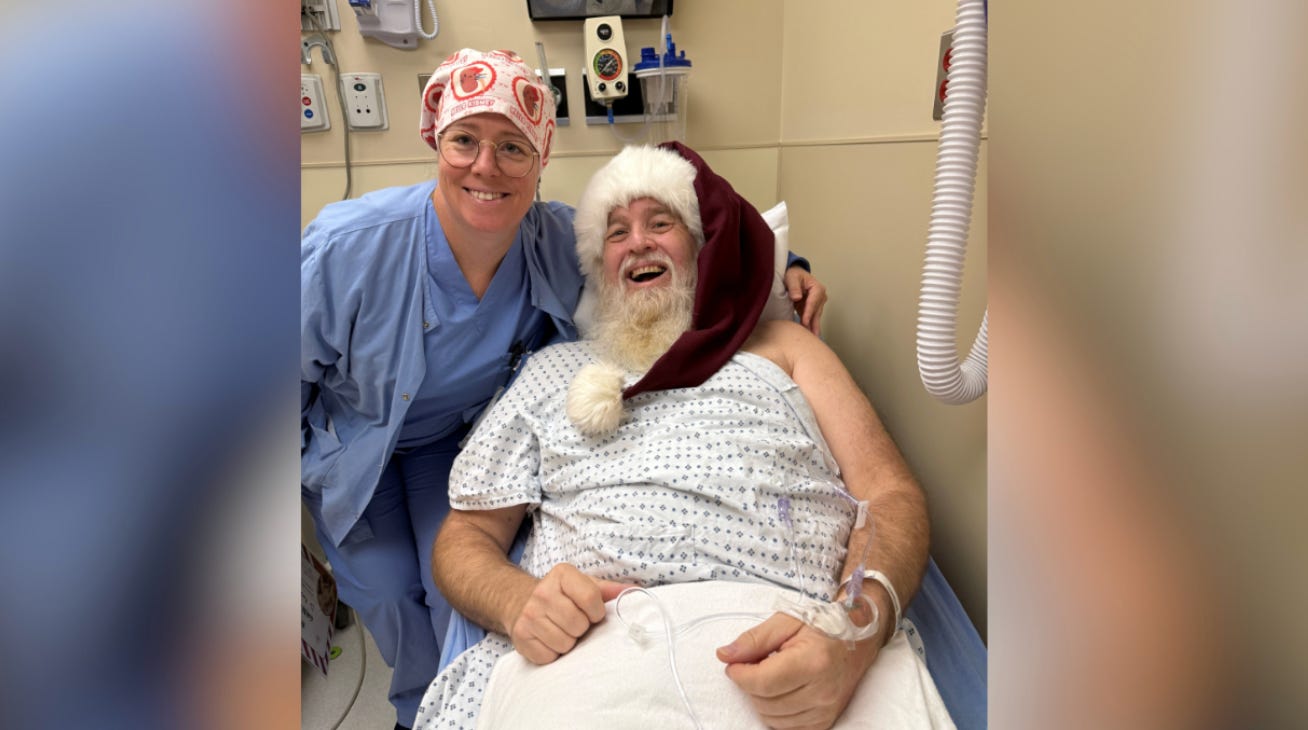
Dave Bell, known around Powhatan, Virginia as the town’s longtime Santa Claus, recently donated a kidney to an anonymous recipient and even wore his Santa hat while recovering at Henrico Doctors’ Hospital. “I have two of these things, and I only need one,” Bell said, explaining his decision to give one to “somebody who has none and they need one.” To qualify as a donor, Bell had to lose 40 pounds, and he now has more work ahead to get back into shape before the holiday season. Dr. Amanda Bailey, a transplant surgeon at the Virginia Transplant Center, said stories like Bell’s “make organ donation feel real and personal” and show how one person can make an enormous difference in someone else’s life.
Eddie Smith Jr. spent 58 years working 80 to 100 hour weeks to rescue Grady-White Boats from near-bankruptcy, eventually building it into a business generating over $100 million a year in revenue. Rather than accept multiple buyout offers worth roughly half a billion dollars, he transferred controlling voting shares to a perpetual purpose trust that will run the company according to his values, including profit sharing and employee education, with the shares never to be sold, while the remaining non-voting shares go to a 501(c)4 that will donate all profits to charity. Smith said he was inspired by Patagonia founder Yvon Chouinard, and after watching CEO friends who sold their companies lose the culture they’d built, he couldn’t bear the thought of the same happening to Grady-White. Raised near the poverty line by a father orphaned during the Great Depression, Smith worked a paper route as a teen and became the first in his family to graduate college, at the University of North Carolina in 1965, before taking over the failing boat company and giving up golf for three decades to turn it around. The deaths of his wife and son to ALS further clarified his priorities, making it easy to turn down big-money offers in favor of preserving the company’s legacy.
John Adesoye, a Nigerian immigrant and father of five, graduated from the University of West England with a nursing degree at age 64, after completing a two-year nurse associate program and a two-year nurse apprenticeship through the NHS Foundation Trust in Bristol. Raised in a poor farming family in Nigeria with an early fascination with electronics, he went on to work as an electronics technician in Greece before eventually settling in Bristol, where he’s now secured a nursing role at Southmead Hospital, the same place he trained. By coincidence, one day a week found him on campus alongside his own son Daniel, who was studying creative music technology at the same university. “I didn’t think I’d ever go to university, to be honest. But I have passion for learning,” Adesoye said, adding, “Don’t listen to people who say you’re too old for university... people are more brilliant than they think and they’re stronger than they think.”


In 2022, an 11,200-foot predator exclusion fence, the longest of its kind in the Pacific, was completed on Kauai, enclosing 168 acres of prime seabird nesting habitat at Kīlauea Point National Wildlife Refuge to keep out feral cats and pigs. Originally developed in New Zealand, the $1.7 million fence is engineered to be too tall for cats or foxes to jump, topped with a claw-proof hood, fitted with a buried skirt to stop pigs from digging under it, and covered in mesh fine enough to block rats while resisting their teeth. Four years on, seabirds including Newell’s shearwaters, red-footed boobies, tropicbirds, great frigatebirds, the endangered Hawaiian petrel, and the Laysan albatross are nesting and raising chicks in areas that previously served as hunting grounds for invasive predators, with a similar fence on Oahu having already quadrupled Newell’s shearwater chick numbers. The protected site, spanning Nihokū and Mokolea Point, also shelters the critically endangered Hawaiian hoary bat and the nēnē, Hawaii’s state bird, and benefits from minimal light pollution and no power lines, both hazards for star-navigating species like petrels. Until invasive predators can be more broadly controlled on the island, officials say the fence will function as a long-term sanctuary safeguarding these seabird populations.
Palaeontologists in outback Queensland have uncovered a 100-million-year-old fossil "crime scene" showing an ichthyosaur that ate a pterosaur before itself being killed and partially devoured by a kronosaurus, one of the clearest examples of "three-tier predator interaction" ever found. The remains, discovered in what was once the Eromanga Sea, include a six to seven metre ichthyosaur nicknamed "BOB," first found by travelers Mick and Cathy Freeman in 2019, whose midsection was shattered and covered in more than 30 bite marks, likely the most ever recorded on a marine fossil. Lead researcher Dr. Matt White of the University of New England said only a kronosaurus, a roughly 14-metre "T-rex of the ocean" with over 100 teeth, could have caused that level of damage, and that preserved stomach contents showing pterosaur remains inside the ichthyosaur mark a world first. British palaeontologist Dean Lomax, who inspected the find during a visit to Australia, called it an "unprecedented snapshot of behaviour in Australia's Cretaceous seas" offering direct evidence of a Eromanga Sea trophic interaction.
A group of Turkish conservationists and fishermen, backed by a $3 million grant from the Cambridge-linked nonprofit Endangered Landscapes & Seascapes Program, restored and tripled protected marine areas along 310 miles of Turkiye’s Mediterranean coast between 2019 and 2023. Led by Goldman Environmental Prize winner Zafer Kızılkaya, who had already proven the model with Turkiye’s first community-managed marine protected area in Gökova Bay back in 2012, the project expanded protections across six MPAs covering 100,000 acres and trained local “marine rangers” to combat illegal fishing after coast guard resources were stretched thin by other priorities, cutting illegal fishing by 80%. The results followed: fishermen reported bigger catches, sandbar sharks returned to what’s now the only year-round shark habitat in the Mediterranean, and more than 30 endangered Mediterranean monk seals now call the area home. Kızılkaya says the project is now focused on linking these protected zones with ecological corridors, since species like sharks and seals migrate beyond any single sanctuary’s borders and remain vulnerable once they leave it.
Fota Wildlife Park in County Cork has announced the successful hatching and fledging of a white-tailed sea eagle chick, its first in more than a decade, born April 13 to resident parents Áine and Tony. The species, Europe’s largest eagle with a wingspan exceeding 8 feet, was wiped out in Ireland by human persecution and absent for over a century before a reintroduction effort began in 2007, led by Ireland’s National Parks and Wildlife Service with the Norwegian Institute for Nature Research. More than 200 eagles have since been released, and Ireland’s population is now considered self-sustaining, with Fota having bred six chicks since it began working on the species in 1991. Conservation officer Jess Hodnett said staff hope the new chick will eventually join a European endangered-species breeding program. Fota’s broader conservation work includes releasing over 13,600 endangered natterjack toadlets back into the wild since 2016, with 750 more expected this August.
Milo, a 15-year-old Appaloosa gelding, lost his sight in both eyes at age 13 due to a severe eye condition but returned to the dressage ring last year and has continued competing at a high level, including winning the Royal Windsor Horse Show for the eighth consecutive year while blind. Owner Megan Share, who has had Milo since he was three, developed a system of rider cues and touch she calls “equine braille,” where the horse reads pressure from her aids and his own hooves on the ground for spatial awareness, while his hearing has become notably more acute. Share, who runs Debdale Riding School in Worcestershire, says the partnership requires much more mental focus and alertness on her part since Milo needs constant guidance. Milo is next set to compete at an Appaloosa show and the Denbigh and Flint Show this August, working toward qualifiers for the Horse of the Year Show and the London International.
Kazakhstan released a female Amur tiger named “Hope” into the Ile-Balkhash Nature Reserve, marking the first tiger returned to the country’s historical range in more than 70 years since the extinct Caspian tiger disappeared. The milestone caps a decade-long effort that began with the reserve’s 2018 founding and included reforestation and reintroducing prey species like Bukhara deer, saiga antelope, and the Asiatic wild ass, with Russian collaboration essential since the Amur tiger is the closest living relative to the extinct Caspian tiger. Hope, fitted with a GPS collar after a clean health check, was released to roam freely, while a male named Amur remains in captivity as experts assess whether he can hunt successfully, and two cubs will grow up semi-wild before being released around 18 months old if they pass behavioral tests. Because the unfenced reserve borders nearby communities, officials say human safety is the top priority and have set up a dedicated response team for any tiger-human encounters. If successful, Kazakhstan would become the first country in the world to fully re-establish a tiger population in an ecosystem where it had gone extinct.
Ryukoku University professor Takahiko Nakaoki and Kakinoki Fireworks Industry Co. president Hiroyuki Kakinoki have developed what may be the world’s first water-soluble fireworks shells, aimed at cutting down on post-show debris. The pair teamed up after meeting in 2018, when Kakinoki had already abandoned earlier attempts to build eco-friendly shells using resins after repeated failures. Instead of inventing a new material, they adapted a water-soluble resin already used on agricultural seeds and soil improvers, which turns sloughy like hot caramel when wet and dissolves harmlessly, particularly useful since most Japanese fireworks displays happen near rivers, lakes, or the ocean. The new shells also use about half as much kraft paper in packaging compared to traditional fireworks. Kakinoki said that of the 20,000 fireworks his company plans to produce this year, he wants half, 10,000, to be the eco-friendly version.
The critically endangered red handfish, photographed at the Institute for Marine and Antarctic Studies in Tasmania, has become the 18,000th species documented in National Geographic’s Photo Ark, marking the milestone just as the project celebrates its 20th anniversary. Photographer Joel Sartore started the Photo Ark in 2006 with the goal of using intimate portraits to build compassion for lesser-known species, and called the red handfish a fitting choice given its rarity and importance to marine biodiversity. Fewer than 250 red handfish are believed to remain in the wild, confined to a small reef off southeast Tasmania, where they “walk” along the seafloor on hand-like fins rather than swim, traveling only about the length of a basketball court in a year, making them extremely vulnerable to habitat loss, pollution, and warming waters. What began with a single portrait of a naked mole-rat at a Nebraska zoo has grown into a global effort spanning thousands of species, with National Geographic’s chief science and innovation officer, Ian Miller, saying the project drives real conservation outcomes by helping people connect emotionally with animals they’d otherwise never see.
See you soon.
— Aaron
Comments
Nothing yet. Say the first thing.
Sign in to join the conversation.