
Good morning, everyone. As promised, our Sunday tradition continues: another weekly good news update. Share one piece of good news from your week in the comments, and pass this along so someone else can join in too.
Three pieces of good news this week. First, our reporting broke through in a historic way. We broke the story on the horrific conditions aboard America’s aircraft carriers, and within 24 hours I was on CNN talking about it. It became front page news everywhere. That’s the power of this community.
Second, I ran 15 miles, and I’m thrilled about it. Third, a colleague ran a focus group on the midterms and asked people where they get their news. An guy from West Virginia and a mom from Missouri both said, unprompted, that they love your content.
Let that sink in. We built this with nothing. No billionaire investment. No platform handed to us. No name recognition to open doors. It hasn’t been easy, but I keep showing up, because this was never just about sharing news. We’re building a community, and communities like this one are what will outlast the old media machine.
None of this happens without you. If this community matters to you, if a media landscape that answers to people instead of billionaires matters to you, this is the moment to back it. Subscribe. Gift a subscription to someone who needs to see this. Upgrade your membership.
This is ours to build. Let’s keep going.
Here’s the good news:
Thalles DeSouza, now 23, grew up homeless in a violent neighborhood near Rio de Janeiro after losing both parents, and in 2016 his mother moved the family to Cape Cod, Massachusetts after surviving a shootout in their home. He got a job at a local Wendy’s, rose to shift manager by his senior year of high school, and impressed owners Usama El-Sehrawey and the late Ernest Smily so much that they offered to pay his community college tuition. He excelled at Cape Cod Community College for three years, then applied to more selective schools and this past May was accepted to Yale with a full-ride scholarship. He starts at Yale this fall studying political science with a human rights minor, aiming to become a lawyer, and has publicly thanked his former bosses for believing in him when college once felt out of reach. The story reflects Wendy’s founder Dave Thomas’s “give something back” philosophy, which the current owners say still shapes the company’s culture.
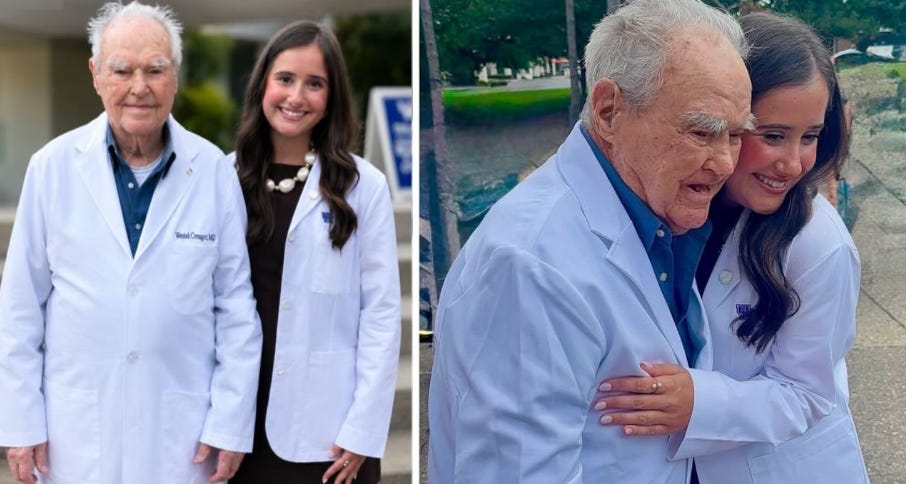
Westel Creager, now 97, attended the University of Kentucky’s medical school 60 years ago after starting out as a carpenter, becoming the oldest in his class before going on to a long career including ER work into his 70s, flights into Mexico with Good Samaritans, and opening an AIDS hospital. When his great granddaughter Haiden Hauret headed off to college, he promised he’d attend her medical school graduation and personally place her white coat on her if she followed him into medicine, and she did, choosing his same alma mater. This summer that promise came true: Westel, visibly overwhelmed, put on his own white coat just minutes before watching Haiden receive hers. His granddaughter says he credits pushing himself and never settling for keeping him sharp, with his advice being simply that it’s never too late to change your path or take on something new.
Researchers at the University of Sheffield’s POLARIS group have developed a lung MRI technique using hyperpolarized Xenon-129 gas, which patients inhale and briefly hold before the scanner captures images, letting doctors see airflow and gas exchange in the lungs without any ionizing radiation. This solves a longstanding problem, since lungs are normally hard to image with MRI because they’re mostly air and constantly moving, and it’s now being used clinically at Sheffield Children’s Hospital to detect early lung disease in children with cystic fibrosis. In some cases the xenon MRI has revealed ventilation problems that standard CT scans missed entirely, and the scans take just minutes, with newer techniques capable of capturing images in as little as 4 seconds, which is especially useful for children who struggle to hold still or hold their breath. Because the method avoids radiation exposure, it’s particularly valuable for children with chronic conditions who need repeated monitoring over many years. The Sheffield team is now working with GE HealthCare to adapt existing MRI machines for this technology and expand access to more clinical sites worldwide.
Fifteen years ago, conservationists began releasing rehabilitated Sumatran orangutans, many orphaned, rescued from conflict, or held in captivity, into the Jantho Pine Forest Nature Reserve in Indonesia’s Aceh province, an area with no existing wild population of the species. Since orangutans normally spend years learning survival skills from their mothers, rescued animals only get released once they show they can forage, climb, build nests, and survive independently. The program, run since 2011 by the Sumatran Orangutan Conservation Program, has released nearly 200 orangutans there, and females have now begun giving birth in the wild, with researchers confirming at least 10 babies born in the reserve so far. Because orangutan mothers raise a single infant for years before having another, population growth is naturally slow, making each wild birth a meaningful step toward establishing a self sustaining population of one of the world’s most threatened great apes.
For over a decade, NOAA Fisheries and a coalition of partners have restored California’s Prairie Creek, converting a former lumber mill site into wetlands and floodplain habitat for three threatened salmon species: California Coastal Chinook, Northern California steelhead, and coho salmon. By reconnecting the creek to its floodplain and restoring slow-moving water, ponds, and side channels, researchers found juvenile coho using the restored habitat grew up to twice as fast as those in the main creek channel in some sites and years. That faster growth matters because bigger juveniles are more likely to survive migration to the ocean, survive their years at sea, and return to spawn, and indeed, survival of the 2023 coho cohort that returned as spawning adults rose to about 2.6%, up from roughly 1% previously. Cal Poly Humboldt researchers have tracked individual tagged fish before, during, and after construction, and monitoring will continue through at least 2028 to confirm whether the growth gains translate into more returning adult salmon long-term.
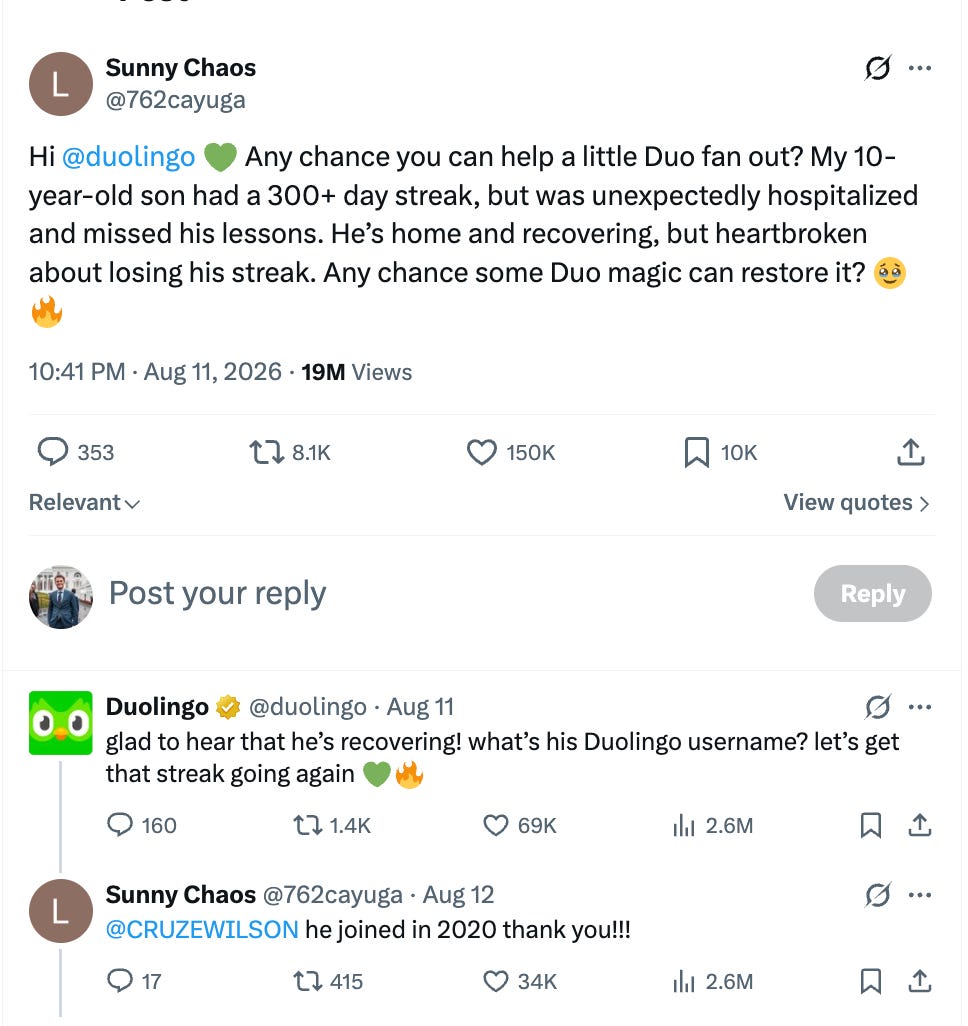
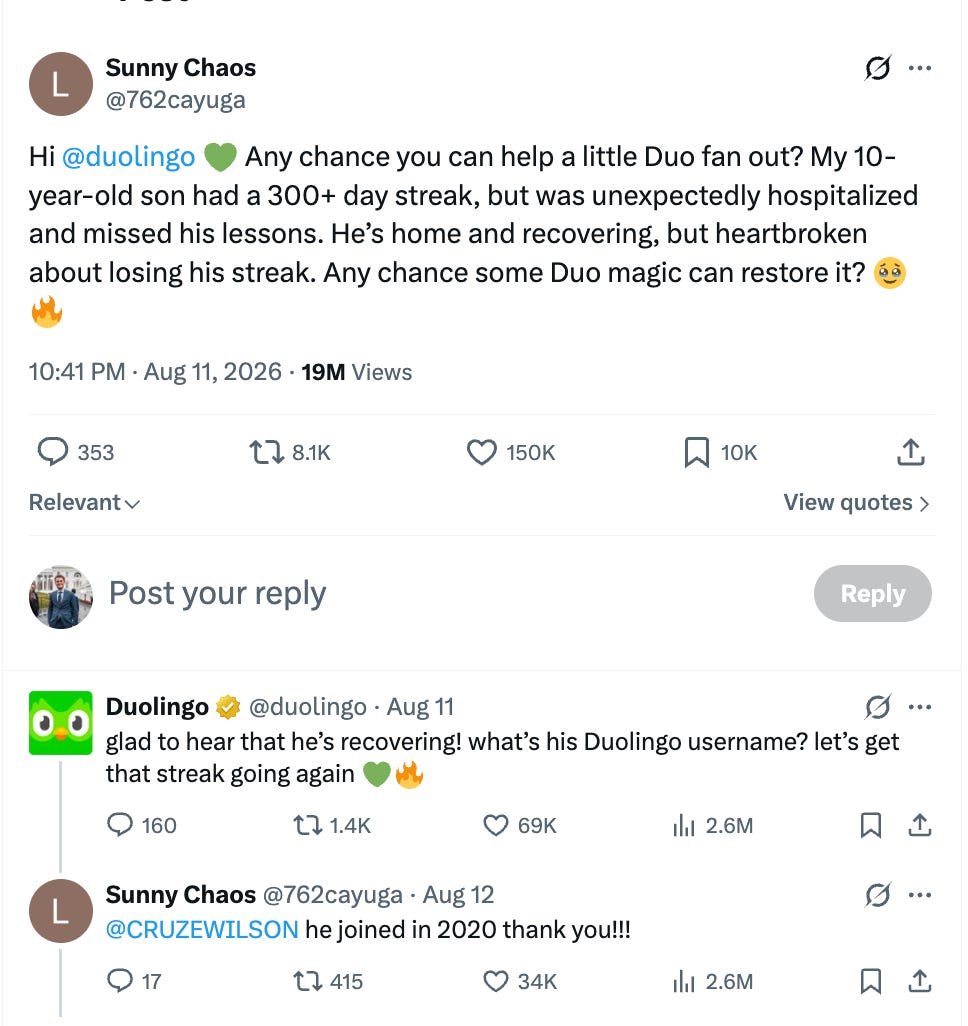
A parent using the X handle @762cayuga posted on August 11 that her 10 year old son had been unexpectedly hospitalized, breaking a Duolingo streak he’d kept for more than 300 consecutive days, and asked the company for help restoring it. Duolingo responded publicly and by the next morning had restored the boy’s streak, with a spokesperson noting he’s an enthusiastic user who studies chess, music, Spanish, and math on the app, with chess being his most frequent activity. Along with the restored streak, Duolingo gave him bonus gems and a streak shield that can protect his progress for up to seven days.
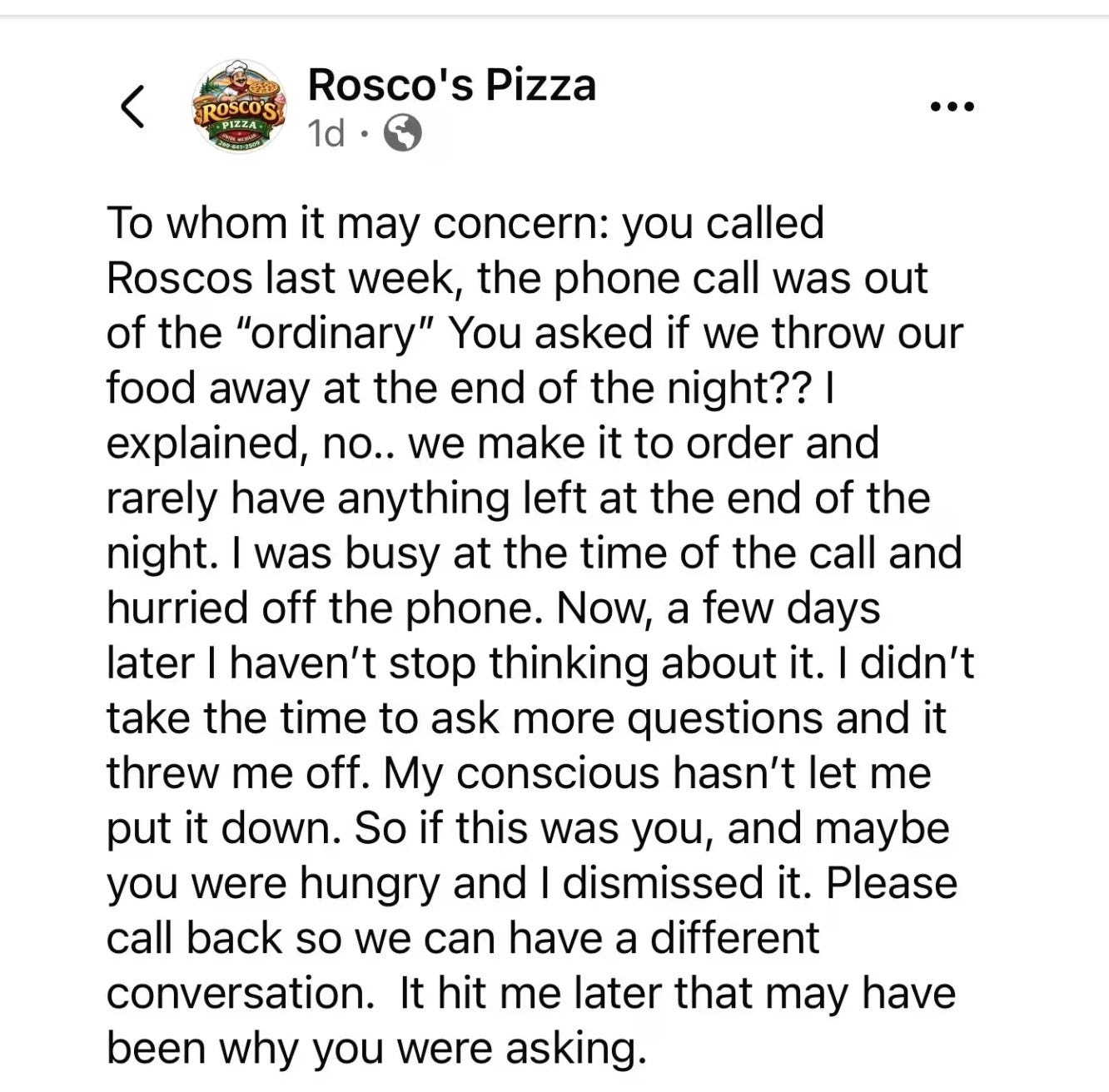
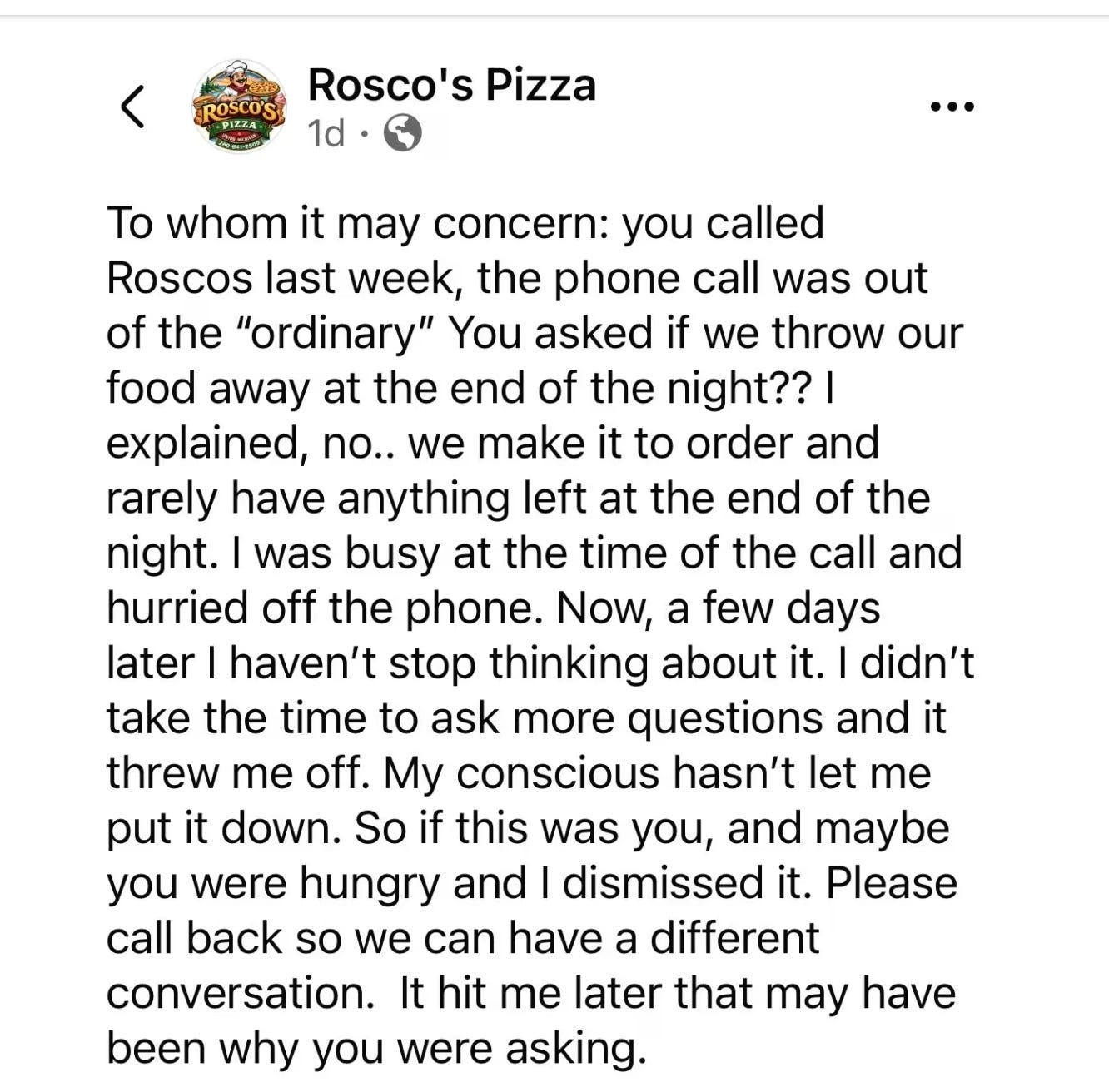
During a busy dinner rush, Rosco’s Pizza manager Shanna Crice fielded a strange call from a timid sounding woman who only asked whether the shop ever threw away food at the end of the night, then hung up before Crice could learn more, since the small Union, Michigan restaurant makes pizza to order and rarely has leftovers. Crice initially brushed off the odd call in the chaos of the shift but couldn’t stop thinking about it afterward, worried the caller might have been someone in need of food, so she posted on Rosco’s Facebook page expressing regret and asking the caller to reach out again. The post unexpectedly went viral, drawing over 100,000 likes and supportive comments from people as far away as Australia, Nigeria, Scotland, and beyond, many of whom suggested she set up a “meal wall,” where customers prepay for meals that people in need can claim. Within about a week, Crice built and launched the wall herself, and it quickly filled with $10 meal tickets donated from across the country and world, each marked with a heart sticker noting the donor’s location, while she also reached out to local schools and churches to make sure families in her own community know they’re welcome to use it.
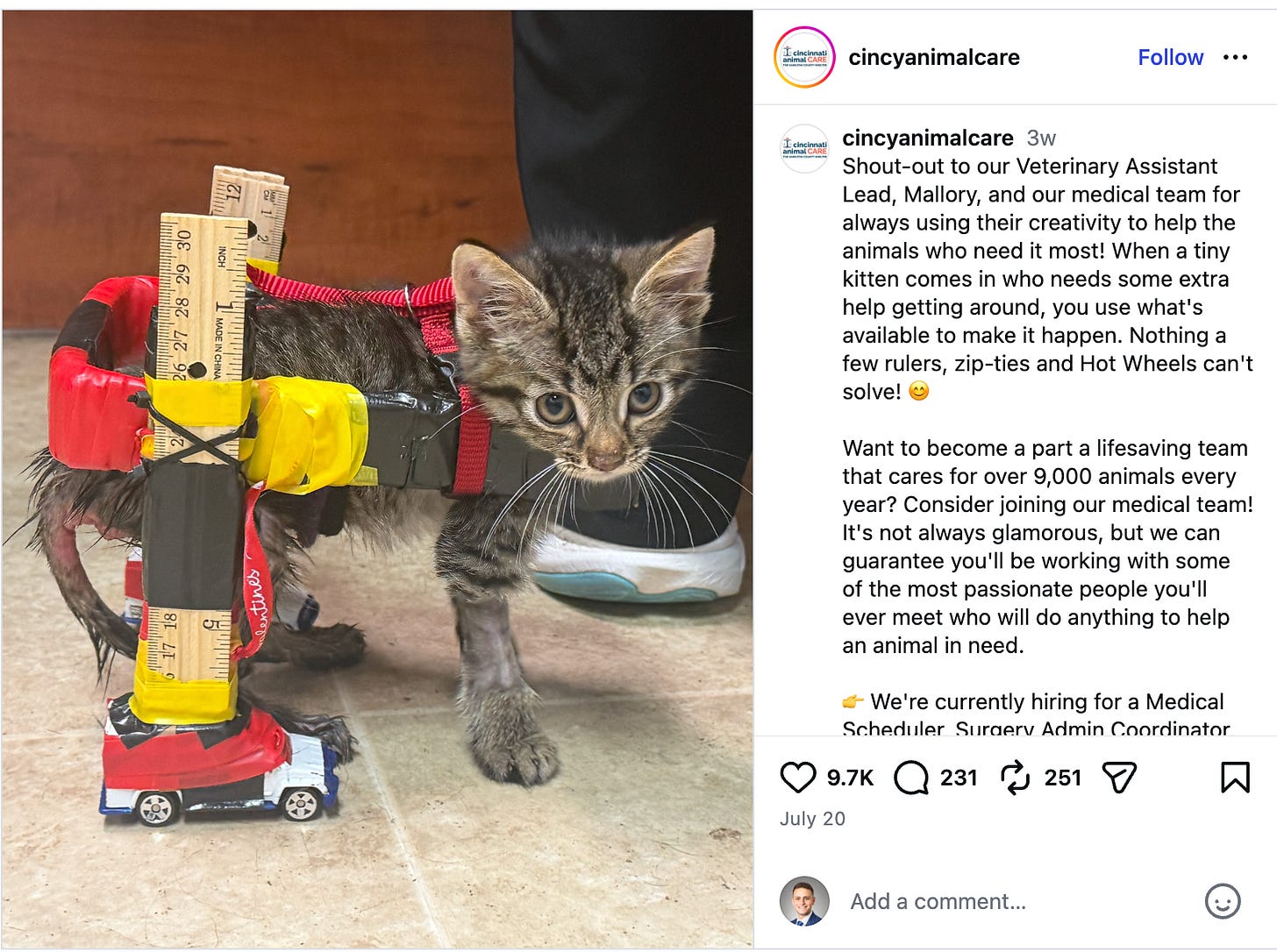
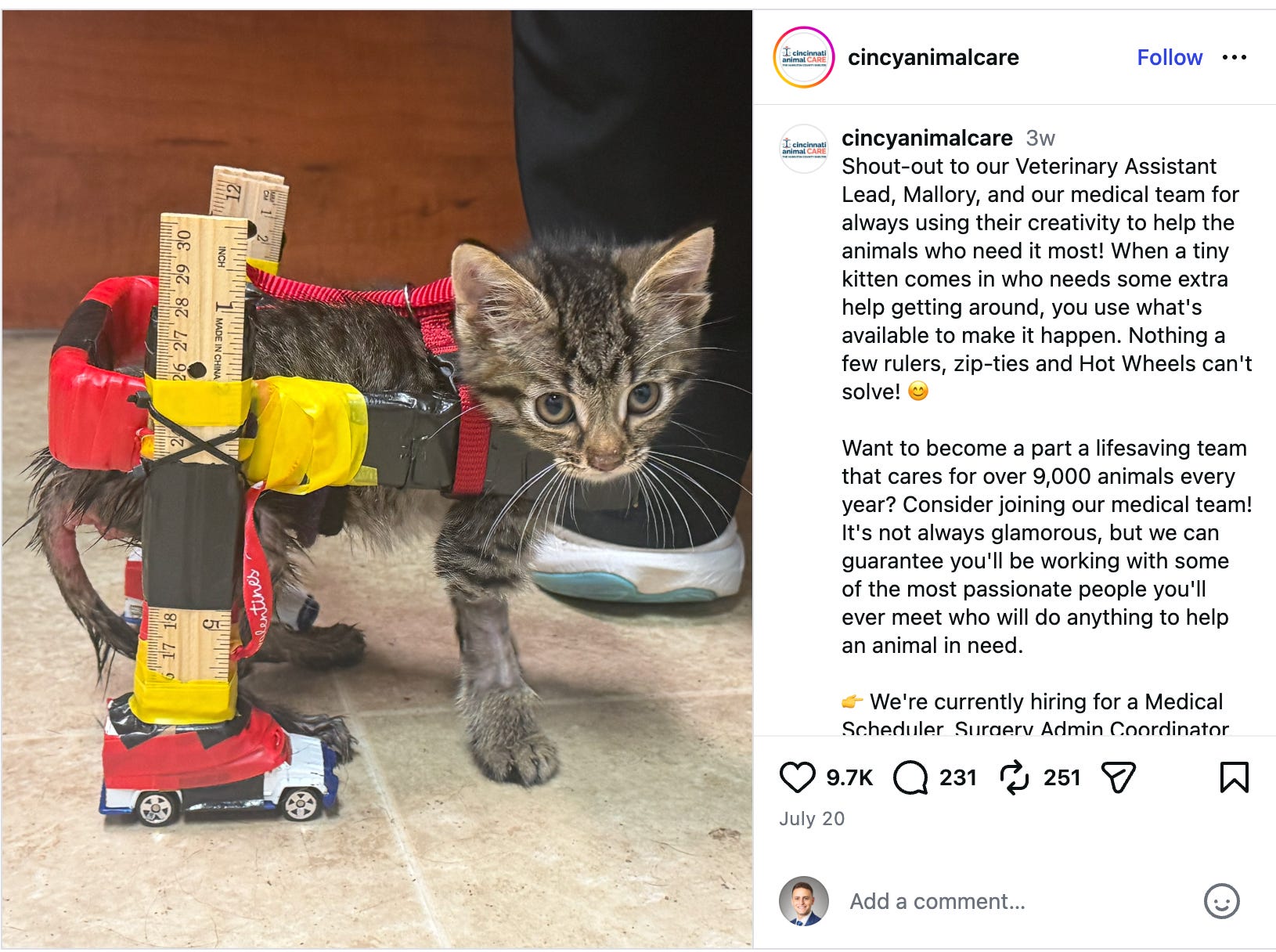
A stray kitten named Gelato arrived at Cincinnati Animal CARE in Ohio in late June after being found in a nearby park with four other kittens, showing a fresh spinal injury that left him dragging his hind end and unable to urinate on his own or use his back legs, likely from being hit by something or falling. Veterinary assistant lead Mallory Smith started him on cage rest, and as he began improving and showing interest in playing and running, she found that his atrophied leg muscles and small size meant none of the shelter’s donated wheelchairs would fit him, so she built one from scratch using rulers, zip ties, and toy Hot Wheels cars. Photos and video of the makeshift wheelchair went viral on social media in July, earning nearly 19,000 likes on Instagram and local media attention, and a friend of Smith’s who had already been designing an upgrade with her ended up 3D printing him an adjustable wheelchair engraved with his name after he outgrew the original. Now around 10 weeks old and in foster care with Smith, Gelato receives daily physical therapy and is expected to be ready for adoption in about a month, with Smith saying his progress and young age give her high hopes, though it’s not yet certain whether he’ll eventually walk without assistance.
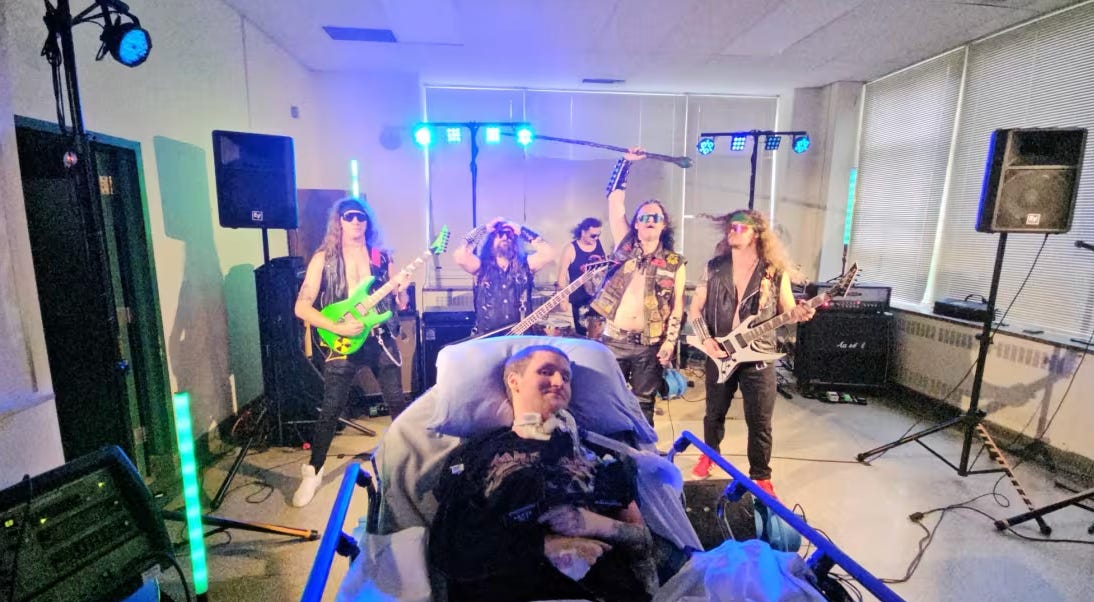
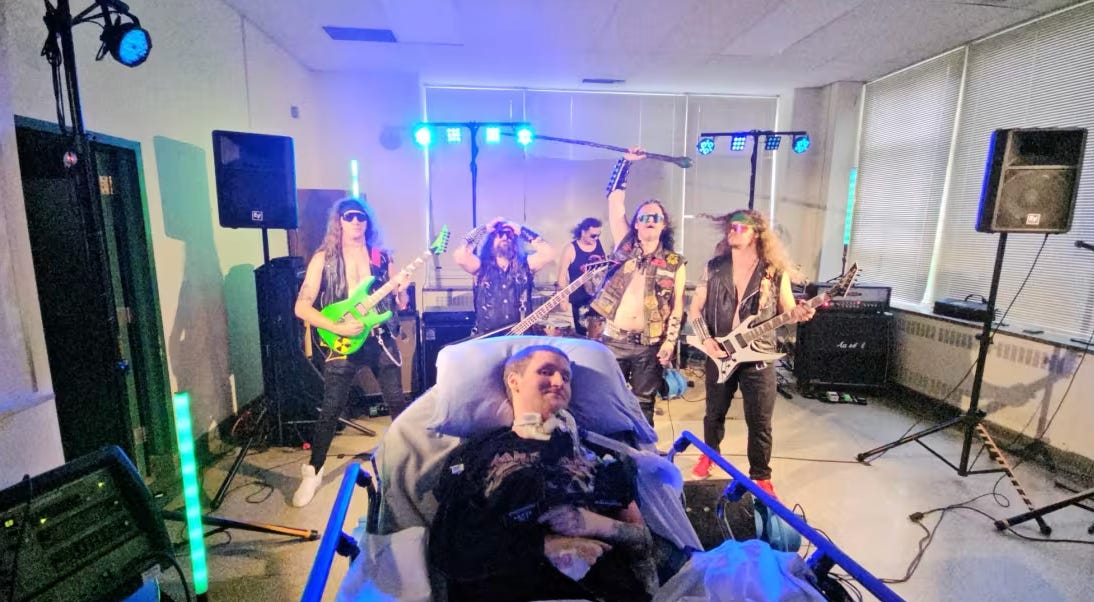
After 27 year old Tim Berry, a patient at Bruyère Health in Ottawa, received difficult news about his condition, clinical chaplain Roshene Lawson asked him what he wanted to focus on with the time he had left, and he said he’d really like to attend a heavy metal concert. Since Berry was too medically fragile to leave the hospital, Lawson reached out to Dominion Tavern owner Scott McClinton, who had the equipment and connections to help and quickly recruited local band The Scepter, known for their energetic, authentic metal shows. In July, the band performed a full 40 minute set for Berry in a hospital conference room transformed with stage lighting, blasting amps, and hair blowing fans, while nurses painted his nails, dressed him in a metal shirt, and Lawson even made tickets so fellow patients and staff could properly attend. Lawson says Berry was moved to tears of happiness during the show, and staff across nursing, recreation therapy, physiotherapy, and clinical management all pitched in to make the experience feel like a real concert rather than a watered down hospital version.
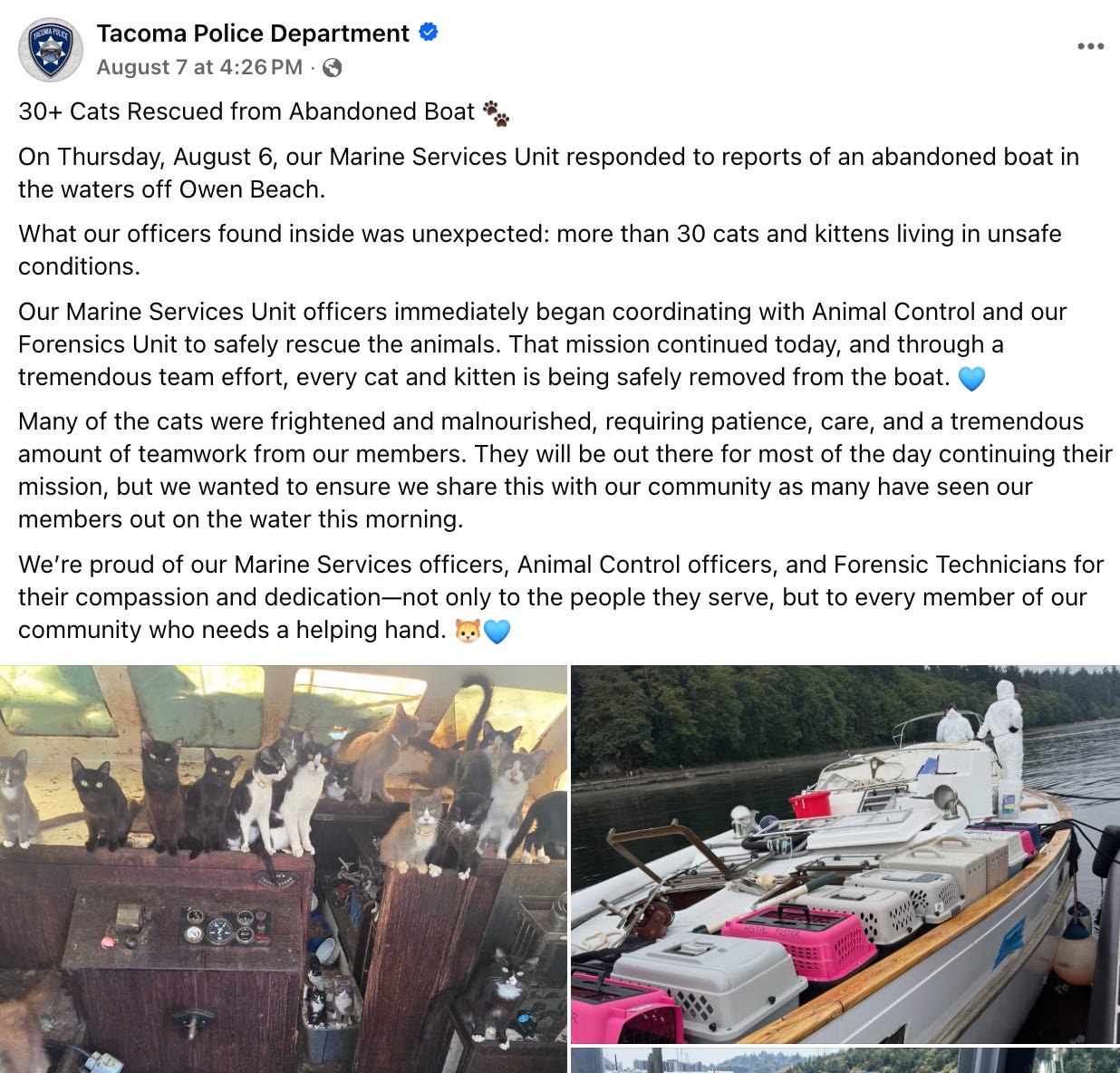
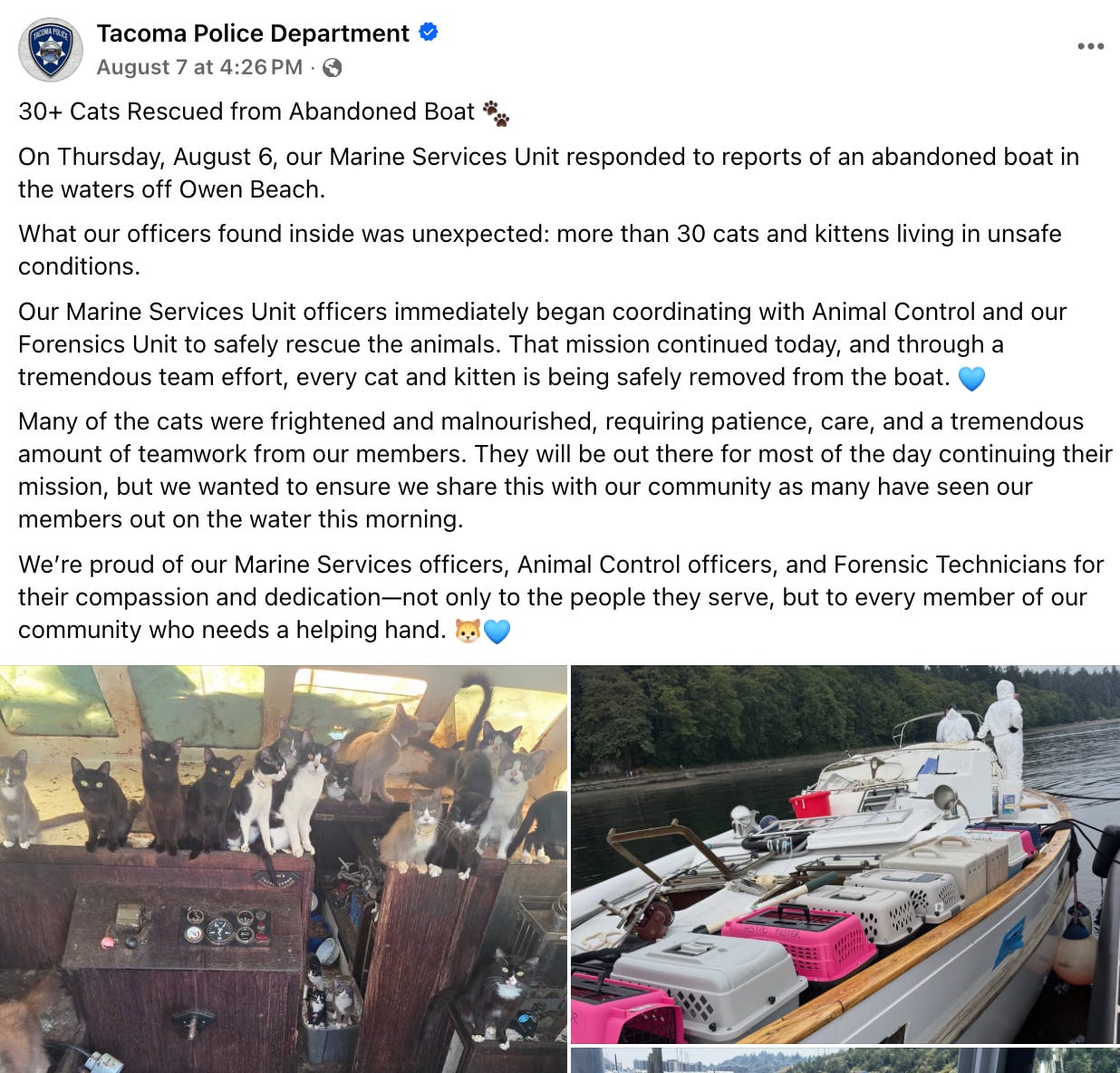
The Tacoma Police Department’s marine services unit responded to reports on August 6 of an abandoned boat off Owen Beach and discovered more than 30 cats and kittens, some wearing collars, living in unsafe conditions with no humans aboard. Officer John Correa described the scene to the News Tribune as looking like “a Studio Ghibli movie,” with cats freely roaming the vessel. Because the boat was privately owned, animal control needed a warrant before rescue teams could enter, and once obtained, officers, animal control, and the department’s forensics unit worked together starting August 7 to remove every cat safely, describing many as frightened and malnourished and requiring significant patience and teamwork. The rescued cats were eventually transferred to the Tacoma Pierce County Humane Society, while the situation remains under investigation and the whereabouts of the boat’s owner are still unclear.
Los Angeles singer-songwriter Mikayla Khramov began volunteering at a horse rescue in Moorpark, California in 2023, where she met Yupia, a distrustful, undertrained 7-year-old Kentucky-bred horse prone to biting. After nine months of building trust, she brought her guitar to his pasture, and he began nuzzling and chomping the strings, effectively “playing” along and turning her solo sessions into duets. She later found he responded the same way to her harp, and the musical bond helped rekindle her love of music after years of treating it as just a job. Mikayla is now recording her first album, a genre-blending mix of folk, electronic, and Portuguese musical influences that incorporates sounds from her sessions with Yupia, with plans to finish it in September.
Rosie, a 5 year old Labrador Retriever with nearly 340,000 Instagram followers, won four first place awards at the 10th Annual World Dog Surfing Championships two weeks ago at Pacifica Beach, California. She started surfing at just seven months old on a stand up paddleboard with her owner, prosecuting attorney and lifelong Santa Cruz surfer Steve Drottar, and now joins him in the water 4 to 5 times a week. At the competition, roughly 15 water dogs were judged across size categories on wave length, wave size, and overall performance, with a mixed breed named Bradley Cooper winning the small dog category and a French bulldog named Iza winning medium, before Rosie and Steve took to the waves in front of hundreds of spectators, some of whom traveled long distances and wore Rosie themed merchandise. Steve says Rosie’s success shows how dogs can become true adventure partners, saying that accomplishing something together builds an amazing bond he hopes to share the joy of with others.
A mechanical issue sparked a fire that engulfed a five story apartment building in a Salt Lake City suburb last week, forcing residents and their pets to evacuate, but a cat named Toast Malone got left behind after hiding behind a washing machine as flames spread. Firefighters battled the blaze for 60 hours, and Salt Lake County Animal Services posted on social media to help search for him as hope faded over the following days. More than 72 hours after the fire began, rescuers found Toast alive and unharmed except for being wet, cold, and scared, inside a closet, one of the few areas of the apartment that survived the fire and the more than 100,000 gallons of water used to fight it. Animal Services credited officers who worked alongside firefighters for four straight days rescuing animals, reuniting families, and caring for displaced pets among the roughly 200 residents affected, and owner Madison Stott said she never lost hope that her cat was still alive.
A new study analyzing 54 years of osprey recolonization data in northern Scotland, led by Bournemouth University researcher Brittany Maxted with Birds of Poole Harbour and the Roy Dennis Wildlife Foundation, found that while most ospreys prefer nesting near existing populations, a small number of "pioneering pairs" settle more than 12 miles away in areas with no competition, forming new subpopulations that speed up the species' recovery. Ospreys went extinct in Britain by 1916 due to hunting and egg collecting before naturally returning to Loch Garten, Scotland in 1954, sparking a conservation movement that researchers have tracked ever since. Building on this insight, conservationists have used translocation, moving young Scottish chicks to new locations, to essentially manufacture pioneering pairs, most notably in Poole Harbour, Dorset, where a five year project starting in 2017 led to the first breeding ospreys in southern England since 1847; that original pair has since hatched four chicks for three straight summers.
Tori and Justin Cannarelli of Brookhaven, Long Island adopted Louie the duck after he hatched at a local elementary school, initially intending it as temporary and expecting him to live at their garden center business. About two years ago their 7 year old golden retriever, Barley, developed epilepsy, and while her seizure medication worked, it left her lethargic and drained her usual lively personality, something Tori described as heartbreaking to watch. Everything changed once Louie moved into their home instead of the store: Barley began visiting his enclosure every morning, and the two started playfully wrestling and stealing bites of each other’s food, forming an instant bond. Tori says Louie effectively became Barley’s emotional support duck, as the dog gradually started smiling, wagging her tail, and acting like herself again, regaining the spark her family feared she’d lost for good.
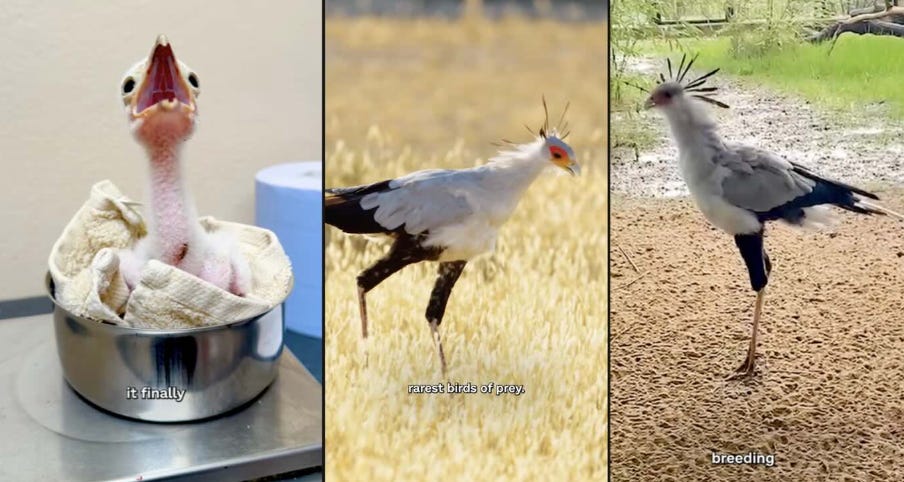
England’s Chester Zoo successfully bred secretarybirds for the first time in its 95 year history last week, with parents John and Jolene producing five chicks as part of an international conservation breeding program for the endangered African bird of prey. The achievement is especially significant given how small the safety net population is: only 79 secretarybirds exist across the entire European breeding program, and just three other chicks hatched anywhere else in the past year. Secretarybirds are unusual among raptors for hunting on foot across African grasslands, using their long legs to stomp venomous snakes, which is reflected in their scientific name Sagittarius serpentarius, meaning “archer of snakes.” In the wild, their numbers have fallen to as few as 6,700 birds due to widespread loss of grassland habitat to agriculture and development, leading the IUCN to list them as Endangered. Zoo officials say the breeding techniques developed at Chester could help other conservation zoos across Europe improve their own success rates with the species.
On July 29, fishing guide Capt. Davis Galland reported an adult female manatee entangled in commercial crab trap lines near St. Simons Island, marking what wildlife officials called the first such reported case in Georgia. A three boat, multi state team, including Georgia DNR, Florida Fish and Wildlife, and the U.S. Fish and Wildlife Service, responded and worked to free her over two days despite a nearby calf staying close throughout, which prevented rescuers from using their initial plan to net her onto a rescue boat. By early afternoon on day two, the team manually cut away the buoy and remaining line, which had begun cutting into her skin, drawing on techniques normally used to disentangle dolphins and North Atlantic right whales, and they also attached a satellite tracking tag before a storm forced them off the water. Officials called it a strong example of interagency collaboration, noting the mother and her apparent calf now have a better chance to survive and contribute to the wild manatee population going forward.
A new University of Cambridge led study published in Communications Sustainability finds that the massive pre Hispanic irrigation system of La Mojana in northern Colombia, a network of canals and raised fields covering about 1,930 square miles, roughly three times the size of London, was likely built through cooperative, locally organized labor rather than by a powerful centralized ruler as long assumed. Used from the first centuries BC until the 11th century AD, the system managed water year round, buffering against both floods and drought while improving soils for farming and possibly aiding fishing. Researchers mapped a 500 hectare portion of the system using satellite imagery, analyzing 1,600 ridges and 63 housing platforms in detail, and calculated that a workforce of around 800 people, drawn from an estimated local population of 1,600, could realistically have built it using traditional tools and practices despite the region's heavy clay soil and lack of metal shovels at the time.
Bryan Newton, a Virginia Tech graduate who now provides security for Rhino Sports and Entertainment Services at the school’s 1,274 seat performance hall, turned a staff guessing game into an unexpected creative outlet. About two years ago, Rhino staff began guessing nightly attendance numbers using Price Is Right rules, and Newton, who owns a 3D printer, started designing a themed miniature rhino trophy for each event as the prize. His creations range from a warrior rhino for a wrestling match to a dancing rhino for an Australian contemporary dance show, along with seasonal versions wearing witch hats, bunny ears, or Virginia Tech’s maroon and orange colors, with some pieces taking as little as a few hours and others up to 12 hours to complete. The rhinos are now displayed near the venue’s turnstiles, and regular patrons look forward to seeing each new design as they enter for a show. Newton says the process taps into a creative and school spirit outlet he’s carried since managing Virginia Tech’s marching band 25 years ago, turning a simple staff game into a beloved campus tradition.
See you soon.
— Aaron
Comments
Nothing yet. Say the first thing.
Sign in to join the conversation.