
Good evening. Ontario is threatening to cut off electricity and critical minerals to the United States as the Canada trade war turns into a real economic fight, with Doug Ford warning “everything is on the table” and Trump escalating with new tariffs on Canadian autos and steel. Iran’s currency has cratered as Treasury Secretary Scott Bessent launches “Operation Economic Outcast,” a sweeping new sanctions push, even as Iran’s leadership shows no signs of backing down.
Also today: Mike Johnson claims the White House calls him “co-president,” the administration revives its $100,000 H-1B visa fee, Army Apache helicopters are crashing at a historically high rate, DHS is reassigning immigration officers to screen South African refugees and hunt for “unlawful” voters, a decorated Iraq War veteran faces deportation, ICE is moving forward with a plan to arm officers with electric shock gloves, a fast-moving wildfire has forced 90,000 people to evacuate near Reno, and the deputy who killed Sonya Massey has died in prison.
Mainstream media keeps catering to the powerful and the profitable. We chose something different. We chose each other, we chose honesty, and we chose to tell the stories that need telling, no matter how uncomfortable they are for the people in power. If you can, subscribe to support this work or upgrade your subscription today.
Here’s the news:
Supreme Court Hands Trump Win:
The Supreme Court sided with the Trump administration Monday in a case over Trump’s executive order restricting mail in voting, though the ruling doesn’t decide whether the order is actually legal, only that the states challenging it lacked the legal standing to sue at this stage, with the conservative majority writing “time will tell” whether implementation ends up lawful. The three liberal leaning justices dissented, and the decision leaves the door open to further challenges, some of which have already been filed, while it remains unclear how much of the order can actually be implemented before midterm ballots start going out in just weeks. The order, signed in March, directs USPS to deliver mail ballots only to voters on lists the administration creates, and 23 states plus D.C. sued to block it, arguing the Constitution gives states and Congress control over elections and warning of chaotic, partisan implementation.
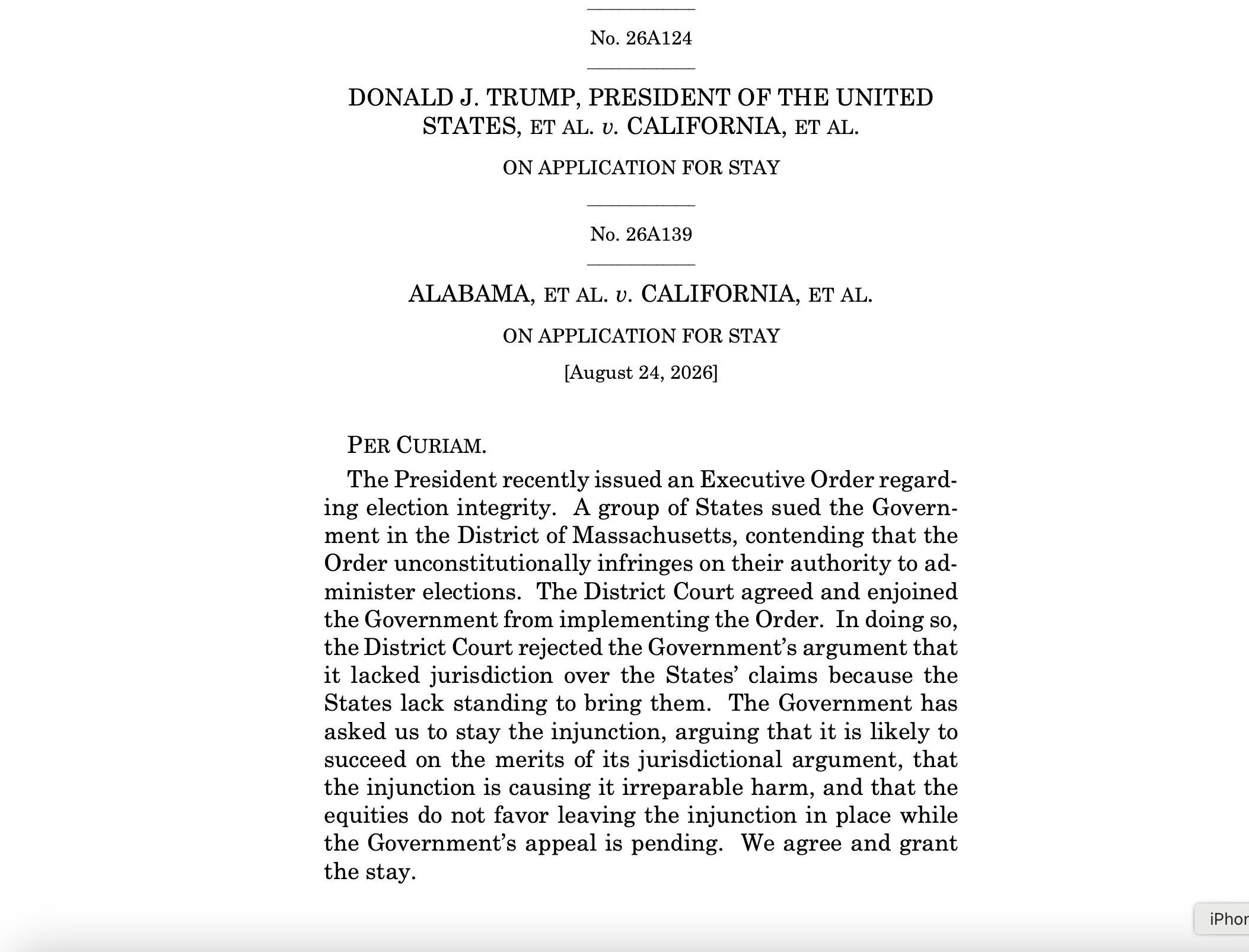
A Massachusetts judge had blocked the plan for the midterms and later expanded that block nationwide, a ruling upheld on appeal, which prompted the Justice Department to appeal to the Supreme Court on procedural grounds, arguing the states sued prematurely and citing a separate Washington ruling that let the order proceed. A dozen Republican leaning states backed the administration, arguing states would still get input on final voter lists, while federal attorneys argued the Massachusetts block was preventing the government from finalizing “election integrity” policies ahead of November. This is one of several mail voting fights before the court, and it follows a June ruling where the justices, after full briefing rather than the emergency docket, sided against Trump-backed arguments by allowing states to count ballots arriving after Election Day.
Trump has long targeted mail voting, claiming without credible evidence that it enabled fraud in his 2020 loss to Joe Biden, despite having used mail voting himself, and has framed the new restrictions as necessary to stop noncitizen voting, which remains extremely rare and already a felony punishable by deportation. Mail voting has actually grown more popular across both parties, accounting for about 30% of ballots in the 2024 presidential election, and a 2025 Brookings Institution study found only about four fraud cases per 10 million mail ballots cast. The ruling adds to a broader pattern of election related fights this cycle, including a related AP story on Trump telling Canada to “fall in line” amid the trade dispute and continued national attention on the administration’s mail voting push heading into a consequential midterm season.
Canada trade war:
Ontario Premier Doug Ford says Canada should be ready to cut off electricity to the United States if the trade fight worsens, declaring “everything is on the table,” including shutting off electricity exports and critical mineral shipments from the province. Ford said Ontario powers 1.5 million American homes and businesses and warned “I’ll cut them off, you won’t get a grain of sand out of Ontario,” specifically citing high grade nickel and processed uranium as leverage Canada could use. He argued Trump has “declared war, economic war against his closest friend and ally” and said Reagan, who opposed tariffs, “would be throwing up” if he saw what Trump was doing, adding Trump should “take that picture off the wall.” Ford has used this tactic before, previously slapping a 25% surcharge on power sent to Michigan, Minnesota, and New York, which prompted Trump to threaten doubling steel and aluminum tariffs before both sides backed off.
The dispute escalated after Prime Minister Mark Carney walked away from trade talks Friday, saying the US had proposed “unfair, uneconomic” terms that questioned the reliability of any deal, including a provision restricting Canada’s ability to strike trade agreements with other countries without US consent. The US responded by imposing 50% tariffs Saturday on roughly $20 billion of Canadian goods, and Carney announced Canada would match those tariffs dollar for dollar starting September 8, covering steel, dairy, appliances, and electronics. Trump then escalated further Monday, threatening a 50% tariff on Canadian vehicles, auto parts, and steel starting January 2027, writing on social media that Canada has been “ripping off the United States” and declaring “we don’t need Canada, they need us.” US Trade Representative Jamieson Greer placed blame for the breakdown on Canada, saying negotiators had reached a near final deal Tuesday night but that Canadians “wanted more” in the closing hours, a characterization Carney disputes.
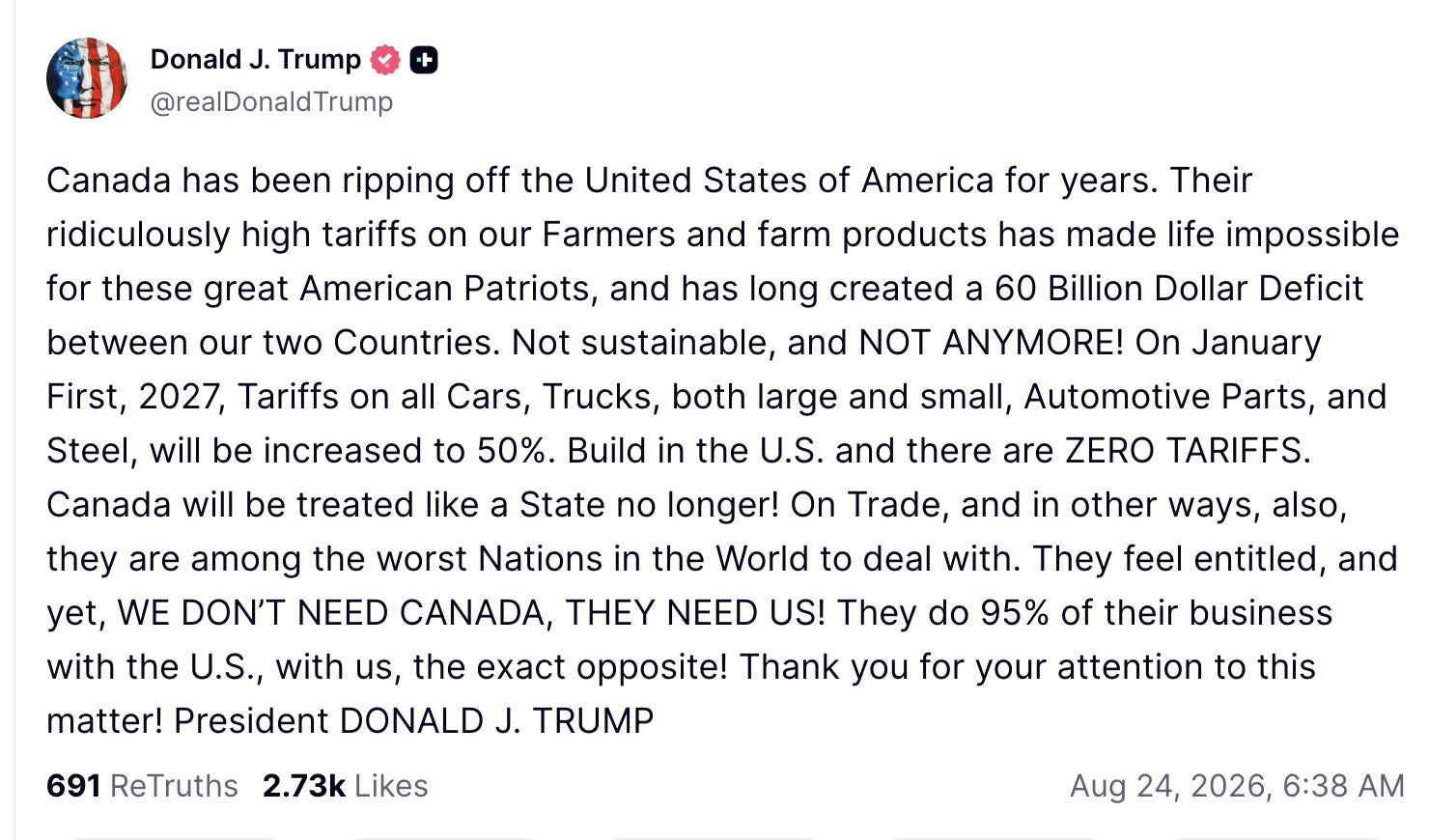
Carney fired back publicly from Quebec, calling Trump’s latest tariff threat unsurprising and revelatory of US intentions to dismantle Canada’s major industries, including its auto sector, and asking what message it sends to autoworkers in Michigan, Ohio, Kentucky, and Alabama who depend on Canada as their largest customer. He said Canada would return to the table only if the US comes back “with the right attitude” and stops treating Canada “like a subsidiary of the United States,” and he separately revealed that a US request to weaken Quebec’s French language labeling requirements was a major, non-negotiable sticking point in the final hours of talks. Vice President JD Vance countered that Canada has one of the “worst trade policies” in the world alongside China, accused Canada of underinvesting in its own military while relying on US protection, and said Canadians came in with “unreasonable last-minute demands.” Ford has broken with Carney on tactics too, revealing he personally opposed the draft deal Carney was considering because it would have put American liquor back on Ontario shelves, saying “I wasn’t going to put the booze back on the shelves.”
The fallout is already hitting businesses on both sides of the border, with Calgary jewelry maker Cindy Baldassi saying tariffs could wipe out roughly half her business since 75% of her sales go to American buyers, and Ontario furniture maker Michael Saifer admitting he doubts Canada can “win a war” with the US given how badly it needs American buyers. Other Canadian premiers have largely rallied behind Carney, with British Columbia’s David Eby warning that US demands would reduce Canada “to the economic equivalent of the 51st state” and Quebec’s Christine Fréchette warning of job losses, though Alberta’s Danielle Smith urged both sides back to the table. Carney used a Monday appearance in Quebec to announce Canada will spend roughly $8 billion building six new icebreakers domestically and touted recent Canadian trade deals giving businesses access to 1.5 billion people worldwide, framing the pivot as proof Canada has options beyond the US. BBC analysis notes Trump’s new auto and steel tariffs don’t take effect until January 2027, leaving room for further negotiation before the dispute becomes a full blown trade war, with the outcome likely shaped by November’s US midterms.
Transportation Secretary Sean Duffy falsely claimed on Fox News Sunday that Canada “doesn’t have a military” and cited “record-high euthanasia rates” while arguing it would be “foolish” for Canada to think it could win an economic fight with Trump, prompting swift online correction since the Canadian Armed Forces actually has roughly 70,000 regular and 30,000 reserve personnel and has fought alongside the US in conflicts including Afghanistan and patrolled American skies on 9/11; Duffy also claimed the US “provides security” for Canada and predicted Carney would “come to the table very very quickly” once tariffs prove “devastating,” even as Carney has instead vowed to match US tariffs dollar for dollar, said “we’ve recognized from the start that America has changed,” and signaled Canada is doubling down on diversifying trade away from the US toward partners like China rather than yielding to Trump’s demands.
Ontario Premier Doug Ford says Canada must be ready to match any further escalation from Trump, using its various points of leverage to inflict maximum economic impact on the US, specifically targeting deep red states, and argues Americans are already feeling the pain since Trump’s tariffs function as a tax on US consumers.
Asked whether Prime Minister Carney told him to tone down his rhetoric after telling Trump to “kiss my ass” earlier in the day, Doug Ford said no, quipping “I have a lot of real estate on my ass, so he has a lot of room to kiss my ass,” making clear he wasn’t backing off his combative stance toward Trump despite sounding calmer than his morning remarks.
Iran:
Treasury Secretary Scott Bessent announced Monday that the U.S. has launched “Operation Economic Outcast,” a new wave of sanctions targeting international entities that facilitate Iranian trade in shipping, oil, crypto, gold, and aviation. He said Trump is personally calling world leaders with “specific requests” to cut trade ties with Tehran, and that the Treasury’s Office of Foreign Asset Control is simultaneously sanctioning over 60 entities, individuals, and vessels tied to Iran’s nuclear and missile procurement, cyber operations, and oil revenue. Bessent framed the goal as forcing Iran to choose between “complete global isolation and a subsistence economy or a path back to normalcy,” warning that any entity found laundering money for Iran would be cut off from the U.S. dollar system. He offered a “cure period” for nations to end their targeted relations with Tehran but gave no immediate concrete actions, and markets showed little reaction to the announcement.
The measures are aimed specifically at “secondary” countries whose trade still benefits Iran, and the timing lined up with the United Arab Emirates announcing it would end all trade relations with Iran ahead of Bessent’s remarks. Experts say the campaign’s real success hinges on whether Iran’s most powerful partners, China, India, and Russia, treat the threats as credible, and one foreign policy analyst was skeptical, noting Russia in particular views Iran as an ally it won’t abandon without damaging its own credibility with other allies. Iran’s economy has already been battered by years of sanctions and roughly six months of war with the U.S. and Israel, a conflict Defense Secretary Pete Hegseth said has cost the U.S. $37.5 billion directly, with broader estimates reaching $150 billion. Economist Mark Zandi has separately estimated the war has cost the average American household more than $1,200 in higher energy and grocery costs.
Iranian officials pushed back hard and publicly. Parliament speaker Mohammad Bagher Ghalibaf dismissed the sanctions as bombast that Iran’s trading partners “don’t take into account anywhere,” while Deputy Foreign Minister Kazem Gharibabadi suggested the scale of the campaign was itself “an admission of America’s defeat” given past U.S. claims that Iran’s capabilities were already destroyed. Central Bank governor Abdolnaser Hemmati said the U.S. had “done everything it could” already and that the new measures introduce no real additional pressure, adding Iran anticipated hard times and had been stockpiling foreign currency since the war began in February. Inside Iran, there were signs of real strain, including a heavy police presence at Tehran’s Grand Bazaar, public frustration over the collapsing rial, and long lines at gas stations, with the police chief accusing the U.S. of trying to stoke unrest over economic grievances.
Iran’s government, meanwhile, appears to have tightened its grip rather than loosened it since the war’s start, with hardliner Mojtaba Khamenei succeeding his father as Supreme Leader after Ali Khamenei’s death early in the conflict and elevating other veteran hardliners from the security and military establishment. That’s a notable contrast to Trump’s early hopes that economic pressure might spark an uprising against Iran’s clerical rulers, especially given that a similar wave of protests in January already left thousands dead and thousands more arrested.
Other news:
House Speaker Mike Johnson claims White House staffers refer to him as “co-president,” telling NOTUS “some on his staff have said, ‘No, it’s really like you’re co-president’” because he and Trump “speak all the time,” comments that came as he hit the campaign trail ahead of midterms where Republicans are expected to lose ground. Johnson is presiding over a historically thin GOP majority that’s repeatedly defied him, including Republicans joining Democrats in July to try to halt the Iran war, far-right members blocking a defense policy bill in June to push Trump’s voting restrictions package, the House failing to reauthorize a key FISA surveillance program, and a GOP rebellion last year that forced release of the Epstein files. Trump himself has joked he effectively has two jobs, “being president and being speaker,” even as Republicans face a brutal midterm environment with his approval rating at 33%, the lowest of his second term and matching his first term low, driven partly by an unpopular war and high gas prices. One Arizona GOP strategist described the bind bluntly, saying “there is one person in this country who doesn’t care about gas prices... and unfortunately that one person kind of controls our fate,” while breaking with Trump carries its own risk since he’s shown he’ll back primary challengers against Republicans who cross him, as he did in Texas and Louisiana.
The Trump administration has revived its push for a more than $100,000 H-1B visa fee, with the Department of Homeland Security formally proposing $103,265 for all new H-1B petitions in a Monday Federal Register filing set to publish Tuesday, kicking off a 30 day public comment period. Trump first floated the $100,000 fee via presidential proclamation in September 2025 to prioritize American workers, but it drew lawsuits from labor unions, research universities, and dozens of states warning it would gut hospitals’ already thin staffing and upend a tech industry reliant on foreign born researchers and coders, and a federal judge blocked it in June, ruling it was an unlawful “tax” requiring congressional approval. The White House frames the fee as a way to curb employers undercutting American workers with cheaper foreign labor, and DHS says the revenue would help fund immigration enforcement activities at agencies like CBP and ICE, acknowledging the rule could reduce H-1B filings, including among small employers, but calling that outcome “appropriate.” H-1B visas are capped at 85,000 a year, with nearly 400,000 petitions approved in fiscal 2024 (mostly renewals), and most recipients come from India followed by China; the proposal is part of a broader administration effort to restrict immigration pathways, following a since struck down January pause on immigrant visas from 75 countries.
The Army’s AH-64 Apache attack helicopters are crashing at a historically high rate this year, with five major “Class A” mishaps since October, including an August crash at Fort Hood, Texas that killed two soldiers, sparked a wildfire, and briefly forced the Army to ground routine Apache training flights before lifting the pause last Wednesday. CNN’s analysis puts fiscal year 2026’s crash rate at roughly 6.24 per 100,000 flying hours, making it the second worst year since the current E-model Apache debuted in 2011, trailing only 2024’s rate of 7.02 per 100,000 hours, when a pilot experience shortage and post-Ukraine invasion training surge were blamed. This year’s causes are murkier: an internal Army safety newsletter attributes just over half of all Apache incidents, including minor ones, to human error, but confirms “a catastrophic transmission failure was noted in one Class A mishap,” and internal safety messages reviewed by CNN describe a widespread transmission problem that can knock out the tail rotor, electrical power, and hydraulics simultaneously, an issue affecting roughly a tenth of the Army’s Apache fleet and still listed as “under investigation” as of mid-July. The Army has declined to say how many crashes are linked to the transmission issue or share findings from the Fort Hood investigation, citing “special controls and release protections,” while manufacturer Boeing says it’s supporting the Army’s probe but referred further questions back to the service.
Trump has tied his August 10 executive order, which cuts the recommended childhood vaccine schedule from 17 diseases to 11 and splits combination shots like MMR into separate doses, directly to autism prevention, claiming it will show a “very big difference” in rates. Critics, including Sen. Bill Cassidy, health groups, and journalists, have pushed back hard, pointing to decades of research showing no link between vaccines and autism and warning the order could fuel vaccine hesitancy and disease outbreaks instead. The administration frames the change as giving parents more flexibility, while opponents counter that spacing out shots adds real costs and logistical burden for families without any scientific basis behind the autism claim.
According to The Guardian, all immigration officers in USCIS’s Fraud Detection and National Security Directorate, the unit responsible for catching fraud in asylum and other immigration cases, have been reassigned full time to two priorities: screening South African refugees and hunting for alleged “unlawful” voters, according to internal correspondence obtained by the Guardian. The shift means USCIS won’t be able to provide officers to train asylum officers “for the near future,” a disruption that comes as asylum processing has already largely stalled under Trump, though it’s unclear whether routine fraud screening of pending asylum cases has also slowed. The refugee screening priority reflects the administration’s push to sharply cut overall refugee admissions while fast tracking South Africans, mostly Afrikaners the administration claims face “white genocide,” a claim South Africa’s government rejects; state department data shows 10,255 of the 10,258 refugees admitted between October 2025 and July 2026 were from South Africa. The “unlawful voter” screening ties into a broader crackdown that’s already led USCIS to bar naturalization for green card holders who voted or registered and pursue deportation against them, even though confirmed noncitizen voting is exceedingly rare, with one February 2026 review finding only about 35 cases nationwide out of 154 million votes cast in 2024, a stark contrast to DHS Secretary Markwayne Mullin’s since deflated claim of “over 250,000 potential” illegal noncitizen registrations across four states.
Benito Miranda Hernandez, a green card holder who came to the US from Mexico as a child and later served three Navy tours during the Iraq War, is now detained at the Otay Mesa Detention Center facing possible deportation after federal immigration agents took him into custody in June, just as he was completing a California reentry program. His mother, Maria Miranda, says he returned from deployment fundamentally changed and unrecognizable, and while he went on to serve years in prison on felony drug and weapons convictions in Virginia and California, advocates including deported-then-reinstated Army veteran Hector Barajas argue his PTSD and legal troubles reflect a systemic failure to care for traumatized veterans rather than grounds for removal, noting research showing about a third of veterans have an arrest history compared to one in five civilians. Hernandez had his green card reinstated in November and was living in a halfway house working and taking classes with an ankle monitor when agents detained him, a reversal his mother calls devastating, saying “all my dreams of being with my son have ended.” ICE told Congress it arrested 125 former service members in Trump’s first year back in office, about a third with active warrants, and did not respond to NBC’s request for comment on Hernandez’s case, while advocate James L. Smith II criticized lawmakers who publicly praise the military while allowing foreign-born veterans to be deported, saying “we’re the pit bulls in the front yard in the global neighborhood.”
The Department of Homeland Security has published plans to spend up to $20 million outfitting ICE officers with electric shock gloves by March, alarming civil liberties advocates who point to the device’s link to serious injuries and at least one death, including a Kentucky man who suffered cardiac arrest after being shocked 27 times with the gloves and 13 times with a Taser during a 2024 arrest. ACLU deputy director Sarah Mehta warned ICE is “putting these in the hands of an agency that has dropped its hiring standards, its training, its background requirements,” saying there are “no circumstances where we think their use is appropriate,” and raised particular concern about their potential use in facilities like the Fort Bliss detention camp where oversight is already limited. The gloves, branded G.L.O.V.E. and made by Compliant Technologies, deliver up to 380 volts through direct skin contact and are already used by roughly 50 police departments in 20 states, including in some public schools, where Omaha recently discontinued their use in its largest school district after deploying them on a middle schooler. DHS defended the purchase, saying it’s “constantly assessing the needs of our officers in the field” and that any technology used is reviewed against applicable law enforcement standards, while a lawyer representing one plaintiff shocked by the gloves in a Kentucky jail noted that only a small fraction of the roughly 18,000 law enforcement agencies nationwide have adopted them, raising questions about feasibility and training risk if ICE rolls them out broadly.
My inbox continues to be flooded with hateful messages. A lot of you have asked how I protect myself. I have and will always continue to work with a company called DeleteMe. They make sure these messages don’t turn more serious. They hide my data, keep my information secret. You can do it too. Go to this link. Use code AARON. Protect yourself today.
Authorities have ordered roughly 90,000 residents of Reno, Nevada, and the adjacent North Valley to evacuate as the wind driven Hawk fire, confirmed human caused and still under investigation, has burned more than 15,000 acres with zero containment as of Monday morning. At least six people have been injured, including three first responders, and several mountaintop homes have been destroyed, while nearly 10,000 homes and businesses lost power and portions of US Route 395 were closed. Officials describe the fire as extremely fast moving and unpredictable, with Washoe County Sheriff Darin Balaam saying it jumped over fire trucks and shifted directions with the wind, and Governor Joe Lombardo has declared a state of emergency and urged residents to evacuate immediately when ordered. Roughly 800 personnel, including crews from Australia and New Zealand, are fighting the blaze, and this is the third major human caused wildfire near Reno in two weeks alone, part of a brutal US wildfire season that has already burned more than 7.8 million acres nationwide this year, the most in a decade for this point in the season.
Sean Grayson, the former Sangamon County sheriff’s deputy convicted of second degree murder for fatally shooting Sonya Massey in her Springfield, Illinois home in July 2024, has died at 32, six months into his 20 year sentence, after being diagnosed with stage three colon cancer in 2023 that had spread to his liver and lungs. Bodyworn camera footage showed Grayson, who is white, fatally shoot Massey, a Black woman and unarmed single mother, after she picked up a pot of boiling water and said “I rebuke you in the name of Jesus,” which he claimed to perceive as a threat; she apologized and dropped to the floor before he fired three times, striking her in the face, and declined to offer her medical care afterward. The case sparked protests over systemic racism and a Justice Department review, leading Illinois Governor JB Pritzker to sign the Sonya Massey Act requiring stricter law enforcement background checks and Sangamon County to agree to a $10 million settlement with Massey’s family. Grayson had apologized at his January sentencing but later sought early medical release by claiming Massey had “attacked” him with boiling water, a petition the Illinois prisoner review board denied in July and that Sangamon County’s state’s attorney called “a miscarriage of justice,” with Massey family attorneys Ben Crump and Antonio Romanucci saying “no one is above accountability, and a badge does not provide an early way out.”
Over a dozen major US companies, including Airbnb, DoorDash, Target, and Zillow, that signed a 2021 letter urging Congress to strengthen the Voting Rights Act are now donating to 527 political groups like the Republican Attorneys General Association that are actively working to undermine it, according to campaign finance watchdog Center for Political Accountability. Google’s Raga contributions alone jumped from $50,000 in 2022 to $325,000 this cycle, and Amazon, Google, Meta, and Microsoft, which had pulled back donations after January 6, have all resumed giving despite Raga having sent robocalls promoting the “Stop the Steal” rally that preceded the insurrection. These state-level 527 groups fly under the radar compared to federal PACs but wield outsized influence, since state attorneys general elected with their help have driven major Supreme Court wins including overturning Roe v. Wade and, this year, gutting key parts of the Voting Rights Act itself in Louisiana v. Callais. CPA’s Bruce Freed argues these donations directly contradict the values companies claim to uphold, warning “there has to be an alignment between company policies, where their contributions go and what they enable,” while researchers note Republican state groups are currently outraising Democratic counterparts $240 million to $197 million this cycle, with corporate money making up roughly a third of both sides’ fundraising.
San Francisco 49ers owner Jed York pleaded no contest to disorderly conduct and possessing criminal tools after being arrested early Sunday at a trailer park in East Palestine, Ohio, with the original prostitution charge amended down to disorderly conduct; court documents cited by the New York Post say York responded to an online ad and “arranged to have sexual activity with a female in exchange for $140.” He was sentenced to a day in jail on each count, served concurrently, fined $1,150 total, ordered to complete an online course, and was released Monday morning, with the East Palestine Police Department and the Mahoning Valley Human Trafficking Task Force both involved in the arrest. York, 46, grew up in nearby Youngstown and still keeps a home in the area; he’s the nephew of former 49ers majority owner Edward J. DeBartolo Jr., took over as team CEO in 2008, and became principal owner in 2024 after acquiring his mother’s shares, a tenure during which the 49ers have reached three Super Bowls without winning any. He also holds ownership stakes in the Premier League’s Leeds United and Scotland’s Rangers through 49ers Enterprises.
See you soon.
— Aaron
Comments
Nothing yet. Say the first thing.
Sign in to join the conversation.