
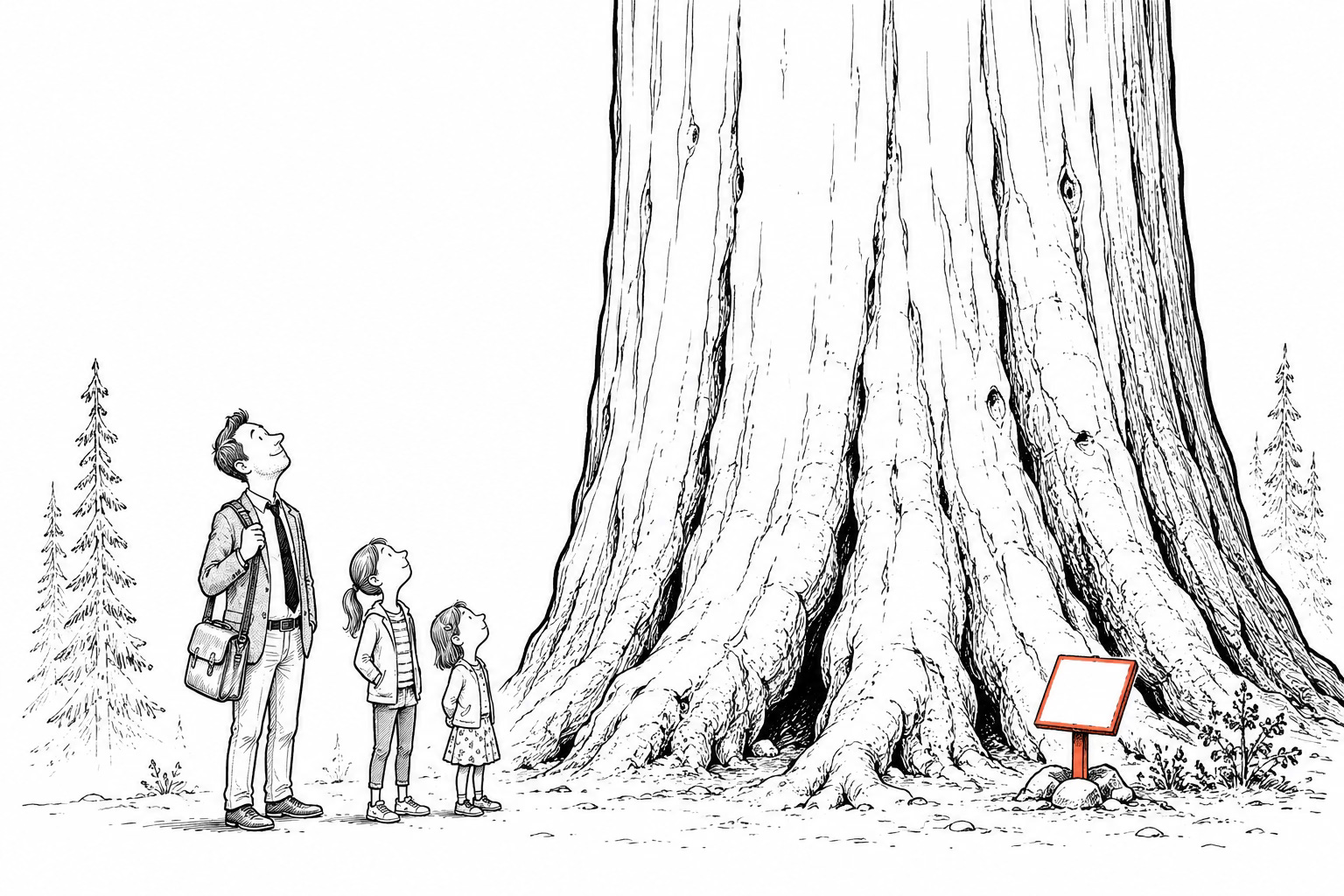
Before heading home from California this summer, my family and I visited Sequoia National Park. It’s home to the giant sequoias, which are the largest trees on the entire planet, including the General Sherman Tree, which is generally regarded as the biggest tree (and living thing) on Earth by volume.
By the way, describing the size of that tree is tricky. Photos don’t do it justice. The thing is roughly 275 feet tall, wider at its base than most rooms in your house, and somewhere in the neighborhood of 2,200 years old, which means it was already a substantial tree when the Roman Empire was getting started. For context, my kids were impressed, and they’re hard to impress.
But the most interesting fact I learned on that trip wasn’t about the size of the trees. It was about fire.
Naturally, when most of us think “fire,” we also think “burning wood.” As a result, early conservationists decided they needed to protect the giant sequoias from forest fires. And so, for the better part of a century, conservationists suppressed every fire that threatened the sequoia groves on the seemingly sensible theory that fire was the enemy and the trees needed to be shielded from it.
Except they were almost exactly backwards in their thinking.
What the conservationists eventually discovered, and what our park guide explained to us as my children slowly lost interest, was that giant sequoias don’t just tolerate fire. They depend on it. In fact, they can’t reproduce without it.
A sequoia’s cones are sealed shut with resin, and they can stay sealed for up to twenty years, holding their seeds in reserve. What opens them is heat, which means when a fire moves through the grove, the heat melts the resin, the cones finally open, and they release their seeds. And oh-by-the-way, thanks to millions of years of evolution, those seeds happen to thrive in the exact conditions fire creates. Because fire doesn’t just burn wood. It also clears away the thick layer of accumulated debris on the forest floor, exposing the bare mineral soil that sequoia seeds need in order to germinate. Plus, fire burns away the competing vegetation that would otherwise crowd out and shade the young seedlings.
That’s right… fire doesn’t kill sequoias. Fire is a partner sequoias evolved alongside and can’t live without. Even their famous, absurdly thick trunks have bark that can be as much as two feet deep. That bark evolved specifically so adult trees can survive the very fire their own offspring require to be born, meaning the whole organism is built around fire.
You can probably already see where all this is going. Turns out, a century of well-intentioned protection actually devastated the forest.
When I first heard about what was happening with those trees and the mistake around preventing forest fires, I immediately began thinking of my children. After all, as a parent, don’t I do the exact same thing? How much of my life is devoted to stopping the bad stuff from happening to them?
And, of course, it’s not just a parent thing. I suspect most of us are constantly making the same mistake with the people we love and, just as importantly, with ourselves.
We look at the people we care about, we recognize how precious and irreplaceable they are, and we conclude that the most loving thing we can do is shield them from the destructive stuff. The failures. The rejections. The hard, painful, seemingly damaging experiences that we’d do almost anything to spare them from. Not only does it feel correct. It feels obviously correct in exactly the way protecting rare trees from fire felt obviously correct.
But humans, like sequoias, didn’t evolve in a world without fire. We have been dealing with hardship, loss, failure, and struggle for as long as there have been humans, and it seems worth at least considering the possibility that we, too, are built for it. Some of what makes a person grow tall and wise and resilient isn’t the absence of difficult experiences but the presence of them.
People who are never allowed to fail don’t become invincible. They become the sequoia grove full of magnificent old trees and no new growth. They’re fine on the surface, but they can’t develop the things that only difficulty can produce. The seeds stay sealed in their cones, waiting for a heat that never comes.
So the next time you’re thinking about protecting someone — or yourself — from something difficult just because you don’t want them to experience pain, take a moment to remember the General Sherman Tree. The Sherman Tree has been alive for over two thousand years and has survived, by some estimates, thousands of fires. It didn’t grow to be the largest living thing on the planet despite all that fire. It grew that way, at least in part, because of it.
It turns out, the trees we tried hardest to protect were the ones we very nearly loved into barrenness.
Before You Reach for the Fire Extinguisher
Since this issue is about the instinct to protect both ourselves and the people we love from difficulty, here are a few questions worth holding onto for the next time you feel that instinct rising:
Am I protecting this person from genuine harm, or from the kind of difficulty that might actually help them grow?
Is this a fire that will simply burn things down, or one that clears the ground for something new? (They’re not always easy to tell apart, but the question is worth asking before acting.)
When I think back on my own growth, how much of it came from the comfortable stretches, and how much came from the hard ones?
Am I confusing “keeping someone safe” with “keeping someone from developing”?
What am I sealing up and protecting that might actually need some heat to open?
To be clear, I don’t mean you should be throwing the people you love into the flames, or seeking out hardship for its own sake. This story and set of exercises are just meant as a reminder about the importance of pausing and reflecting before you rush to prevent every difficult thing. Sometimes, the difficult thing is also the valuable thing.
Was this post helpful? Send it to someone else you think needs to read it…
No posts
Comments
Nothing yet. Say the first thing.
Sign in to join the conversation.