
A NOTE FROM DR. DININ: As promised in my email last week, welcome to the new newsletter. Swanky, huh? More importantly, it’s going to help me deliver more of what you’ve been asking for, starting with a full archive of the entire first year+ worth of posts. Read the current issue below, then grab yourself a cup of coffee, curl up in your favorite chair, and enjoy finally being able to catch up on what you’ve missed.
Also, if you think Learning to Fail would be valuable to someone you know, please help spread the word by sending this to a friend. Or even an enemy. I’m honestly not that picky.
Earlier this week I flew to Mississippi to speak with a group of high school teachers. (Shout out to my new friends at Puckett High School… go Wolves!) As always with these trips, I found myself driving a rental car. But don’t worry… I didn’t run into any deer this time. I did, however, spring for the insurance.
While I don’t particularly enjoy driving strange vehicles in strange cities, one small benefit is that I drive a sixteen-year-old car at home, so a rental is my periodic opportunity to tinker with whatever new features have become standard.
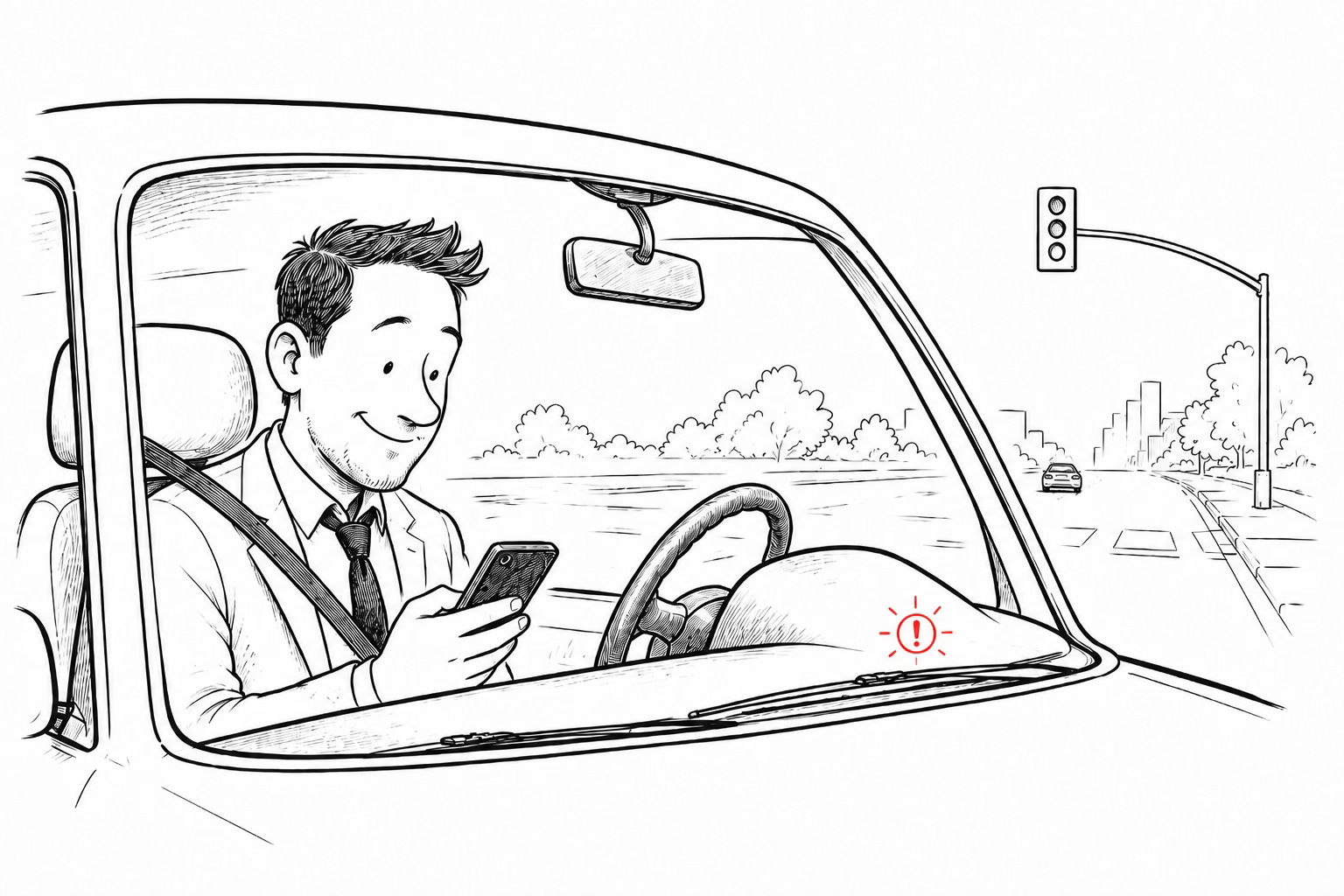
While some new features make me feel like a caveman encountering fire for the first time (hello, blind spot detection!), on this trip, nothing really jumped out at me. However, I did notice an interesting bit of unexpected functionality while sitting at a red light. Apparently I waited a beat too long after the car ahead of me started moving, which triggered a soft chime. I glanced down at the dashboard, where a little message appeared:
“Leading vehicle is driving on.”
I paused for a moment, trying to understand what I was looking at, but then it clicked. It was a feature built for a very modern kind of failure where drivers are regularly sitting at traffic lights, staring at their phones, and oblivious to the lights turning green. In other words, it’s a feature built for all of us, because we’ve all, at some point, been that person.
After experiencing the feature, I found myself debating its merits. On one hand, it’s a smart feature because it’s surely preventing lots of crazy road rage incidents. On the other hand, it’s a problematic feature that seems to encourage using phones while driving. In both cases, the chime reveals something wonderfully deep about how humans actually deal with our failures.
If we’re being honest with ourselves, we all have to admit that humans are strangely OK with sabotaging our futures in exchange for things we want right now. By that I mean we tend to reach for the immediacy of comfort and satisfaction while ignoring long-term consequences that’ll almost certainly become a problem for some future version of ourselves who, frankly, we don’t seem to like very much.
A perfect miniature of this phenomenon is using our phones at traffic lights. Every single person who has ever glanced at their phone at a red light knew, in the abstract, it was a bad idea. After all, most of us know someone whose life has been touched in some horrible way from an accident caused by distracted driving. And yet we do it anyway because, in the moment, the pull of I’ll just check this one thing real quick reliably overwhelms the distant, statistical knowledge that doing it enough times is how the odds eventually catch up with us.
The obvious solution to the problem is, of course, to simply put the phone down and not look at it while operating two tons of machinery. It’s not a complicated solution, and it would work perfectly.
But we don’t do that. Instead, we keep looking at our phones while telling ourselves, “This one time is fine.”
More importantly, our preference for instant gratification at the expense of future consequences goes well beyond phones and traffic lights. It impacts nearly every failure we try to correct in our lives… how we eat, how we spend, how we manage our time, how we treat the people closest to us, and so much more. We know we don’t want to be unhealthy or broke or distracted, but we’re rarely willing to make the necessary sacrifices. Which means “just stop doing the bad thing” — usually the most obvious and most effective solution — is the solution we’re the worst at actually executing.
Even though humans are bad at stopping self-destructive behavior for the sake of immediate gratification, the gentle chiming I experienced in my rental car points to something we’re genuinely good at. Since we can’t convince people to stop looking at their phones in cars, some engineers somewhere accepted that failure as a fixed feature of human nature and asked a different question. They must have wondered: “Given that people are going to keep looking at their phones while driving, how do we build something that helps make it less bad?” Their answer was a little sensor and a soft chime. Sure, it doesn’t fix the underlying problem since people are still looking at their phones while behind the wheel. But it adapts to the problem, and in doing so, it makes the problem meaningfully less bad.
This, it turns out, is the thing humans are actually excellent at. Even though we’re terrible at stopping our failures, we’re fantastic at inventing clever infrastructure that lets us fail more safely. We couldn’t make people stop looking at their phones, so we made a chime. We couldn’t make ourselves less distracted in general, so we built screen-time reports and grayscale settings and apps whose entire job is to lock us out of other apps. We’re not good at losing weight, so we invented drugs to curb our appetites. And so on. Every one of those “innovations” is simultaneously an admission of defeat and a small victory.
To be clear, I’m not arguing any of this is good (or bad). I’m just pointing it out. And the reason I’m pointing it out is because so many of us interpret our failures like they’re these grand character flaws we’ll need to correct if we want any sort of success in the world. But, in general, fixing our failures isn’t something humans are particularly good at. Instead, focus on getting better at the skill humans already have a knack for, which is adapting.
In other words, the next time you run into one of your own stubborn failures — and you certainly will — resist the urge to fix it. Heck… you’ve probably already tried (and probably more than once). So try asking the same question the engineers behind the chime in my rental car asked: assuming I’m going to keep doing this, what would help? The solution you come up with won’t be perfect, but it’ll almost certainly be a lot better for you… and maybe even some of the people around you.
Since this whole issue is about adapting to failures instead of fixing them, here’s a short exercise. Pick one stubborn failure in your life. It’s probably one you’ve tried to fix before, promised yourself you’d stop, or otherwise attempted to rectify multiple times. But instead of gearing up to fight it again, I want you to try asking the same kinds of questions the engineers who built my rental car asked:
Have I actually tried to fix this before? How many times, and how’d that go?
Am I resisting the goal, or am I just resisting the sacrifice that “fixing it” would require?
If I assume I’m going to keep doing this, what would make it less costly to me and/or the people around me?
Instead of trying to be someone who never slips, what’s a small system, constraint, or piece of infrastructure I could create that catches me when I slip and makes that mistake less problematic?
Who else is affected when I fail at this, and would implementing this adaptation protect them, even if it can’t cure me?
Also, just to clarify, this exercise isn’t about giving up on improving yourself. We’re just trying to be honest about what can actually help. After all, consistent partial improvement is better than a permanent cycle of trial and failure.
Was this post helpful? Send it to someone else you think needs to read it…
No posts
Comments
Nothing yet. Say the first thing.
Sign in to join the conversation.