
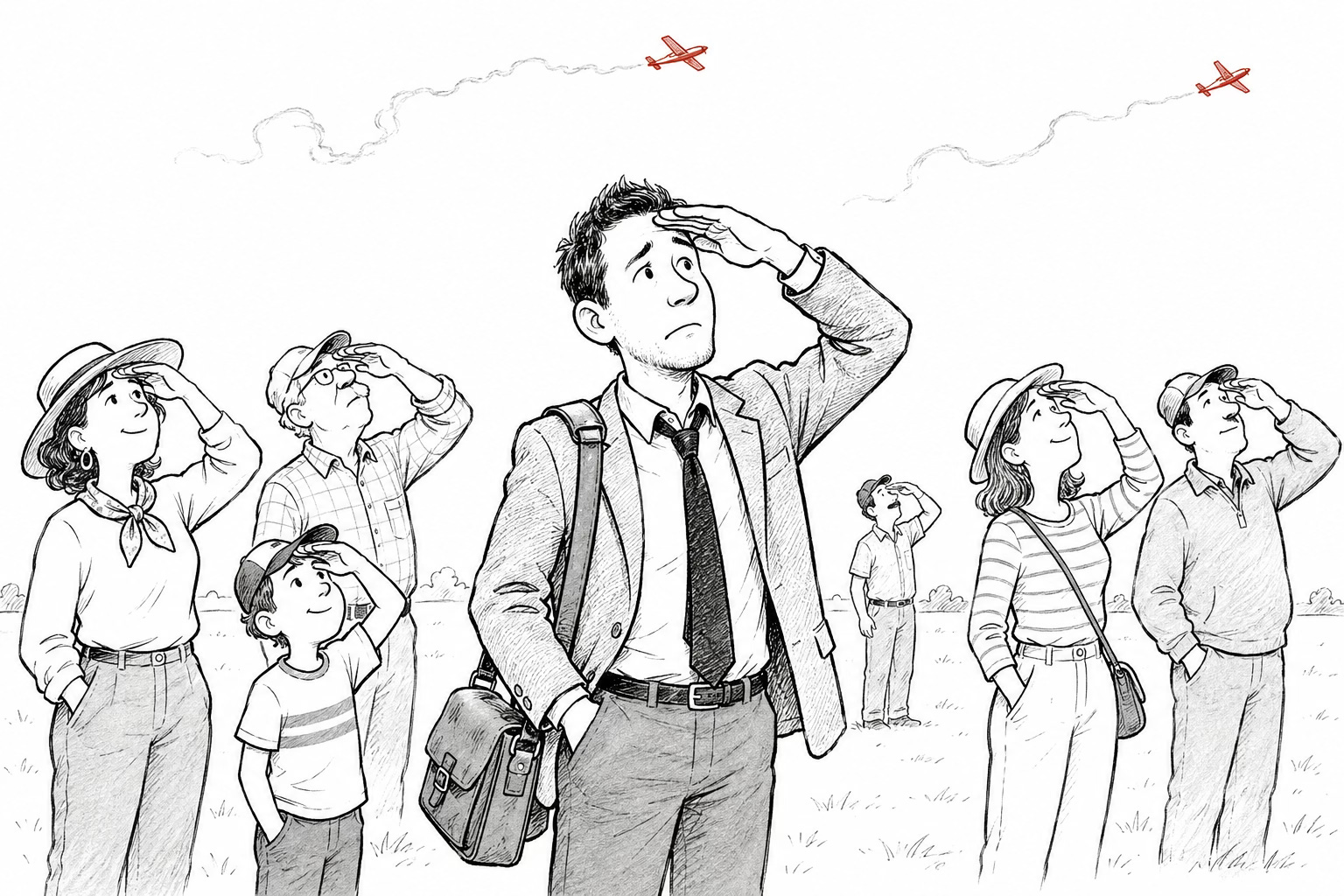
In case you didn’t hear, last Sunday, two Navy jets collided mid-air during an air show in Idaho. The planes came down in a fireball, but, luckily, all four crew members ejected safely. While one was treated for minor injuries, everyone went home, which, considering what the footage looked like, feels about as close to miraculous as anyone can hope to get.
As I read the news coverage, I found myself doing what I always do when something dramatic happens… against my better judgment, I opened the comments. And the comments were exactly what you’d expect. Two planes worth of expensive military hardware just fell out of the sky in front of a crowd of spectators, which is not a subtle event, and the internet had… lots of opinions.
What a waste! Taxpayer money, gone! These pilots will never fly again! Air shows are reckless! We should stop doing this entirely!
While I’m as prone to a gut reaction as the next Internet commenter, I also happen to be a bit of an #AvGeek (i.e. someone who enjoys learning about the aviation industry), and the more comments I read, the more I found myself thinking about the gap between how the internet was responding to this event and how the people actually responsible for understanding it were going to respond to it.
That gap is worth paying attention to…
The Difference Between Reacting and Investigating
When something goes wrong in aviation, there’s a formal process for figuring out why. Investigators collect data, interview crew, examine wreckage, reconstruct timelines, and work through hypotheses systematically before drawing conclusions. It’s a slow, methodical process, and one of its foundational principles is that your first instinct about what happened is probably incomplete, possibly wrong, and almost certainly too simple.
Simply put, the aviation world has learned, through hard experience, that complex accidents almost never have simple causes.
For example, in a case like this, what looks like pilot error could easily turn out to involve equipment, communication, environmental factors, procedural gaps, or some combination of all of them. In other cases, what looks like negligence sometimes reveals a systemic flaw that nobody had noticed because nothing had gone wrong yet.
My point is, the natural rush to assign blame frequently points at the wrong thing and obscures the right one.
Knowing this, investigators don’t rush. Instead, they do the uncomfortable, patient work of actually figuring out what really happened.
The Most Expensive Lessons Are the Ones Worth Learning
The other thing that struck me about the comment section was the reaction to the cost. Two military jets are, of course, an enormous amount of money. But assuming expensive jets shouldn’t continue flying in air shows misses something important about how complex, high-stakes industries actually get better over time.
From what I was able to find, deaths during airshows over the past three-ish decades have declined by over 66% (it’s now around one per year).
That’s still not perfect, but it’s a dramatic improvement, and it didn’t happen because aviation professionals responded to accidents by calling for fewer flights. It happened because they treated every accident — every expensive, painful, embarrassing accident — as a source of information they didn’t have before.
Even though losses like what happened last Sunday are real, the lessons are real, too. And the willingness to extract the lessons rather than simply absorbing the losses is a significant part of why the aviation industry, as a whole, is orders of magnitude safer than it used to be.
And that approach to failure doesn’t have to be unique to aviation. We can use it in our own lives, too.
Sure, failures are expensive. They’re also usually embarrassing, and they’re occasionally spectacular enough to end up on the internet with thousands of people yelling about them. But, if you’re willing to do the work, they’re some of the most reliable sources of information available precisely because they reveal things that normal operations keep hidden.
Thanks for reading Learning to Fail! Subscribe for free to receive new posts every week.
In the Moment…
A helpful reframing for those moments where failure feels possible.
When something goes wrong — at work, in a relationship, in a project you’ve invested in — the first few minutes produce a lot of feeling and not a lot of clarity. Before you act on the initial reaction, try asking:
What do I actually know right now, versus what am I assuming?
Is my instinct about what happened pointing at the cause, or just the most visible thing?
Am I trying to understand this, or am I trying to decide who’s to blame?
What would I need to know before I could draw a conclusion worth trusting?
If I wait before responding, what might I see that I’d miss if I react immediately?
Remember, you’re going to react. Your goal is to notice how your initial reaction will always arrive quicker than the full set of information, and you want to practice slowing yourself down enough to get more details.
The Debrief…
Reflecting on our experiences is where the most important learning happens.
Once you’ve had some distance from a failure, that’s when the real work begins. Try asking:
What do I now know that I didn’t know when it was happening?
What did my initial instinct get right, and what did it miss?
What was the actual cause and how did that compare to the first explanation?
What would have stayed hidden if this failure hadn’t happened?
What did this cost me versus what did it teach me that I couldn’t have learned any other way?
What’s different about the way I’ll approach this next time?
Remember that the most expensive lessons have a way of also being the most durable ones, but only if you do the work to actually learn them.
Was this post helpful? Send it to someone else you think needs to read it…
Comments
Nothing yet. Say the first thing.
Sign in to join the conversation.