
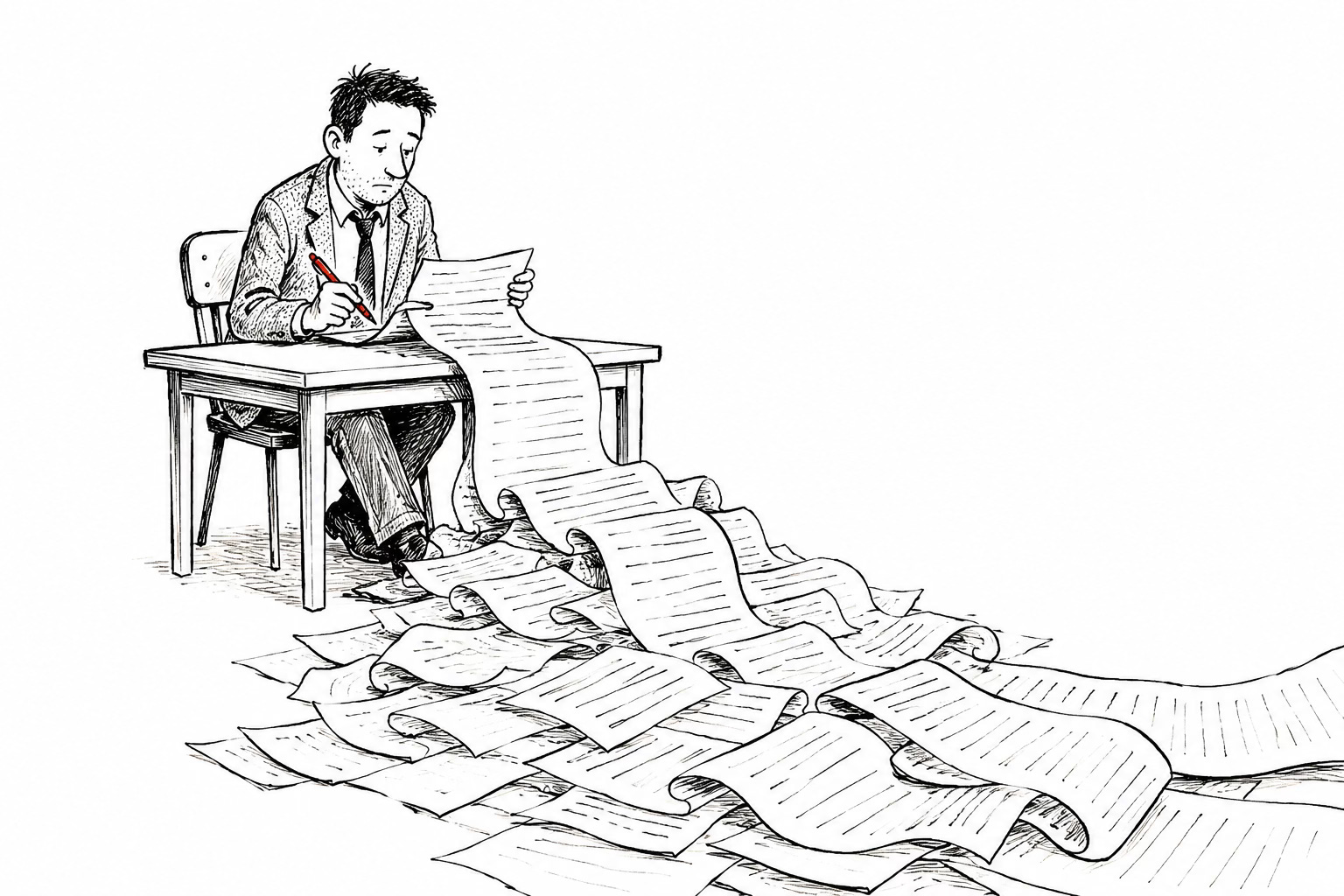
At various times over the past few weeks, for a handful of unrelated reasons, I’ve found myself buried in contracts. There was an insurance thing, some employment paperwork, a couple of speaking agreements, and so on. None of it was particularly dramatic, but it did mean I spent an unusual amount of time reading the kind of dense, clause-heavy language most of us skim past on our way to the signature line. And somewhere around the third or fourth document, I noticed something I’d never really thought about before:Isn’t it strange how contracts are almost entirely about failure?The next time you’re handed a contract, read it closely and you’ll quickly notice how the bulk of the language isn’t describing the wonderful thing two parties are excited to do together. It’s meticulously cataloging everything that could go wrong. What happens if one side doesn’t deliver? What happens if the money doesn’t arrive? What happens if the project collapses, the relationship sours, the timeline slips, or one party simply walks away? A contract is, in essence, an exhaustive map of failure. It’s every pothole, every wrong turn, and every way the whole thing might fall apart, written down and agreed upon in advance. Isn’t that strange? Here are two parties, presumably entering a relationship because they’re optimistic about what they’re hoping to accomplish together, and the document formalizing that relationship is fixated almost entirely on all the ways it could end badly. What does it say about us that so many of our most important relationships — with our employers, our partners, our insurers, even our phone carriers — are built on a foundation that
I suppose the easiest way to interpret the natural pessimism of contracts is as reflections of distrust. We write everything down because we don’t trust the other party, and the more elaborate the contract, the deeper the suspicion. But the more I sit with that interpretation, the more I find myself wondering if it’s exactly backwards. Rather than viewing contracts as expressions of distrust, what if a contract is the thing that lets you proceed For example, I have no personal relationship with my insurance company. They don’t have one with me. We have no reason, on a human level, to trust each other with anything that matters to us, and yet we can enter into a serious, high-stakes, long-term relationship — a relationship involving real money, real risk, and real consequences — precisely because the contract has already worked out what happens if things go wrong. In other words, the failure planning of the contract isn’t the pessimism that undermines the relationship. It’s the foundation that makes the relationship possible in the first place. Nobody would ever buy a car, accept a job, board a plane, or insure a house if every party first had to be genuinely In a way, it’s kind of beautiful. A contract is two parties agreeing, in advance and in good faith, to treat each other fairly even on the worst day of their relationship. It’s a promise about how you’ll behave when things fall apart, made at the precise moment when everyone’s still hopeful and nobody’s angry yet. That’s not cynicism. It’s actually something closer to… tenderness?
Now compare the situations where we sign contracts versus the situations where we don’t. In our actual lives — in the relationships and ambitions that matter most — we tend to do the exact opposite of signing contracts. We refuse to plan for failure at all. We treat any serious consideration of “what if this doesn’t work” as a kind of betrayal, and we presume that naming the ways something might fail is the same as inviting it to fail and admitting we don’t really believe in the thing we’re supposedly committed to. But the more I think about it, the more I’m seeing how that refusal to consider failure doesn’t really protect us. If anything, it makes the whole enterprise more fragile. When failure does arrive — and some version of it always does — there’s no structure waiting to absorb it and no agreed-upon understanding of what happens next. What’s left are two people forced to improvise their way through the worst day of the relationship with nothing to hold onto except whatever painful emotions are surely floating around. And how does that help anyone? I suppose it doesn’t. As much as I hate to admit this, I suppose the contract-writers have it right, and the rest of us have it backwards. The people most able to commit boldly aren’t the ones who’ve convinced themselves nothing will go wrong. They’re the ones who’ve already made peace with how things might break. That’s not disloyalty. It’s the thing that lets you chase hope without being paralyzed by everything you can’t control.
So here’s a small, slightly strange exercise I’ve been thinking about ever since I climbed out of my pile of paperwork… just trust me on this one, OK? Pick one important thing in your life that’s never had a contract — and never will. It could be a friendship, a marriage, a creative project you care about, or a goal you’ve been chasing for a while. It can be related to anything, just make sure it’s something that matters enough that the thought of it failing is genuinely unpleasant. Now, instead of doing what we normally do — which is to look away from that unpleasant thought as quickly as possible — try doing what a contract would do. Sit down and actually write a few clauses for it. Obviously, it doesn’t need to be real legal language. Instead, focus on producing honest answers to the questions a contract would force you to answer if anyone had bothered to draft one:
What does it actually look like if this fails? Name the real version, not the vague dread. Vague dread is paralyzing precisely because it stays vague. But a named failure is just a problem, and problems can be planned for.
What would we — or I — do if that happened? This clause does most of the important, challenging work when it’s not nearly as hard to do. Knowing, in advance, that there’s some plan for the worst day tends to drain that day of an enormous amount of its terror.
What am I promising to do even if things go badly? Contracts are, at heart, promises about behavior on the worst day. How do you want to treat the other person — or yourself — if this thing falls apart? Deciding now, while everyone’s still hopeful, is a lot easier than deciding in the wreckage.
As you do this exercise, you’ll hopefully notice that the act of writing the clauses doesn’t make failure feel more likely. It actually makes failure feel more survivable. And even though our instincts tend to confuse those two things, they’re very different. By the way, with this exercise, I’m not suggesting you actually draft a contract for your marriage and hand it to your spouse over dinner. (Please don’t. I take no responsibility for how that conversation goes.) I’m suggesting that the
Was this post helpful? Share it with someone you think needs to read it…
No posts
Comments
Nothing yet. Say the first thing.
Sign in to join the conversation.