
Music has long been a potent force in shaping societies, transcending borders and resonating with individuals on a profound emotional level; it’s the reason this newsletter was created. Recognising this power, it is fascinating at best (terrifying at worst) to learn how governments and intelligence agencies have harnessed music's influence as a tool for political manoeuvring and regime change. The CIA, in particular, has a long history of utilising music to further its geopolitical objectives, namely, to topple regimes and governments whose politics don’t align with American interests.
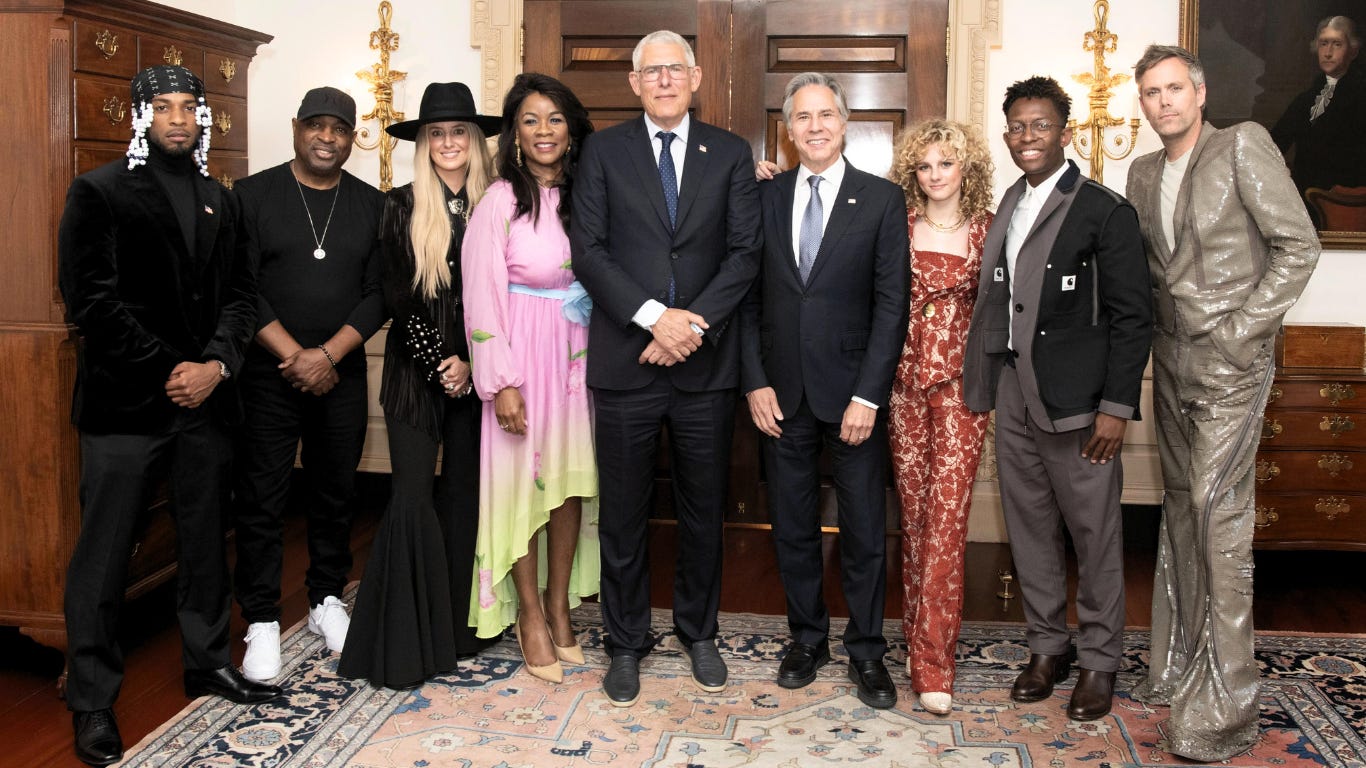
Last summer, Chuck D appeared at the White House to reveal his new partnership with YouTube and the US State Department as a "global music ambassador." This may seem innocent until you learn the ambassadorial project is co-run by former US Secretary of State Anthony Blinken and YouTube’s Global Head of Music, Lyor Cohen.
Before we go into the programme and its history, let’s double-click briefly on the two people behind it -
Former U.S. Secretary of State Antony Blinken has faced overwhelming accusations of complicity in war crimes due to his continued dismissal of the unfolding genocide in Gaza and his dehumanisation of Palestinians. An investigation from September 2024 revealed that Blinken misled Congress by denying that Israel was obstructing humanitarian aid to Gaza, despite internal reports proving otherwise. In November 2023, the Center for Constitutional Rights filed a lawsuit against Blinken, alongside Biden and Secretary of Defense Lloyd Austin, arguing that U.S. military aid to Israel made American officials complicit in genocidal acts. Further intensifying these claims, in December 2024, Palestinian families launched legal action against the U.S. State Department, accusing it of violating human rights laws by continuing to support Israeli military operations despite mounting evidence of war crimes in Gaza and the West Bank. These legal reports paint a damning picture of Blinken’s role in shielding Israel from accountability while facilitating policies that enable ongoing atrocities.
YouTube’s Global Head of Music, Lyor Cohen, was born in New York City to Israeli parents with deep ties to the Zionist paramilitary group, the Haganah. His father, Elisha, was a member of the infamous Harel Brigade during the 1948 Nakba. The Harel Brigade played a pivotal role in the killings of thousands of Palestinians and the expulsion of hundreds of thousands more. This included carrying out biological warfare against the indigenous population. After the 1948 Nakba, he became an officer in the Israeli Defense Forces.
Lyor’s early years included living in Kfar Haim in Israel, at a settlement named after Haim Arlosoroff, a Zionist negotiator who worked with Nazi Germany in the 1930s, transferring German Jews and their assets to historic Palestine.
Lyor has also come under fire for promoting and profiting from the negative stereotypes in Black communities.
Back to the initiative -
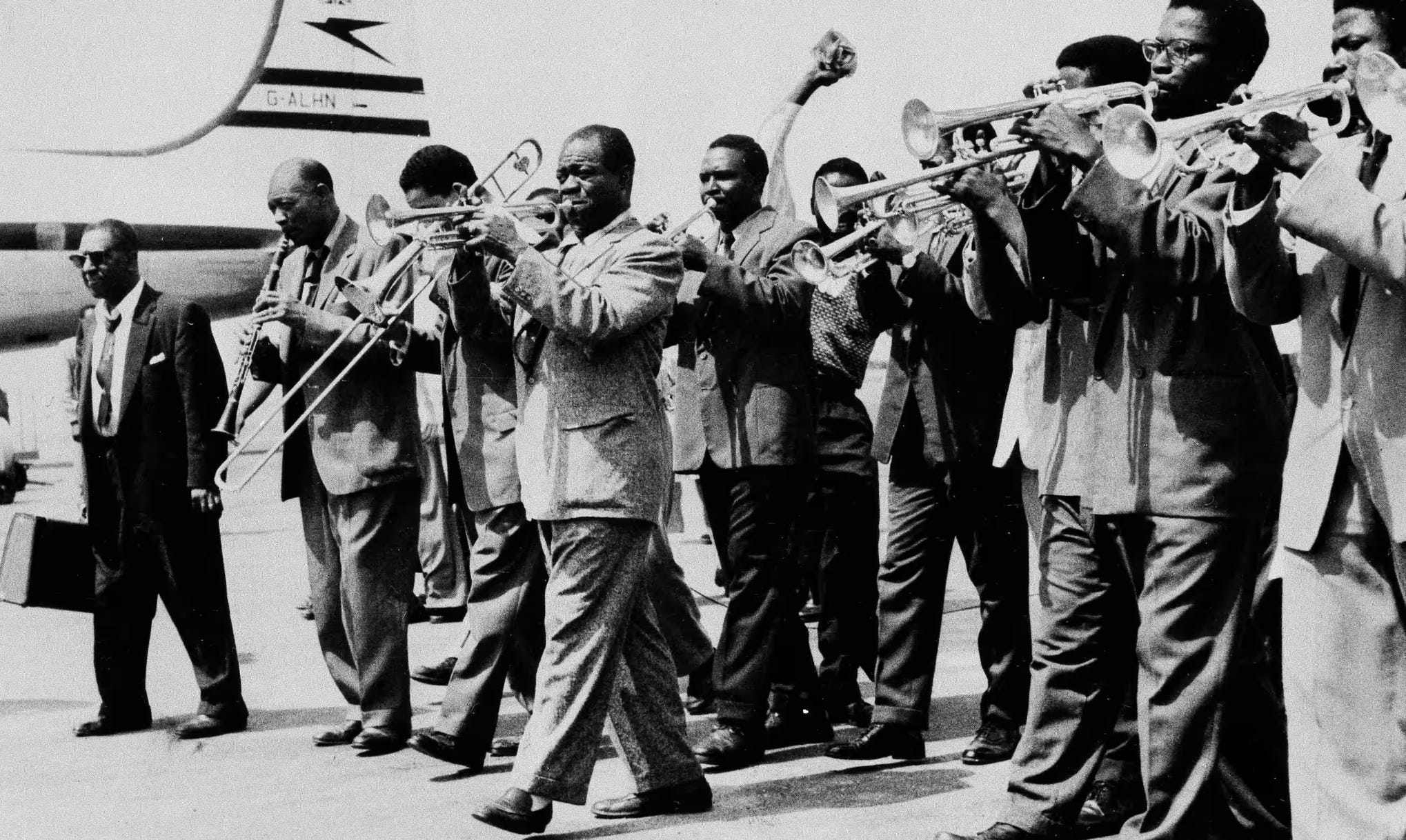
This “global music ambassador” programme echoes tactics from the Cold War when the U.S. government strategically used musicians and “goodwill music tours” to promote its political agenda abroad and, included within some of these tours, provided a front for covert CIA operations, including attempts to assassinate foreign leaders.
“The role of cultural ambassador is complex: it is not always assumed voluntarily, it may come with limitations of agency or strict codes of conduct, and performers may find themselves caught up in the hands of a government whose interests they ultimately serve” (Davenport 2010; Fosler-Lussier 2012; Biasioli 2023).
Unsurprisingly, Chuck D fans are not happy. He is an artist known for channelling the spirit of the Black Panthers in both his music and stage presence, often drawing comparisons to Malcolm X with a mic. For someone who once championed Black empowerment in songs like “Fight The Power” to now align himself with state power is as disappointing as it is suspicious. He may genuinely have been led to believe that this State-backed role is for peace, but the evidence proves that the likelihood of this is close to zero.
During the press conference last summer announcing this programme, both Blinken and Cohen repeatedly referenced the CIA’s covert Cold War efforts to use music and the arts as tools for regime change. Blinken highlighted the deployment of jazz legend Louis Armstrong to perform beyond the Iron Curtain, remarking, “America’s secret weapon is a blue note and a minor chord. Music is such a powerful diplomatic force because, I think, it taps into something fundamental, universal.” He also pointed to Bruce Springsteen’s concert in Berlin shortly before the fall of the wall, describing the overwhelming enthusiasm of the crowd as an example of music’s political influence.
Cohen went on to explain that YouTube was teaming up with the U.S. State Department to help them “leverage global events.” “We will utilise major international gatherings to inspire action”. What action exactly, he didn't say.
The U.S. has been careful in describing the programme as a peace effort, but let’s briefly examine the US’s history of this kind of work and decide for ourselves -
The United States has a long history of using musicians to promote its political agenda abroad, often under the commonly used banner of “cultural diplomacy”. There’s evidence now that, in some cases, this so-called cultural diplomacy has provided a front for covert CIA operations, including regime change efforts and even assassination attempts.
During the Cold War, the U.S. inundated rival nations with propaganda, and they proudly spoke of their role in bringing down communism in Eastern Europe. Consequently, it invested considerable sums in sending renowned artists such as Nina Simone, Louis Armstrong, Dizzy Gillespie, and Ella Fitzgerald abroad to make jazz synonymous with ‘individualism’ and ‘democracy’.
Artists were sent on global “goodwill” tours to promote American culture as a counterweight to socialist (or anti-American capitalism) influence.
If you are someone who still believes in the American ideology, you may view this work as an innocent effort to genuinely promote freedom. However, the U.S. would send Black musicians on these tours to project ideals of freedom and progress while, back home, racism and state violence against Black people were rampant, and the broader American culture certainly didn’t authentically embody these ideas. No work was done to truly solve these issues back home. Essentially, it was a strategy to propagate a false ideology merely to subvert foreign populations and win power.
One of the best-known cases is that of Patrice Lumumba, the first democratically elected Prime Minister of the Democratic Republic of the Congo, a newly independent country. Young and charismatic, Lumumba was a true leader who believed that his nation’s immense resources should be used to build a democratic, egalitarian society. CIA director Allen Dulles described Lumumba as an “African [Fidel] Castro,” and in essence, signed his death warrant.
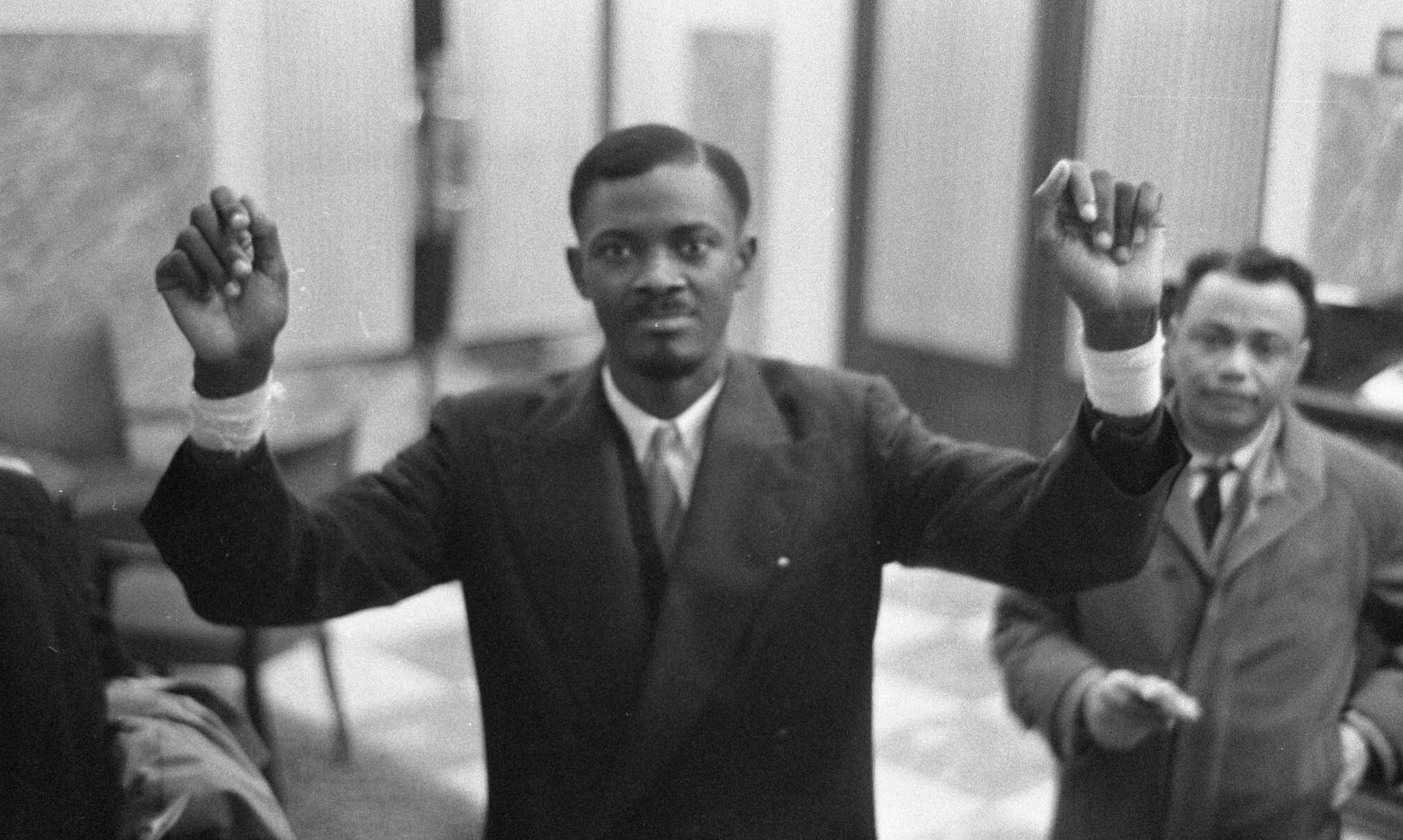
Louis Armstrong was sent on a “goodwill” music tour across Africa in the 60s, which coincided with significant political upheaval in the Congo and other African nations. The documentary Soundtrack to a Coup d'Etat explores how the CIA attached itself to Armstrong's tour, accompanying him around the country and gathering crucial information on Lumumba’s whereabouts and security to carry out an assassination.
Lumumba was killed a few months later. The killer’s identity remains debated, but what is clear is that, after his death, the Congo went into a 60-year tailspin of dictatorships and civil war, from which it has not recovered. Throughout the violence, Western corporations continue to control the nation’s vast mineral resources.
In 1962, the CIA passed information to the apartheid government in South Africa that led to the arrest and imprisonment of Nelson Mandela for 27 years.
An investigation by Seymour Hersh for the New York Times found that the CIA was involved in the overthrow of Ghana’s first president Kwame Nkrumah, widely considered one of the finest leaders the continent has ever produced.
Fifty years ago, the United States worked to end the presidency of a democratically elected communist in Chile and, in turn, helped usher in an authoritarian right-wing dictatorship via a CIA-backed coup. Music played a significant role in Chilean society during this time, particularly through movements like Nueva Canción, a folk-inspired, left-wing genre that supported the Allende government. However, in 1973, the U.S. supported anti-Allende cultural efforts, including importing and promoting musicians, such as Los Huasos Quincheros and Palmenia Pizarro, who performed far-right, pro-American, anti-socialist songs. Some Chilean musicians later claimed that the US-backed entertainers “had suspicious ties to the embassy and intelligence agencies”. The coup resulted in the overthrow of Allende and the fascist Augusto Pinochet's brutal dictatorship, which resulted in the deaths of over 40,000 people.
The Reagan administration, through the CIA and Radio Free Europe/Radio Liberty, promoted rock and punk music behind the Iron Curtain to encourage youth rebellion against the Soviet system. The CIA and Western intelligence services actively smuggled banned rock, jazz, and disco music into the Soviet Union and Eastern Bloc countries to undermine communist ideology.
Big tech is playing a monumental role in political activity. A recent MintPress News investigation found a network of dozens of former CIA agents and officials who are now working in senior positions at Google and YouTube. Among them include Jacqueline Lopour, Google’s senior intelligence collection and trust and safety manager, who spent more than ten years as a CIA analyst; Ryan Fugit, who left the CIA in 2019 to become a senior global trust and safety manager for Google; and Bryan Weisbard, a former CIA intelligence officer and State Department official, who, in 2021, became director of YouTube Trust and Safety.
Other MintPress News investigations have found similar networks of ex-CIA agents working in top jobs at Facebook, TikTok and other platforms.
These individuals were not being appointed to politically neutral areas, such as sales or customer service, but were instead parachuted into positions where they affected what billions of people see, read and hear every day in their newsfeeds, usually with little to no relevant expertise in that field except their longtime careers as spies and spooks.
That individuals like this are in charge of defining authentic from fake news is deeply problematic, given the CIA’s long history of being the source of false information. John Stockwell, former head of a CIA task force, explained on camera how his organisation infiltrated media departments the world over, created fake newspapers and news agencies and planted false news about Washington’s enemies. “I had propagandists all over the world,” he said, adding,
“We pumped dozens of stories about Cuban atrocities, Cuban rapists [to the media]… We ran [faked] photographs that made almost every newspaper in the country… We didn’t know of one single atrocity committed by the Cubans. It was pure, raw, false propaganda to create an illusion of communists eating babies for breakfast.”
The CIA's strategic use of music highlights its formidable capacity to influence societies worldwide. However, this power is often wielded to serve specific political agendas, while the broader populace remains unaware of music's potential as a catalyst for change. By monopolising this influence, governments can steer cultural narratives and public sentiment to align with their objectives.
It also supports their efforts to keep the population unaware of the subconscious influences gained through music and culture. If we, the people, remain deeply aware of these powerful forces, we can make better-informed decisions about our own personal cultural and political alliances.
The fact is, public opinion has dramatically swayed away from U.S. idealism over the recent years; in other words, the veil has been lifted. Ordinary people see the ties between American political and corporate activity and the gravest war crimes, climate disasters, and human rights abuses. These are massive global systemic problems that we need to face head-on and dismantle as a matter of urgency.
If authorities can use music to destabilise regimes and propagate their ideologies, it stands to reason that individuals and communities can harness the same medium to foster positive transformation. Expanding our awareness and understanding of music's cultural, social, and political capabilities is imperative to achieving this.
Grassroots movements and social activists have historically employed music to unite people and amplify their messages. From the civil rights anthems in the US to protest songs during apartheid in South Africa, music has been a unifying force, galvanising collective action against oppression.
Cultural power is one of the most effective forms of power because it is ingrained in people’s hearts and nervous systems.
Some describe cultural power as “soft power,” but it is anything but soft. Cultural power affects our thoughts and behaviours. Once you win cultural power, you win the people's desires, purchasing power, votes, etc.
Music has the ability to reclaim a country, a person, or a movement’s cultural power. The U.S. has lost much of its cultural influence, so it will undoubtedly strategise ways to regain it. This is almost certainly one of them.
MintPress. (2024). From Fight the Power to Work for It: Chuck D, Public Enemy and How the CIA Neutralized Rap
U.S. Department of State. (2023). The United States Expands Global Music Diplomacy Initiative.
White House Briefing. (2023). Chuck D Joins State Department Music Diplomacy Program.
Center for Constitutional Rights. (2023). Building the Case for US Complicity.
Al Jazeera. (2024). US court hears civil case accusing Biden of 'complicity' in Gaza.
The Guardian. (2024). 'Palestinians are taking the stand': can legal challenges to Israel's war in Gaza stop the continuing onslaught?
Shalev, A. (2022). The Haganah and the War of 1948: A Historical Perspective. [Book/Journal]
The New York Times. (2023). The Zionist Roots of YouTube’s Music Head Lyor Cohen. (Link now removed by NYT)
Davenport, L. (2010). Jazz Diplomacy: How the U.S. Used Music in the Cold War. Oxford University Press.
Fosler-Lussier, D. (2012). Music in America’s Cold War Diplomacy. University of California Press.
Biasioli, C. (2023). The Role of Music in State Propaganda: Historical and Contemporary Perspectives.
De Witte, L. (2001). The Assassination of Lumumba. Verso Books.
U.S. Senate Church Committee Report (1975). Alleged Assassination Plots Involving Foreign Leaders.
Soundtrack to a Coup d'État. (2024). Documentary on the Role of Jazz in Cold War Africa.
The Guardian. (2016). CIA Tip-Off Led to Nelson Mandela’s 1962 Arrest, Former Spy Claims.
Liberation School. (2013). It was the CIA that helped jail Nelson Mandela
Hersh, S. (1978). The CIA’s Role in the Overthrow of Ghana’s President Nkrumah. The New York Times.
CIA Declassified Documents. (2001). Ghana and the Nkrumah Regime.
Kornbluh, P. (2013). The Pinochet File: A Declassified Dossier on Atrocity and Accountability. The New Press.
National Security Archive. (2016). CIA Documents Reveal U.S. Role in 1973 Chilean Coup.
Richards, A. (2010). Rocking the Wall: Bruce Springsteen and the Unmaking of the Iron Curtain.
Radio Free Europe Archives. (2005). The CIA and the Secret War on Soviet Culture.
Nye, J. (2004). Soft Power: The Means to Success in World Politics. PublicAffairs.
Keane, M. (2013). Creative Industries and Cultural Power. Routledge.
Comments
Nothing yet. Say the first thing.
Sign in to join the conversation.