
Season 20, Episode 03: Stop kissing your boyfriend’s brother!
3 April 2026 – Why the love triangle trope is everlasting in popular media.
Here is your spoiler warning for any show/film mentioned in this article! Be aware!
Love triangles are trending.
Summer to autumn of 2025, the world collectively reacted to The Summer I Turned Pretty (2022) episode-by-episode until the series finale. So many of us were really beautifully and dramatically obsessed. But TSITP was only the continuation of this already explosive media trend, which has existed far longer than we might imagine. Perhaps we assume its birth was with early 2000s serials, like One Tree Hill (2003) or Dawson’s Creek (1998). Maybe with a deeper knowledge of film, we can connect it back to iconic films like Casablanca (1942) or Gone with the Wind (1939).
Although my analysis in this article will focus on modern love triangles in film and television (and only those I’ve watched at that), it’s important to mention the historical nature of the trope. Shakespeare’s Twelfth Night is an early example, though we can dive even further into history with the myth of Helen of Troy.
Why have love triangles persisted so valiantly throughout the media of our world? Why do they seem to be spiking in popularity in the 21st century?
We have a natural instinct to seek out more love than necessary.
Writers and artists are attracted to love in their work as a means of fulfilling their innermost desires––we consume this content, even if we are happily in love, because we’ve been consistently told that romantic love is the most important goal of life. Nothing ever feels like enough. And, for those who aren’t in love, these love triangles serve as a means of absorbing romantic love from an outside source.
Basically, love triangles are our ultimate coping mechanism for a lack of love.
Stop kissing your boyfriend’s brother!
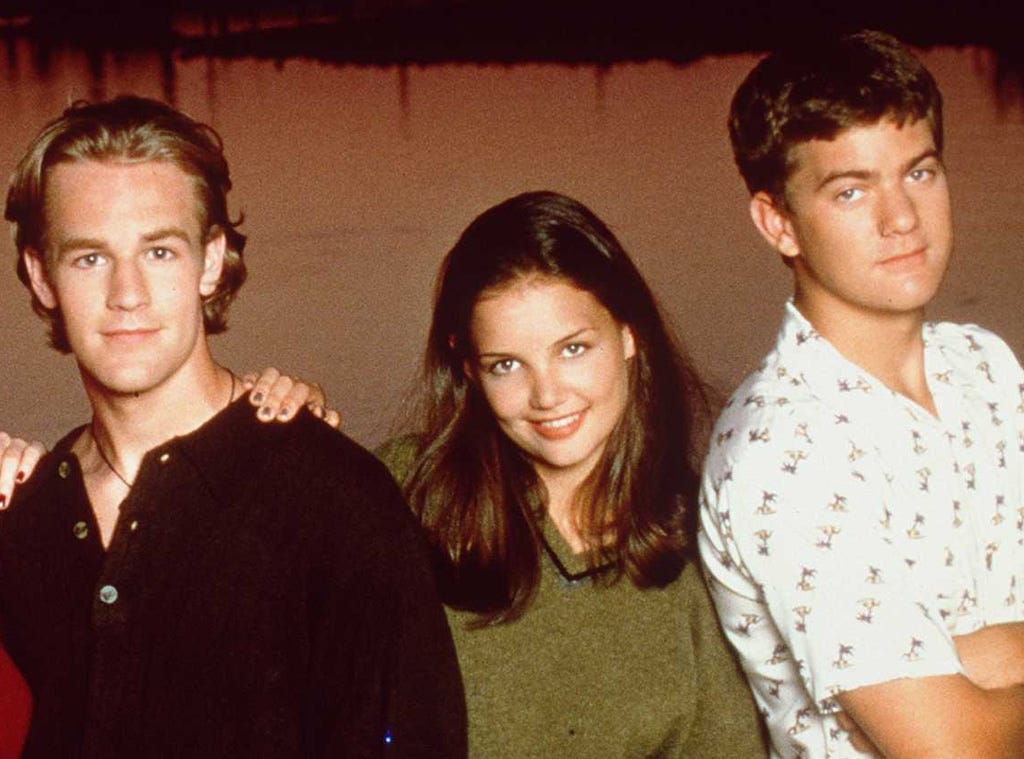
The Summer I Turned Pretty is iconic, of course, but I think everyone can agree that no one should be in a love triangle with brothers. It’s uncomfortable and unrealistic, though it does make for good content.
The show idealizes childhood friends to lovers, but creates a strange triangle of tensions when both brothers are in love with Belly, their longtime friend. All of it revolving around the summer she suddenly “became pretty” doesn’t make things any better. Still, I love the show, and so do many others.
I can’t figure out the appeal of dating brothers. Why do we love it so much, and what makes it different from any other love triangle?
It’s absolutely the added angst. The idea that someone would choose you over their family. Having a love triangle with brothers pits two loyalties against one another. At their core, this type of love triangle is about the longing to be someone’s first choice.
Let’s next inspect The Vampire Diaries (2009) regarding love triangles with brothers. This one is… very complicated. Elena first meets Stefan and falls in love with him, but she has an enrapturing pull towards his estranged brother Damon. The narrative in the case of TVD has more depth than other love triangles when you consider an entire, totally complex doppelgänger plot that I simply do not remember enough about to get into.
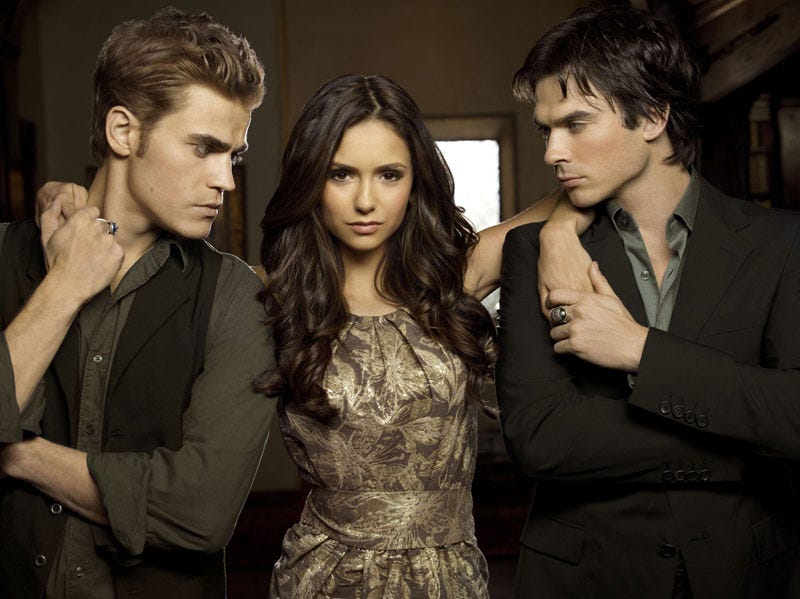
Stefan and Damon don’t stay estranged, even while fighting over Elena for a few seasons. They become true brothers again. Elena got the guy, and she was a part in fixing their relationship. So, another reason we may love a love triangle with brothers is because we long for familial love just as much as romantic love. We understand their angst and dissonance, but ultimately want them to support each other. I think many of our own family lives could be reflected in this, on top of our already strong desire for romantic love.
An interesting case in this type of love triangle is Bridgerton season 2 (2022). Instead of brothers and one woman, its one man and two sisters. We rarely see sisters pitted against one another in this way, stemming from one core reason that I can conclude:
Most writers of the love triangle trope are women, and it’s better to imagine two men fighting than two women fighting. It’s not avoided because we want the woman to have more choice, nor because the angst is any different. Instead, it’s avoided because women being pitted against one another for a man is an aged stereotype that most women argue vehemently against.
Kate & Anthony’s Bridgerton season is about two sisters, but their love triangle isn’t about both girls being helplessly in love with Anthony. Kate hates Anthony at the start, and she tries to tell her sister not to marry him. Her sister, Edwina, only loved Anthony for his status, protection and image he projected onto her. The sisters stay close, and their falling out is brief and amendable. This variation on the love triangle trope is loved for the same reasons others are loved, though it feels like the purpose of this triangle is stronger.
No matter the genders, these stories are unrealistic. The belief we have to suspend while watching is higher than any other type of love triangle, only because the likelihood of someone being in love with their partner’s sibling, and the sibling loving them back, is absurdly low. This isn’t to say the trope isn’t great TV, because it definitely is.
All I’m saying is don’t kiss your boyfriend’s brother. It’s not cool, and you won’t end up with either of them. I mean, imagine the family dinners?
Is this thing queer? 🎤
Love triangles, when not including siblings, are not really triangles. They’re just two lines pointing to one person. But… there’s often a ton of queer coding involved, and in more recent media there’s even overtly queer love triangles, making them actual triangles.
I first must point out Stranger Things (2016). Obviously, the final season was horrible (I’m sorry if you loved it). The first half was phenomenal, leading us towards the idea that Will accepting his queerness would help him save the world… and it did… except he was forced to come out due to fear and the entire scene was a disaster anyway. It’s hard to believe that Robin’s coming out to Steve was in the same show. The Will/Mike/Eleven love triangle is again not an actual triangle, but it had the potential to be something exponentially complicated and beautiful. Spoiler alert: it wasn’t. I’m not even a diehard Byler truther and I was disappointed.
Really, queer Stranger Things fans got closer to an actual triangle with Steve-Jonathan-Nancy, though of course this is all non-canon. Maybe it’s even a square if you add Robin in there (because she definitely had tension with Nancy, come on now). I won’t ramble about this any longer, but it’s a classic example of queer coding love triangles and doing nothing about it.
Queer people have always seen through love triangles, noticing instances in which the two guys who fight over the girl would be great together instead.
Euphoria (2019) explores a queer love triangle in its second season, through the characters of Rue, Jules, and Elliot. This relationship dynamic is complicated, and I watched the show only when it was first released so I admittedly don’t remember all the details. I do, however, know that it was a great overtly queer love triangle in modern TV. It was unlike anything else we’ve seen on a show so mainstream.
My favorite queer love triangle is Challengers (2024). Some argue that it’s not queer, but we see Art and Patrick kissing for the first time after meeting Tashi, then subsequently fighting over her, though they’re really fighting to maintain their closeness… so I don’t even acknowledge any other argument. Their queerness isn’t overt, but queerness doesn’t have to be overt. Cut it out with expectations of what queer love looks like.
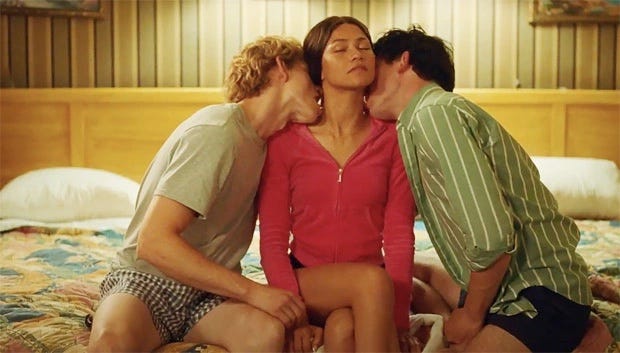
This love triangle presents us with new and clearer layers to why we may love the trope: friendship and competition. Part of love has always been friendship with your partner, and this film shows the grittier reality of a love triangle; friendship can fail and be messily intertwined with what love means. In terms of competition, the entire movie is about Art and Patrick playing against one another in tennis. They’re in a tense game on several levels.
We love love triangles because there’s always a winner, something that doesn’t always happen in real life, and especially wouldn’t happen if these fictional situations were real.
(If you’re interested in more queer film and TV analysis, check out the film Rock Hudson’s Home Movies (1992) or the academic article “Rock: The Last Guy You’d Have Figured?” by Richard Dyer)
The better guy might not be the better guy.
A more modern trend in the love triangle is losers winning. Loser is used in the stereotypical sense to say the guy that doesn’t have much going for him, usually other than the fact that they’re in love (at least on the surface).
Gossip Girl (2007) is the first example I can think of to fit this sub-trope. It’s also my least favorite example. Serena should’ve ended up with Nate, next question.
Okay, no, I’ll say more. Dan is the “loser” that wins his relationship with Serena in this case. While Nate is rich, stereotypically hot, and a playboy, Dan is conversely poor, more “normal” looking, and a bit of a nerd. These personality types are the blueprint of this type of love triangle, and you’ll see them in every example I give.
In narratives similar to Gossip Girl’s main love triangle, though, I usually agree that the loser should win.
A more recent film, Materialists (2025), features the loser winning as well. Unfortunately, they chose Chris Evans––literally Captain America––to play the loser, bad actor, poor guy. Pedro Pascal plays an excellent rich but still empathetic guy to counter Chris Evans. Throughout the film, you know who the girl will chose. The stakes are low in comparison to many other love triangles. Materialists does tell us one thing about where love triangles are heading in the future, though: towards the real over the fantasy.
In our media as of late, we’re more attracted to the realistic guy than the dreamy, impossible one. Maybe this is a recession indicator. I believe that no one should give up hope of finding the “perfect guy,” but who is the perfect guy?
Here, we stumble upon the film that initially inspired this article: Eternity (2025). We have Luke, the dashing war-hero first love of Joan, and Larry, her practical and oftentimes obnoxious last love. The three meet up in the afterlife, and Joan must choose who she wants to spend eternity with. Chaos ensues.
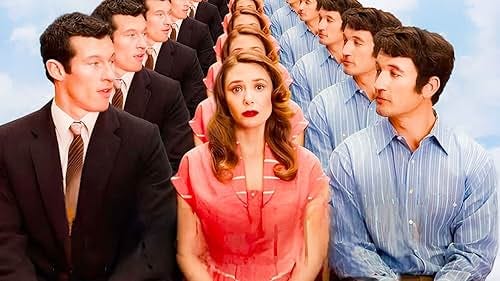
It seems, for a while, like Luke is the clear choice. Eventually, though, Joan (Elizabeth Olsen) delivers a beautiful monologue. She emphasizes that love isn’t about being your happiest, or about everything being perfect. She says it’s about knowing one another, good and bad, and staying together through anything that comes your way.
“But love isn’t just one happy moment, right? It’s a million.”
I highly recommend watching the full monologue here (or the film itself while you’re at it). It’s beautiful. The entire movie is a testament to the realities of love, the beauty in the hardships.
Ultimately, the loser wins. But the history him and Joan share, then continue to have makes him seem very non-loser-like. You know she’s made the right choice in the end.
We long for the love triangle because it provides us with an abundance of love in a time when love may be lacking in our lives. The trope also, though, is telling us to follow our hearts, to not be bogged down by societal expectations, and to knock fantasy out of your mind because real love is so much more than what you’re imagination is conjuring.
Love triangles aren’t bad, and this article isn’t trying to make you stop watching them. In fact, there are soon-to-be-released shows like Off Campus (May 2026) and Every Summer After (June 2026) that will have elements of the now very familiar love triangle trope. I will be attentively watching both.
However… I think the way we consume and process these television shows and movies is important.
Don’t go seeking chaos, drama, and love triangles in your real life. That’s not the standard, and it will only cause you heartache when no one wins. And, if anyone puts you in a love triangle situation, dump them first. They’re not worth it, and you wouldn’t want to end up with someone who was so distraught about choosing you.
You deserve to be the first choice. You deserve the messy, the love-filled bickering, the romance of your dreams. It’ll probably look different than what you’re imagining right now, and that’s okay.
Lean into love.
P.S. This song is representative of what I mean by lean into love. Romantic, platonic, familial, and for yourself. They’re all important, don’t forget.

Comments
Nothing yet. Say the first thing.
Sign in to join the conversation.