
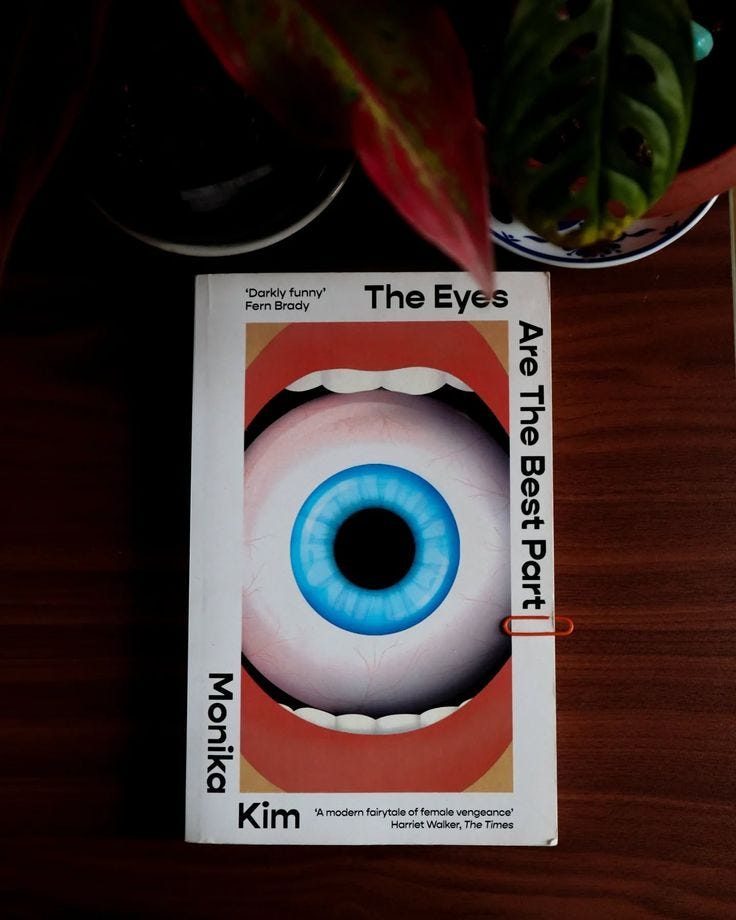
There is a phrase that circulates quietly among readers and reviewers of Monika Kim's debut novel: "Dead men don't catcall and eyeless men can't gaze." It is at once a joke, a threat, and a manifesto. It captures the essence of the novel because the male gaze is fundamentally violent, not just unsettling. For a woman who has been objectified by this gaze, the only truly radical reaction is to reclaim the tools of her own objectification and use them for her empowerment.
This essay examines The Eyes Are the Best Part as a work of social horror that operates on multiple, simultaneous registers. It is, first, a psychological novel about a young woman’s descent into violence and her attempts to hold her fractured family together. It is, second, a pointed critique of the intersecting oppressions that Asian American women — and Korean American women in particular — navigate in contemporary America. It is, third, a work rooted in specific Korean cultural traditions and superstitions, particularly the folk practice of eating fish eyes, which Kim transforms into one of the novel’s most resonant symbols. And it is, finally, a text that deliberately positions itself within the tradition of feminist horror, deploying the genre’s capacity for political commentary to argue something that more polite literary forms might struggle to voice: that the rage of the doubly marginalised woman is not aberrant — it is logical, cumulative, and wholly justified.
We girls are taught from an early age that we are demonstrably inferior to our male counterparts. We are smaller, weaker, stupider. When we succeed, it’s only because men allow us to. And as Asian women, we are foreign and especially powerless, with our supposedly porcelain skin, delicate physiques, “slanted pussies,” and quiet, submissive natures.
The Eyes Are the Best Part centres on Ji-won, a Korean American college freshman living in a cramped Los Angeles apartment with her mother (referred to throughout only as Umma, the Korean word for mother) and her fifteen-year-old sister, Ji-Hyun. The novel opens in the aftermath of Ji-won’s father (Appa) having abandoned the family following an extramarital affair. The departure is catastrophic since Umma collapses emotionally, barely managing to maintain her job at a grocery store; Ji-won’s college grades are failing; and Ji-won herself has been saddled with the weight of the eldest-daughter role in a Korean immigrant household, a burden that is simultaneously deeply cultural and deeply gendered.
The narrative engine is set in motion by two developments. First, Umma begins dating George: a white man who ogles Asian waitresses, brags about his consulting career, drives a truck decorated with a political sticker that reads "I'm Republican Because We Can't All Be On Welfare," and treats Ji-won and Ji-Hyun with condescending presumption. He is a grotesque, almost satirically drawn figure, and this is intentional. Second, Ji-won begins having dreams or nightmares of rooms full of eyes. Blue eyes specifically. And then she starts eating them.
The cannibalism begins with fish eyes. Umma, in a moment of warmth that functions also as cultural transmission, offers Ji-won the eye of the fish at dinner, explaining that the eyes are the best part: a delicacy, bringing luck, passed down through generations. Ji-won eats it, and something unlocks. The hunger, initially metaphorical, becomes literal. Ji-won begins targeting the blue-eyed men around her, including Geoffrey, a fellow college student who presents as a progressive feminist but who is revealed to be a predatory voyeur interested in Ji-won not as a person but as an exotic object. George and Geoffrey, as the critic writing in Reactor magazine observed, are "two sides of the same coin": the overt and covert faces of white male entitlement toward Asian women.
The novel is narrated in Ji-won’s first person. We see the world as Ji-won sees it, which means we see the casual, normalised degradations she navigates every day, and we feel the cumulative weight of those degradations. Kim uses the unreliable narrator not to invalidate Ji-won’s perspective but to explore the distance between how Ji-won is perceived by the world and what she actually is. To the men around her, she is a type: an Asian girl, a sexual category, a cultural curiosity. To herself and to us, she is a person in terrible pain, loving her family with a ferocity that the world refuses to see, and fighting to survive in a society that has already decided what she is.
I’ve always been jealous of the kids who have never had to deal with this crushing pressure. They have no idea how good they have it, how lucky they are. Often, I find myself wondering: What is it like to live freely, to live a life untethered, without having to be responsible for everyone around you?
The theoretical framework most relevant to reading The Eyes Are the Best Part is the concept of double marginalisation, or, more precisely, what scholars of intersectionality (following Kimberlé Crenshaw’s foundational 1989 essay) call compounded oppression experienced by women occupying multiple subordinate subject positions simultaneously.
Asian American women face a distinct form of gendered racism that cannot be adequately understood by examining race and gender as separate variables. As documented in the American Psychological Association‘s landmark study, they are inseparably gendered: they include fetishisation, the ascription of submissiveness, hypersexualisation, and the presumption of sexual availability for white men.
This intersectional oppression has deep historical roots. The 1875 Page Act, which predated the more famous Chinese Exclusion Act by seven years, barred Chinese women from immigrating to the United States on the presumption that they were prostitutes — that their very bodies were inherently immoral and threatening. The War Bride Act of 1945 and subsequent legislation then repositioned Asian women as useful — but only insofar as they provided comfort and sexual availability to American military personnel returning from wars fought on Asian soil. The arc is consistent and devastating: Asian women are alternatively demonized or domesticated, never simply regarded as full human beings with independent desires, aspirations, and inner lives.
The cultural stereotypes that emerged from this history are known as the “Lotus Blossom” and “Dragon Lady” archetypes. The Lotus Blossom (also known as the China Doll or Geisha figure) is submissive, sexually eager to please white men, fragile, and possessed of an almost childlike docility. The Dragon Lady is her shadow-self: hypersexual, devious, using her sexuality as a weapon, ultimately a dangerous temptress deserving of punishment. Both stereotypes, as Edward Said’s foundational theory of Orientalism makes clear, are products of the Western imagination’s need to construct the East as its exotic, feminized, and controllable Other. Both reduce Asian women to objects defined entirely in relation to white male desire.
Kim places Ji-won in deliberate, pointed relationship to both archetypes and then systematically dismantles them. Ji-won does not conform to the Lotus Blossom: she is not submissive, not eager to please, not docile. She is furious, she lies, she manipulates, she refuses to perform gratitude for the attention of men who have decided she owes it to them. But she is not the Dragon Lady either, because the Dragon Lady archetype still defines the Asian woman entirely through the lens of male desire — she is dangerous because she is seductive. Ji-won's violence is not seductive. It is not organised around the logic of male desire at all. It is organised around hunger, rage, and a kind of grotesque reclamation of agency.
The only power he has is the power you are willing to give him, and you’ve given him nothing. Not a scrap. By the time you’re done with him, he’ll be begging for mercy. Who is he if he can’t control you? Is he even a man anymore?
One of The Eyes Are the Best Part‘s most sophisticated achievements is its use of Korean cultural practices and superstitions as the novel’s symbolic and thematic architecture. Kim has spoken about the novel’s origins in a specific folk practice: in Korean (and more broadly East Asian) culture, the eyes of a whole fish are considered a delicacy, reserved for honoured guests, believed to bring luck, and thought to have homeopathic qualities. The fish eye is associated with wisdom, clarity of sight, and perception because fish are thought to have exceptional vision (navigating murky water that humans cannot see).
The phrase that gives the novel its title — “Umma tells me that the eyes are the best part” — introduces this practice in the novel’s opening lines, with Kim presenting it through Ji-won’s somewhat ambivalent perspective. Ji-won has grown up in America, and Asian food practices have been consistently marked by the dominant culture as strange, disgusting, or “exotic.” The fish eye sits at the intersection of cultural pride and cultural shame for a second-generation immigrant who has internalized enough Western norms to find her own heritage unsettling. When she eventually eats the fish eye and experiences a kind of awakening or hunger, it represents not just a psychological turn but a cultural reclamation, which is a return to the wisdom her mother carries and that the dominant culture has told her to discard.
The novel's deployment of the Korean word Umma throughout, rather than "mother" or "mom," is similarly deliberate. Kim's use of Korean language markers — Umma, Appa, palja (fate or destiny) — insists on the cultural specificity of the world she is describing.
The palja that Ji-won acknowledges — the fate of the eldest daughter, burdened with responsibility, expected to hold the family together — is a specifically Korean concept of destiny that has no exact equivalent in Western culture, and Kim's use of it without translation demands that readers enter her world rather than expecting her to translate herself for their comfort.
There was a delicate, tenuous thread tying us together. If I moved, would it break?
To read The Eyes Are the Best Part is to spend time inside a subjectivity that mainstream culture has consistently rendered invisible, to feel the specific textures of what it is to be a young Korean American woman navigating racism and sexism simultaneously, to understand from within why the rage that builds there is not pathological but logical.
The Reactor reviewer — herself a Korean American eldest daughter — ended her review with a phrase in Korean: jal meokkesseumnida. “I will eat well.” In Korean culture, the phrase is said before a meal — it is an expression of gratitude and anticipation. To address it to the author is to say: your book is a feast. This is a beautiful and precise response.
The eyes, Umma says, are the best part. And Ji-won, in the end, agrees. But she has decided for herself what eyes she will eat, and what kind of vision she will take into her body, and what kind of power she will make her own. That decision is messy, violent, unresolved, and human. And it is exactly that humanity which makes it the novel's greatest gift: to its readers, and to the tradition of feminist literature that it joins.
Comments
Nothing yet. Say the first thing.
Sign in to join the conversation.