
Dear BWR Shoeshiners and Barbers!
To ensure full access to the piece, it is best to read it on the Substack platform. Many email servers truncate the emails.
Also, don’t miss last week’s Barbershop Whispers…Las Améяicas, a mid-week publication that covers all things South America and the Caribbean. Last week’s issue was:
Follow BWR’s daily posts on X and Blue Sky for daily updates and posts.
In last week’s BWR, I discussed Ukraine's drone campaign into the Sea of Azov, where closing one shallow strait squeezes a quarter of Russia's grain exports — and the pain runs inland to the harvest, the pumps, and an electorate heading for September's Duma vote. Again, the War is coming home - to roost.
In this week’s BWR, I discuss how the war now lives with citizen Ivan Petrovich — and Putin’s non-performing social contract. Ivan kept his end of the social contract - stayed out of politics - and the state has delivered body bags, inflation, a heavier tax invoice, petrol shortages, and, this past week, the burning of his neighbors’ livelihoods in Wildberries’ warehouses. Ivan is resilient, but for how long can he last?
The Third Oil — The Kremlin is now extracting from a third reserve: the population’s capacity to absorb hardship. Ivan Petrovich is reminded of the war daily — at the petrol pump, and now in the warehouses where small-business inventory burns.
People’s Burden — In three weeks, Russia’s multi-billion-dollar digital marketplaces revised their contracts to exclude drone damage. The financial burden of the war now rests on those already giving their sons to a war they did not choose.
The morning elektrichka (commuter train) out of Elektrostal smelled of smoke on 18 July. Overnight, swarms of Ukrainian drones — more than 370 of them, by the authorities’ own count — had struck the Moscow region, hitting an oil depot and one of the largest warehouses of Wildberries, the biggest online retailer serving Russia.
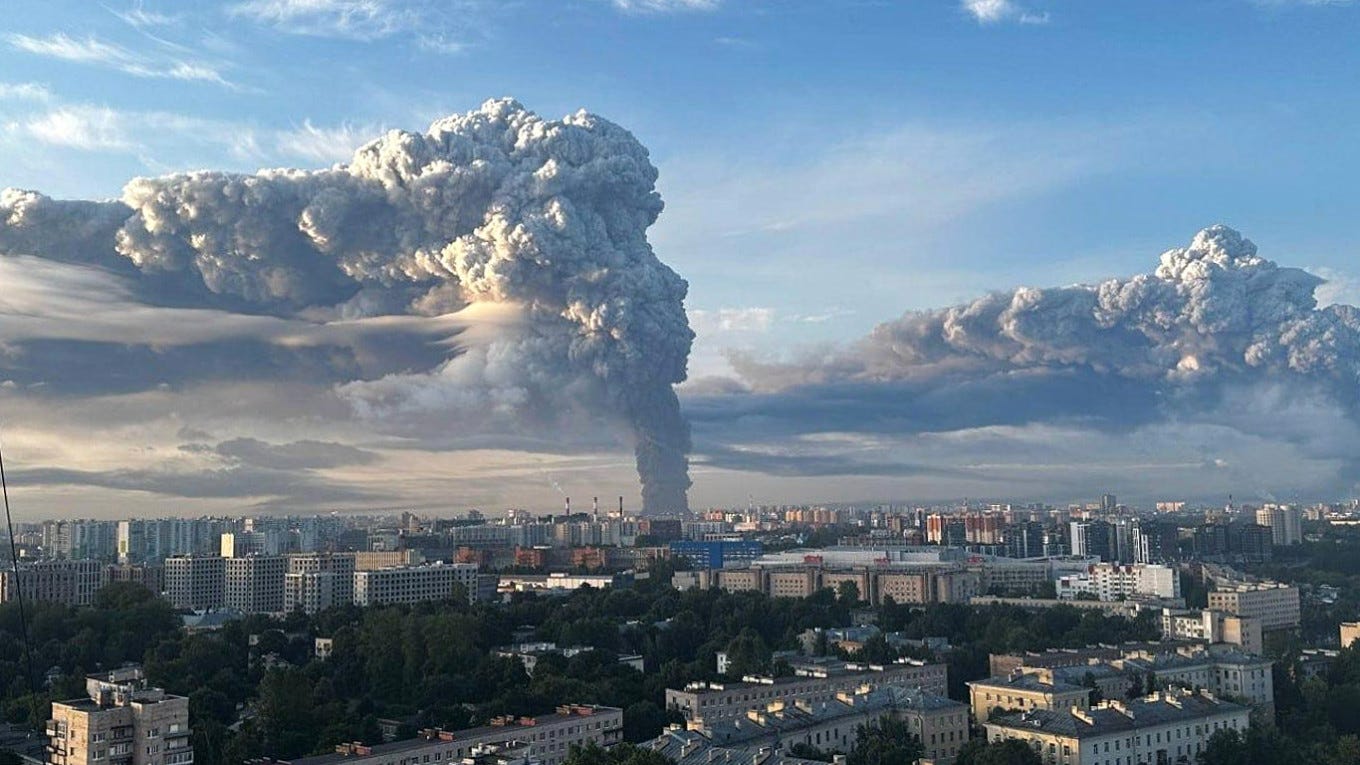
Summertime is when ordinary Russians travel outside the city to their dachas to plant and tend their vegetable gardens, which are harvested just before fall and preserved for the winter. It is also the time when government officials and the elite travel abroad – although their choices are significantly limited these days given Western sanctions – and they return at the end of August.
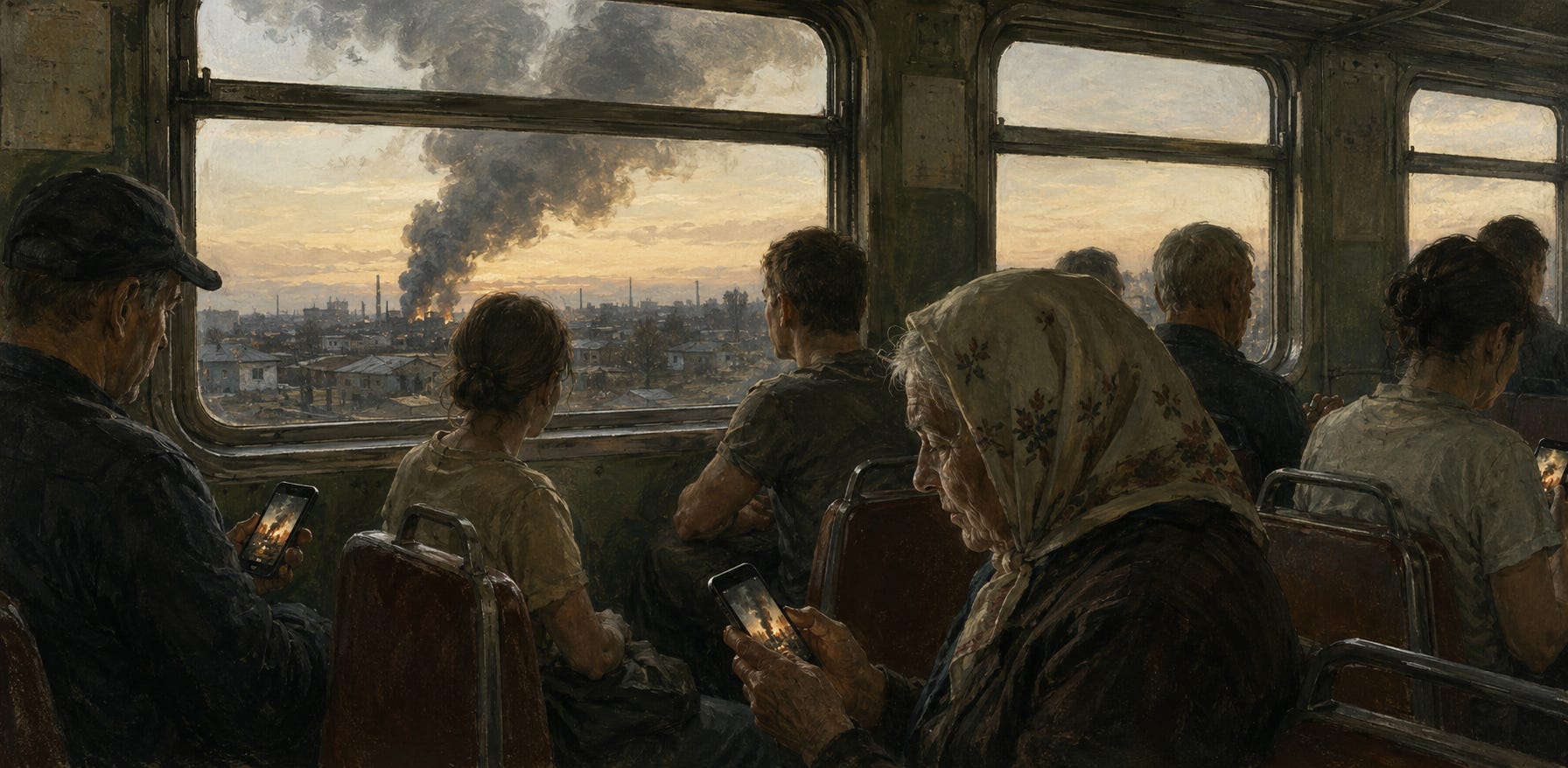
On this summer day, Meduza, one of many online exiled news platforms, captured and published a colorful conversation. The publication recounts ordinary Russian citizens grumbling on the commuter train about government bosses spiriting off to their summer homes abroad, while everyone else rode to work under smoke-filled skies, while Ukrainian drones “fly wherever they want.” As this is happening in the carriage, a babushka’s phone lights up with a video from Moscow Mayor Sergei Sobyanin’s Telegram channel tracking the drones’ flight path toward the capital, and she waves it away as if to say, nothing new.
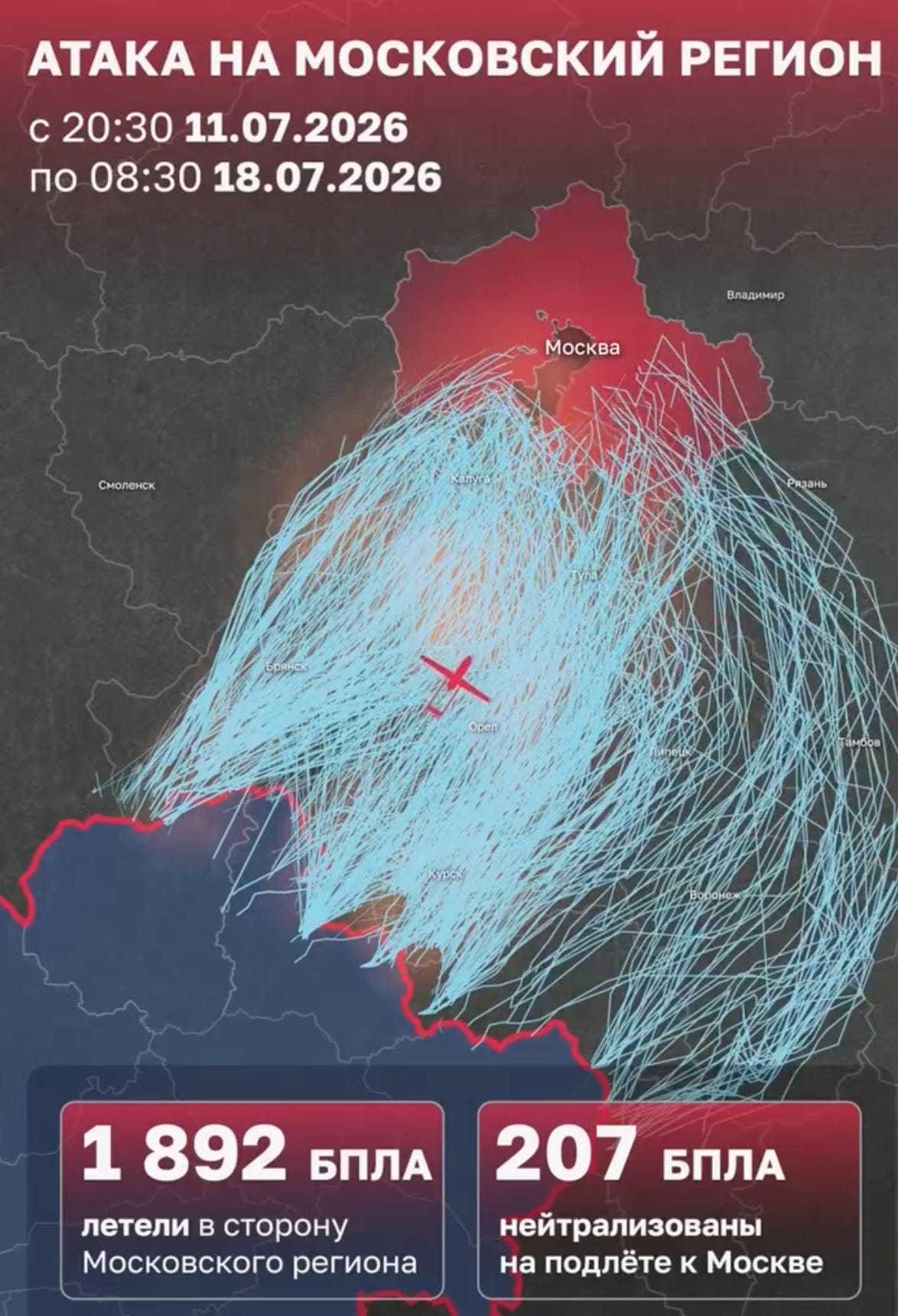
After fifty-three months of war and many official excuses, citizens have become desensitized to the official party-line stories.
Back in Elektrostal, the warehouse fire was still burning; across the country, sellers watched it on their phones.“Millions, billions of rubles are burning there,” said the founder of a men’s wear brand whose stock was in one of the warehouses.
The social contract between President Putin and the Russian people that has governed Russian life for a quarter century — stay out of politics, and the state will keep you safe and secure a comfortable standard of living — began to unravel when Russian troops invaded Ukraine in 2022, and Western sanctions began to accumulate, making Russia the most sanctioned country in the world.
Shortly thereafter, body bags returned to Russia; inflation began eroding the dinner table; the tax collector began asking for more money; and now there are long queues at petrol stations, and Russian cities are being swarmed by Ukrainian drones as far as Irkutsk.
What began as a one-week “Special Military Operation” became a series of temporary inconveniences caused by Western sanctions. The Barcelona vacation was replaced by trips to Sochi and Crimea, and Armenian brandy was poured instead of Cognac. Import substitution and Russian self-reliance became every Russian citizen’s patriotic duty. Soon, the television promised, it would all end: Ukraine would fold, and the West would lose its political will to support it. But after seven months of war, President Putin decreed a “partial mobilization” — 300,000 reservists, according to Shoigu’s public statement, with the decree’s actual numbers classified— marking the first mobilization since the Great Patriotic War. This led to the largest exodus of working-age men and women since the collapse of the Soviet Union. Estimates run as high as 1.2 million leaving the country over the subsequent three months following the mobilization decree.
Then came the body bags. By mid-2024, U.S. Defense Secretary Lloyd Austin cited at least 350,000 Russian soldiers killed or wounded; the statistical work of Mediazona and Meduza put the range at 462,000 to 728,000. By 2026, a figure of roughly one million cumulative casualties — killed and wounded — was circulating among Western officials, at a tempo on the order of 10,000 a month. Measured against any yardstick, the losses exceed those of every Russian war since 1945 combined. To put it into perspective, the Soviet Union lost roughly 15,000 dead over a decade in Afghanistan, and the population of the Soviet Union was twice that of Russia.
The dead and wounded came, and continue to do so, disproportionately from the impoverished provinces, where a signing bonus of up to $60,000 and a death payment could remake a family’s finances. In addition to large signing bonuses for contract soldiers, the private armies contracted by the Ministry of Defense were recruited from the Russian prison system. In exchange for service, a prisoner’s sentence was commuted to the time already served after his front-line service. By some estimates, fewer than a third survived their contracts, and many were sent back to the front after completing their service due to repeat criminal offenses.
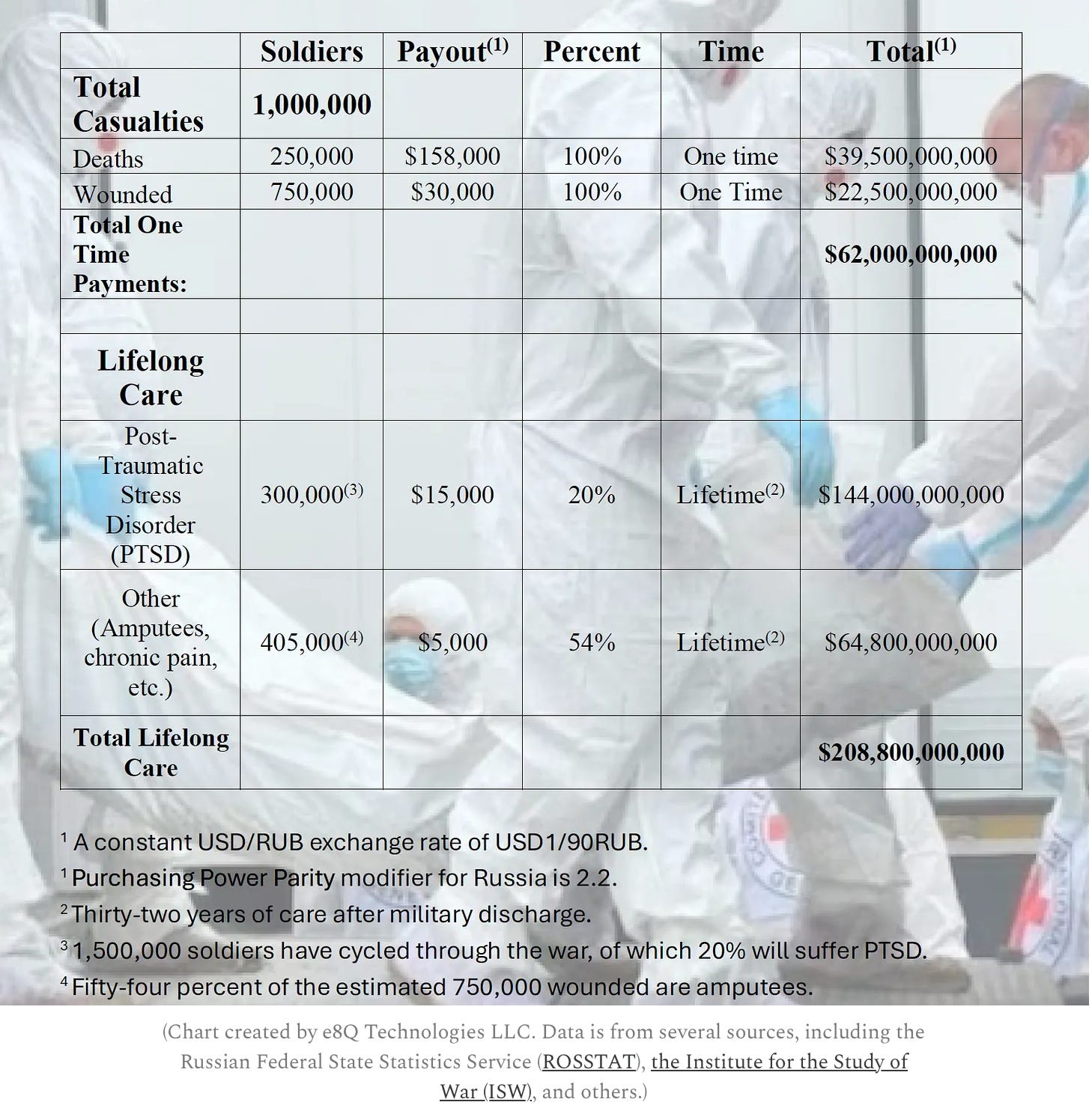
It should be noted that the cost of the war will linger over Russian society for generations. The dead are buried, but the wounded need to be cared for and assimilated back into civil society. Many will have mental health issues that the Russian healthcare system is not capable of handling at the moment.
Comments
Nothing yet. Say the first thing.
Sign in to join the conversation.