
Russia Daily Business Brief is a collection of the most important daily events reported by select open-source media platforms and governments in Eurasia.
If you are not a subscriber, subscribe below:
Takeaways for the day
Long-Range Sanctions – Ukraine’s drone campaign against Russian energy infrastructure struck the Slavneft-Yanos refinery in Yaroslavl (one of Russia’s five largest) and facilities in Bashkortostan and a Wildberries logistics hub in Tver.
Refinery Capacity – The Ukrainian armed forces campaign on refineries has pushed Russian crude processing to a 24-year low of roughly 3.6 million b/d.
Export Ban – Moscow extended its gasoline and diesel export ban through January 2027 — a material tightening of global refined-product supply.
Potemkin Fuel Prices – Independent Russian outlets highlighted a widening gap between Kremlin messaging and on-the-ground fuel shortages with staged price cuts during presidential visits.
Mobilization – rising public anxiety ahead of a possible autumn mobilization.
ENERGY & INFRASTRUCTURE
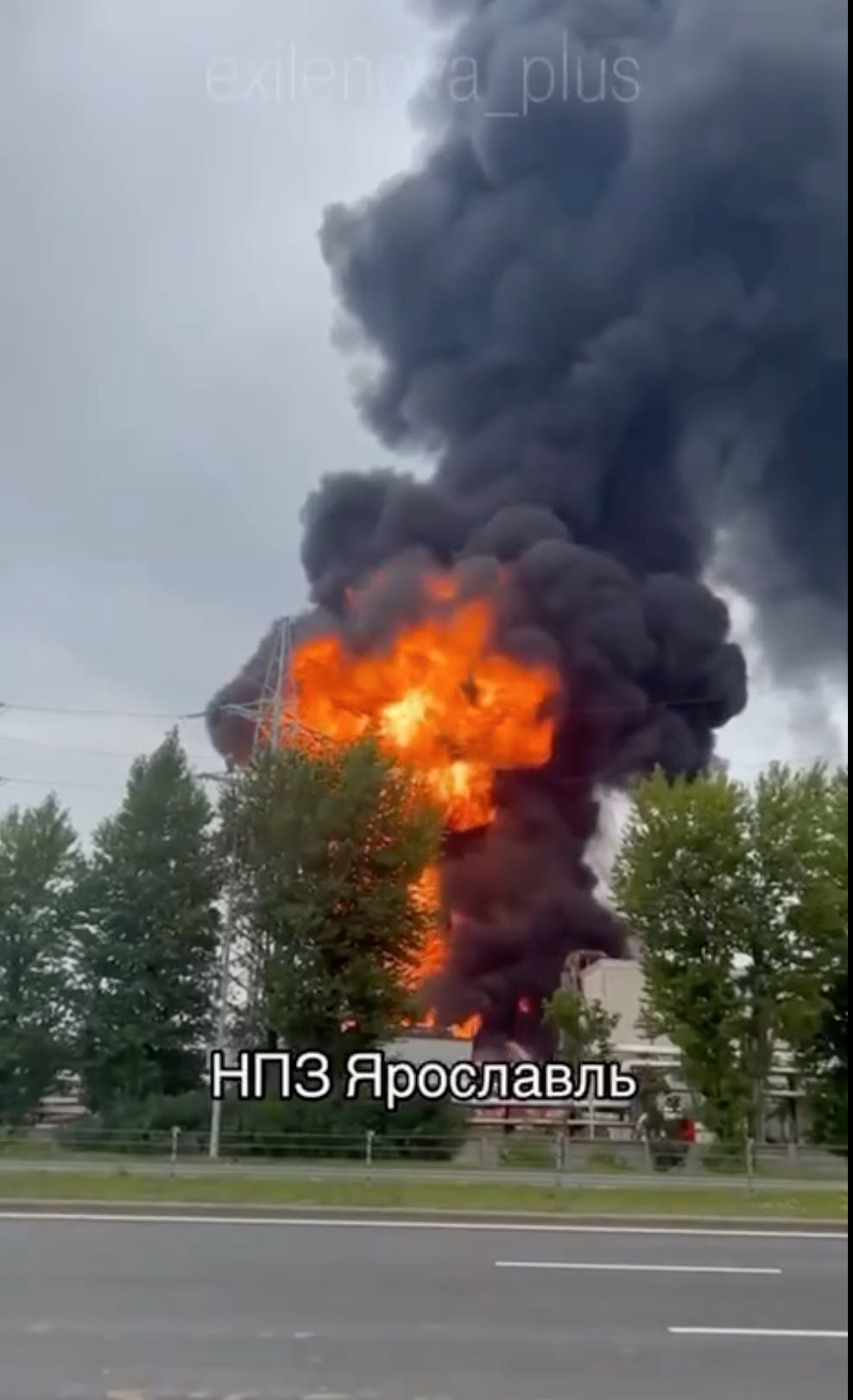
Ukrainian Drones Strike Yaroslavl and Bashkortostan Refineries in Overnight Assault [High]
Ukrainian drones struck oil refineries in the Yaroslavl region and Bashkortostan overnight on 6 August 2026, with footage indicating a large-scale fire at the Slavneft-Yanos refinery in Yaroslavl.
The Slavneft-Yanos plant lies over 700 km from the Ukrainian border and is one of Russia’s five largest refineries, with an annual crude capacity of 15 million metric tons.
Significance: Continued strikes on core refining assets deepen Russia’s refined-product supply squeeze, drive fuel inflation, and reinforce Moscow’s export-ban posture. Russian majors entering tolling contracts with India and Kazakhstan continue – Russian crude for refined petroleum imports.
Sources: Moscow Times · Kyiv Independent
Russian Oil Refining Falls to 24-Year Low as Drone Campaign Bites [High]
Russian refineries processed an estimated 3.6 million barrels of crude per day in July 2026 — the lowest level since May 2002 and roughly one-third below the seasonal norm — according to EA Analytics data cited by Bloomberg (latest available data, July 2026).
Ukrainian drones and missiles struck eighteen refineries in July, exceeding the previous monthly record of 17 set in May.
Significance: The scale of lost refining capacity — reportedly near one-quarter of Russia’s total — constrains export volumes given limited pipeline, storage and tanker slack, tightening global diesel/gasoline balances and raising counterparty risk for buyers reliant on Russian product.
Sources: Moscow Times
Potemkin Fuel-Price Cuts Underscore Depth of Russia’s Domestic Shortage [Medium]
Novaya Gazeta reported that retail fuel prices in Krasnoyarsk fell by 20-22 rubles per liter around President Putin’s early-August visit, echoing an 11.5-12.5 ruble drop during his late-July trip to Irkutsk, before rebounding after his departure.

The outlet framed the episodes as ‘Potemkin’ price optics masking a nationwide fuel crisis, gasoline queues and shortages.
Significance: Managed price optics signal that underlying domestic fuel stress persists despite official reassurances, implying continued export restrictions and elevated operational risk for Russian retail and logistics-dependent businesses.
Sources: Novaya Gazeta
MILITARY
Russia Reports 605 Drones Destroyed; Wildberries Warehouse Hit in Tver [High]
Russia’s Defense Ministry claimed interception of 605 drones over 19 regions and the Azov and Black Seas overnight on 6 August 2026, with the Yaroslavl region governor calling it the most massive drone attack the region has faced.
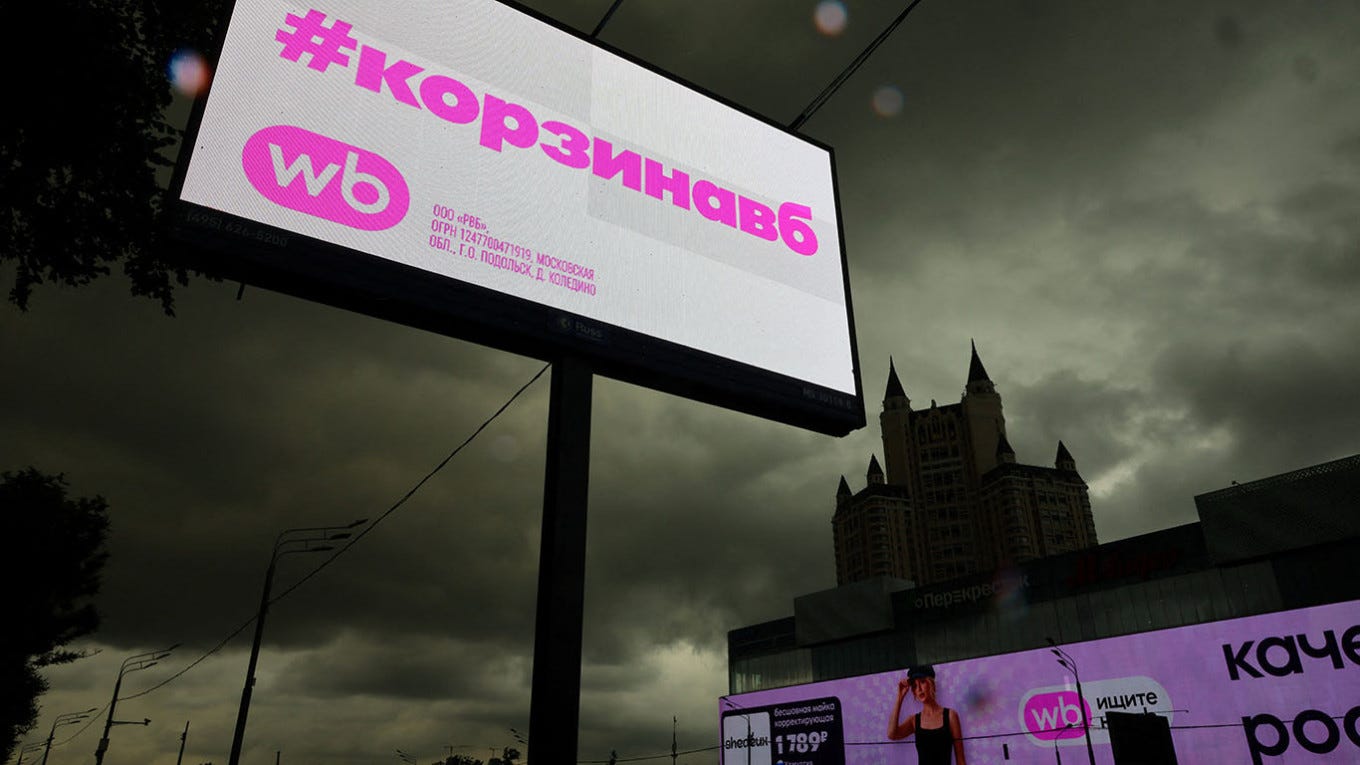
In Tver, falling debris caused what the governor described as minor facade damage to a Wildberries logistics complex, with additional damage reported in Voronezh and to agricultural facilities.
Significance: Repeated strikes on e-commerce logistics hubs threaten Russia’s fast-growing online-retail sector and elevate insurance, supply-chain and inventory risk for domestic distribution operators and their financiers.
Sources: Novaya Gazeta · Moscow Times
Russian Defense Ministry Reports Strikes on Ukrainian Energy and Logistics Targets [Medium]
Russia’s Defense Ministry said on 6 August 2026 that its forces struck Ukrainian fuel-energy and transport infrastructure and logistics centers used by the Ukrainian military over the preceding day.
It separately claimed a drone strike on two Ukrainian dry-cargo vessels near Odessa.
Significance: Ongoing reciprocal strikes on energy and Black Sea shipping infrastructure sustain war-risk premia for grain and commodity flows and keep freight/insurance costs elevated across the region.
Sources: Interfax · Novaya Gazeta
Japan Protests Russian Military Drills Near Disputed Kuril Islands [Medium]
Japan lodged a protest over Russian military drills near the disputed Kuril Islands, exercises that Russia’s Defense Ministry said would involve dozens of warships and aircraft plus more than 13,000 servicemen (reported 5 August 2026). The exercises reprise a long-running territorial dispute between the two states.
Significance: Renewed friction over the Kurils sustains diplomatic risk to any Russia-Japan economic normalization and keeps Sakhalin-linked energy and trade exposure in the geopolitical spotlight.
Sources: Moscow Times
ECONOMY & SANCTIONS
US State Department Imposes INKSNA Sanctions on Russian Defense Units and Traders [Medium]
A US State Department notice released on 4 August 2026 added several Russian Defense Ministry entities, two Russian trading companies (Gedion Alpha and International Invest) and five Russian nationals to a sanctions list for activities covered by the Iran, North Korea and Syria Nonproliferation Act; the underlying decision was dated 24 July 2026.
Significance: The INKSNA action expands secondary-sanctions exposure for counterparties transacting with named Russian defense-linked and trading entities.
Sources: Ukrainska Pravda
Kyrgyzstan Reaffirms Russian Market as Key Export Destination [Low]
Kyrgyz President Japarov described the Russian market as one of the key destinations for Kyrgyz products, expressing confidence that expanding trade and economic cooperation would open new opportunities for businesses in both countries (reported 6 August 2026).
The remarks underscore deepening Eurasian trade integration.
Significance: Continued Central Asian trade alignment with Russia sustains channels relevant to sanctions-circumvention and parallel-import scrutiny, a persistent watch item for compliance and correspondent-banking risk.
Sources: TASS
POLITICS & SECURITY
Independent Analysts Flag Rising Public Anxiety and Autumn Mobilization Fears [Low]
In commentary published 6 August 2026, Novaya Gazeta characterized President Putin’s Krasnoyarsk visit as the start of a new ‘rally around the flag’ phase amid a multi-dimensional crisis and rising mass anxiety tracked by pollster FOM.
The piece argued the population fears possible martial law and mobilization after the elections.
Significance: Escalating mobilization risk would strain Russia’s labor market and could tip the fuel squeeze toward a broader energy crunch into winter — a macro and operational risk factor for Russia-exposed employers and investors.
Sources: Novaya Gazeta
Belarus Opposition Leader Denied Polish Bank Account Over Expired Passport [Medium]
Belarusian opposition leader Svetlana Tikhanovskaya said a Polish bank declined to open an account for her because of an expired Belarusian passport, according to remarks on Euroradio (reported 6 August 2026).
The case highlights documentation hurdles facing Belarusians abroad.
Significance: Illustrates the practical banking-access frictions and enhanced due-diligence facing Belarusian and Russian nationals in the EU, relevant to KYC/onboarding risk for financial institutions.
Sources: Meduza
OFAC Sanctions Monitor
On 4 August 2026, OFAC added several Russian Defense Ministry entities, two Russian trading companies (Gedion Alpha and International Invest) and five Russian nationals to a sanctions list for activities covered by the Iran, North Korea and Syria Nonproliferation Act; the underlying decision was dated 24 July 2026.
Confidence Levels (based on open-source corroboration)
High — confirmed by multiple independent open sources, or by an authoritative primary source (official government release, OFAC designation, central-bank data).
Medium — reported by a single credible source, or multiple outlets tracing to one origin; plausible but not independently corroborated.
Low / single-source — a single source, unverified, or a state-media claim without independent confirmation; treat with caution.
Confidence reflects the degree of open-source (OSINT) corroboration at the time of writing and does not reflect human-source (HUMINT) verification. This brief is for information only and is not investment advice.
You may also enjoy reading Barbershop Whispers…Las Améяicas and this week’s
Barbershop Whispers....Russia is a reader-supported publication. To receive new posts and support my work, consider becoming a free or paid subscriber.
BWR Daily - 06 August 2026, Week 32
Comments
Nothing yet. Say the first thing.
Sign in to join the conversation.