
Dear BWR Shoeshiners and Barbers!
To ensure full access to the piece, it is best to read it on the Substack platform. Many email servers truncate the emails.
Also, don’t miss last week’s Barbershop Whispers…Las Améяicas, a mid-week publication that covers all things South America and the Caribbean. Last week’s issue was:
Follow BWR’s daily posts on X and Blue Sky for daily updates and posts.
In last week’s BWR, I discussed how the Kremlin’s War now lives with Russian citizen Ivan Petrovich — and with Putin’s non-performing social contract. Ivan stayed out of politics for decades, and now, a Kremlin war of choice has come home to roost, bringing body bags, inflation, a heavier tax burden, and petrol shortages to citizen Petrovich.
In this week’s BWR, I turn to the Kazakh–Russian relationship, recalibrating in real time as President Tokayev manages Russian President Putin and courts foreign devils for the benefit of Kazakhstan. Not all near abroad are equal.
The Whisper in Omsk | Oil on the Fire | The Steppe’s Foreign Devils | The Tsar Wields Influence | The Multi-Vector Tightrope
A Concession in Kind — Urged to freeze the war in Ukraine, Putin didn’t rebuff Tokayev; he promised to brief him in detail, one Soviet man to another. The “no” came later, from Kremlin spokesman Peskov. Deference is what a stretched Kremlin extends to a partner it needs.
A Leash of Pipe — With four-fifths of its oil crossing Russian soil, Astana can’t exit Moscow — so it settles for diluting it into a pool of four patrons.
On 25 July, at the 22nd Kazakhstan–Russia Interregional Cooperation Forum in the Siberian city of Omsk, President Kassym-Jomart Tokayev did something only a skilled Soviet diplomat, cut from the same Soviet cloth as Russian President Vladimir Putin, could possibly do. Sitting beside Putin, he praised the Russian leader’s “utmost diplomatic flexibility” — and then, in the same breath, offered,
“If I may offer my humble opinion, since I have been asked…perhaps it is time to freeze this conflict and return to the Istanbul formula 2.0.”
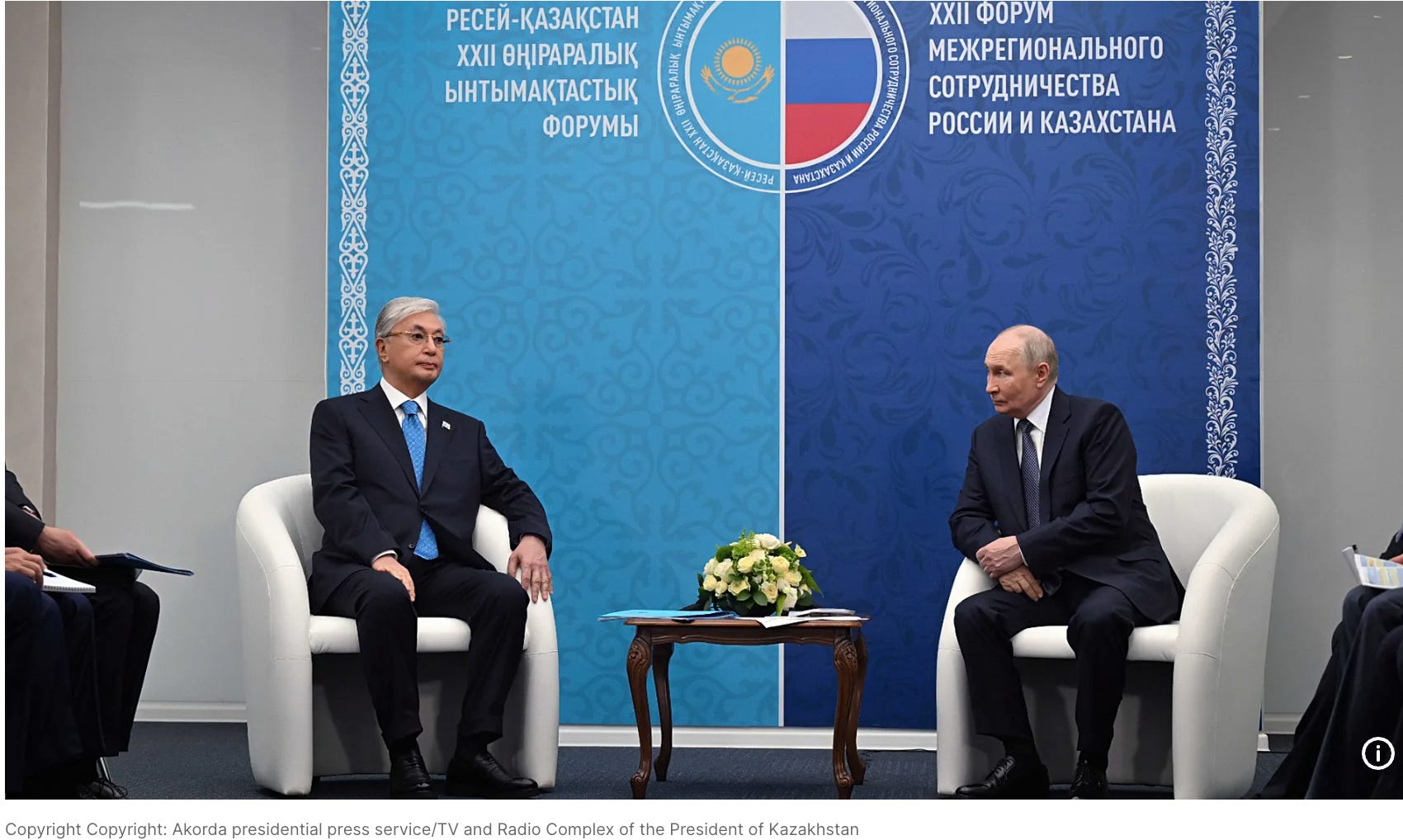
Prior to making the request, he eloquently, and without notes, expressed his view of the war as a conflict between two states…the root of the conflict is not clear…and that Kazakhstan respects the Ukrainian language and culture…only the adversaries of Ukraine and Russia benefit from the conflict, as Putin patiently listened.
The deference was thick, but the message was clear and frank. This was a communiqué delivered by a reigning Khan, with deference and respect, to his Tsarist equal, in the presence of his court and electorate — the Russian cameras were rolling.
Putin’s reply was a courtesy in kind. He neither dismissed the idea nor corrected his guest; he offered a promise:
“As for the Ukrainian direction, I will certainly inform you in detail during our talks today.”/ «…я вас в ходе наших бесед сегодняшних обязательно проинформирую в деталях»
Note the tense — not a rebuttal but a deferral, the substance reserved for a private conversation between two men schooled in the same Soviet tradition. It read as a respectful concession to someone Putin regards as a peer — not quite an equal, but far from the brush-off a suzerain gives a client state.
The formal “no” surfaced only afterward, and through the Russian presidential spokesman, Dmitry Peskov. He told reporters that,
“freezing the conflict as such is impossible, given Kyiv’s position.”
Yet Peskov was careful to add, separately, that although Tokayev’s stance was a consistent one,
“this does not mean that we agree — but Kazakhstan is our closest partner and our closest ally.”
That the rejection came from Peskov rather than Putin — and wrapped in the language of alliance — hinted at how much Moscow values keeping Astana onside.
Kyiv, for its part, pushed back on the framing: a freeze along current lines rewards the aggressor. Tokayev even mused that “the nature of this conflict is not entirely clear” — the kind of studied diplomacy that sends messages to three capitals at once — Beijing, Washington, and Ankara. So why would the leader of a landlocked state that shares a 7,600-kilometer border with Russia — the second longest continuous land border on earth — choose that venue and time to say all this about the war? It is complicated, but we can start with the oil money, followed by sovereignty and territorial integrity.
Comments
Nothing yet. Say the first thing.
Sign in to join the conversation.