
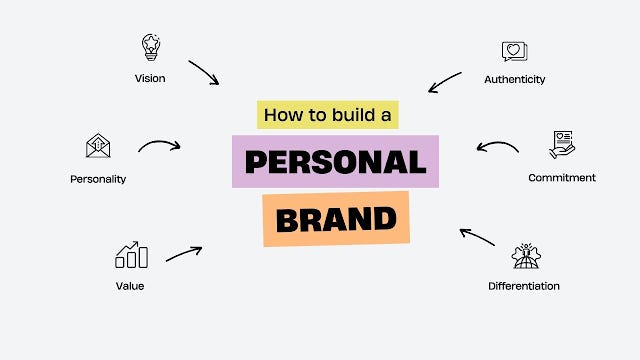
First things first.
The most important step in the journey of personal branding is knowing yourself. And we don’t mean that metaphorically, or in some philosophical sense. Rather, knowing yourself means:
Knowing what makes you authentic
Knowing your strengths and capabilities
Knowing what distinguishes you from the rest
Only then can recruiters, customers, investors, or business partners take you seriously. Why?
Because this knowledge is crucial to determine your personal brand’s vision, story, message, and worth, among other things.
Now, these things are important so, obviously, they’re not that easy to answer. Don’t try to tackle them straight-on.
Instead, start by answering the following questions:
What are my core values?
What is my message and my story?
What are my passions?
What are my skills?
What makes me different and better than my competitors?
Where do I see myself in one year, five years, and 15 years?
What is the purpose of this personal brand?
What problems can I solve and why should my target audience listen to me?
How do I want to deliver my message?
Who can help me reach my goals?
Once you come up with (and, optimally, write down) the answers to these questions, you can get on with the next step.
For the next step, what you want to do is translate all that raw information into usable assets.
The said assets are what you will then base your personal brand on.
To make things easier, categorize the information as follows:
Competence
Values
Goals
Identity
Let us walk you through what each means and how it can serve your personal brand.
Competence involves your capabilities to tackle a given task effectively.
It encompasses your knowledge and experience, your skills (both soft skills and hard skills), and your professional attributes and abilities.
It’s no secret that people (clients, investors, recruiters...you name it) have an easier time trusting someone with a strong skill set and proven experience in the field. So, you want your personal brand to reflect your competence and express your capabilities.
As such, your “competence” category can include any of the following: communication and interpersonal skills, technical know-how (computer skills, writing skills, etc), and/or soft skills such as conflict resolution, relationship building, organization, etc.
Your values represent what you stand for, or the beliefs that you hold most dear and that guide you through your professional life.
They are the characteristics and morals that guide your decision-making process, your work ethic, and your communication process, among others. For example, one of the core values of your personal brand might be integrity.
If that’s the case, your clients or business partners will expect this core value to be an indispensable part of how you act and work. Moreover, in the off chance that your integrity is compromised, your personal brand will be as well.
This is why it’s important that your values are as genuine and achievable as possible - otherwise, they might be hard to uphold.
Your goals include your desired future achievements, plans, and outcomes. To be as realistic and achievable as possible, make your goals specific and quantifiable, as well as set yourself a time limit, or deadline, to achieve them.
Thus, the goals guiding your personal brand can change as your professional journey progresses.
For example, as a social media influencer, your initial goal might have been to use your personal brand to get recognized and gain a follower base of 5,000 people in the first six months.
Once you achieve that minestrone, your goal might become to find advertisers that can potentially fund you for promoting their products on your social media accounts.
Your identity involves the things that make you authentic or the distinct traits that give you an edge over your competitors.
As we mentioned earlier, for a personal brand to be successful, it should distinguish you from other competitors in your niche. So, for example, if you’re giving wellness advice to women, you should determine your point of difference compared to other wellness providers.
Do you focus on advice on healthy lifestyle choices? Or, maybe, you use certain meditative and spiritual practices that you’ve learned from your traveling experiences.
Your identity can be anything that makes you uniquely you and that benefits your personal brand.
Templates are reusable content blocks you can insert into any post. Use them for content you repeat often, like:
Standard disclaimers or disclosures
Calls to action (subscribe, share, etc.)
Custom dividers or recurring sections
Post templates or boilerplate
To create a template, click "Template" in the editor toolbar and select one to insert. You can organize templates into groups by using "/" in the name (e.g. "Email/Welcome").
Once you have determined your competence, values, goals, and identity, you can begin creating your personal brand.
First, you have to decide your personal brand’s mission and vision statement. Here’s what this means, exactly:
A vision statement states a personal, business, or brand ambition in the long term. It explains why your personal brand matters and can help your career decisions stay aligned with your ultimate goals. Moreover, a vision statement done right can attract like-minded people or potential clients to stick with you throughout your professional journey. The vision statement remains constant throughout your career, with minimal changes.
A mission statement is a formal summary of a person’s or business’s values and goals. It defines your approach to present tasks and your promise for taking on future endeavors. The mission statement has a short-term and more narrow range. It focuses on the present and near future and can change along your personal brand’s goals or target audience.
Lucky for you, the information collected in the first two steps makes this step easy.
To create your brand’s vision statement, write down your long-term vision (10+ years), your purpose and core values, and your definition of success. In the best-case scenario, your vision statement will be clear, brief, and memorable.
To create your mission statement, use the assets you collected from answering the following: “what do I do?” “What are the skills, experiences, and competencies that help me do it?” and “what motivates me to do what I do?”
Get inspired by the memorable mission and vision brand statements online to get a feel of what works and what speaks to the public.
Your personal brand’s story is an excellent way to connect with your target audience on an emotional level.
Think about it. When you know someone’s back story, their motivation for doing something, and the events that led them to a certain decision, you are more likely to sympathize and relate to their personal brand.
Sometimes, it might even happen that a personal brand’s story is so on-point, it gains popularity, recognition, and appreciation even from people outside of the target audience.
For example, you don’t have to be a computer lover or IT enthusiast to get behind Bill Gates’ amazing story of how he started the Microsoft that we know today in a small garage in Albuquerque, Mexico.
A personal brand story is not mandatory (meaning, don’t try to make something up just to have one), but it can definitely be of use to your brand identity. So, if you have an interesting backstory that led you to where you are, make sure to incorporate it into your personal brand, as it’s guaranteed to boost its impact on the target audience.
Your personal brand’s success relies on the quality and consistency of your online presence as much as it does on your experience, skills, and vision. As such, the channels that you will use to show your personal brand should follow a similar color scheme, style, logo, etc.
Think of your target audience, in addition to your personal brand, when you start creating your brand’s stylistic elements. This will help you stay in touch with what people want, instead of pleasing your personal aesthetics alone.
Imagine if you owned a club, but instead of flashing lights and loud music, the environment was quiet like a library, and you played Mozart.
Sure, you might’ve loved the atmosphere personally, but your guests would be a tad surprised.
What we’re saying here is, a successful personal brand should be a combination of the audience’s expectations and of your own unique personality. So, you should aim for these two to meet halfway. Once you’ve thought it through, start working on your brand identity and your brand image.
Your brand identity consists of your brand’s visual elements. These include your logo, color scheme, tagline, typography, form, website and social media, packaging (if applicable), etc. These are all elements that can help others distinguish and remember your personal brand.
Your brand image involves your brand’s non-visual elements, particularly its reputation, impression, and the emotions it evokes on the target audience. Do you want to be thought of as someone who will fight for what is right, no matter what? Or someone who comes up with innovative solutions? Your brand image defines all that!
As we mentioned earlier, personal branding wouldn’t be as effective (or important, for that matter), if it wasn’t for the rise and importance of the internet and of social media websites.
They enable direct access to people and products to recruiters, clients, and investors and simultaneously allow you to be in control of your online image and presence (if you correctly follow our guide on personal branding, that is!)
In addition to using a personal website or blog, you can also take advantage of Facebook, LinkedIn, Twitter, Instagram, and Reddit.
Keep in mind, however, that building your online channels is not enough. You need a firm strategy in place to ensure that your personal brand doesn’t just fade away in the virtual world.
To meet your personal brand objectives, you need to engage your target audience with relevant brand activities, achievements, and topics. Otherwise, these channels will only serve as typical social media accounts and will not meet your personal brand’s objectives.
What we’re saying here is, instead of just creating a LinkedIn profile and leaving it as-is, you need to actively “brand” your profile:
Add a cover image with your mission statement and logo.
Use a catchy professional title. Instead of “SEO professional,” you can do “SEO Pro Helping Businesses Hit 5-Digit Traffic Numbers.”
Post your case studies, testimonials, and achievements.
Publish articles on LinkedIn that portray you as an expert.
Or, to give you another example, let’s say that your personal brand aims to distinguish you as a fashion guru. It’s not enough to have a website where you show how well you dress and what awesome style you have.
Rather, it should also include:
Fashion news.
Blog posts with fashion advice and tips.
Recent trends in the fashion industry.
Polls, newsletters, and more.
Last but not least comes measuring your impact.
This step is particularly important because it can let you know whether you’re doing things right or you need to change the direction of your personal brand. It is not uncommon to change certain aspects of your personal brand, such as its mission statement or its identity, when these things no longer work, or when your target audience changes.
Similarly, you may need to rethink certain aspects of your outreach and social media strategy, the channels that you use or the story you are telling, if your personal brand’s impact doesn’t meet your desired objectives or long-term ambitions.
Luckily, online channels make it easy to measure your virtual impact. You can check some of the ways below:
Website: Your website will allow you to check the number of visits, the demographics, your audience’s location, the level of engagement, mobile and desktop traffic, as well as users’ search behavior, devices, and interests, among others. You can also gain insight on how your audience finds you (directly, or through referrals and social media channels, for example).
Podcast: If you promote your personal brand through a podcast, you have insight on your subscribers, listeners, number of downloads, social shares, conversion rates, trends, etc.
Social media: Your social media channels allow you to check the number of likes, shares, followers, growth rate, impressions, mentions, reach, response rate, Click Through Rate (CTR), and much more!
Search engines: Google and other search engines will offer you insight on organic traffic, conversion rate, average session duration and time on page, page errors, keyword performance, etc.
If you’re not experienced in reading and understanding what these indicators mean in terms of your personal brand’s impact, don’t hesitate to ask for help from someone who knows.
These indicators are extremely important in paving your personal brand’s future success, so the faster you learn how to utilize them, the best!
Well, that was a lot to take in! We hope that by now, you feel ready to take on the process of personal branding!
Let’s go through the most important points we covered for good measure:
A personal brand encompasses the experiences, competencies, actions, expertise, or achievements that make a person known within a community, professional field, or at large.
The process of creating and/or maintaining a personal brand, on the other hand, is called personal branding.
A strong personal brand can help you by making you stand out from the competition, generating professional opportunities, and building up your credibility.
To begin your personal branding process, discover who you are, determine your assets, write down your mission and vision statements, tell your story, create your brand image and identity, build your online strategy, and measure your impact!
Comments
Nothing yet. Say the first thing.
Sign in to join the conversation.