

Last Friday, I recounted the negatives that often come with grades. It wasn’t the most uplifting Friday post, but its ultimate goal—that of minimizing any grade harm even while teaching in a graded world—is one of the most positive changes we can make in our classes.
Also, as we put the machinery of our classes into gear again, I think it is important to take time to reflect on grade harm because it can impede so much we seek to do in the early weeks, ranging from building a positive class community to motivating our students to engage earnestly with the class.
Of course, the rub with grades has long been that they are not so easily cast aside. They lie at the core of most school systems and the academic psyches of many, many students. They are also often required by our contracts, expected by parents/caregivers, and needed by post-secondary education and employment to determine placements. And so while I dream of a completely gradeless future, I’m not there yet.
Thanks for reading The Rewrite Newsletter! Subscribe for free to receive new posts and support my work.
For many years, my approach with grades was to work around their issues as much as possible. You can see this in the grade-less suggestions I offered in 2019:
Separating feedback and assessment, so the feedback doesn’t get overshadowed by the grades
Creating grade deserts, where there are long periods in my classes—and especially early in the year—without grades.
Looking for ways to design assignments so grades are less impactful.
I stand by and still follow these suggestions, but I now also strive to take on grades more directly because avoidance of issues can generally only get us so far. To truly tackle a thorny problem, one often needs to look it right in its spiky eyes, which is what I now do in my classes concerning grades by doing the following:
I Now Discuss Grades and Assessment Openly and Often
If I could update Flash Feedback, the first thing I would put in is more about feedback literacy, which is the idea that if we want to maximize our feedback’s effectiveness, we need to directly teach students what feedback is and how to use it instead of assuming they know.
I have come to think a similar thing is true for assessment. In education we generally give grades and assessment a very Wizard-of-Oz-esque treatment. They are presented as unbreakable tenets laid out by an infallible power because to admit the truth—that we are simply normal people behind the curtain—could invite criticism and power struggles we don’t want. The trouble with this approach though is that the vacuum of information around grades also leaves the door for so many of the negative narratives discussed last Friday.
That is why in my first week of school, before I hand out the syllabus discussing grades, I now have a discussion with my students where I directly ask them what success looks like in an ELA class:
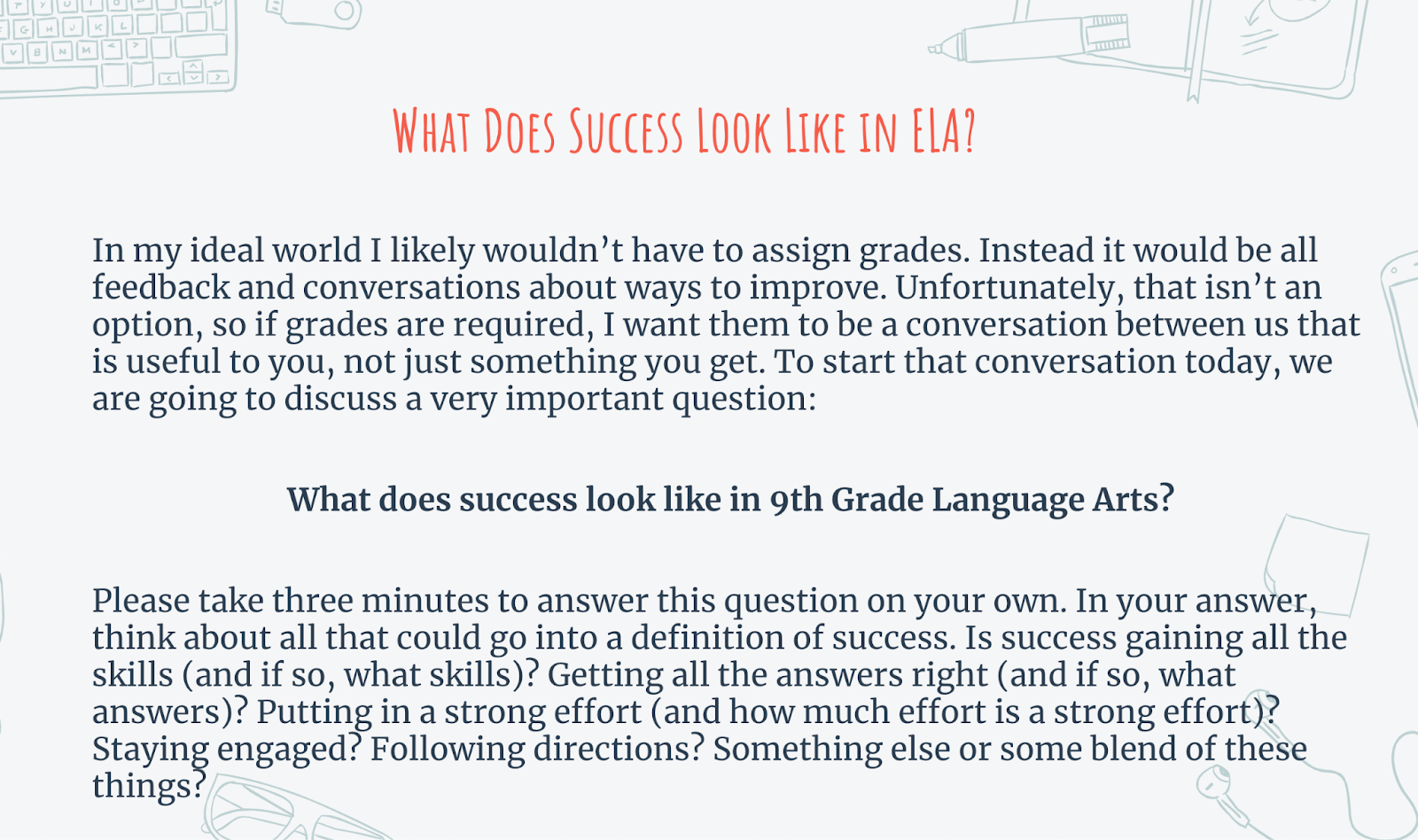
This conversation begins a discussion that lasts all year with the goal of helping students to understand what the grades in the class are and are not. Specifically, I want them to see that grades are not indicative of fixed character traits or some sort of punishment; instead they are snapshots that capture as best as they can the complicated question of success in the course. I also find that students almost invariably end up right where my grading system starts: That grades in the ELA classroom, if they need to exist, should likely be some sort of blend of effort, growth, and skills, which brings me to the next point.
I Now Blend Assessment Approaches
When I talk to educators about grades and assessment, I generally find three approaches to be the most common:
Points-Based: This is easily the most commonly used system. It is where a teacher assigns point values to work that the class does and at the end of the semester the points are added and converted to a grade.
Standards-Based: In standards-based, the grade is based on how well students master a list of content and skills. Most commonly the content/skills are assessed on a 4, 3, 2, 1 scale.
Contract-Based: This is a sort of inverse to standards-based. The core notion is that the teacher and students come to some sort of agreement or contract for how the grade will be determined, often with a focus on effort and/or growth (it is also sometimes called Labor-based assessment)
In the last four years, I experimented with all three models, but no model fully and accurately captured what success meant in my classroom. I knew I didn’t love the point-based model from years of doing it, but when I tried a standards-based approach, I found the lack of ability to build in effort and growth frustrating. Then I experimented with contracts (and their cousin portfolios), but this led to worries about what to do with hardworking students whose skills still needed some serious work and students with strong skills who didn’t work as hard.
In the end, none of the approaches fully fit, but these experiments helped me to better understand why the points-based model persists as the most common approach. Simply put, it offers the most flexibility, which I think is its main appeal. With this in mind, the last couple years I’ve tried to do something different, which is to combine my favorite elements of each grading methods into a hybrid model that looks like this:
The gradebook is in points because that gives me flexibility and is the expectation of students, parents/caretakers, and administration in my district.
Part of the grade (last year it was 30%) is based on effort, and like a contract-based approach, we discuss what effort looks like and come to an agreement of what effort means. Then for all of the effort work (think reading reflections, in-class processing assignments, earlier drafts of papers, etc.) students get grades based solely on the effort and work they put forth.
Part of the grade is core skills (last year it was also 30%). These are specific skills that are scored on a Standards-Based 1-4 rubric. In reality, I try to also approach these as mastery-based assignments, where I keep returning them to students who don’t have a 4 (which translates to an A in my gradebook) until they hit the mark.
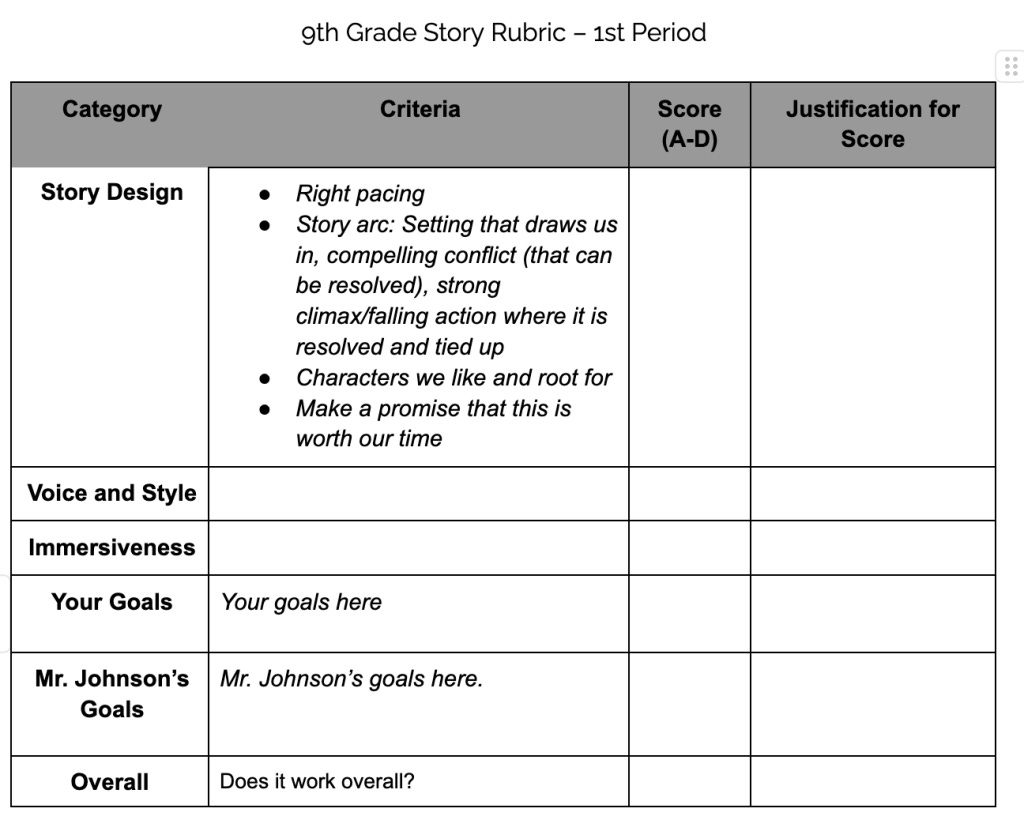
The last part of the grade (40% last year) is larger papers and projects, which are scored on rubrics like the one below. The score on the rubric is based on a combination of skills (see the first three boxes in the rubric below, which are based on my district standards) and growth and effort (see the student and teacher goals). The only score options for any category are A, B, C, or D, which mimics the common standards-based scores.
The thread that ties together both of these shifts in my approach is taking grades out of the mysterious black box and making their internal mechanisms clear to all through discussion and clearly defining where they come from. Doing this has been the second most impactful thing I’ve ever done with my approach to assessment.
And the most impactful thing? Making my grades more malleable, a topic at the heart of my third post on Going Gradeless Five Years In, which drops next Tuesday.
Until then, thanks for reading and yours in teaching,
Matt
A quick word from Matt on his new course:
The first cohort of my Better, Faster Feedback course is filling now. It will close on Sept. 15, and given your support for my work, I am offering a one-time discount of 50% for newsletter subscribers and readers. To get the discount, use the code SUBSCRIBER when checking out. Also, I am a huge fan of teacher money staying teacher money, so I would recommend doing the following (all of which I've seen work) to pay for the class:
Asking a supportive administrator. Many admins will be really excited to have a feedback specialist on staff.
Asking the PTO/PTSO. Our district and many others has PTO/PTSO mini-grants for amounts like the $40 for the course.
Asking for department money. For an investment of $40, you can offer your department up-to-date research and pedagogy on how to give better, faster feedback.
Going in as a whole department/school/district. If you are looking to study feedback as a department/school/district, I have significant discounts for bulk purchases, and I think you could hardly find a better deal. Click here for all that is offered and contact me for more information.
Also, if anyone is interested and money is an issue, let me know. I have some scholarships available for those who are interested but can't make the money work right now.
Hope to see you there!
Thanks for reading The Rewrite Newsletter! Subscribe for free to receive new posts and support my work.
Comments
Nothing yet. Say the first thing.
Sign in to join the conversation.