
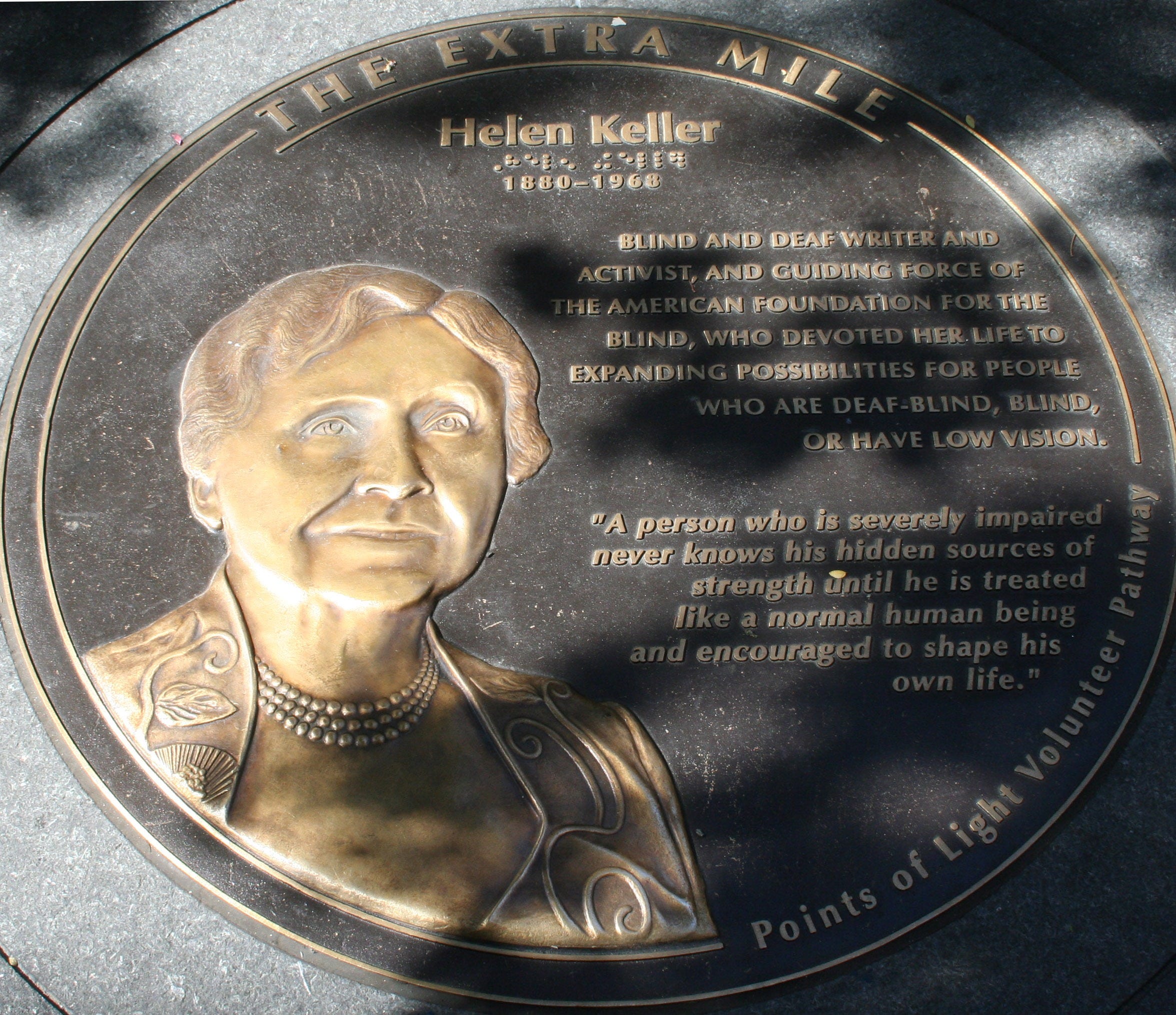
June 27 is Deaf Blind Awareness Day, coinciding with the birthday of Helen Keller. I wanted to take this as an occasion to revisit an old blog post on deaf blindness:
Deaf Blindness, the often overlooked side character
·
July 13, 2025

When you hear the word deaf-blind, you might think, “How do you communicate then?” And if you have ever studied anything related to communication, I’m sure your old professor is haunting you right now with Paul Watzlawick’s “One cannot not communicate
Since publishing it, I’ve learned a number of new things that I would like to add. So grab some popcorn for the sequel: “Deaf Blindness, the Often Overlooked Side Character: Still Not in the Dark!” Coming to an interface near you, now.
While I picked that title purely for the pun (even comparing it to the second lead in K dramas, who never end up with the main character), it was quite accurate.
Since I work in assistive tech for low vision and digital accessibility, I’ve learned to think of deaf-blindness as something to study up on whenever possible because there is just so little when it comes to standards or good practices that one can reference. I am by no means an authority on the topic now, but when there was a rare panel discussion on deaf-blindness, I would go there. I would read up on aspects that puzzled me because it might become relevant to my own work later on. Recently, I was invited to a podcast on deaf-blindness alongside an advocate with lived experience, which made me realize how terrifyingly easy it is to be considered knowledgeable in something that is otherwise talked about so little.
Blindness is extensively covered in the WCAG & Co., and Deafness/Hard of Hearing have great community resources as well. Both are also the focus points of plenty of innovations around the globe. Deaf-blindness, which theoretically falls under both of them to spice things up, is rarely regarded as a viable demographic. Yes, it’s not the biggest market opportunity, and if you’re in assistive tech for the money, you won’t find happiness here. But that does not make it any less valuable to know.
Compared to the many options blind shoppers have (hypothetically, we're not looking at price tags or local availability), deaf-blind people are limited in their choices because most innovations for low vision rely on audio interfaces.
Yet designing for deaf-blindness is not that complicated, if you know what to look out for (pun very much intended).
The needs of deaf-blind individuals are a combination of known challenges in interface design, like customization of screen interfaces to fit the individual vision, independence from audio-only, limited surface contact with the body, and receiving information in relation to oneself.
And while those are some tricky challenges in design, if we claim to be good at our jobs, we should be able to figure out the problems and address them.
To be honest, in the first part, I focused more on misconceptions surrounding deaf-blindness, but now I know that communication strategies are just as important- if not even more so- for inclusive design.
Tactile signing is an example for use of different communication channels. Observing it from the outside, it looks similar to sign language, but it is experienced fundamentally different. Sign language heavily relies on visual information, while tactile signing uses - as the name suggests - tactile channels. Different types exist, one of which is tactile fingerspelling, which is what Anne Sullivan used with Helen Keller. Other variants are hand-over-hand or hands-on signing, ProTactile, braille singning and the lorm alphabet.
Here is a simple, but important example for ProTactile:
To get the deaf-blind person’s attention, tap on their shoulder/arm. You may need to keep your hand on their shoulder or arm until they face you.
If a deaf-blind person appears to be in danger, draw an “X” on their arm or back (to indicate an emergency), and then lead the person to a safe area. Upon arrival at a safe place, explain what is happening.
Please keep in mind that not all deaf-blind individuals will be familiar with “X.” It depends on when the onset of hearing and/or vision loss occurred, as well as their experience with survival tips.
The Lorm alphabet is mostly used in German-speaking countries as well as the Netherlands, Czech Republic, Poland, and Georgia. I find this fascinating, because it does not matter whether you look at it from a linguistic or geographical perspective; either way, at least two of them are not like the others. I was not able to figure out yet why, but would love to learn more about the history of my Landsmann (fellow Austrian) Heinrich Landesmann aka Hieronymus Lorm.
My first sign language teacher was deaf-blind, therefore the first lesson included communication rules. Looking back, this shaped my understanding of Deafspace and how the necessary adjustments can be very simple.
I noticed that many people, as they initially start thinking about accessibility, chase the phantasm of a ‘fully accessible space’. Be it in the digital world, workspaces or events. Achieving that is impossible and thinking about it can be tiring. But the real tragedy is that it distracts us from person-to-person interaction. On the inter-personal level, most accommodations are surprisingly easy: wearing black clothes for better visibility while signing for light skin types and light-colored clothes for dark skin types, facing someone when talking or signing and not facing away from them or standing at an angle, having the room well-lit, and asking for and remembering their preferred way to to grab their attention (stomping, flickering the lights, or lightly tapping the upper arm are common ways, but the best choice is to be respectful and simply ask).
On a systemic level, accessibility and inclusion are complex, but on the individual level, it boils down to one thing:
You have to ask and be willing to listen.
Deafblind UK: Deafblind Awareness Week 2026 #SeeHearUs Campaign
aj granda & Jelica Nuccio (2018). Protactile Principles. Seattle, Washington: Tactile Communications.
National Center on Deafblindness: Overview on Deaf-Blindness Factsheet
Assisitve Technology and Equipment Living with Deafblindness
Unique Technologies Presented at First Deaf-Blind International Conference
Comments
Nothing yet. Say the first thing.
Sign in to join the conversation.