
It’s ironic that Wealthfront struggled to find product-market fit during its early years, considering it was founded by the very person who had coined the term: Andy Rachleff. A co-founder of the leading VC firm Benchmark Capital, Rachleff moved back to the operator side in 2007. He started a company to democratize access to endowment-quality investment management.
Joining forces with Dan Carroll, who previously launched a game where people managed virtual portfolios, the co-founders built KaChing, enhancing the game with an ability to hire any of the “players” to manage real portfolios. When KaChing didn’t take off, they pivoted into Wealthfront, replacing the crowdsourced money managers with vetted professional advisors. But that didn’t work either. The company built a healthy supply of financial advisors, but the demand wasn’t there. No one was better suited than Rachleff to diagnose the problem: Wealthfront had no product-market fit.
I was lucky to hear about this pivotal moment directly from Carroll, who joined our Stanford Business School class as we discussed this case study. He described a painful realization: Wealthfront was raising VC money – given Rachleff’s background – much faster than it was raising assets to manage. Without product-market fit, it had to either shut down or look for another pivot.
They chose the latter. This time, however, there would be no human money-managers. Neither amateurs nor professionals. Wealthfront set out to build an automated passive indexing platform. The automation cost-savings would be passed on to the customer in the form of low fees – 0.25% of assets, compared to an industry average of 1%. Building a fully automated financial robo-advisor was a significant undertaking back in 2012, but it paid off: Wealthfront assets grew by 450% during 2013 to more than $500M. It became the largest software-based financial advisor, and bigger than 87% of RIAs in the US. Finally, the dogs were eating the dog food.
Why, though? One reason is that Wealthfront was packaged for millennials. with a sleek mobile app, customers didn’t have to talk to anyone over the phone. The app provided asset allocation charts and 30-year projections that helped users navigate short-term market volatility.
And it went beyond the millennial preference for doing things through mobile apps. Carroll argued to our class that millennials were traumatized, having seen their parents go through the global financial crisis. Therefore, and unlike the previous generation, they would not be looking for star money managers such as Peter Lynch and Warren Buffett to make them rich. Rather, they just want someone they could trust. And Wealthfront set out to earn that trust. First by not being a part of Wall Street – perceived as the villain whose greed led to the great recession – and second, by offering the exact opposite: no greed, no frills, just a boring, automated and efficient platform to manage their money in a sound manner.
That Wealthfront approach, not quick profits and risky investments, was what millennials wanted, Carroll hypothesized. That was going to turn out very wrong.
But none of us sitting in class back in 2016 would have predicted how social networks were going to make meme stocks and crypto coins go viral. Contrary to Carroll’s theory, the new generation developed a stronger appetite for risky investments.
Warren Buffett recently compared the financial market to a church with a casino attached, where people can move freely between them. Wealthfront belongs to the church side, efficiently managing clients’ savings in a way that is optimized for the long-term, and not very exciting in the short-term. The casino side, however, has been attracting more and more activity. “We’ve never had people in a more gambling mood than now,” Buffett noted.
The “gambling” is done via apps such as Robinhood1. It’s way more exhilarating. Screenshots from the Wealthfront app don’t typically go viral, whereas Robinhood screenshots do. Especially when big money is made from betting on short-term options or crypto coins. The casino side of the market also monetizes at a much higher rate.
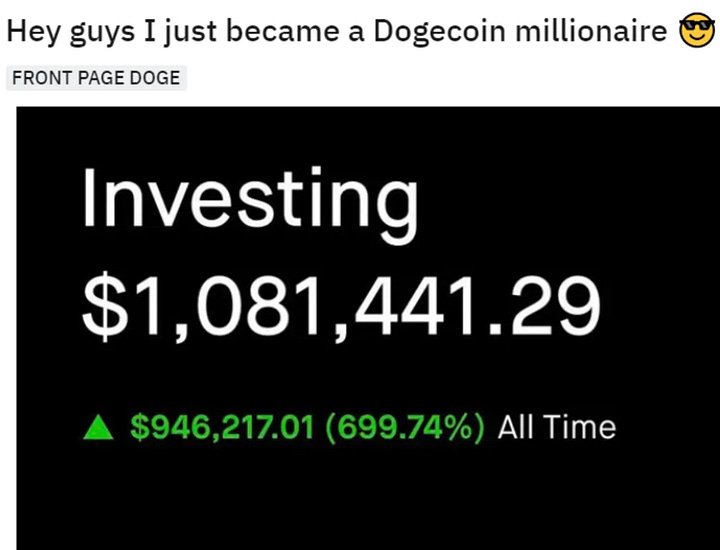
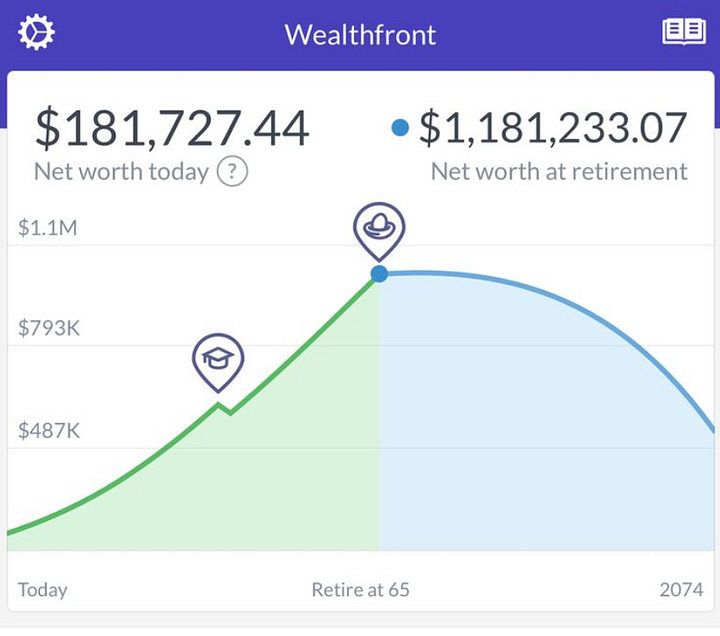
The pandemic-era boom in retail trading allowed Robinhood to go public at a valuation of about $30B in 2021. It doubled to $60B within months. Wealthfront, meanwhile, ended 2021 announcing its sale to UBS for a mere $1.4B. This is obviously a success, albeit modest compared to Robinhood. This comparison reflects the size difference between the church and casino parts of the market. Robinhood added 10 million users in 2021 alone, ending the year with 22.7 million funded accounts and $98 billion assets under custody. Wealthfront, at the same time, had less than half a million customers. Fourteen years into its existence, it was struggling to turn a profit.
It’s important to note, however, that Carroll wasn’t completely wrong – Wealthfront did appeal to a certain demographic: digital-native customers with real savings, looking to manage them in a responsible manner. This group was managing $27B with Wealthfront at the end of 2021 – more than $57k on average per customer, and almost 15 times the average Robinhood account.
Carroll’s prediction missed the financial nihilism trend, whereby millennials and Gen Z favored the casino over what Wealthfront had to offer. There was indeed demand for the latter, alas limited to a smaller segment of the market: the churchgoers, to keep using Buffett’s metaphor.
Things seemed particularly dire after UBS announced it was walking away from the deal, in September 2022. Still a money-losing business, Wealthfront had enough cash for less than six months of expenses. It was a challenging environment for raising money, with ZIRP ending and fintech valuations crashing down. But rising interest rates turned out to be a gift for Wealthfront. Its high-yield cash management feature found an instantly strong product-market fit as a standalone offering.
Amid recession fears, the stock and crypto crashes of 2022 pushed people away from the casino, while rising interest rates made conservative church-type investments seem more attractive. People were finally able to earn interest on their cash, rather than losing it in the stock market. Yield chasing became a trend, with consumers moving their cash to wherever it earned the highest interest. Wealthfront, with its fully automated asset management platform, was poised to offer competitive yields, while still making money for itself. In its S-1, Wealthfront noted that its cash management assets grew almost 20x in three years, going from $2.4B in April 2022 to over $46B in July 2025.
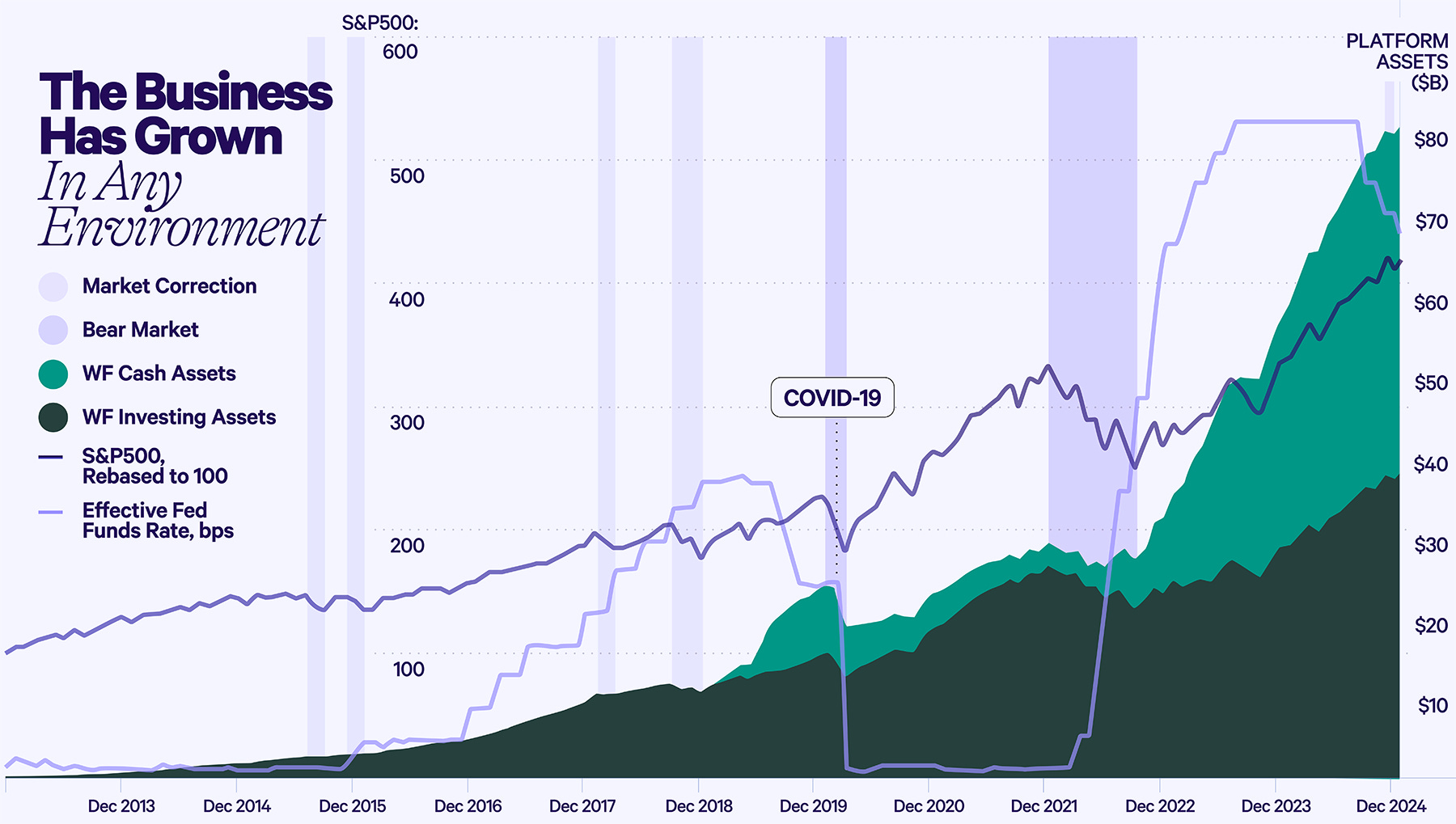
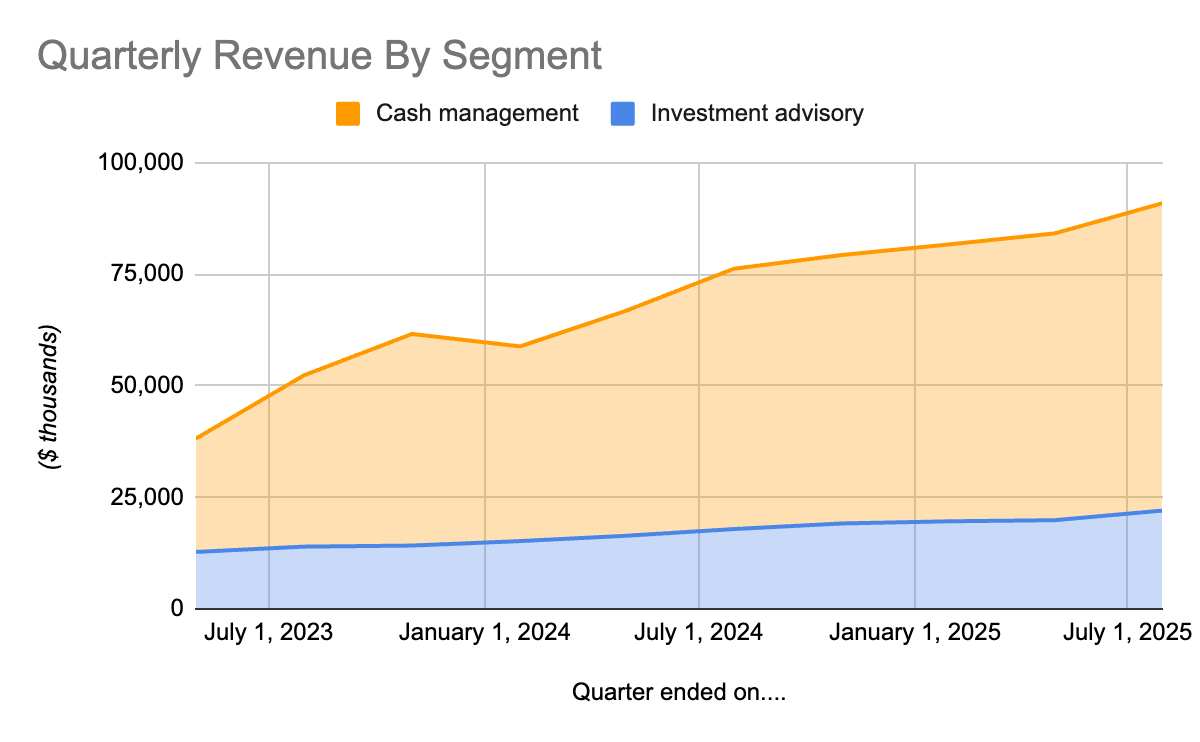
Not only did Wealthfront’s cash assets surpass its investing assets, the ~0.60% take rate from cash was several times higher than the 0.22% earned on investing assets. As a result, cash management revenue quickly dwarfed the revenue Wealthfront made from investment advisory.
Thanks to that tremendous and sudden spike in cash management revenue, Wealthfront became profitable by the second quarter of 2023, and went public at the end of 2025. The IPO valued Wealthfront at $2 billion, over 40% more than the $1.4B price tag UBS was supposed to pay in 2022.
The collapse of the UBS deal, amidst the high inflation of 2022, looked like a disaster at the time. It turned out to be the luckiest thing that ever happened to Wealthfront. But luck is not a business strategy; could Wealthfront turn this windfall into a durable business?
Wealthfront’s stock dropped over 30% this month, having recently reported a deceleration in growth. But the market might be missing how sober and long-term minded Wealthfront’s strategy actually is.
Imagine you’re running a venture-backed company; you’ve found product-market fit, and spent a decade building a business around it. You suddenly realize you can spin off a piece of your infrastructure into a standalone business. It is growing so fast that it eclipses your original business. It’s far more profitable. It feels like Amazon starting with e-commerce and discovering AWS. Or Netflix shifting from DVD-by-mail to streaming. The right move, it seems, is to adapt. Shift the focus away from the mature business as it hits its ceiling. Lean into the serendipity, and go all in pivoting to the new and better business line. Right?
Well, not necessarily.
There is something far more important than short-term growth and margins: durability. A moat. From Warren Buffett’s 2007 letter to shareholders:
A truly great business must have an enduring “moat” that protects excellent returns on invested
capital. The dynamics of capitalism guarantee that competitors will repeatedly assault any business “castle” that is earning high returns. Therefore a formidable barrier such as a company’s being the lowcost producer (GEICO, Costco) or possessing a powerful world-wide brand (Coca-Cola, Gillette, American Express) is essential for sustained success. Business history is filled with “Roman Candles,” companies whose moats proved illusory and were soon crossed.
[...] A moat that must be continuously rebuilt will eventually be no moat at all.
As lucrative as Wealthfront’s cash management operation has been, it does not have much of a moat2. First, switching costs are low. Yield chasers who park their cash with Wealthfront can tap a button and move to a competitor offering a higher rate. Then there’s the macro exposure. Demand for cash management exploded when the Fed sharply raised rates; what would happen if it lowered them? Modeling this business requires clairvoyance about Fed actions 5-10 years out.
It’s easy to imagine a different management team being dazzled by the rapidly growing cash management profits. Inspired by Silicon Valley culture, they might get tempted to raise money with a vision of going after a huge TAM: the global market for high-yield cash accounts. Then burn investors’ money on acquiring customers at any price. Until rates drop. Or a VC-backed competitor starts subsidizing customers in an attempt to win over the market. It’s risky to pour money into a business without a moat. Interestingly, Wealtfhront is pursuing a different strategy.
[…] So we think in terms of that moat – and the ability to keep its width, and its impossibility of being crossed – as the primary criterion of a great business.
And to our managers, we say we want the moat widened every year. You know, that does not necessarily mean that the profit is more this year than last year, because it won’t be sometimes.
But if the moat is widened every year, the business will do very well.
- Warren Buffett, Berkshire Hathaway’s 2000 Annual Meeting.
Wealthfront’s strategy is focused on moat-building. It attempts to lock in its cash customers by incentivizing them to set up direct deposit. This is the classic banking playbook: once a customer sets up their account details with their employer and automatic bill payments, it’s hard for them to leave. What’s interesting is that unlike the typical $500 one-time bonus banks tend to offer, Wealthfront appeals to what its customers are truly after: a permanent 0.25% yield boost. Wealthfront is effectively taking a short-term hit – by reducing its take rate – in order to widen its moat.
And one more thing: to win the additional yield, customers must also open and fund an investment advisory account.
Wealthfront does not treat its investment advisory operation as a legacy business with inferior economics; rather, it prioritizes it. Effectively giving money to clients whole move funds from cash (0.60%3 take rate) to investments (0.22% take rate).
In other words, Wealthfront is “paying” its customers for the right to earn less money.
This might sound counter-intuitive. On the recent quarterly earnings, Wealthfront reported a 39% growth in advisory assets (lower take rate), and only 3% increase in cash management assets (higher take rate). The cash management take rate went down, partially as a result of the yield boost. This puzzled the analysts on the earnings call, most of whom had questions about the new incentive. The confusion is understandable. Wealthfront is, presumably, proactively sabotaging its own profitability. But it makes perfect sense when considering how wide the moat is around the investment advisory business.
Investment accounts, in general, tend to be sticky. Unlike cash, moving a portfolio can be a real hassle that most customers would prefer to avoid, unless something is materially broken. Wealthfront’s advisory product has additional layers of lock-in. One is direct indexing: instead of buying a handful of ETFs, Wealthfront’s robo-advisor tailors a “custom ETF” per customer through directly buying the underlying stocks. This could result in a portfolio made up of hundreds of individual stocks, including fractional shares that can’t be transferred without selling and triggering taxable events.
Adding to the complexity of transferring out of Wealthfront is tax-loss harvesting; through routine automated selling of losing positions4, the Wealthfront account accumulates capital losses that could be used against future gains. This is an awesome feature of the automated platform, but another headache for those looking to move their Wealthfront investment account.
So while the growth charts above made the cash side of the house seem more exciting, the advisory business has more compelling long-term prospects. In addition to a strong lock-in, stock market gains act as a tailwind to the asset base, on top of new clients and deposits.
In nudging its cash customers into advisory accounts, Wealthfront is following Buffett’s instructions to Berkshire managers: widen the moat every year and the business will do well, even if profit doesn’t grow in the short-term.
It’s also what Wealthfront has been telling its customers since the very beginning: focus on what’s right for the long-term, don’t get distracted by short-term thrills, and you’ll do well. The company is following its own advice.
Disclaimer: Long WLTH. Not financial advice. This post is for educational and general purposes only and should not be relied upon for investment decisions.
Sure, you could use Robinhood to manage a lazy ETF porftolio. And I’m sure some people do. That is not what the gamified user experience is trying to encourage though.
Wealthfront’s management has been emphasizing their automated money management infrastructure as a source of competitive advantage. And indeed, an efficient cost structure can be an advantage, as the low cost producer can typically make money in commodity markets. But even if that’s true, and competitors would find it challenging to match Wealthfront’s yields (which doesn’t seem to be the case) — this doesn’t make for much of a moat, as some brokers might treat cash management as a loss leader to attract more business.
It should be noted that take rate from cash management has been somewhat dropping in recent years, which is probably another testament to the competitive pressures and lack of a moat for high yield cash accounts.
No posts
Comments
Nothing yet. Say the first thing.
Sign in to join the conversation.