
As promised, when we wrote our first article on the RWC2027 rankings race, we’re back to look at what has happened to the 24 Rugby World Cup teams on the next stage of their journey.
A quick refresher - we’ve taken a snapshot of the World Rugby rankings at the date of the draw in December 2025, and in our first article, we compared those rankings with the rankings 667 days before, which, by an amazing coincidence, is the same number of days between the draw and the start of the 2027 tournament.
We also added the latest rankings just before the most recent Test window which included the Nations Championship, the Nations Cup, and assorted other Test matches.
Now we’re back to review what happened throughout that July Test window, and just in time for the next Test window starting this weekend. We’ll use the same baseline as our reference point - the December 2025 Draw - and compare that with the latest rankings.
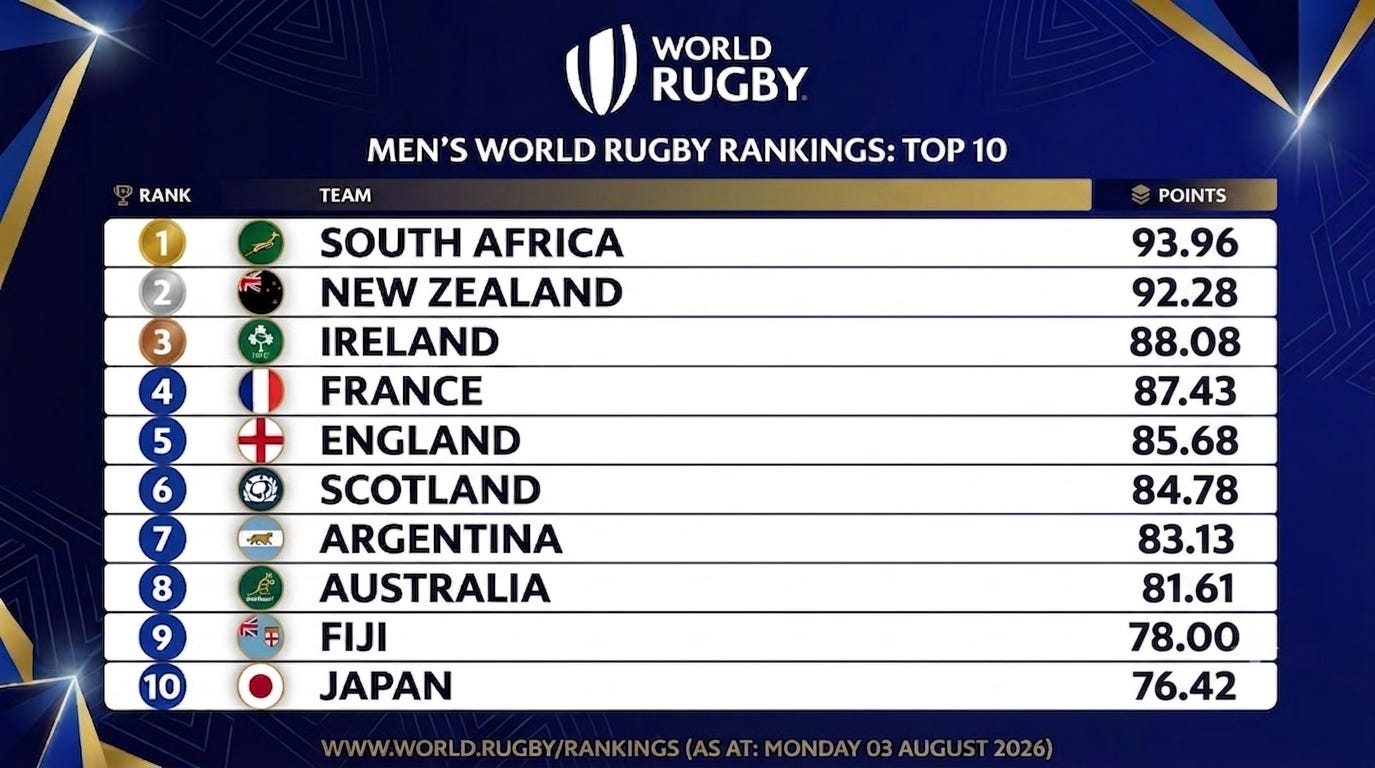
But first, another little refresher on how the rankings work, and a possible glitch in the matrix.
Firstly, we need to separate rankings from ranking points. The latter determines the former, and the latter nearly always changes, but the former may not. Also, teams may change their ranking without having played at all, due to the ranking movements of teams around them.
Secondly - ranking points are head-to-head, so it’s a zero sum game in any match. The winning team will gain as many points as the losing team loses. Simple. However, how many points are in play depends on a few different factors.
Let’s start with the result - there are five possible outcomes:
Win by more than 15
Win by 15 of less
Draw
Lose by 15 or fewer
Lose by more than 15.
Each variation carries a separate weighting. That weighting is determined by the ratings gap between the teams, which, given the algorithm used, means if the higher ranked team wins, they gain fewer points (and the lower ranked team loses fewer points).
However, if the lower ranked team wins, they gain more points for knocking off a higher ranked team (and the higher ranked therefore also loses more points). A margin of greater than 15 results in an added weighting multiple of 1.5.
Now here is where it gets really interesting. To take into account the benefits of playing at home, there was also a loading added to the home team, which meant their ranking points were notionally higher.
Counterintuitively, this generally meant the higher-ranked home team gained less benefit from winning at home but meant a lower-ranked team winning away gained lots of points. Until now.
Under cover of darkness, World Rugby changed the ranking system with effect from the 1st of July.
There is now no longer a weighting for the home team. The rationale is that there are now too many Tests played in neutral locations, for a multitude of reasons, such as tournament play or financial and logistical reasons. So that loading has been done away with. Just as the All Blacks take on a major tour of South Africa.

Had the old system stayed in place and New Zealand won the series, we may well have seen a change in the rankings at the top. The new system decreases that chance, as there are fewer ranking points on offer for the lower ranked away team, and more points on offer for the higher ranked home team.
This may also impact the rankings on the run into the RWC, given we’ve been looking at ranking changes since 2024. Will this decrease the amount of change? Will it entrench the incumbents? Only time will tell.
Having taken that diversion, what can we learn from the latest rankings?
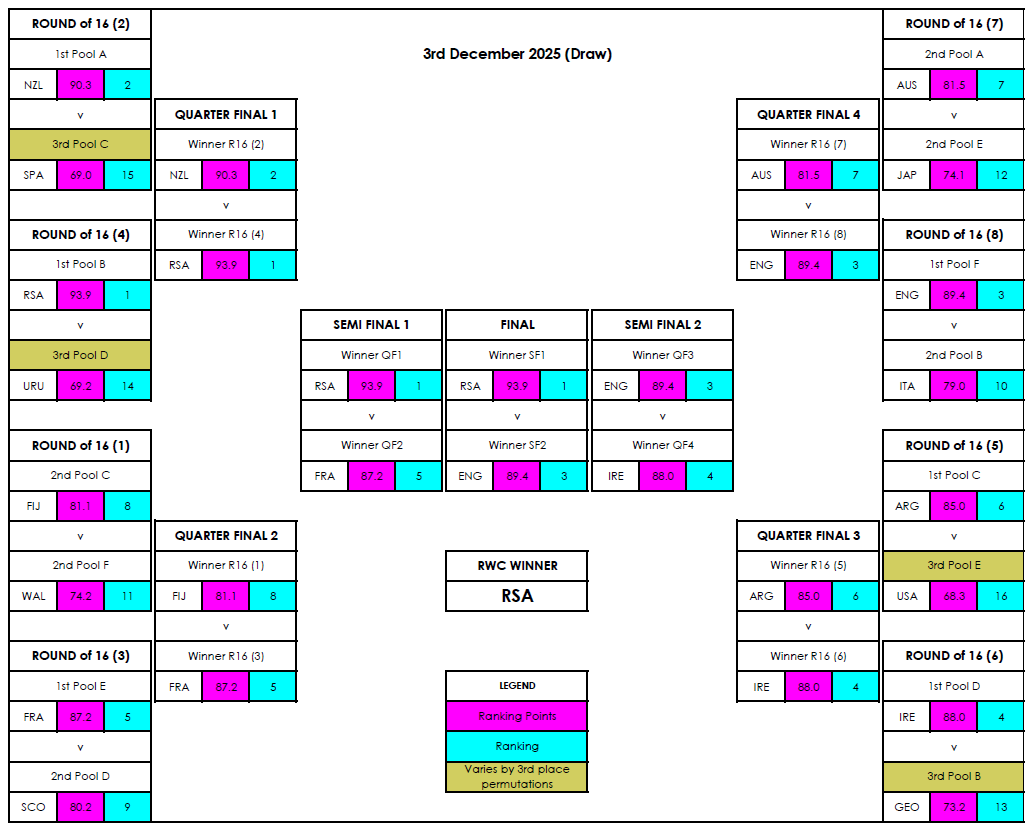
As of 3 December 2025 – when the RWC2027 draw was done
As of Monday, 3 August 2026 – latest update after the July international window
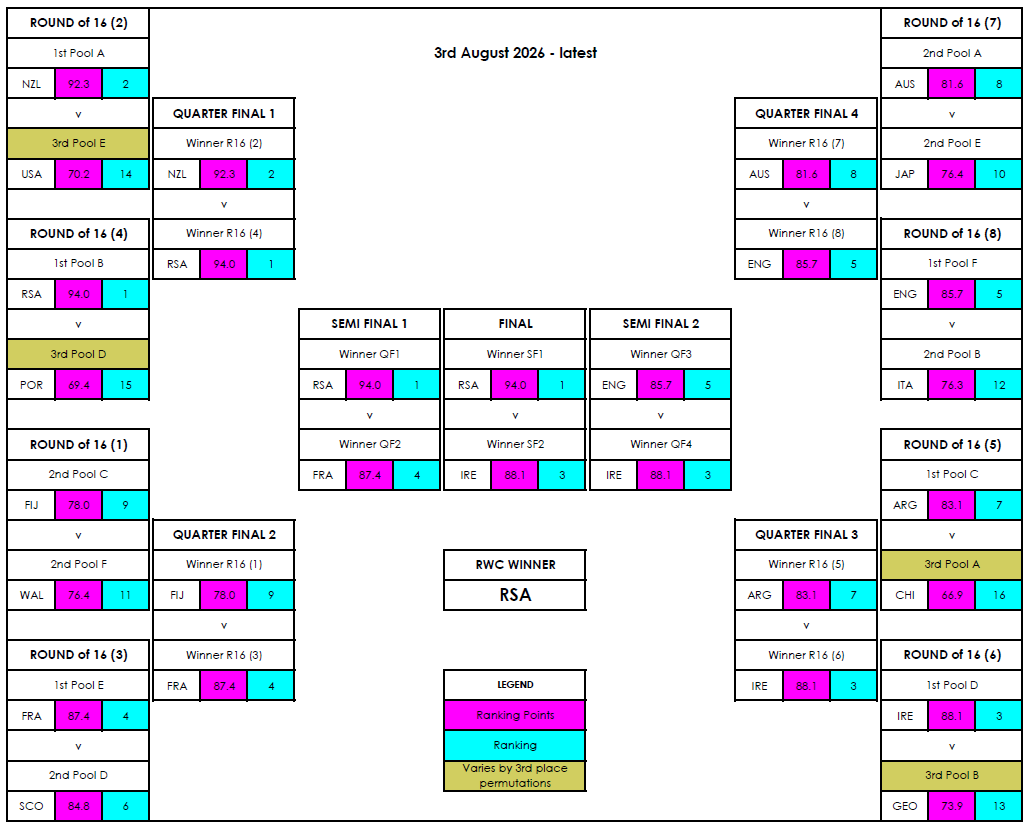
Pool D remains the strongest, Pool F the weakest.
We have three pairs, with D and B closely ranked, followed by similar margins between A and E, and then C and F.
Pool D has 308 ranking points, Pool F 285.
Once again, we have semi-finals featuring South Africa against France and England against Ireland, with South Africa taking the final from Ireland.
QF1 - the winners of Pool A and Pool B, is still the biggest match, followed by the Final. Based on ranking points, that match will be NZL v RSA.
Worth noting, RSA plays the last match of the pool games, against Romania. All other results will be known by then. Should NZ finish top of Pool A, and RSA want to avoid them, the other side of the draw does beckon...
All countries have changed their ranking points since the RWC2027 draw, but five have the same ranking as they did at the date of the draw: South Africa, New Zealand, Wales, Georgia, and Hong Kong China.
Where it continues to be tight and providing plenty of action is in the battle for 3rd and 4th in the Pools.
At the moment, the hot spots are Pool C (Spain and Canada), Pool D (Uruguay and Portugal), and Pool E (USA and Samoa).
Then there is the battle across the pools for the best four third places. The combination of these then determines the Round of 16, with different crossovers depending on the permutations. So, plenty to play for.
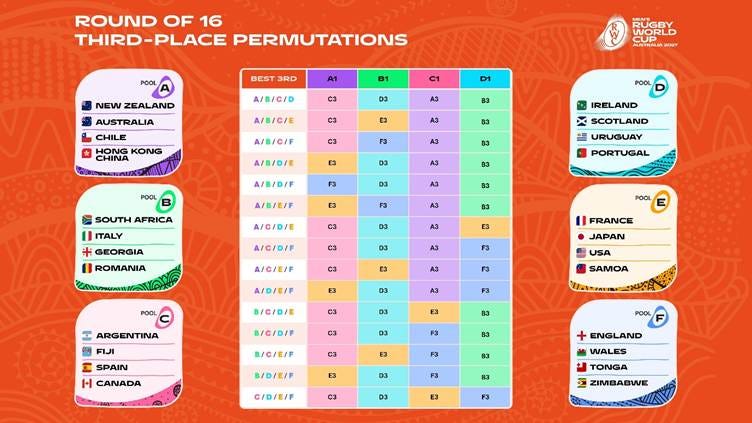
This weekend gives us a little taste of what can happen, or not.
For example, South Africa can’t gain any more ranking points if they beat Argentina, as the rankings point gap between the two teams is too high.
However, if South Africa were to lose, they would drop to 2nd in the rankings, behind New Zealand, who don’t play.
Meanwhile, irrespective of the result, Australia’s ranking won’t change, as there is too much of a ranking points gap to Argentina above them, and to Fiji below them (who aren’t playing) to make a difference. Australia’s ranking points WILL change, it’s just a question of by how much.
We now have a steady stream of Test matches between now and October - what’s not to like about that?
We’ll take some more snapshots as required and then have a look at how the rankings are shaping before and after the Test festival in November.
Comments
Nothing yet. Say the first thing.
Sign in to join the conversation.