
In the latest edition of Ask the Ref, experienced NSW Referee Rob McKay is here to answer all your questions with clear, simple explanations. In true ‘referee speak’, if you like.
An early wish list item of 8/9 Rugby, this is an opportunity to engage in discussion about the Laws that you don’t generally find elsewhere. And yes, we want you to submit your questions for future editions!
Why are ‘non-participating’ players sanctioned so much more heavily, and how long a suspension might he have been looking at?
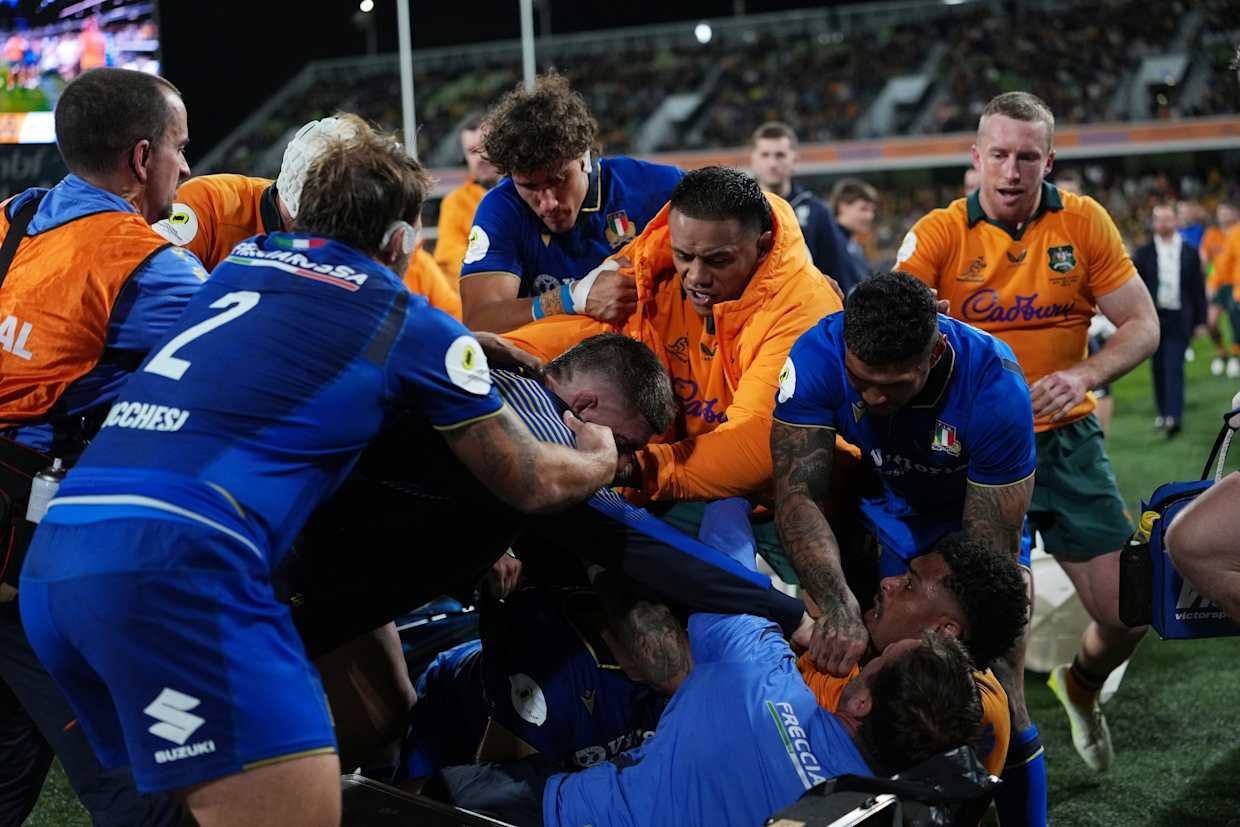
After Riccioni was red carded, quite a feat in itself considering he wasn’t on the field at the time, many were left pondering how this could be so. Some even went so far as to suggest it was unprecedented.
And yet, it wasn’t even the first such occurrence that day! Serendipitously, an almost identical scenario had played out in the Sydney suburban competition half a dozen hours or so prior, and this author was the referee. Red cards can be a bit like buses sometimes...
But how is it so? As ever, we delve into our reference - the Laws of the Game - and two key components become apparent:
LAW 6 Match Officials
DUTIES OF THE REFEREE DURING A MATCH
Within the playing enclosure:
The referee, alongside the other appointed match officials, is the sole judge of fact and of law during a match. Match officials must apply the laws of the game fairly in every match.
Let’s unpack that a bit. ‘Playing enclosure’ is the key, and we find that in the Definitions:
Playing enclosure: The playing area plus a space around it, which is known as the perimeter area. Law 1 supplements this with several diagrams and importantly, the Playing Area includes the technical zones.
Very clearly, the match officials have jurisdiction. Then it becomes a question of the most likely offence.
A fracas or a melee in a Test is not uncommon, and unless there is something particularly egregious, there is a captain’s chat, the players cool down, and we move forward. However, a bench player becoming involved crosses the line - literally and metaphorically, and hence we saw the match officials take a hard line here by issuing a red card to Riccioni, and levying a charge of under Law 9.27: “A player must not do anything that is against the spirit of good sportsmanship”.
At which point it enters the normal judicial process. In this case, with the Nations Championship being managed by SANZAAR and the Six Nations, SANZAAR took the lead, a hearing was held, the Foul Play Review Committee determined that the act of foul play merited a low-end entry point of four weeks, which ended up as two weeks.
It certainly wasn’t a hanging offence as some saw it, but it’s something that needs to be promptly addressed, and it was.
It does also highlight the increasing strength of the Laws and supporting structures for dealing with unwanted behaviour - more about that another day.
There is a LOT to unpack here, so let’s start with some context. Which means going directly to the source - the World Rugby TMO Protocol.
Under Section 1: Guiding Principles, we kick off with the following:
“The referee remains the lead decision-maker of the officiating team. The intention of the protocol is to provide the referee, assistant referees and the TMO (commonly referred to as the Team of 4 – Tof4) with a technology-based solution to collectively make better and more accurate decisions.”
“The Protocol operates in the space commonly defined as ‘clear and obvious’”.
“Clear and obvious” - highlighted not by me, but in the document itself. Remember those words.
So, to the match and what ultimately became the final play of the game.
The play takes us to the right-hand corner and a possible Argentinian try, and immediately it looks tight. The Assistant Referee (AR) on that side is Nika Amashukeli. Gus and Nika have a quick chat, with Nika saying he has seen an on-field grounding but to check.
On that basis, Gus says, “On field try” and heads upstairs to the TMO, Brett Cronan.
Brett responds immediately with “This is EXTREMELY tight”.
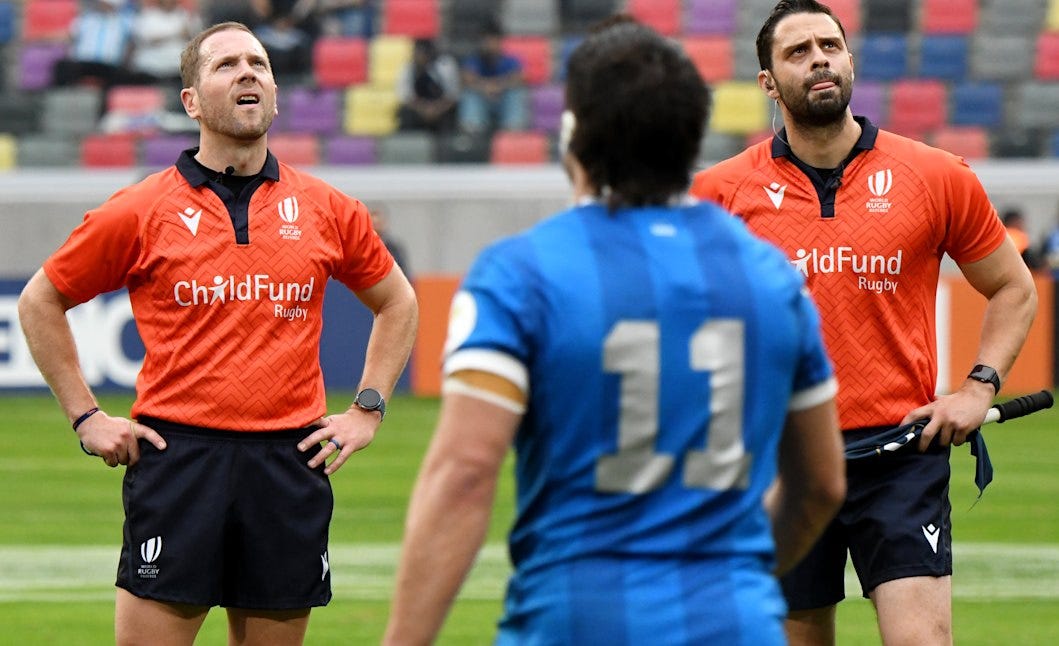
Depending on the exact equipment, he probably has a screen on delay, which means he’s already had a closer look and knows how tight this is. Meanwhile, Gus and Nika are now joined by the other AR, Paul Williams.
There is a brief discussion about the first tackle, with Gus declaring: “Around the shoulder for me” followed by “I’m happy”.
That’s a contextual decision, built out from what has happened throughout the game. It’s an easy penalty in community rugby, but not so at the elite level. Similarly, the ball carrier diving to score and the tackler make contact low to the ground - a common enough situation during a game where the referee may call “falling, no foul play, play on” or similar.
At this point, both teams are trying to crowd the match officials, which is not helping. If anything, it’s counter-productive to their respective causes. The red mist has descended for both teams.
The MOs are now looking at the screen inside the stadium. Bear in mind we don’t know what they’re seeing, nor the quality of the screen. We also know TMO Brett Cronan is again struggling to access the footage he wants from the Director, not for the first time during the match.
It’s unusual to hear the TMO request angles over the open comms line, and what he wants is a frame by frame shot from the best angle, which he eventually receives, and which we also see on our broadcast screens at home.
Meanwhile Pablo Matera is still trying to influence the decision. Inappropriate and messy. And, spoiler alert, ultimately unhelpful. Yet more noise on top of what is already a noisy environment. It’s a long way from ideal.
It’s worth pointing out Gus and Brett have worked together a lot, both at Super and Test level. They’re both in the Australian system and there is a level of trust there, and here we see that dynamic come into play.
There is some to-ing and fro-ing and then Brett says “it’s clearly” simultaneous. Then, to reiterate, he says “clear and obvious”. That is what Gus needs to hear - and that results in the final decision - no try. Correct in Law.
And, upholding another tenet of the TMO protocol, namely: “The Protocol enables the To4 to make formal referrals where discussions are needed to decide on the best game decision”.
The consequences of a knock forward (note: it’s no longer a called a ‘knock-on’), the circumstances surrounding it and the appropriate sanction still seem to confuse way too many people, especially within the continuum stretching from attempted intercepts to blatant knock downs. So, we’ll try and make it a little clearer for everyone.
In such a scenario, the simple test is, “Did the player have a realistic chance of regathering the ball?”
If the answer is yes, assuming no advantage, we end up with a scrum to the non-offending team.
If the answer is no, we then enter a more complicated decision making matrix.
It’s also worth noting, this is for XVs, not Sevens (more about that later). Note also, this assumes no advantage accrues to the non-offending team, rather than an automatic and immediate sanction.
If the answer is no, we’re now looking at a penalty as a minimum (a deliberate infringement under Law 9.7).
The next question to ask is, “Was there a line break opportunity?”
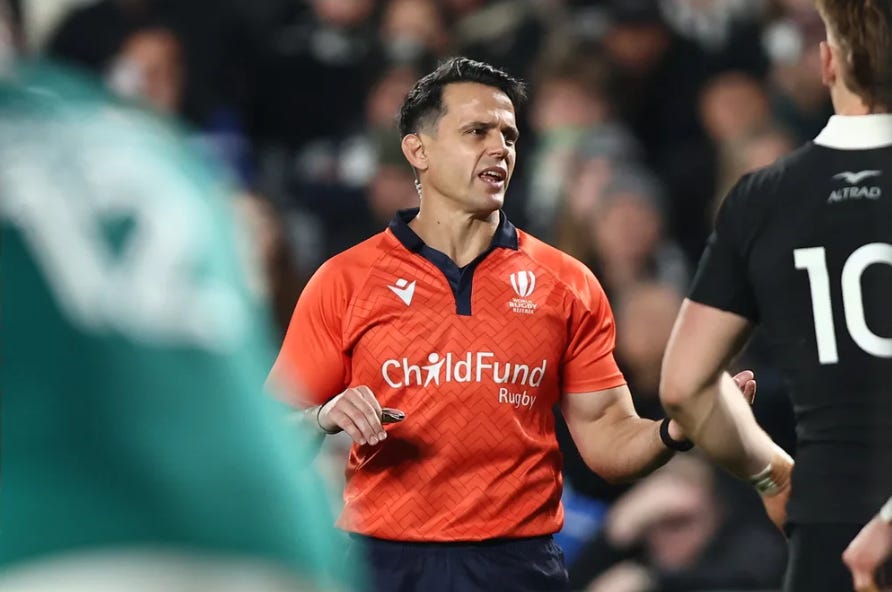
This may require consultation with the ARs and TMO, to enable a wider view of the field, and the opportunity forgone. If the answer is yes, we land on penalty and a yellow card.
Then a further question is asked (and if we’re really close to the line, we may skip the line break question entirely): “Would a probable try have been scored?”
If the answer is again yes, then we’ve landed the holy trinity - PK + YC + PT. Simple, right?
Just about. But there are quirks. Of course there are.
The two biggest are TMO Protocol variations and Super Rugby Pacific (SRP) variations.
SRP runs a shorter TMO protocol, so it may not be possible to come back to such a situation, and this was something Nic Berry alluded to with the Quinn Tupaea example in the New Zealand-Ireland game.
Secondly, the SRP variations being played this year give the MOs the option of NOT imposing a YC when a PT is awarded.
The other nuance often missed is that a deliberate knock BACK is perfectly acceptable - there is no infringement. A trap for new players which has caught out many elite players AND coaches!
Finally, to Sevens. A deliberate knock-forward is almost without exception a YC, thereby changing the risk/reward scenario and promoting open play. And there’s lots to like about that.
Do you have a question about the Laws, or the way the game is being officiated, for Rob to tackle in the next edition of Ask the Ref? Drop your question into the comments below, and we’ll tackle it in coming editions.
🎧 Catch Rob on Play On: The Rugby Referee podcast, where he’s joined every week by Candace Barritt and former Super Rugby ref Nathan Pearce. Get it on Spotify and pod platforms everywhere!
Comments
Nothing yet. Say the first thing.
Sign in to join the conversation.