
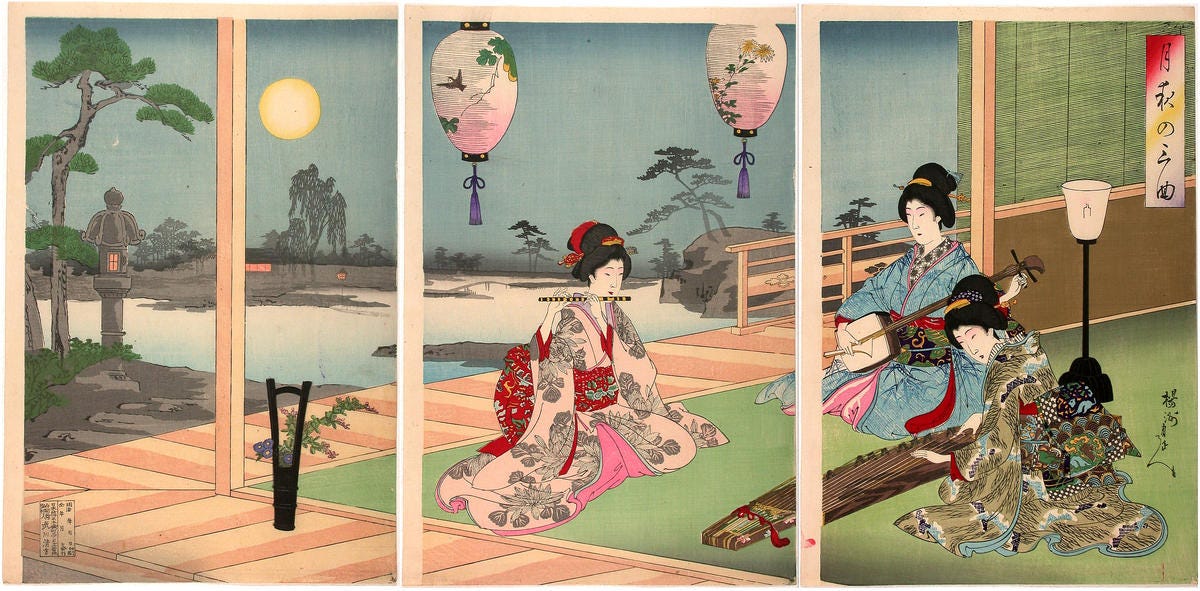
Happy New Year! That is, at least, according to lunar calendars like the Koyomi1. We just wrapped up a full year of microseasons posts, and I wanted to take a look back at the kō we’ve covered so far. However, writing about all 72 in one post would probably keep us here until well into next year.
One way that modern Japan celebrates the end of the year is the New Year’s Eve television program Kōhaku Uta Gassen (紅白歌合戦), a big battle of the bands that airs December 31st on the national broadcaster NHK. Each year, noteworthy musical groups face off split into a Red Team and White Team2 (girls versus boys). Since poetry recitals and song have long been a common way in Japan to celebrate the microseasons and other seasonal events, it seemed fitting to connect these old observances to modern music.
So, with apologies to Make Believe Mailer, here’s a song for each microseason we’ve covered. From the kigo in haiku to modern melodies, the acknowledgement and awareness of nature’s shifting seasons and its various signs is deeply ingrained in Japanese culture, which necessarily includes pop culture. After all, the Kurashi no Koyomi was made for the masses.

These were selected via the rigorously researched and highly scientific process of “finding songs that I think sound good with matching words or themes to the kō.”3 For fun, I’ve also noted whether they’d be on the Red Team or White Team4, so feel free to vote in the comments on which you think deserves the win (this may wind up horribly unbalanced, but then again, so is NHK’s programme usually).
I’ve made a Spotify playlist of all the songs, if you’re seeking a soundtrack to your own late New Years party that will be very difficult to explain to guest or would simply like to come back to listen as you read through each kō coming up this year.
This will be split into two separate posts, mainly because I realized it was taking me longer than expected to put this all together. I’ve gotten distracted more than once discovering a lot of fun, new music. It’s shaping up into a very interesting cross-section of genres and artists, so I hope you enjoy it and maybe find something new.
(Note: the amount of embedded links and overall length might not play well with your email inbox, so this might be best viewed on the Substack website)
Without further ado: the 72 Microseasons In Song, Part One
And that’s halfway! 36 out of 72, spring and summer.
For the moment, I need to go finish writing up our new post for Kō 1 before the microseason’s over. You can expect that in your inbox next, then hopefully the rest of the playlist soon.
See you next kō~
[Images & info by kurashikata.com, kurashi-no-hotorisya.jp, 543life.com, and Wikipedia except where otherwise noted]
While not as big in Japan these days, the Lunar New Year is still very much celebrated in mainland and Southeast Asia, as well as the global Asian diaspora—for 2024 it will be officially celebrated on Saturday, February 10th
Kōhaku (紅白) literally means “red and white,” which are Japan’s main celebratory colors for auspicious occasions but also the main colors used for competing teams—this is said to derive from a famous 12th century civil war between the Taira and Minamoto clans, whose standards bore these opposing colors
Also, if we want to split hairs (and if you’re here with me in the footnotes I assume you do), 紅 is not so much “red” as it is “vermillion,” a more orangey tone most commonly seen as the painting for torii shrine gates
Japan color history could make for an interesting newsletter…
This would’ve been an extremely laborious process without the website Mojim, which allows for searching for Japanese song titles and lyrics by keyword
NHK’s criteria are simply: whether the group is led by a male or female vocalist
There are approximately ten million Japanese songs about sakura, but I picked this one due to the flagrant personal bias that is my longtime appreciation for Hikaru Utada
Utada has publicly spoken about being nonbinary and thus uncomfortable with strict labeling into a specific gender role—feel free to count them towards whichever team you like better and think should win
(And of course if anyone is aware about similar statements by the other artists here, feel free to let me know!)
First written in 1913, 早春賦 (“Ode to Early Spring”) is a staple of classic Japanese music and included in the “100 Song Selection” created by the country’s national PTA as a recommendation to schools for students to sing, and often appears in NHK’s daily radio programme みんなのうた (“Songs For Everyone”)
There’s no end of covers for it, so I chose one that I liked and fit the playlist well
If, listening to this, you thought “wait isn’t that Auld Lang Syne?” you’d be half-right! In Japan, the familiar New Year’s tune was given its own set of wholly different lyrics, which were created as a children’s song but gradually came back around to being sung during New Year’s in Japan as well
Given this is technically a New Year’s post, I thought it only appropriate to include this very nice version by modern “city pop” producer Cunimondo Takiguchi
Some of you may have seen this coming, but what else could I possibly choose?
No posts
Comments
Nothing yet. Say the first thing.
Sign in to join the conversation.