
Sungchul Ji, Ph.D.
Emeritus Professor of Theoretical Cell Biology, Rutgers University
with conceptual assistance from ChatGPT
For more than a century, neuroscientists have tried to understand one of nature’s greatest mysteries: How does the brain generate thought, consciousness, and meaning?
As neuroscience has progressed, researchers have developed increasingly sophisticated mathematical tools to describe brain activity. Three approaches illustrate this evolution particularly well:
Markov Chains — the brain as a sequence of changing states.
Markov Fields — the brain as a network of interacting elements.
The Dynamic Body-Centered Tetrahedron (Dynamic BCT) — the brain as a continuously evolving relational geometry.
Although the third approach remains speculative, comparing these three perspectives reveals an interesting trend in modern science: our understanding of the brain appears to be shifting from objects, to networks, and perhaps eventually to organization itself.
1. Stage One: The Brain as a Sequence
The simplest mathematical picture of the brain is the Markov chain [1].
The central assumption is surprisingly simple:
The future depends only on the present.
Mathematically,

In plain English,
if we know the brain’s present state,
we no longer need its earlier history to predict its next state.
Imagine walking through a house.
Bedroom
↓
Kitchen
↓
Living room
↓
Front door
Each room leads probabilistically to the next.
This is a Markov chain.
Many models of decision making, learning, and perception have successfully used this idea.
Its strength lies in simplicity.
Its weakness is equally obvious.
The human brain is rarely a simple sequence of events.
Billions of neurons interact simultaneously.
2. Stage Two: The Brain as a Network
To address this complexity, scientists introduced Markov Random Fields, usually called Markov Fields [2].
Instead of describing a sequence,
they describe a network.
Rather than asking
“What happens next?”
they ask
“What influences what?”
Imagine four friends sitting around a table.
Each person’s opinion depends on the neighboring people.
No single person determines the conversation.
Instead,
the conversation emerges from everyone’s interactions.
This is the essence of a Markov field.
Modern neuroscience increasingly views the brain this way.
Memory,
attention,
emotion,
perception,
and decision making
all arise through massive networks of interacting neurons.
The emphasis has shifted
from individual neurons
to patterns of connectivity.
This represents a profound conceptual advance.
The brain becomes
not a sequence,
but a web.
3. Stage Three: The Brain as Relational Geometry
But perhaps another step is possible.
Recently I have been exploring what I call the Dynamic Body-Centered Tetrahedron (Dynamic BCT) [3].
Originally,
the Dynamic BCT emerged from an attempt to understand the relationship between the ordinary tetrahedron [4] and the four-dimensional hypertetrahedron, also known as the 5-cell [5].
Unexpectedly,
it suggested a new way of thinking about organization itself.
The Dynamic BCT consists of
four fixed vertices,
together with a fifth vertex that moves continuously.
Initially,
I regarded the moving vertex simply as a geometric point.
Now I think that interpretation may be incomplete.
The moving point may instead represent
a changing pattern of relationships.
4. A Different Kind of Coordinate
Every position of the moving vertex can be described by four barycentric coordinates

where
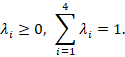
These numbers do more than specify position.
They naturally describe
relational strengths,
connection weights,
probabilities,
attention weights,
degrees of participation.
In other words,
the geometry already speaks the language of modern neuroscience.
Each position corresponds to one unique relational state.
This leads naturally to the following statement:
The Dynamic BCT defines not merely a geometric figure but a continuous manifold of relational configurations.
5. Beyond Networks
This is where the Dynamic BCT differs from an ordinary Markov field.
A Markov field describes
which nodes influence one another.
The Dynamic BCT describes
how the entire relational organization continuously changes.
Instead of representing
connections,
it represents
changing patterns of coordination.
One might imagine
four relatively stable neural assemblies
occupying the four fixed vertices.
The moving fifth vertex then represents
their continually changing integration.
The geometry itself becomes a map of organizational states.
6. Four Fundamental Principles
The interpretation becomes even richer if the four vertices represent
Energy
Matter
Information
Consciousness
The moving vertex then no longer represents another object.
Instead,
it represents
the current organization of these four principles.
Every point inside the Dynamic BCT corresponds to one possible balance among
energy,
matter,
information,
and consciousness.
The geometry becomes
a coordinate system
for organization itself.
7. A Possible Comparison
The three approaches may be summarized as follows.
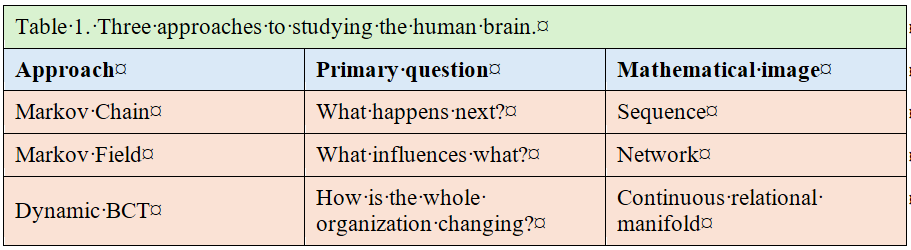
Each approach includes the strengths of the previous one while asking a broader question.
8. From Objects to Organization
Looking back,
I find this progression remarkably suggestive.
Classical neuroscience focused on neurons.
Later,
attention shifted toward neural networks.
Perhaps the next frontier lies in understanding
organization itself.
This possibility resonates with many ideas that have occupied my own research for decades.
Conformons describe organized molecular energy.
The Gnergy Principle describes organized information and energy.
The Cell Language Theory describes organized communication.
The Dynamic BCT may now describe organized relationships.
These are not disconnected ideas.
They all point toward organization as a fundamental scientific concept.
9. An Open Question
The Dynamic BCT should not yet be regarded as a theory of the brain.
It remains a conceptual framework.
Whether it can eventually produce experimentally testable predictions remains to be seen.
That challenge belongs to future work.
Yet history reminds us that many important scientific ideas began as simple geometrical insights.
Graphs eventually transformed computer science.
Differential geometry transformed Einstein’s theory of gravity.
Network theory transformed biology.
Perhaps a geometry of dynamic relational organization could one day illuminate aspects of consciousness that remain difficult to describe using either sequential models or static networks alone.
10. Toward a Geometry of Organization
One unexpected consequence of this comparison is that it suggests a broader evolution in scientific thinking.
The progression is not merely
Markov Chain
↓
Markov Field
↓
Dynamic BCT.
It is also
Sequence
↓
Network
↓
Organization.
Perhaps this is the deeper pattern.
The question is gradually changing.
Instead of asking
What is the brain made of?
or
Which neurons are connected?
we may eventually ask
What principles govern the continual organization of relationships?
If that turns out to be the right question, then geometry may once again become one of science’s most powerful languages—not simply the geometry of objects, but the geometry of organization.
Epilogue: A New Research Program?
I do not suggest that the Dynamic BCT should replace Markov chains or Markov fields. Both have proven mathematically powerful and experimentally valuable. Rather, I suggest that they may represent successive levels of description.
A Markov chain captures temporal succession.
A Markov field captures relational connectivity.
The Dynamic BCT seeks to capture the continuous evolution of relational organization itself.
Whether this third perspective ultimately proves useful is an empirical question. But if it does, it could point toward a broader scientific program—one in which geometry, network theory, neuroscience, and the study of consciousness begin to converge around a common mathematical language of organization.
In that sense, the Dynamic BCT is not proposed as an alternative to existing neuroscience, but as a possible extension of it. It asks whether the changing architecture of relationships—not merely the components or their connections—may be the deepest level at which complex systems, including the brain, are understood.
References:
[1] Markov chain. https://en.wikipedia.org/wiki/Markov_chain
[2] Markov random field. https://en.wikipedia.org/wiki/Markov_random_field
[3] Ji, S. (2026). Beyond Geometry: Could the Dynamic Body-Centered Tetrahedron Model Relationships Rather Than Objects?
https://622622.substack.com/p/beyond-geometry-could-the-dynamic
[4] Ji, S. (2026). Beyond Visibility. https://622622.substack.com/p/beyond-visibility
[5] 5-Cell. https://en.wikipedia.org/wiki/5-cell
Comments
Nothing yet. Say the first thing.
Sign in to join the conversation.