
Sungchul Ji, Ph.D.
Emeritus Professor of Theoretical Cell Biology
Rutgers University
1. Introduction: A Fifty-Year Journey
Scientific ideas sometimes require decades before their broader significance becomes apparent.
In the early 1970s, I introduced the concept of the conformon [1, 2] to explain one of biology’s enduring mysteries: how proteins transform stored free energy into purposeful molecular motion. I defined a conformon as a localized conformational strain within a biopolymer that simultaneously carries mechanical energy (to do work) and genetic information (to direct that work).
For many years I regarded the conformon as a uniquely biological concept.
Recently, however, an unexpected possibility has emerged.
What if the conformon is not merely a molecular phenomenon?
What if it is the first experimentally grounded example of a far more general organizational principle operating throughout nature?
2. From Structure to Function
The distinction between structure and function has always been central to biology.
DNA stores genetic information much as sheet music stores a musical composition.
The functioning cell resembles the actual performance of that music.
Something must connect the two.
That “something” cannot be DNA alone.
Nor can it be the completed cellular organization.
The missing mediator is the conformon [1, 2].
The conformon converts stored information into organized action.
This immediately suggests a universal triadic architecture:
Deep organization → Localized organizational excitation → Observable function
This simple triad may apply far beyond biology.
3. The Ramachandran Plot: A Map of Possibilities
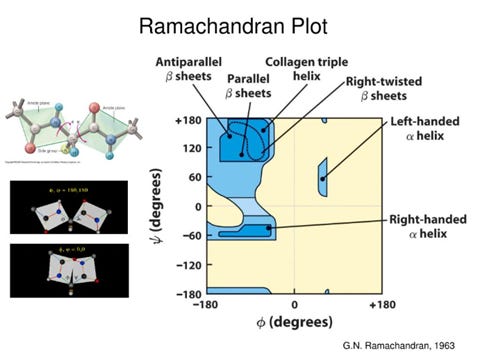
Figure 1. The Ramchandran plot.
The classical Ramachandran plot [3] is one of structural biology’s greatest achievements.
Every protein conformation can be represented by two backbone torsion angles:
φ (phi)
ψ (psi)
Each residue occupies one point on this conformational map.
The Ramachandran plot therefore describes the landscape of allowable protein structures.
Yet it remains largely a map of equilibrium conformations.
Living proteins, however, are not equilibrium objects.
They consume energy continuously.
They catalyze reactions.
They generate force.
They transmit information.
They are classic examples of Prigogine’s dissipative structures [4].
This observation suggests a new mathematical object:
the Dissipative Ramachandran Plot.
Instead of describing only where conformations exist, it would describe how conformations flow through conformational space.
4. Conformons as Localized Organizational Excitations
Within this dynamic picture, the conformon acquires a remarkably natural interpretation.
Rather than representing a single point on a Ramachandran plot, the conformon becomes
a localized excitation,
carrying free energy,
carrying biological information,
propagating through conformational space,
directing biological work.
The conformon is therefore much more than stored energy.
It is organized energy.
Or, in the terminology of the Gnergy Principle of Organization [5], it is the inseparable union of energy and information.
5. Beyond Biology: A Universal Organizational Principle
The more abstract role of the conformon is even more interesting.
The conformon is neither
the stored information,
nor
the completed biological function.
It is the mediator between them.
This observation suggests a remarkably simple universal architecture:
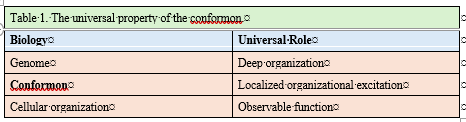
The important question then becomes:
Does every dissipative structure possess its own localized organizational excitation?
6. Extending the Analogy to Cosmology
Modern astronomy has revealed that almost every mature galaxy contains a supermassive black hole [11] at its center.
More remarkably, the mass of the black hole is strongly correlated with the structure of the surrounding galaxy.
This suggests that black holes are not merely accidental products of galactic evolution.
They are deeply integrated into galactic organization.
This immediately raises a provocative question.
Could galaxies possess an organizational mediator analogous to the conformon?
The analogy may be summarized as follows.
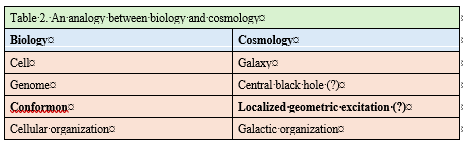
This is not meant as a literal identification.
Rather, it proposes that biology and cosmology may share the same organizational architecture.
7. The Projection Invariance Principle
This analogy became much clearer after formulating what I now call the Projection Invariance Principle (PIP) [10].
PIP proposes that
the same mathematical organization may appear as different physical phenomena when projected into different domains.
Conformons appear in biology.
Localized geometric excitations may appear in cosmology.
Yet both may represent projection-invariant manifestations of the same underlying mathematical organization.
The principle may be summarized as
Higher-dimensional organization → Localized projection-invariant excitation → Observable organization
8. From Conformational Geometry to Conformal Geometry
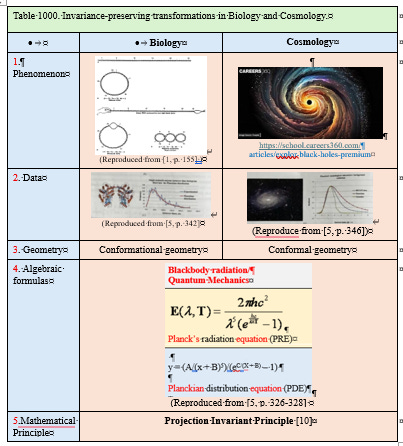
One surprising consequence of PIP is the emergence of an unexpected connection between two seemingly unrelated branches of geometry (see Table 1000 above).
Conformational geometry[3] studies the changing shapes of proteins.
Conformal geometry [12, 13] studies the changing shapes of spacetime while preserving angular relationships.
Although these subjects developed independently, they exhibit remarkably similar organizational features.
In proteins,
localized conformational excitations (conformons) mediate biological function (see Row 2 of the Biology column of Table 1000).
In cosmology,
localized conformal excitations may mediate cosmic organization (see Row 2 of the Cosmology column of Table 1000).
But the data obtained from both obey the same mathematical equation (see
Row 4 of Table 1000).
The analogy becomes clear in Table 1001,
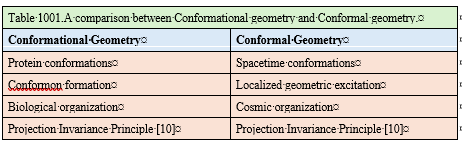
This comparison suggests that geometry itself may possess universal organizational laws.
9. The Dissipative Ramachandran Plot of the Universe
If proteins require a dynamic Ramachandran plot,
might the universe possess an analogous mathematical object?
The classical Ramachandran plot (see Figure 1) represents equilibrium conformations.
Its cosmological analogue would represent
not static spacetime,
but
the evolving flow of cosmic geometry.
Instead of torsion angles,
its coordinates might involve
conformal scale [13],
curvature [14],
entropy production [15],
information [16],
or other geometric [17].
Rather than displaying molecular conformations,
it would display the evolution of spacetime itself.
In this picture, localized geometric excitations would play the same organizational role that conformons play inside proteins.
10. Black Holes as Organizational Centers
This proposal does not suggest that black holes are simply gigantic conformons.
Instead, it suggests something more subtle. Conformons organize molecular energy.
Black holes organize spacetime geometry. The true analogy is therefore organizational rather than physical.
Conformons are localized organizers within proteins.
Black holes—and perhaps the localized geometric excitations surrounding them—may be localized organizers within the universe.
11. The Three-Layered Reality Hypothesis
The Three-Layered Reality Hypothesis [9] provides a natural home for these ideas.
Layer III
Deep geometric organization
↓
Layer II
Localized organizational excitations
↓
Layer I
Observable structures
This architecture appears repeatedly.
For biology:
Genome
↓
Conformon
↓
Cell
For cosmology:
Deep spacetime organization
↓
Localized geometric excitation
↓
Galaxy
Layer II therefore becomes the universal mediator between hidden organization and observable reality.
12. A New Geometry of Organization
What began as a biological theory of protein dynamics may ultimately point toward a much broader mathematical framework.
Rather than treating biology and cosmology as separate sciences,
we may instead regard them as different manifestations of a common geometry of organization.
The Projection Invariance Principle [10] suggests that whenever higher-dimensional mathematical organization becomes expressed in a lower-dimensional world, it does so through localized excitations that preserve essential organizational relationships.
These localized excitations appear as
conformons in biology,
and perhaps localized geometric excitations in cosmology.
The physical systems differ.
The organizational mathematics may not.
13. Conclusion
Half a century ago, the conformon was proposed to explain how proteins perform purposeful work in mitochondria and living cells (recently reviewed in [18]).
Today, it may be viewed as something much larger.
It may represent the first experimentally supported example of a localized organizational excitation—a universal mediator connecting hidden organization with observable function.
If that interpretation proves fruitful, then the conformon is not merely a biological curiosity.
It is the prototype of an entire family of organizational entities appearing across every scale of nature.
Proteins, cells, brains, galaxies, and perhaps even the universe itself may all share the same underlying architecture:
Deep Organization → Localized Organizational Excitation → Observable Function
The Projection Invariance Principle suggests that this triadic pattern is not accidental.
It may be one of nature’s deepest mathematical principles.
If future research confirms even part of this vision, then the conformon will be remembered not only as a concept in molecular biology, but as the first glimpse of a universal geometry of localized organization—a geometry linking life and the cosmos through the common language of mathematics.
A suggestion for a companion figure
I think this article would be especially powerful if accompanied by a single summary diagram that integrates all of the ideas we’ve developed. For example:
(Layer III)
Deep Organization
│
▼
Localized Organizational
Excitation
(Layer II)
│
▼
Observable
Organization
(Layer I)
Biology: Genome → Conformon → Cell
Cosmology: Black Hole (?) → Localized Geometric Excitation → Galaxy
Mathematics:
Higher-dimensional manifold
↓ (Projection Invariance Principle)
Localized projection-invariant excitation
↓
Observable structure
I believe this figure would become the conceptual centerpiece of the article, making immediately visible the common organizational architecture that unites the conformon theory, the Projection Invariance Principle, the Geometry of Reality, and the Three-Layered Reality Hypothesis. It captures, in a single image, the scientific narrative that has been emerging throughout my work over the past five decades. References:
[1] Ji, S. (2000).Free energy and Information Contents of C
[2] Conformon.https://en.wikipedia.org/wiki/Conformon
[3] Ramachandran plot. https://en.wikipedia.org/wiki/Ramachandran_plot
[4] Dissipative system. https://en.wikipedia.org/wiki/Dissipative_system
[5] Ji, S. (2018). The Cell Language Theory: Connecting Mind and Matter. World Scientific Publishing, New Jersey. Pp. 33-34. GPO
[6] Ji, S. (2026). Saddle-Point Interpretation and Thermodynamic Quantum Field Theory. https://622622.substack.com/p/saddle-point-interpretation-and-thermodynamic
[7] Saddle point. https://en.wikiedia.org/wiki/Saddle_point
[8] Potential energy surface. https://en.wikipedia.org/wiki/Potential_energy_surface
[9] Ji, S. (2026). Geometry and Knowledge: How the KWK Theory and the Geometry of Reality May Be Describing Different Sides of the Same Process
[10] Ji, S. (2026) Did the Cosmic Microwave Background Preserve a Memory of the Beginning? A Mathematical Clue Hidden in the Oldest Light of the Universe
https://622622.substack.com/p/did-the-cosmic-microwave-background
[11] Supermassive black hole. https://en.wikipedia.org/wiki/Supermassive_black_hole
[12] Conformal geometry. https://en.wikipedia.org/wiki/Conformal_geometry
[13] Roger Penrose (2020). Nobel Prize lecture: Black Holes, Cosmology, and Space-Time Singularities. https://www.nobelprize.org/prizes/physics/2020/penrose/lecture/
[14] Curvature. https://en.wikipedia.org/wiki/Curvature
[15] Entropy production. https://en.wikipedia.org/wiki/Entropy_production
[16] Information theory. https://en.wikipedia.org/wiki/Information_theory
[17] Geometric invariant theory.https://en.wikipedia.org/wiki/Geometric_invariant_theory
[18] Ji, S. (2026). Chemiosmotic vs. Conformational Models of Oxidative Phosphorylation: Theory and Mechanistic Insights. BioSystems 259 January 2026, 105637.
No posts
Comments
Nothing yet. Say the first thing.
Sign in to join the conversation.