
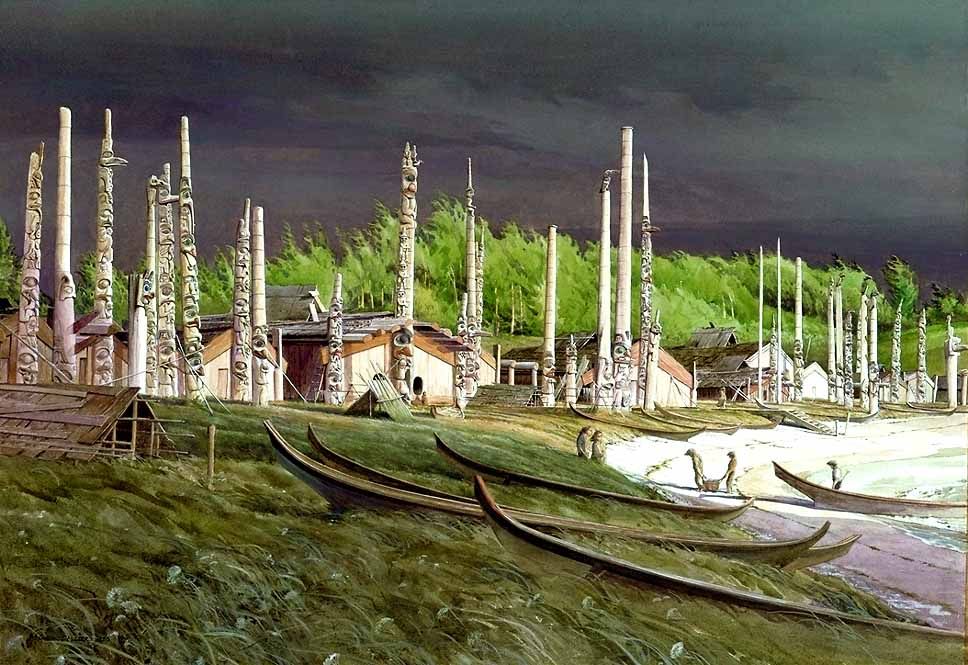
Masset circa 1876, © Gordon Miller, 1985, Canadian Museum of History
From A Story as Sharp as a Knife

Swanton’s hope, as he has told us, was to transcribe every story, or every mythic episode, told in Haida Gwaii. But you can no more record all the stories in a mythology than you can write down all the sentences in a language. A mythology is not a fixed body of stories; it is an open set. It is a narrative ecology; a watershed, a forest, a community of stories that are born and die and breed with one another and with stories from outside.
The mythteller’s calling differs little from the scientist’s. It is to elucidate the structure and the workings of the world. Myths are stories that investigate the nature of the world (whereas novels, for example, more often look at questions of proprietary interest to human beings alone). A genuine mythology is a systematically elaborated, extended, interconnected and adaptable set of myths. It is a kind of science in narrative form.
Science too is an ecology of ideas. Science, in fact, is a kind of mythology in computational form. Where science is in fashion and mythology is not, it is widely claimed that science is “true” and mythology “false”. This claim proves, on close inspection, less a theorem in science’s defense than a partisan slogan. Both science and mythology aspire to be true, and both for that reason are perpetually under revision for as long as they are alive. Both lapse into dogma when these revisions stop. Where they are healthy, both mythology and science are as faithful to the real as their practitioners can make them, though it seems to be an axiom that neither ever perfectly succeeds.
— A Story as Sharp as a Knife, pp.287–288
Further reading
- A Story as Sharp as a Knife: The classical Haida mythtellers and their world, Robert Bringhurst
- The Myths We Live By, Mary Midgely
- “Beyond Thaumatophobia”, John Michael Greer
Comments
Nothing yet. Say the first thing.
Sign in to join the conversation.