

At a Glance: Making 1+1=3 is rare. When it happens again and again, boosters land on drone ships in the open ocean. Since 2002, SpaceX hasn’t just hired brilliant engineers; it has engineered the environment to create a fit‑for‑purpose organization that scales learning in the highest‑stakes space race since JFK’s moonshot. This is not a tale of lone heroics, but an organizational design at work.
Every generation has a company that shifts the horizon of what feels possible. For an earlier era, GE rewrote management orthodoxy. Apple reimagined the personal device. Today, SpaceX’s launches run like live sports and capture the attention of a global audience. Reusable boosters arc back to Earth and touch down on drone ships with grace. Beneath the awe is a system designed to make breakthroughs repeatable.
What looks like audacity from the outside is fit‑for‑purpose design: small, high‑trust teams, credible integrators bridging specialties, and short decision paths that turn feedback into action. The roots of SpaceX’s success are not the heroics of any one individual, but the product of a system designed to capture the collective efforts of 13,000 minds and generate compounding outcomes. Consistently.
Take Starship’s iterative test flights (SpaceX’s reusable launch system), which advanced through rapid redesigns and unapologetic learning in public. What it showed is that when you shorten the loop between idea, build, test, and fix, you bend the curve on both cost and capability. For those of us on the outside, the question becomes how to create organization shaped to learn that fast.
A Culture Built to Fit the Job
None of this is accidental. It is engineered performance, and the engineering includes the culture. SpaceX is a fit‑for‑purpose system: a culture aligned to its specific strategy and need, and relentlessly fine-tuned to carry ideas from whiteboard to orbit.
SpaceX’s exponential outcomes become possible when organizational design matches mission. That’s the engine behind SpaceX’s repeatability: rapid learning under risk. SpaceX is designed to replace hypotheses with facts quickly. It turns insights into code and hardware fast, moves information across teams through informal bridges, and keeps decisions close to the work so revisions integrate smoothly.
Like any firm, the backbone of its success is its people. SpaceX leans on the Responsible Engineer (RE) and systems‑level thinking as the primary layer. That combination gives engineers direct ownership requirements (which it calls designs) and the onus to ensure compatibility across systems. By keeping decision rights intact, engineers move faster and with greater understanding of the entire system, which limits rework.
To many long‑standing executives and traditional MBA orthodoxies, this may sound like heresy. Management layers are considered indispensable to ensure financial and operational oversight, especially in complex, heavily regulated environments. But that’s not to say SpaceX doesn’t have those safeguards. They just do it in ways that don’t compromise speed and system‑level understanding.
Instead of relying on formal hierarchies that add bureaucracy and operational friction, which slow learning, SpaceX uses small, product‑centric teams composed of a diverse mix of experts: propulsion, materials, avionics, testing, etc. Integration engineers work directly with and across teams to transfer critical insights in real time. That allows work to develop independently and concurrently, accelerating speed and deepening understanding at, ahem, the systems level.
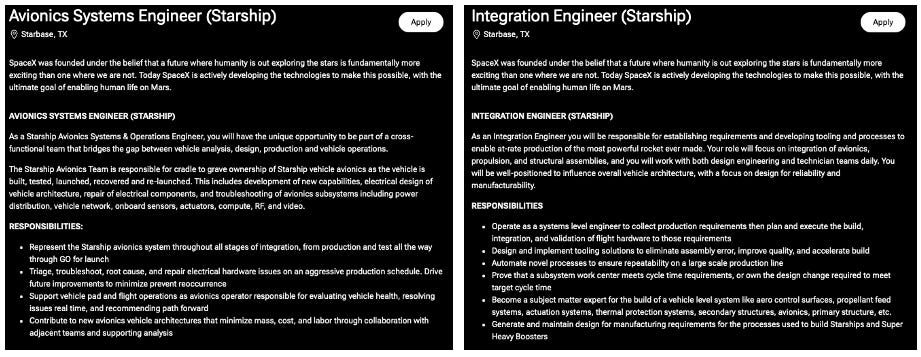
This structure—what we call closed networks—gives engineers significant ownership and autonomy, empowering them to drive innovation and quality without an overbearing management structure.
Though it’s arguably more effort to build and fine‑tune a fit‑for‑purpose system tailored to the strategic aims of the company, it can pay for itself in speed, cost reduction, and mitigation of errors. That’s one reason behavioral economics is finding its way into corporate design.
The result is higher‑quality iterations than rivals—incumbents and upstarts alike. For SpaceX, that learning rate shows up as lower cost per launch and record launch cadence (i.e., greater net income). For investors, SpaceX is now valued among the world’s most valuable private companies, fueling speculation of a possible IPO in the coming months.
Thanks for reading 3Fold Outcomes! Subscribe for free to receive new posts.
More Than Name Alone
Many firms stop with team design: they copy “Agile” principles but skip the real‑time social mechanisms that keep independent teams in sync. Compared to traditional meetings and communication channels, informal networks are relatively boundless and often move information up to 5x faster.
SpaceX’s intentionally curated integrators facilitate the flow of critical information in real time. This thin layer of integrators is often described as weak ties (“weak” refers to how lightly they are embedded in any one team, not the level of trust or value). Combined, these create compact decision hubs that spread high‑fidelity information quickly and integrate new designs reliably.
For SpaceX, that is fit‑for‑purpose design: a social system tuned to raise the learning rate at scale.
When information gets stuck in unnecessary bureaucracy, friction builds and capacity drops, leading to a quiet drift between organizational design and strategic mission. The losses are quiet: slower cycles, costly rework, and teams that look busy while learning less.
Sidebar: A Simple(-ish) Learning Equation
Innovation velocity rises when four ingredients compound: tight knowledge-building cycles, high‑fidelity feedback, authority to act, and institutional memory. Quality prototyping comes from small, highly integrated teams. High-fidelity feedback comes from reliable and frank reviews meant to support growth rather than punish. Authority to act comes from short, respected decision paths. Institutional memory comes from rituals that turn fixes into standards. SpaceX’s visible performance suggests these ingredients are present together, which is why its learning shows up as both speed and cost curve shifts.
Every Design Has a Cost
A network that privileges speed extracts a toll, most often time. External review sites like Glassdoor often cite lower scores on work‑life balance relative to other factors, implying long hours and sustained pressure that not everyone absorbs the same way. What emerges is a common pattern: world‑class learning and breakthrough innovation come with a cost.
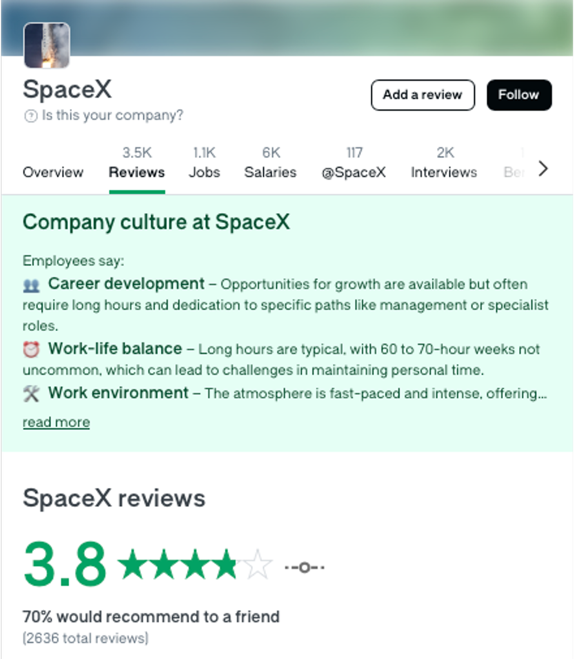
That doesn’t invalidate the design; it clarifies the trade‑off: speed demands space for people and ideas to recover, reset, and reflect, otherwise attrition and disengagement compound.
Safety is the second signal. Public reporting and inspections have at times found injury rates above industry averages. For leaders, the point is not to litigate each data point. It is to notice what the pattern implies about where a network is tight and where it is thin. Higher cadence without enough connective tissue amplifies local risk before it migrates into quality issues.
Some leaders reject these trade‑offs; others manage them as side effects of a fast‑moving learning culture. That doesn’t excuse safety lapses; it acknowledges that a fast‑moving learning system will generate mistakes. And each is an opportunity to improve. That’s what “fail fast” looks like in practice. Tenure often shortens for the same reason: the pace is demanding, and many eventually choose different rhythms. Compensation may reflect the intensity, but the implicit trade‑off is clear: longer hours and periodic personal sacrifices in exchange for accelerated growth.
In fit‑for‑purpose cultures, that doesn’t mean yielding to the trade-offs and sacrificing long-term strategy. It means building intentional systems to mitigate the effects. SpaceX does this by expecting engineers to design and contribute to automated workflows, yielding multiple benefits. Automation increases speed and repeatability, while freeing engineers to focus on higher‑order work—and, not incidentally, that increases engagement, satisfaction, and loyalty. Further, automated workflows mitigate risk by creating deep knowledge‑sharing mechanisms so company knowledge doesn’t reside with any one individual.
While there are predictable costs of a system tuned for speed, the goal is to pace the load, add redundant communication between closed teams, and keep the learning engine intact as scale raises complexity.
Adaptations Required
What wins at one size can fail at the next if you don’t adapt. Success at scale depends on building intentional bridges that keep the firm and its people connected throughout various phases of growth. As a company scales, its complexity and operational nuances increase, often exponentially. At 13,000 employees, SpaceX hasn’t shown the slowdown many firms face at scale.
For instance, Starlink’s scale forced tighter coordination across manufacturing, launches, spectrum (licensed frequencies), ground stations, and user operations. When a company manages thousands of satellites in low Earth orbit, small errors aggregate. You need the same fast local feedback loops, and you also need just enough cross‑system connective tissue to move risks and edge cases to where they can be resolved. Precision at the core and designed bridges between cores are how you keep both speed and coherence.
Systems‑level thinking and ownership only work when there’s a forum with real authority to act. After Columbia, NASA made challenge routine by creating protected paths and clarifying who can grant exceptions. The lesson is that principles endure when systems reinforce them. In any high‑stakes setting, the move is the same: give excellence a decisive forum so uncomfortable facts surface in time to matter.
Fine‑Tune for Possibility
SpaceX offers a hopeful template for leaders who want innovation to compound rather than flare. The transferable lesson is not to copy SpaceX’s culture but to copy the logic of fit‑for‑purpose: write down the job your organization must do over the next three years, describe the pace of learning required, then tune the social system to fit. The most critical levers are team size, makeup, and the number of bridges to keep networks sufficiently connected. *See the final sidebar for a deeper discussion.
For companies pursuing radical innovation, aim for closed networks. Make challenge routine rather than requiring people to be brave as a workaround. Put challenge on the map inside the integration process and make it normal to surface uncomfortable facts when the evidence warrants it. NASA’s reforms show what this looks like when lives are at stake. Apple’s creative forums show what it looks like when product quality is the currency. In both cases, the forum is the proof that the principle is real. You can tune intensity and cadence to fit your mission. The point is to make it part of the job, not a side channel that depends on personality.
If risk reduction is the critical factor, aim for broad, open networks. Keep the engines that create speed, and layer in transparent, high‑fidelity knowledge‑sharing routines—traceable decisions, lightweight documentation, visible metrics—that put risk awareness and impact mitigation at the forefront. Treat disclosure, safety reviews, and post-mortems as ways to preserve speed over time. The signal you want investors and regulators to read is simple. This is a system that learns fast and tells the truth. That is how a company keeps its edge when the spotlight gets brighter.
Make the Invisible Visible
Organizational Network Analysis (ONA) is how you see the real system beneath the chart—whether it’s open or closed, and which levers need to be fine-tuned to alter the design. ONA maps the organization’s cultural and relational dynamics driving the work, and shows whether the system is functioning as it should or where tweaks are needed.
ONA draws on collaboration data, surveys, and communication patterns to show how hidden influence, trust, and decision-making operate in practice. It often highlights the underlying source of why strategy and execution begin to drift by identifying who actuallyworks with whom, which nodes are overloaded, where clusters are insular, and whether connections exist where they should.
For instance, a detailed ONA can help explain (and diagnose) how certain behaviors arrive:
Team density → local cycle time. Higher internal connection and intellectual diversity usually mean greater high-quality testing and prototyping.
Intentional brokerage → decision latency. When cross-team traffic is shared by multiple integrators, learning accelerates and knowledge sharing stays high‑fidelity.
Modularity → parallel experimentation. Defined teams with clear handoffs and decision boundaries enable multiple tests to run in parallel with minimal rework.
Weak ties → incident capture. A few deliberate cross-links spread emerging insights quickly and surface patterns early.
While ONA is diagnostic, a behavioral‑economics lens can help leaders create the right organizational incentives to reward specific behaviors. In this way, ONA allows an organization to tailor its design with high-fidelity feedback on whether the system is responding accordingly. For instance, does adding a second integrator to a fragile boundary increase communication flow or overburden teams? Will rotating two engineers for a six‑week sprint seed fruitful ties or slow decision‑making? ONA turns culture from an article of faith into a design problem you can iterate.
For leaders, the point is not to memorize terminology. It is to see that outcomes are adjustable. If your mission looks like SpaceX’s (high stakes, high complexity, high cadence), you will bias toward small, high‑trust teams, crisp modules, and fast bridges. If your mission trades speed for stability, you will tune differently. The job is to set the dials to your purpose and revisit them as the work changes.
Organizational Design Is Strategy in Social Form
SpaceX shows what happens when you design a network to fit its strategic aims. Innovation does not rely on heroics when small teams are set up to move quickly, when integrators can carry the hard truths, and when decisions do not get stuck. Cadence improves, costs fall, and the public rediscovers awe.
Importantly, it’s not rocket science. Start with the purpose. Tune density, modularity, and brokerage like dials. Build the forum where excellence can do its work. That design, more than lone‑wolf efforts, explains why SpaceX commands outsized confidence and valuation expectations. And for you, it’s how 1+1 becomes 3!
Thanks for reading 3Fold Outcomes! The best way to support our work is to share!
Final Sidebar: The Cultural Dials at Work
If you strip away the spectacle, what remains is an organization that moves information with intent. SpaceX looks like a company that tunevd a few basic network dials to fit the job. Here are the basics, in plain language, and how each choice likely shows up day to day.
Density (how connected a team is inside the room). High density means most people on a team talk to most others. Inside SpaceX, that likely creates speed, shared context, and fewer surprises. Turn density up and you get faster coordination and trust. Turn it too high and you risk echo chambers and fatigue. Turn it down and you create room for independent thought, though handoffs will slow.
Modularity (how clearly work is split into clusters). Modularity separates the system into tight clusters with clear handoffs and decision boundaries. For SpaceX, propulsion, avionics, structures, and ground ops likely operate as well-defined modules. Turn modularity up and teams can sprint in parallel, which is essential for cadence. Push it too far and you create walls that make integration harder. Turn it down and collaboration feels fluid, yet cross-talk can overwhelm.
Brokers and bridges (who connects the clustered teams). Brokers are the people who stitch modules together. Think systems, safety, and operations leads who see across boundaries. Turn brokerage up by creating more credible bridges and you lower the odds of late-stage surprises. Go too far and you add meetings and overhead. Turn it down and you move fast until you hit a boundary you cannot resolve, then speed evaporates.
Weak ties (links across distant teams). Weak ties are periodic touchpoints that move ideas or risks across the org without intentional coordination. At SpaceX, rotating engineers through cross-team technical reviews or short tours can seed these ties. Turn weak ties up and you catch edge cases earlier and share insights faster. Push them too far and you flood busy teams with noise. Turn them down and you get focus, at the cost of blind spots.
Centrality (how many paths run through a decision hub). A compact escalation process can compress time. SpaceX reads as founder-centric with a small inner circle that clears blockers quickly. Turn centrality up and decisions align and move. Push too high and you create bottlenecks and fragility. Turn it down and you gain resilience, while risking drift if mid-level forums lack authority.
Redundancy (backup for the bridges and the glue). Redundancy is less about extra people and more about overlapping knowledge at key seams. When one broker is out, the handoff still works. Turn redundancy up and you gain resilience with a small cost in overhead. Turn it down and you move lean, until a single absence stalls the line.
Put together, SpaceX looks like this: high density inside teams, clear modular boundaries, a thin but strong layer of brokers, selected weak ties, a compact decision hub, and enough redundancy at the seams to keep cadence when people rotate or burn out. You can feel the trade-offs. Speed where it matters. Guardrails where it counts. Minimal ceremony elsewhere.
About the Author
Jason is a behavioral economist and founder of 3Fold Collective, an organizational design firm helping leaders diagnose and reshape cultural dynamics. Visit 3FoldCollective.com to discover more.
References:
Books & Long-form
Isaacson, W. (2023). Elon Musk. Simon & Schuster.
Vance, A. (2015). Elon Musk: Tesla, SpaceX, and the quest for a fantastic future. Ecco/HarperCollins.
Greiner, L. E. (1972). Evolution and revolution as organizations grow. Harvard Business Review, 50(4), 37–46.
Granovetter, M. S. (1973). The strength of weak ties. American Journal of Sociology, 78(6), 1360–1380.
Burt, R. S. (2004). Structural holes and good ideas. American Journal of Sociology, 110(2), 349–399.
Uzzi, B., & Spiro, J. (2005). Collaboration and creativity: The small-world problem. American Journal of Sociology, 111(2), 447–504.
Columbia Accident Investigation Board. (2003). Columbia Accident Investigation Board Report (Vol. 1). NASA.
Cross, R., & Parker, A. (2004). The hidden power of social networks: Understanding how work really gets done in organizations. Harvard Business Review Press.
Company & Program Structure
Podolny, J. M., & Hansen, M. T. (2020, November–December). How Apple is organized for innovation. Harvard Business Review.
SpaceX. (n.d.). Starship: Flight test overview (Flight 11). Retrieved October 6, 2025, from https://www.spacex.com/launches/starship-flight-11
SpaceX. (n.d.). Updates. Retrieved October 6, 2025, from https://www.spacex.com/updates
Associated Press. (2025, August 26). Latest launch of SpaceX’s Starship deploys 8 dummy satellites, then splashes down into Indian Ocean. AP News.
Federal Aviation Administration. (n.d.). SpaceX Starship Super Heavy project at the Boca Chica launch site. Retrieved October 6, 2025, from https://www.faa.gov/space/stakeholder_engagement/spacex_starship
Valuation, IPO/speculation, headcount
Nishant, N. (2024, May 23). SpaceX mulling tender offer at $200 bln valuation—Bloomberg News. Reuters.
Fortune Editors. (2024, July 16). Musk is moving SpaceX and X to Texas. Fortune. (Notes headcount “roughly 13,000.”)
Safety & culture reporting
Taylor, M. (2023, November 10). At SpaceX, worker injuries mount in Elon Musk’s rush to Mars. Reuters Investigates.
Taylor, M. (2024, April 22/23). Exclusive: Injury rates for Musk’s SpaceX exceed industry average for second year. Reuters.
Glassdoor. (n.d.). SpaceX “work-life balance” reviews. Retrieved October 6, 2025, from https://www.glassdoor.com/Reviews/SpaceX-work-life-balance-Reviews-EI_IE40371.0,6_KH7,24.htm
Role design / “Responsible Engineer”
SpaceX. (n.d.). Careers. Retrieved October 6, 2025, from https://www.spacex.com/careers
Oh, wow you made it to the very end of one our longest pieces yet. I can’t imagine you’re still in the mood to read more. But then again, here you are. Let me reward your curiosity with another interesting topic: return to office. There is no doubt that in-person helps create meaningful connections, but when you look at the research there is far more to the story that is not dependent on proximity. You can read that story here:
Thanks for reading 3Fold Outcomes! Subscribe for free to receive new posts and support my work.
Comments
Nothing yet. Say the first thing.
Sign in to join the conversation.