
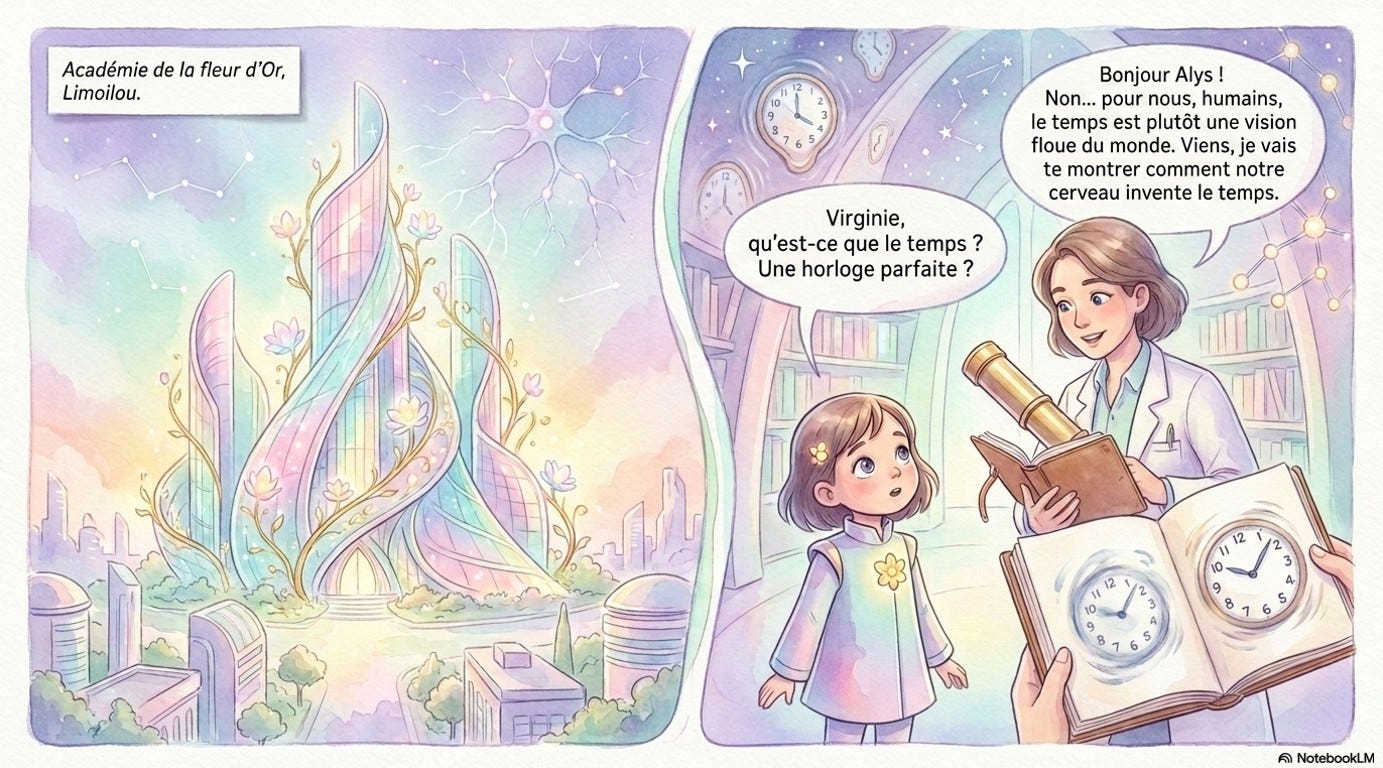
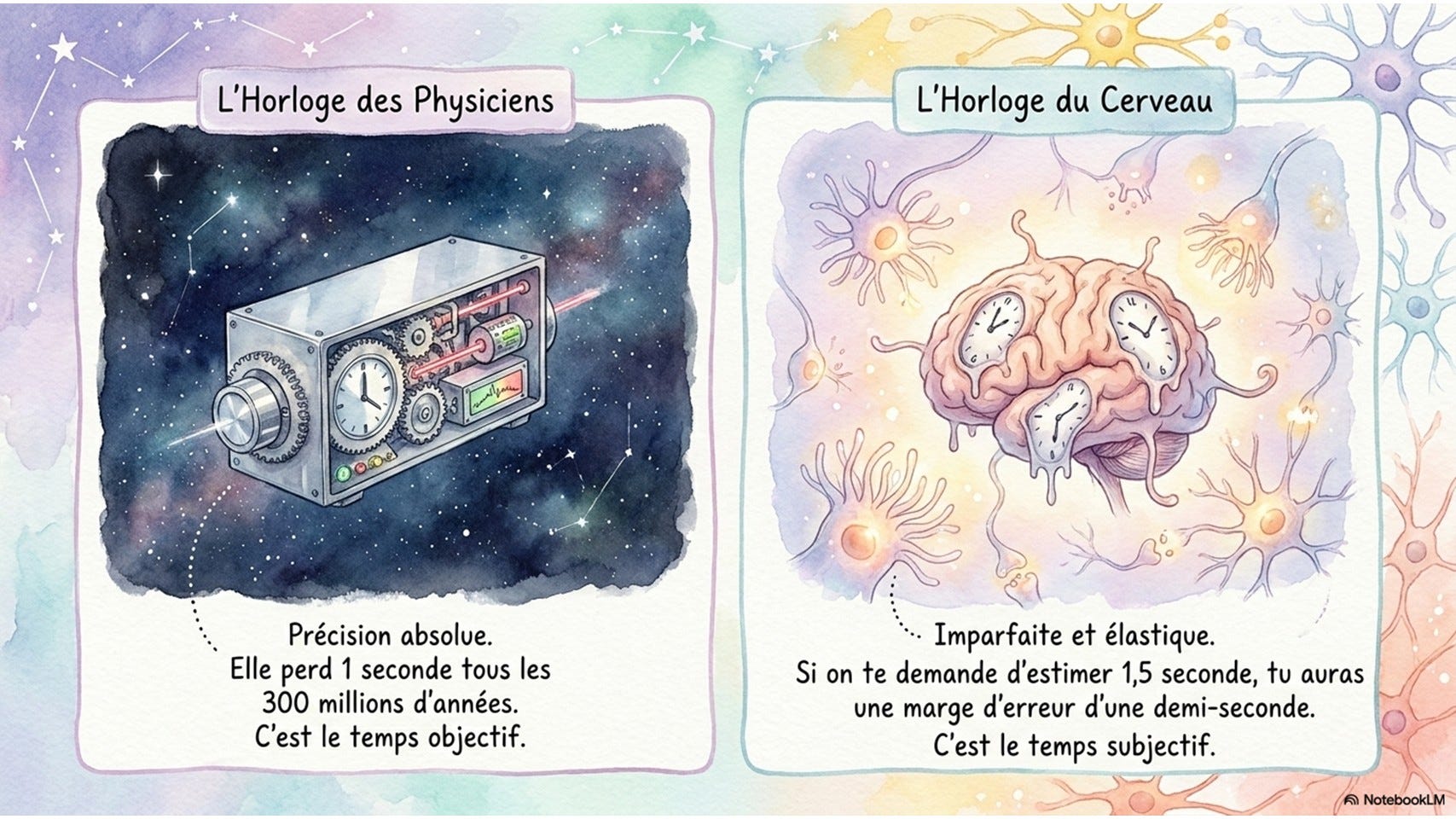
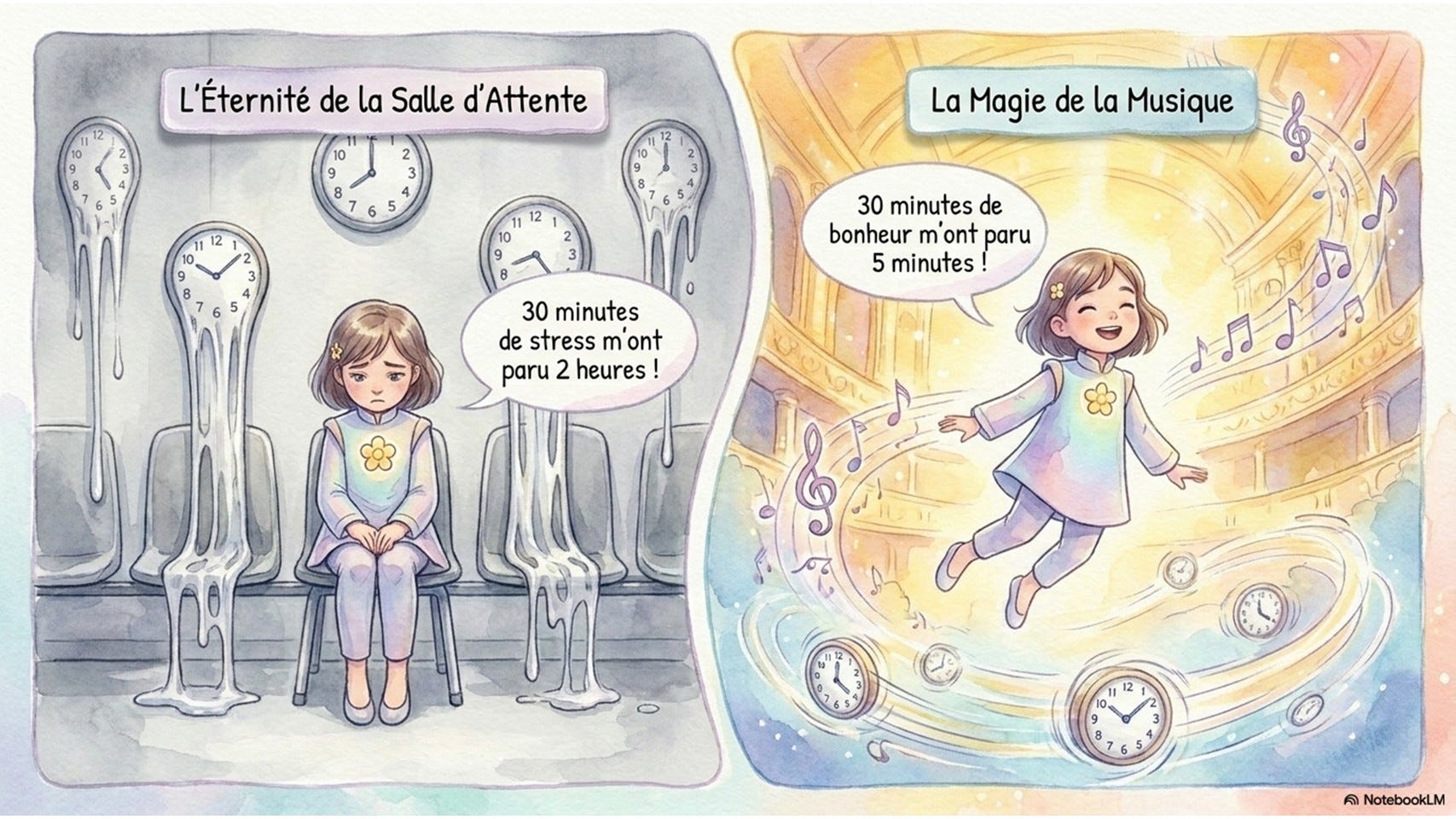
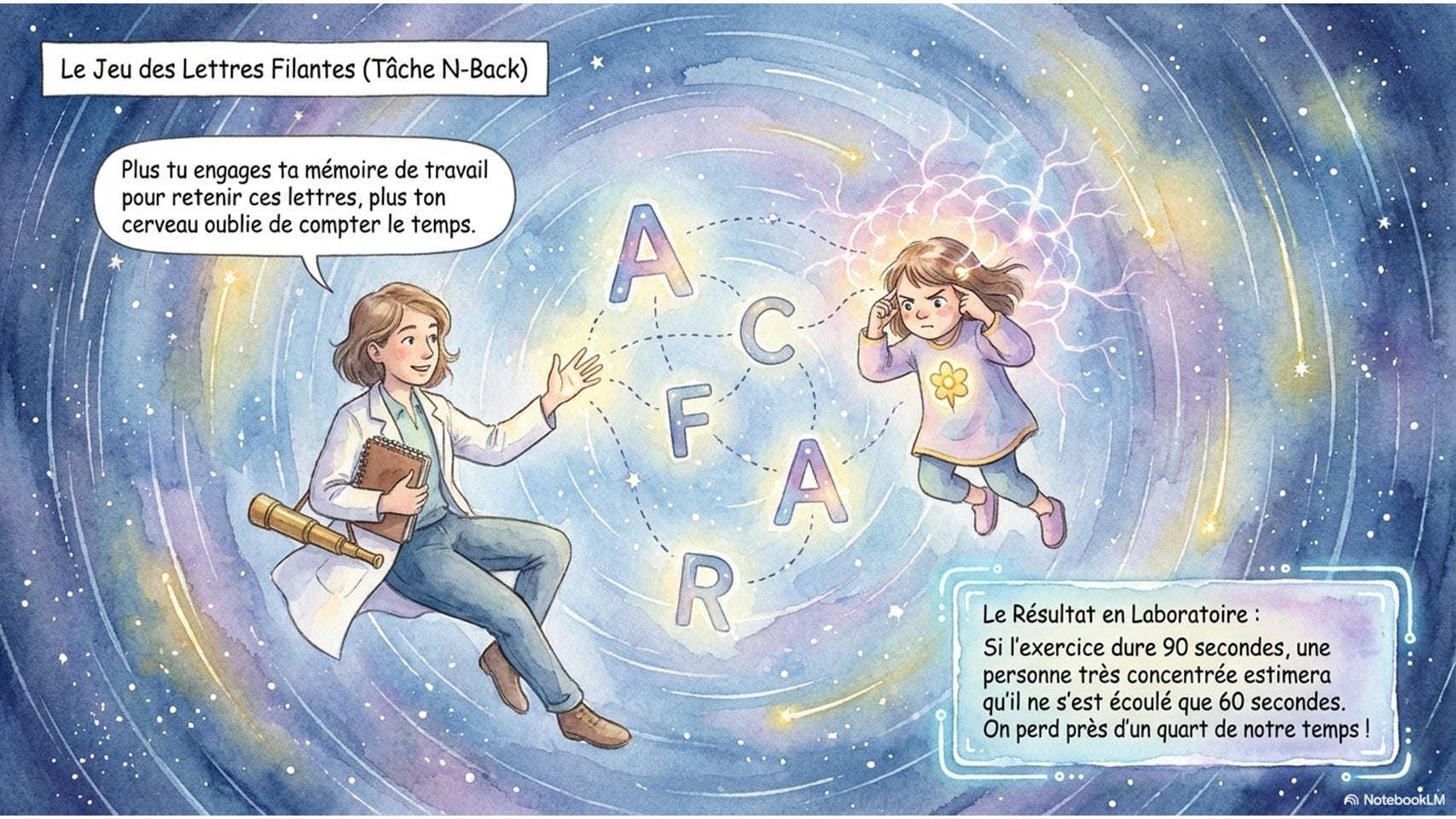
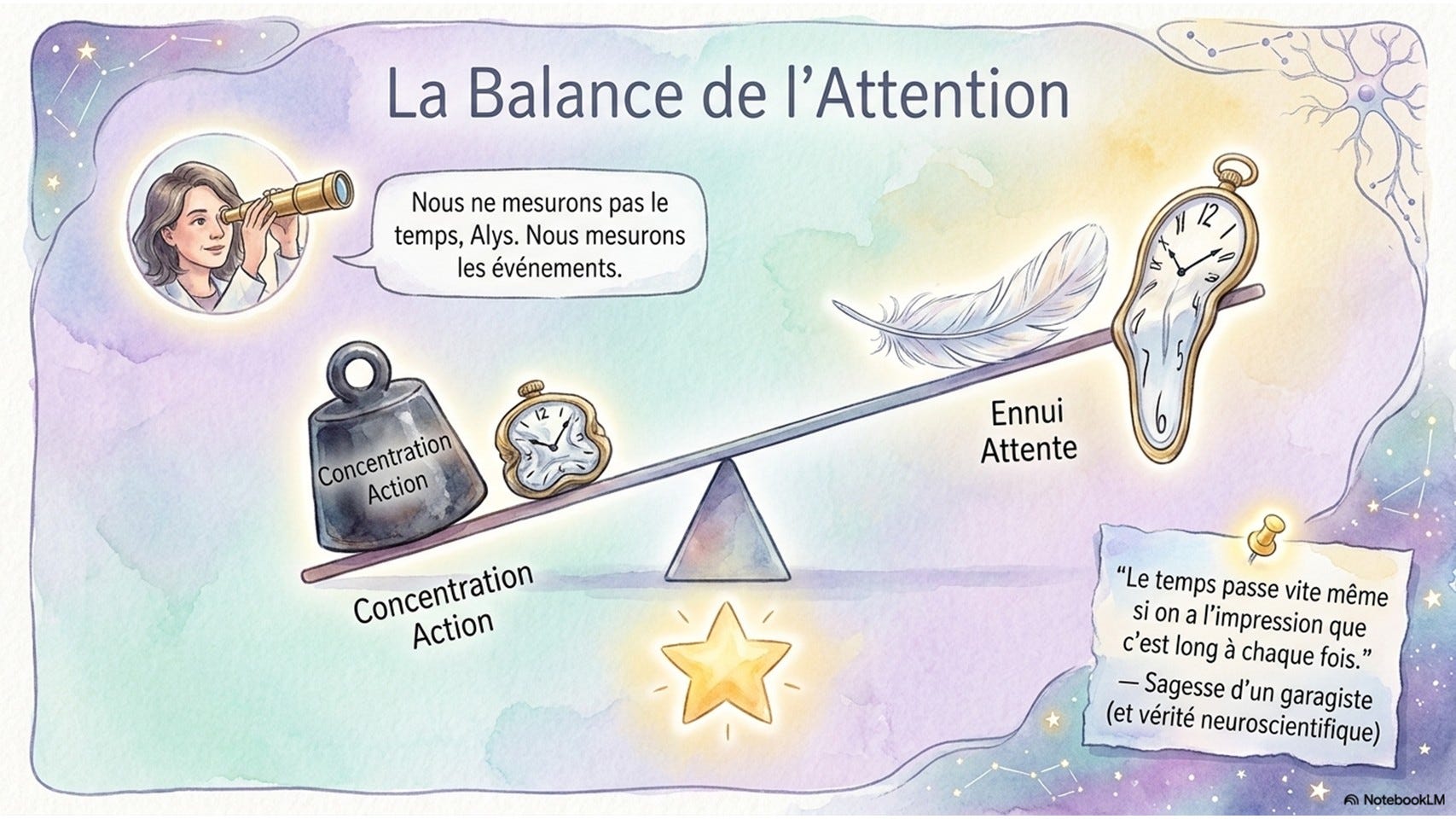
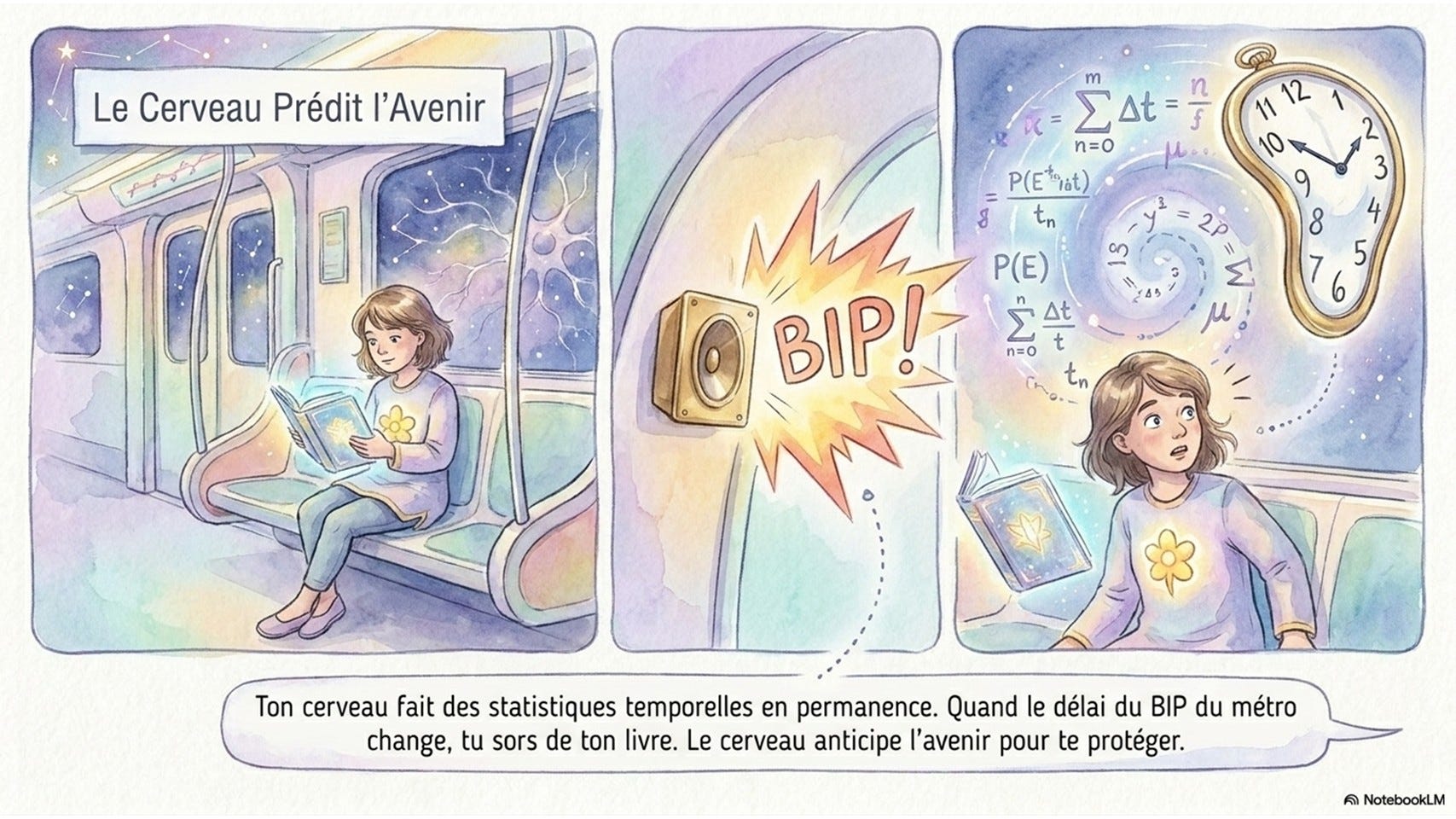
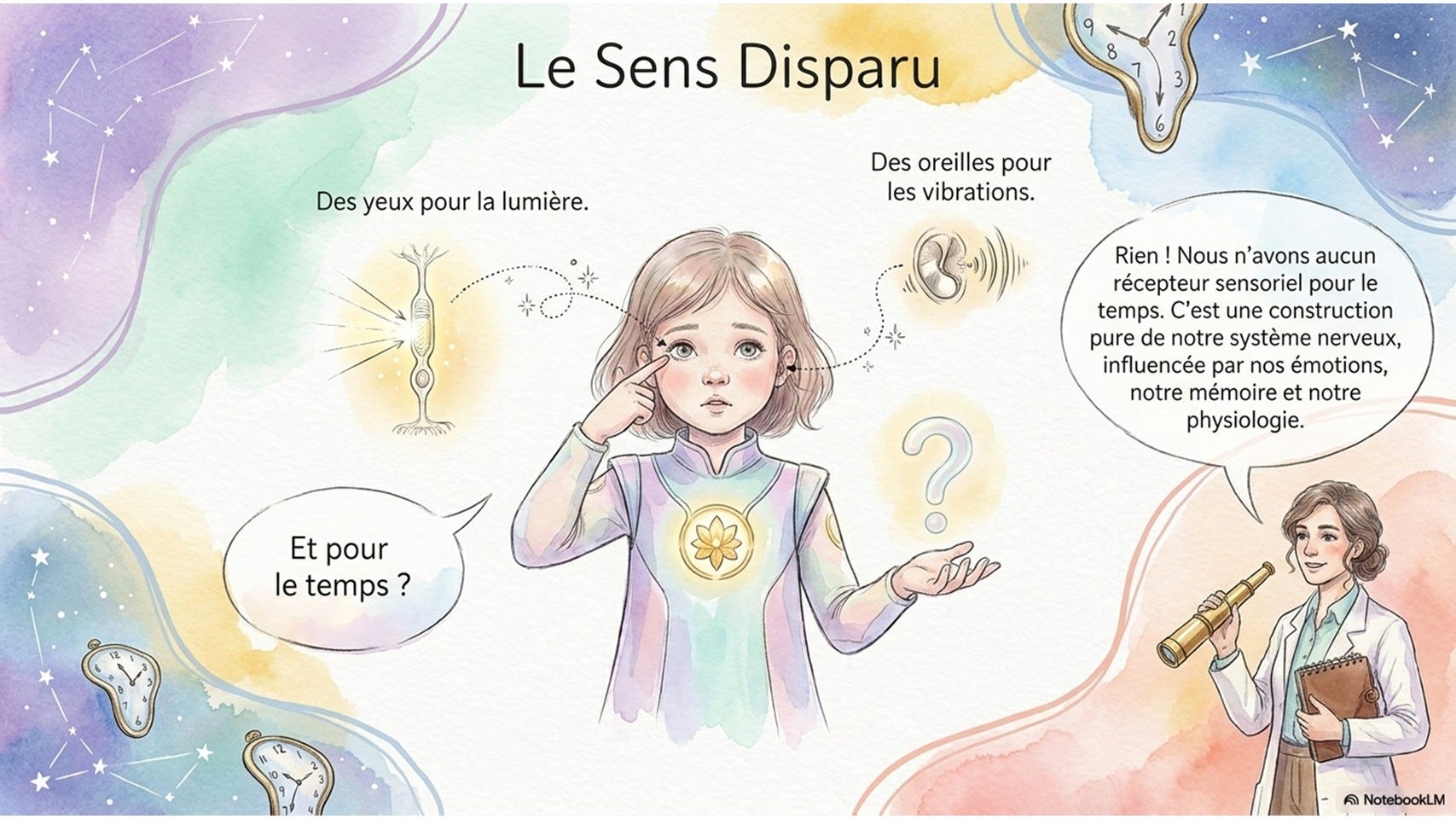
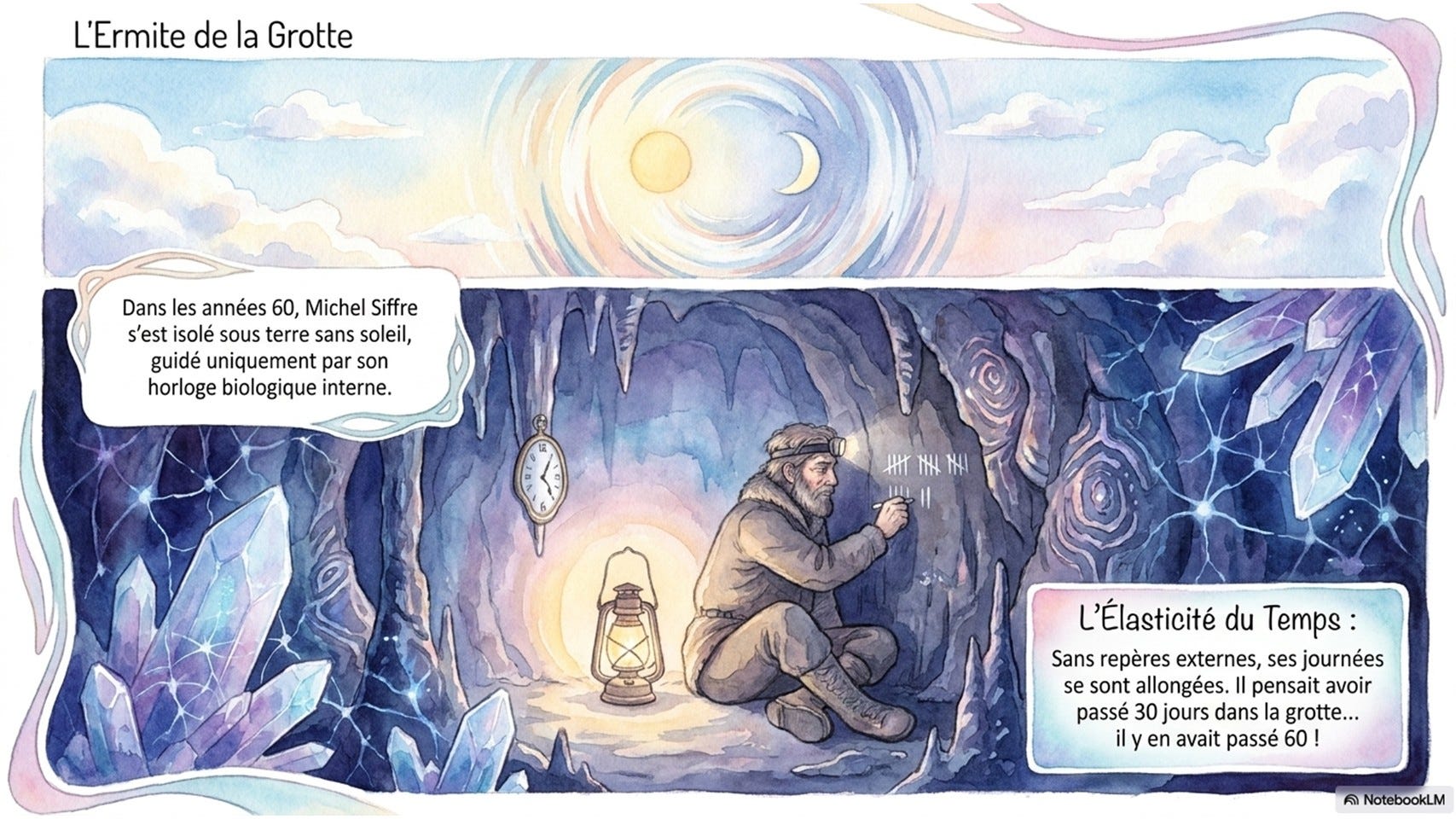
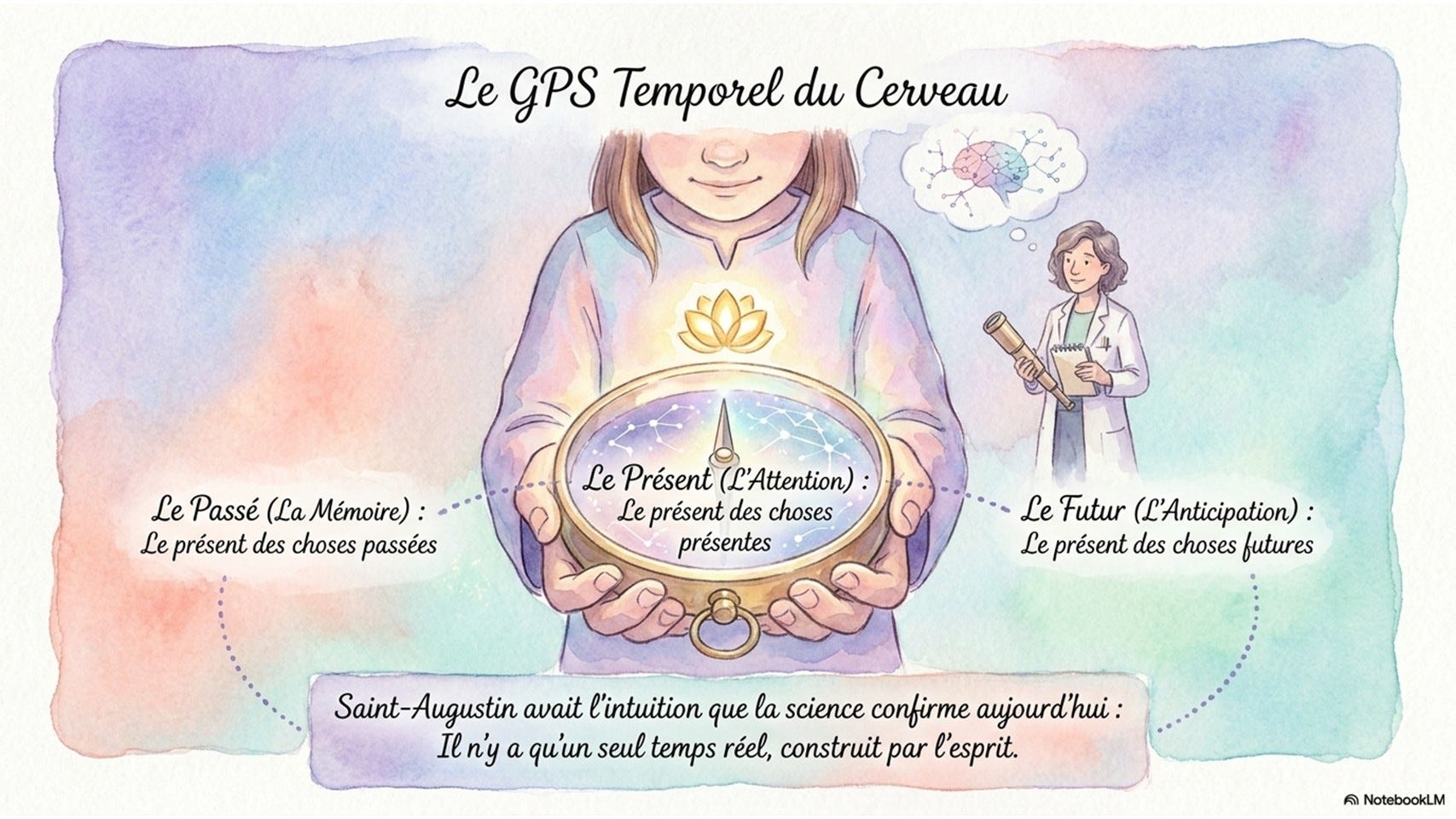
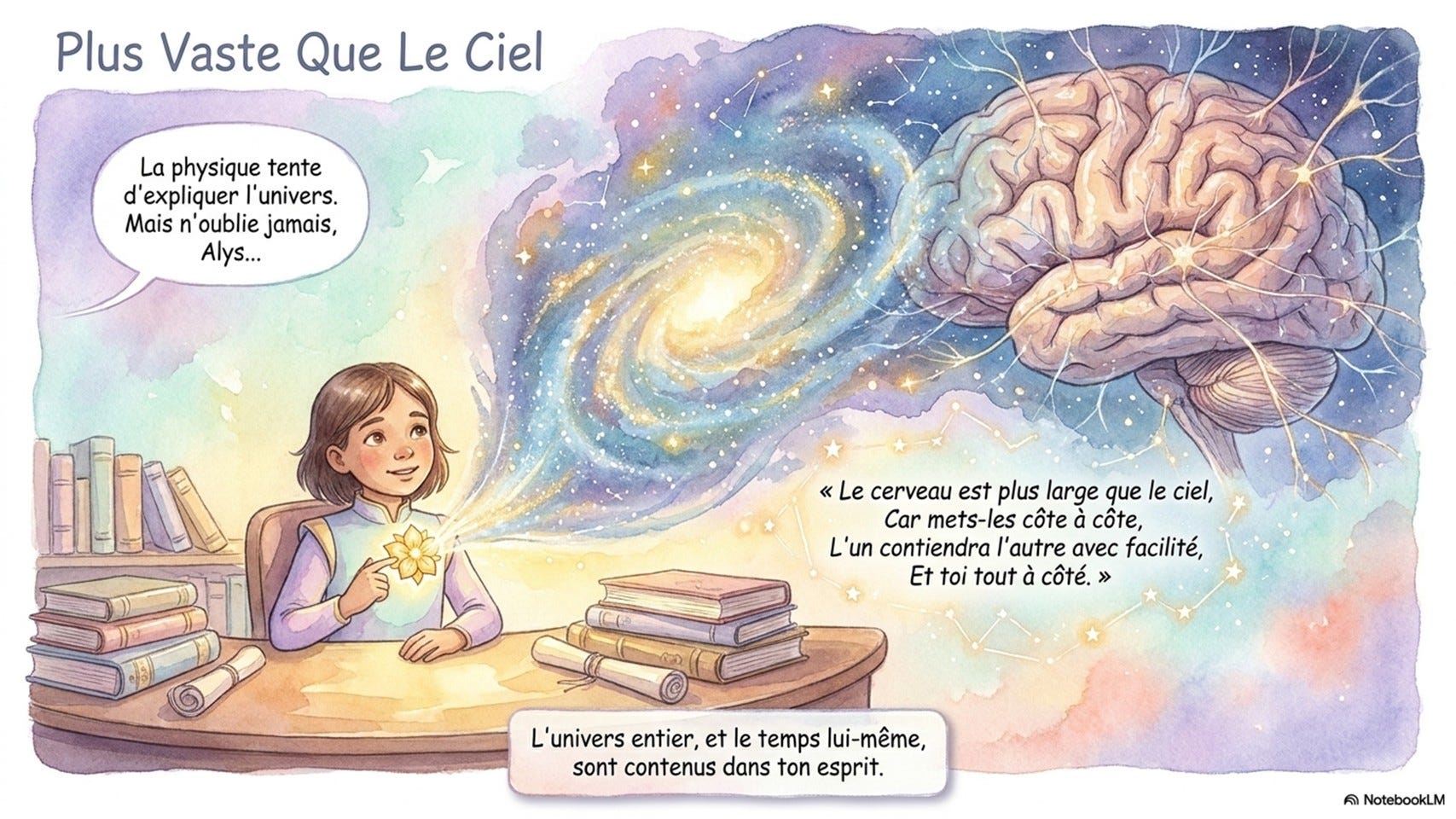
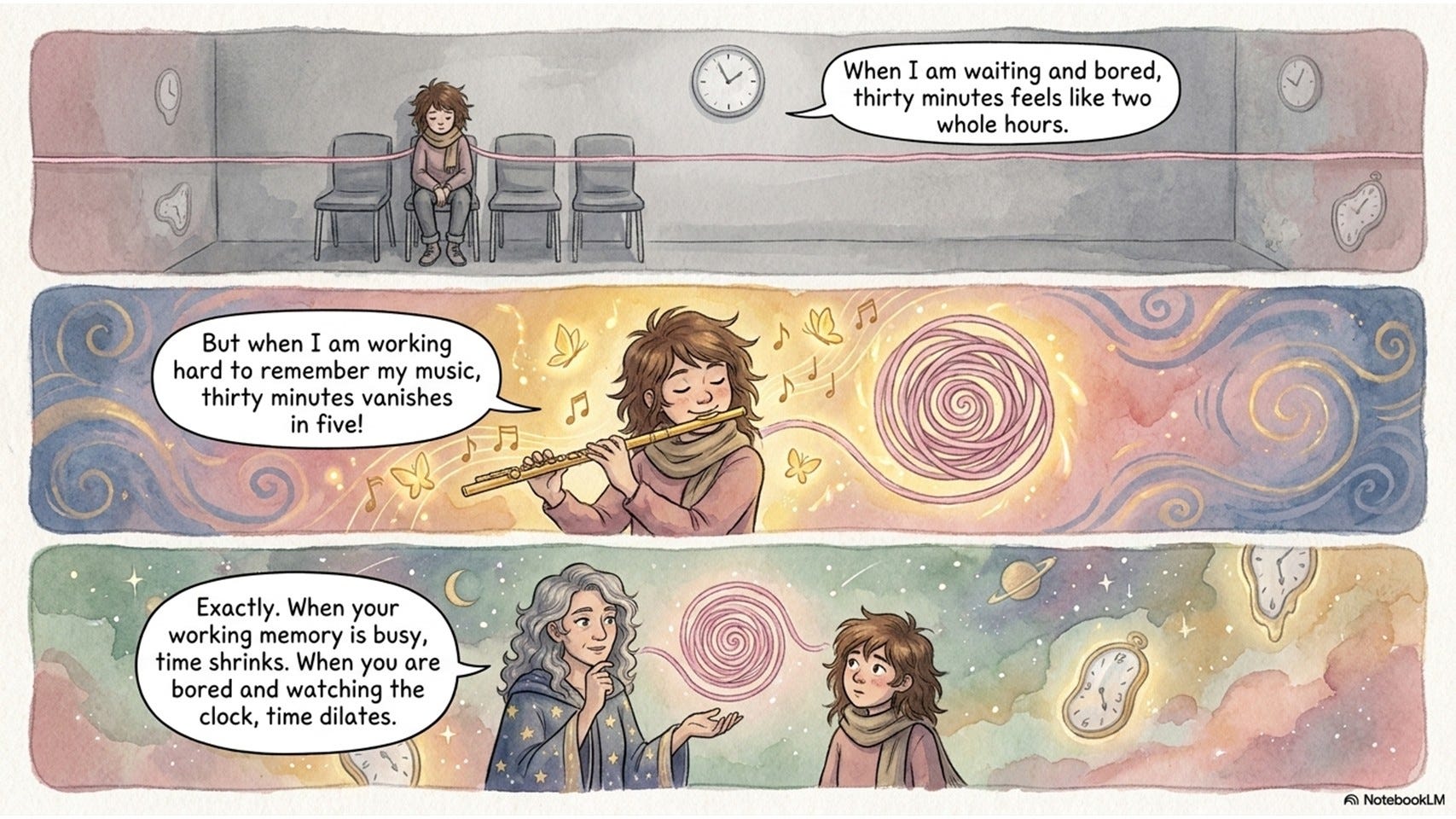
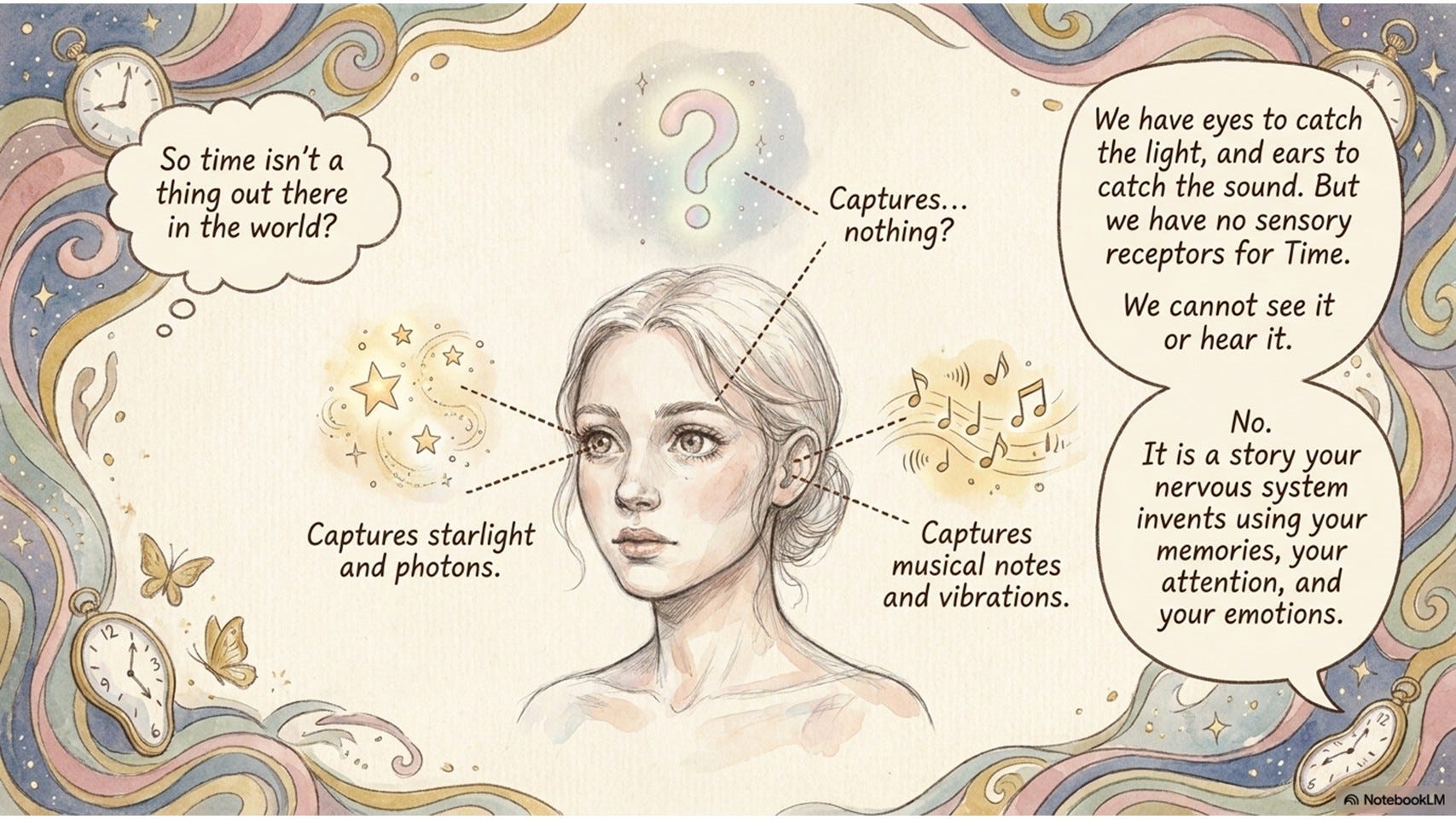
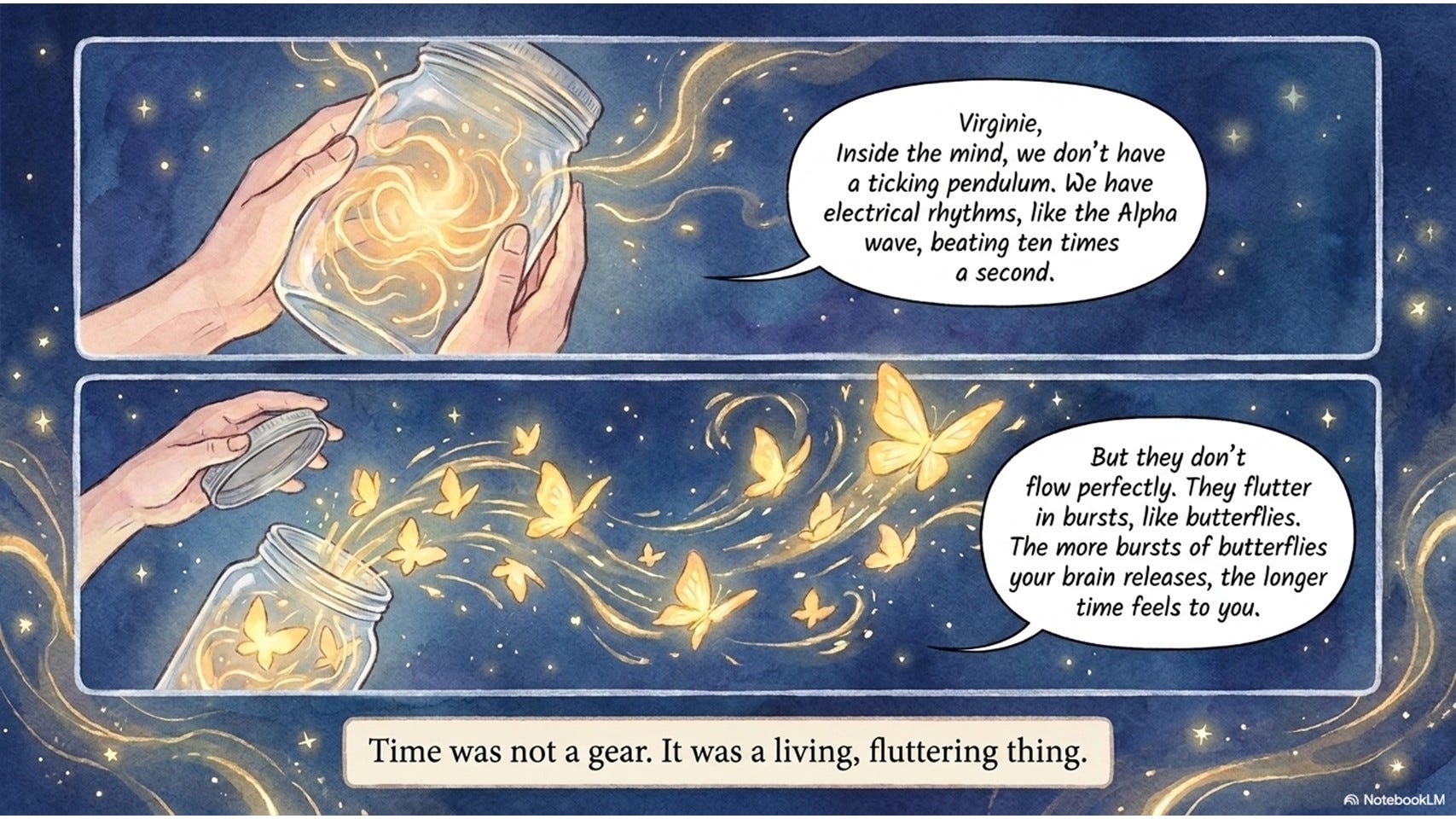
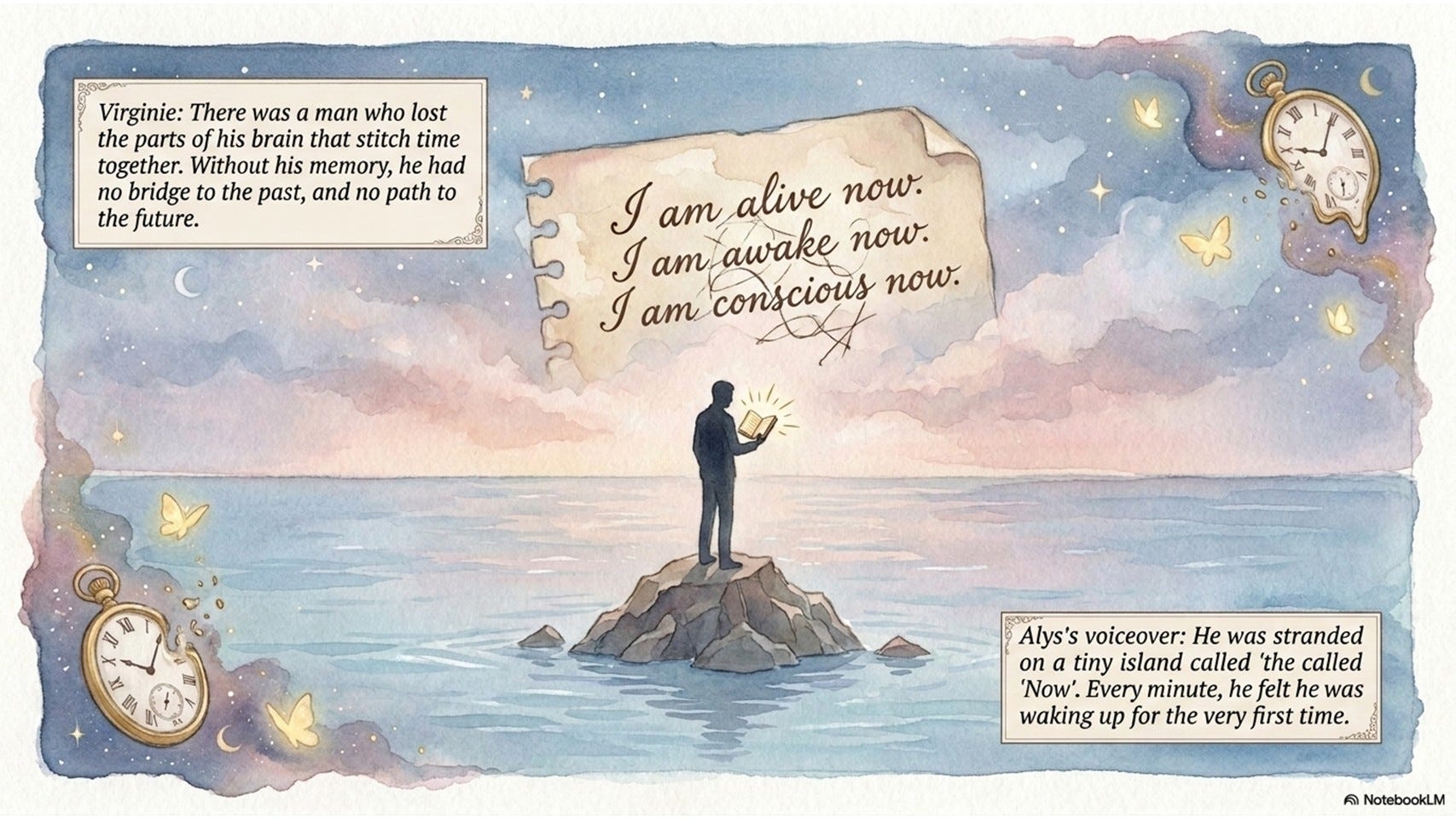
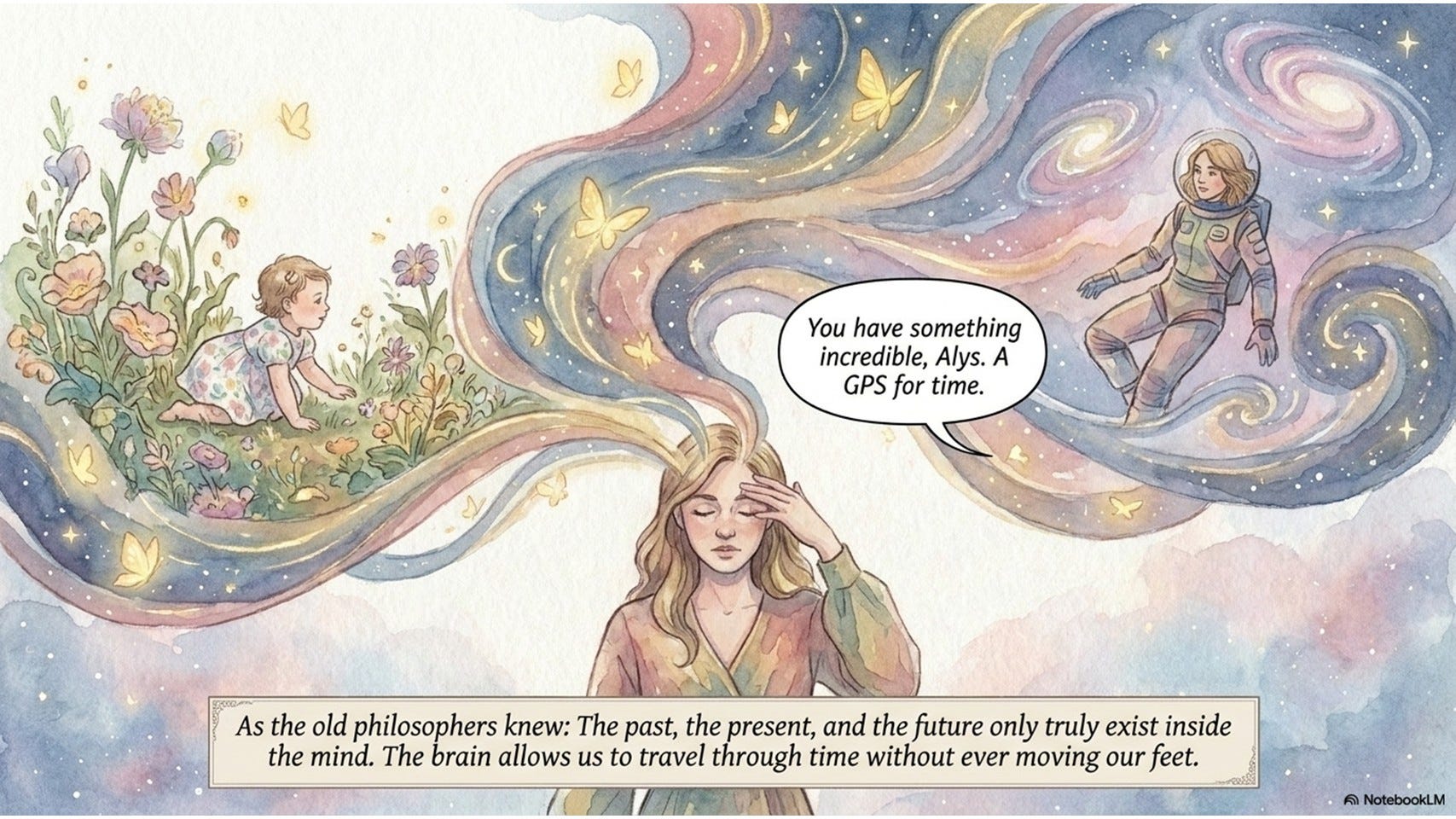
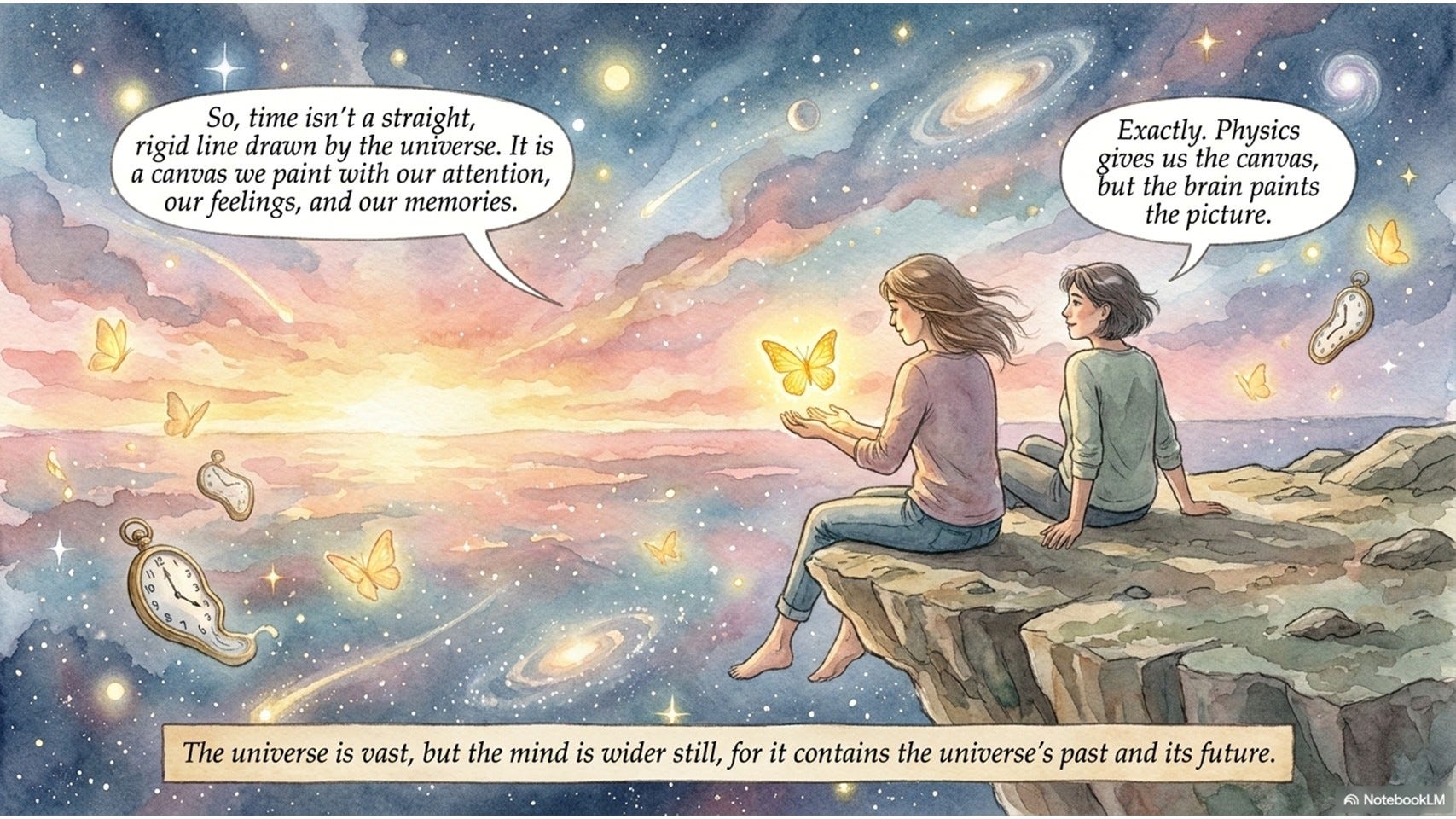
Cet épisode de Radio Alys synthétise une conférence en neurosciences de explorant la distinction entre le temps physique et la perception subjective. L'intervenante explique que le cerveau ne possède pas de récepteur sensoriel dédié au temps, mais qu'il construit une représentation temporelle influencée par l'attention, les émotions et la mémoire. À travers des expériences comme la tâche « N-back », elle démontre comment la charge cognitive peut mener à une sous-estimation ou une surestimation des durées. Elle examine également l'activité rythmique cérébrale, notamment les ondes alpha, comme marqueur potentiel de cette expérience consciente. Enfin, le cas clinique de Clive Wearing illustre l'importance des structures cérébrales dans la création d'un récit de vie continu. Ces sources soulignent que, pour l'humain, le temps est une construction biologique et psychologique complexe plutôt qu'une simple mesure linéaire
.
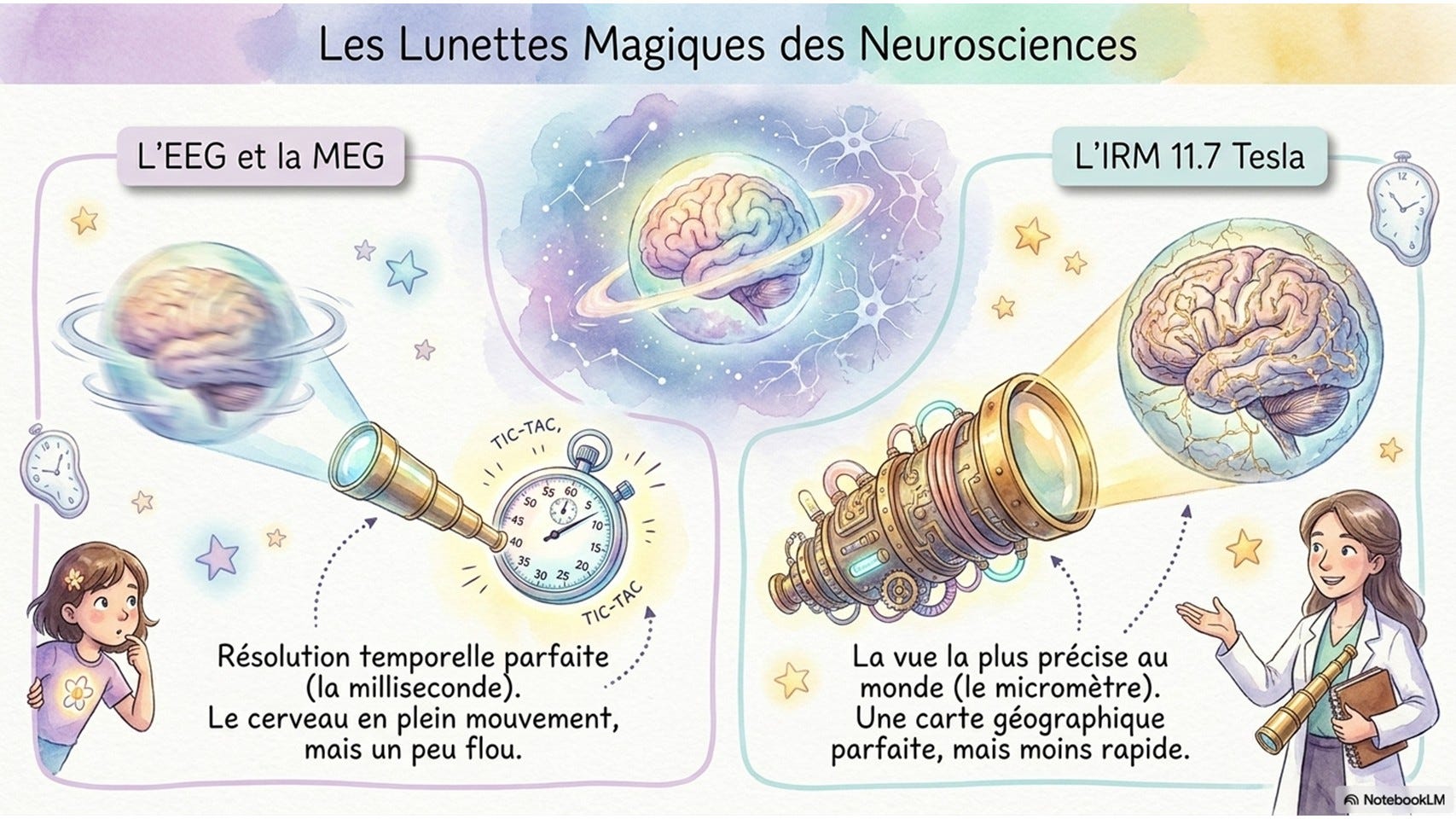
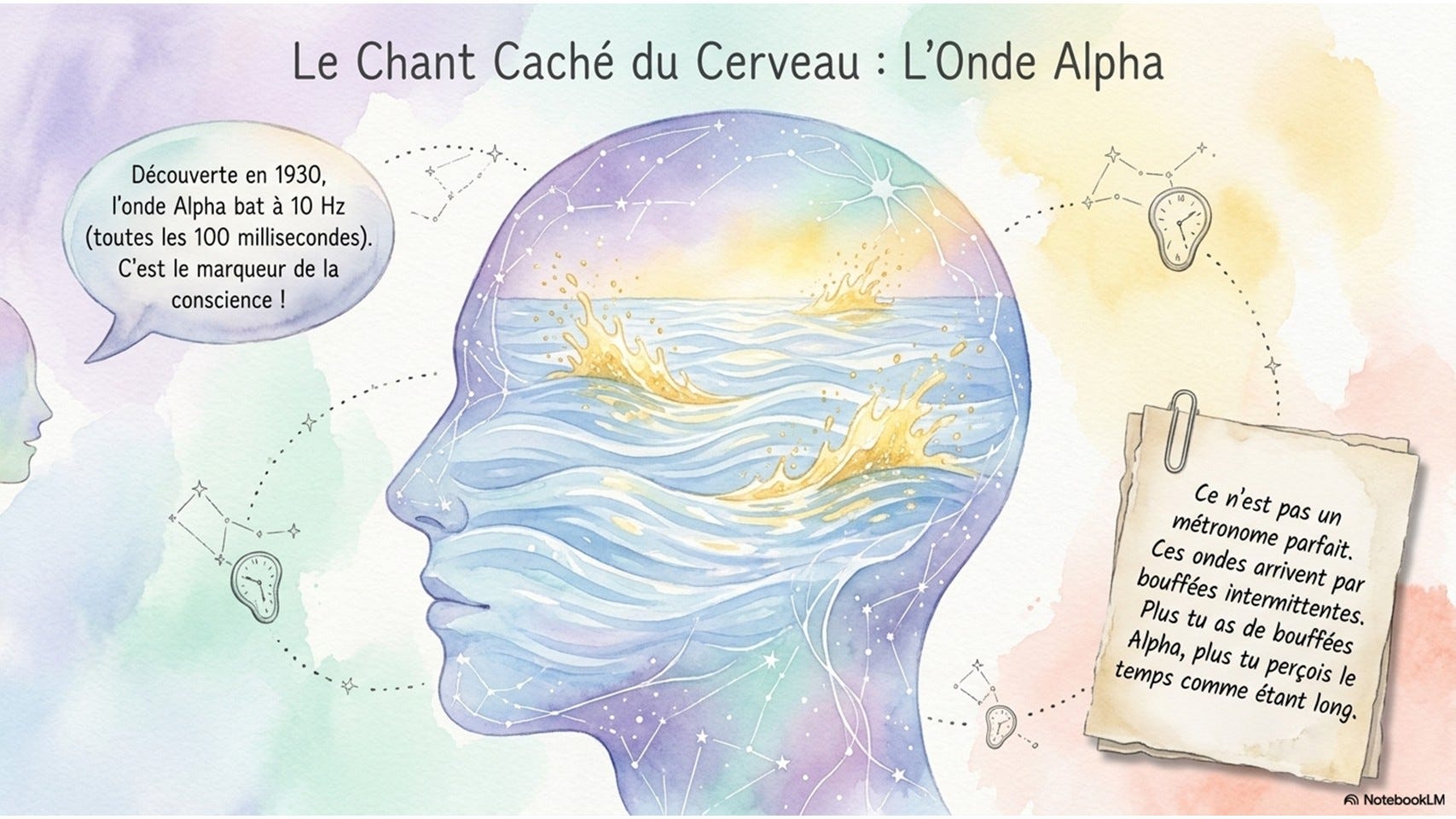
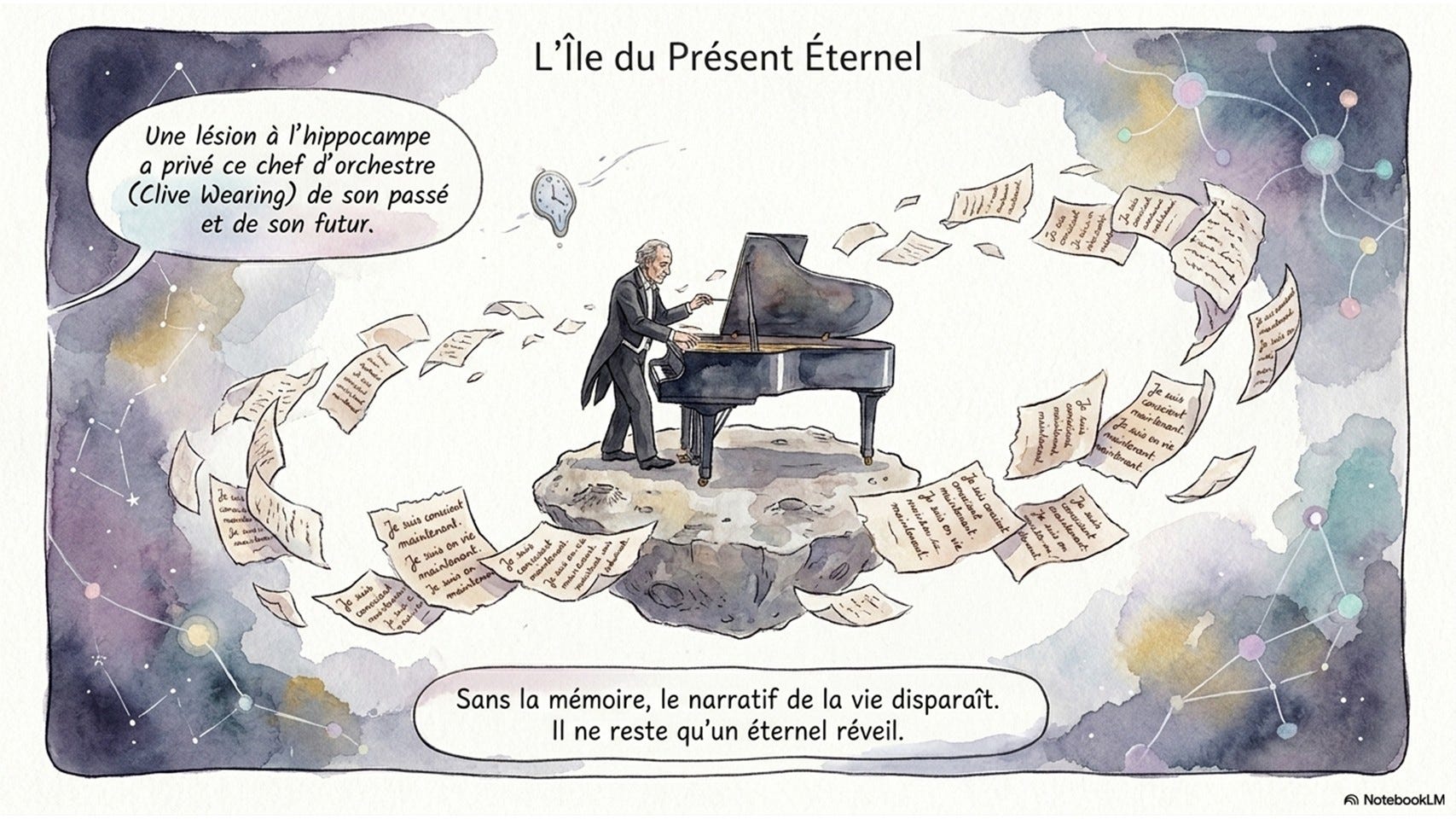
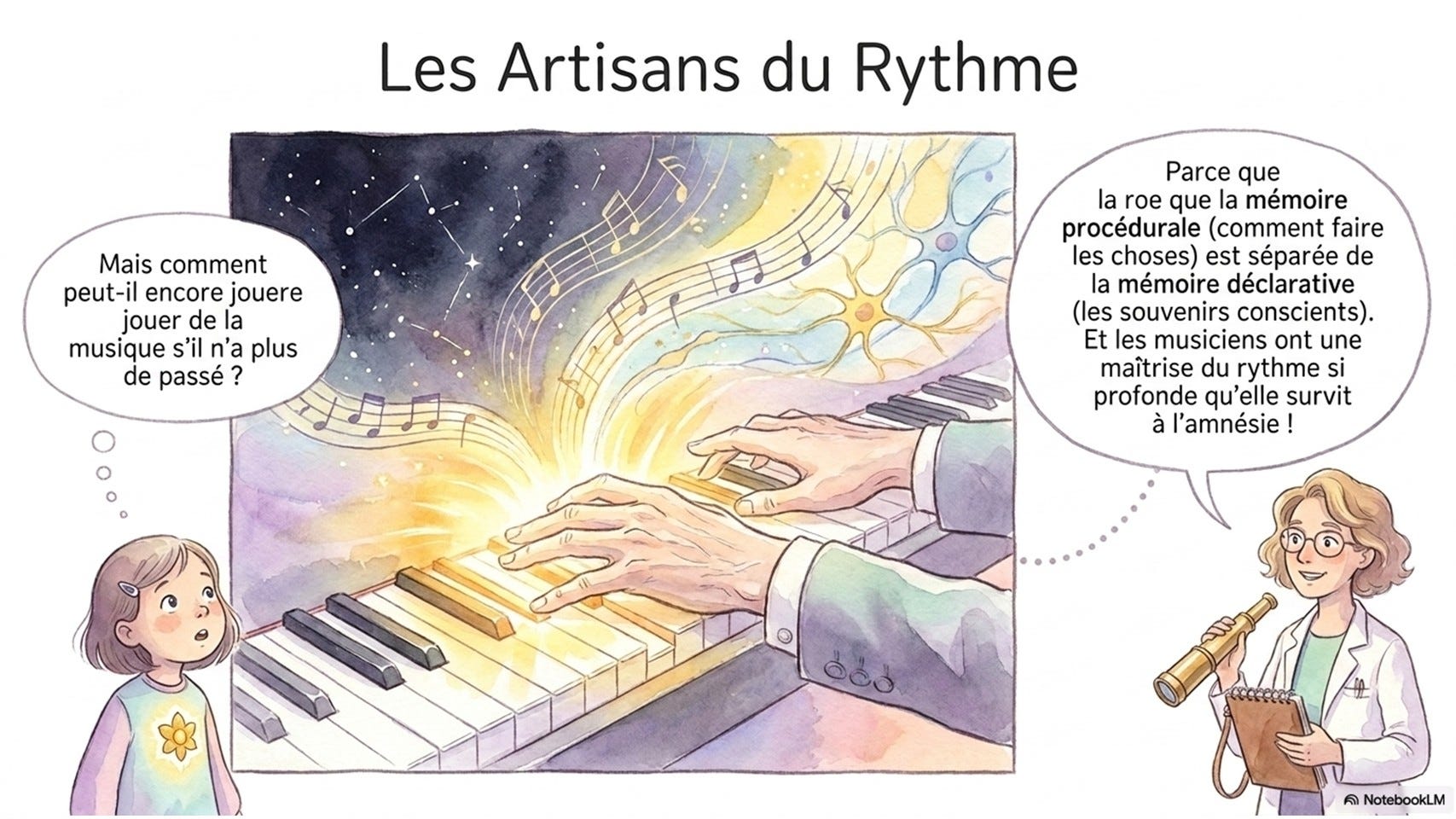
Audio de la conférence de Virgine Van Wassenhove, neurobiologiste, CEA Saclay, Neurospin : “Donner sens au temps dans le cerveau”
0:00
-44:18

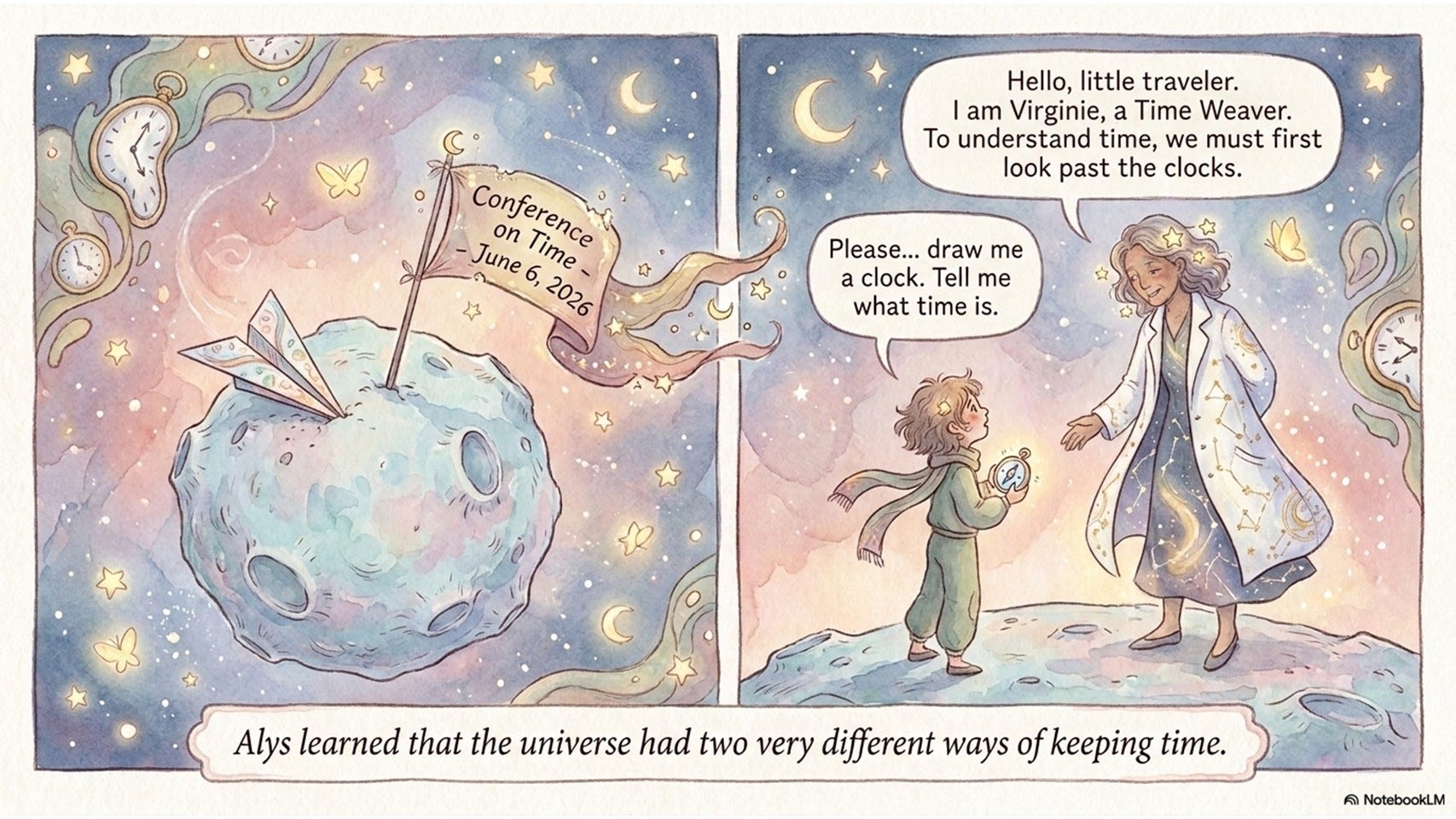


English Audio Synthesis
0:00
-20:10
Références
Azizi, L., Polti, I., & van Wassenhove, V. (2023). Spontaneous α brain dynamics track the episodic “when”. Journal of Neuroscience, 43(43), 7186-7197.
Bordas, R., & van Wassenhove, V. (2026). Spontaneous oscillatory activity in episodic timing: an EEG replication study and its limitations. eneuro, 13(1).
Buzsaki, G., & Draguhn, A. (2004). Neuronal oscillations in cortical networks. science, 304(5679), 1926-1929.
Buzsáki, G., & Mizuseki, K. (2014). The log-dynamic brain: how skewed distributions affect network operations. Nature Reviews Neuroscience, 15(4), 264-278.
Campbell, R. E., & Conway, M. A. (1995). Broken memories: Case studies in memory impairment. Blackwell Publishing.
Carroll, S. (2017). The big picture: on the origins of life, meaning, and the universe itself. Penguin.
Dole, H. (2026). Le côté obscur de l’univers. Dunod.
Grabot, L., & van Wassenhove, V. (2017). Time order as psychological bias. Psychological science, 28(5), 670-678.
Grabot, L., Kononowicz, T. W., La Tour, T. D., Gramfort, A., Doyère, V., & van Wassenhove, V. (2019). The strength of alpha–beta oscillatory coupling predicts motor timing precision. Journal of Neuroscience, 39(17), 3277-3291.
Kononowicz, T. W., Roger, C., & van Wassenhove, V. (2019). Temporal metacognition as the decoding of self-generated brain dynamics. Cerebral cortex, 29(10), 4366-4380.
La Rocca, D., Zilber, N., Abry, P., van Wassenhove, V., & Ciuciu, P. (2018). Self-similarity and multifractality in human brain activity: A wavelet-based analysis of scale-free brain dynamics. Journal of neuroscience methods, 309, 175-187.
Lamprou-Kokolaki, M., Nédélec, Y., Lhuillier, S., & van Wassenhove, V. (2024). Distinctive features of experiential time: Duration, speed and event density. Consciousness and Cognition, 118, 103635.
Marks, L. (2017). A stitch of time: The year a brain injury changed my language and life. Simon and Schuster.
Polti, I., Martin, B., & Van Wassenhove, V. (2018). The effect of attention and working memory on the estimation of elapsed time. Scientific reports, 8(1), 6690.
Carlo, R. (2017). L’ordre du temps.
Sejnowski, T. J., Churchland, P. S., & Movshon, J. A. (2014). Putting big data to good use in neuroscience. Nature Neuroscience, 17(11), 1440-1441.
Smolin, L. (2013). Time reborn: From the crisis in physics to the future of the universe. Houghton Mifflin Harcourt.
van Wassenhove, V., Herbst, S. K., & Kononowicz, T. W. (2019). Timing the brain to time the mind: Critical contributions of time-resolved neuroimaging for temporal cognition. In Magnetoencephalography: From signals to dynamic cortical networks (pp. 855-905). Cham: Springer International Publishing.
Comments
Nothing yet. Say the first thing.
Sign in to join the conversation.