
320 Sycamore Studios publishes original kids stories served fresh monthly, plus essays, book recommendations, and postcards from Readerville. Everything is completely human-written.
The doe sent another look straight at Peter, one that seemed to say, “You humans, you ruin everything.”
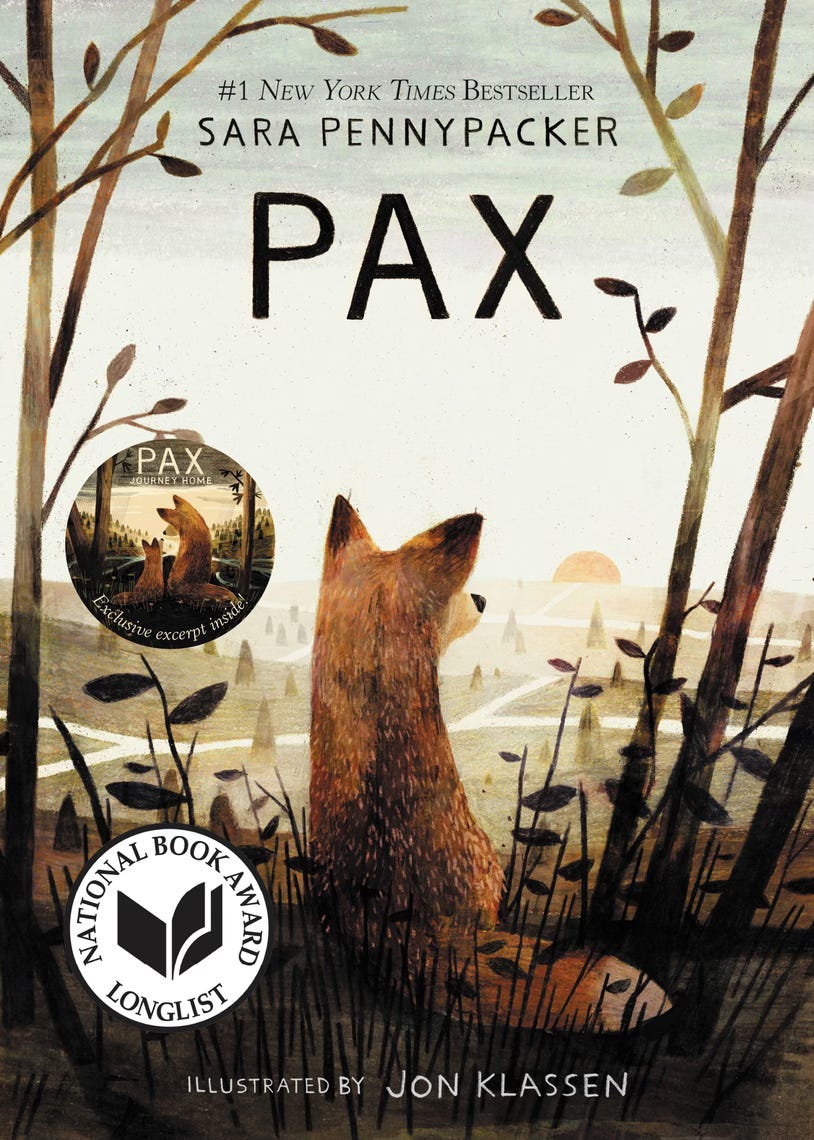
Although it’s only a thought in a boy’s mind, that deer’s imagined accusation haunts Sara Pennypacker’s middle-grade novel “Pax”.
“Pax” is the book’s title and theme (“pax” meaning “peace”), as well as the name of one of its protagonists, a fox raised from kit-hood by the story’s second protagonist, a 12-year-old boy named Peter.
At the start of the book, Peter’s father forces him to abandon the now-grown Pax to a forest life the fox has never known. Peter, too, will be abandoned in a way, sent to live with his embittered grandfather while his father goes soldiering in the unnamed war that backdrops the story. Wracked with guilt at not protecting Pax, Peter decides to travel hundreds of miles through the forest to find his fox.
Pax, meanwhile, has to find his own place in the world. At first, he waits for his boy to return. He’s hungry and cold, but aching from something even deeper — an inability to protect his person, for when “he couldn’t perform this role, he suffered.”
Day by day, however, Pax adjusts. He befriends a brother-sister pair of foxes. He learns to catch his own food. He thrills to his freedom. Slowly, he begins to reconnect with his wild self.
Still, he feels the tug toward his boy. So he sets out to find him.
Early in Peter’s journey, he breaks his foot and is taken in by a gruff farmer who becomes his mentor. Vola is a veteran who lives alone, working her way through her own brokenness to recover her true self.
Vola helps Peter confront and heal his own internal conflict. And he does the same for her. Once healed, he continues his journey. But he has to hurry. He and the war are headed toward the same place. Pax.
There are no specific villains in the story, aside from war itself, which affects lives and souls and landscapes. “There is a disease that strikes foxes sometimes”, an older fox tells Pax. “It causes them to abandon their ways, to attack strangers. War is a human sickness like this.”
Peter’s journey is an attempt to heal from that sickness, and to answer that deer’s imagined accusation. Humans indeed ruin much, but we can repair so much as well. Key to that repair is something Vola says to Peter about the bond he and Pax share. “Two but not two”, she calls it, “It’s about oneness, about how things that seem to be separate are really connected to one another. There are no separations.”
I thought a lot about “Pax” this week, a week when we’re enduring a brutal heat wave in Europe, and a moment from the movie “Mindwalk” came to mind. Based on the work of physicist Fritjof Capra, the film is essentially a long conversation among a physicist, a politician, and a poet about the various sicknesses our troubled species is heir to and how repair might happen. The subject matter is rich, and I return to the film every year or so. (It’s free to watch on YouTube.) The acting is terrific (Liv Ullmann, Sam Waterston, and John Heard star), and the Mont-Saint-Michel setting spectacular.
At one point, the physicist says to the senator, “You don’t see that all the problems are simply fragments of one single crisis, a crisis of perception.”
The senator scoffs, but the physicist persists, insisting that what we don’t perceive is how everything is connected. “Whether we like it or not”, she says, “we’re all part of one inseparable web of relationships”.
There are no separations.
Happy reading,
Jeff
PS. All the content I write is free, but if you want to support my work, consider a one-dollar tip, max, for the year. That’s it! One buck. Once a year. No AI. No auto-renew. No shenanigans. Thanks, Jeff.
Comments
Nothing yet. Say the first thing.
Sign in to join the conversation.