
In September, a Brooklyn nursing home just a few miles from my apartment made national headlines after the violent death of an 89-year-old Holocaust survivor and great-grandmother. Police say the resident was attacked by her 95-year-old roommate and later died at the hospital.
This was a tragedy, but federal records point to a deeper problem. Seagate Rehabilitation and Nursing Center has long been marked by chronic understaffing—one of thousands of U.S. nursing homes operating under similar conditions. In the 1,278 days since New York state implemented a staffing minimum of 3.50 hours per resident day (HPRD), Seagate has fallen below the threshold every single day, according to analysis of federal CMS Payroll-Based Journal (PBJ) data. That doesn’t prove understaffing caused what happened at the 360-bed facility, but it does reflect the kind of environment where adverse outcomes are more likely.
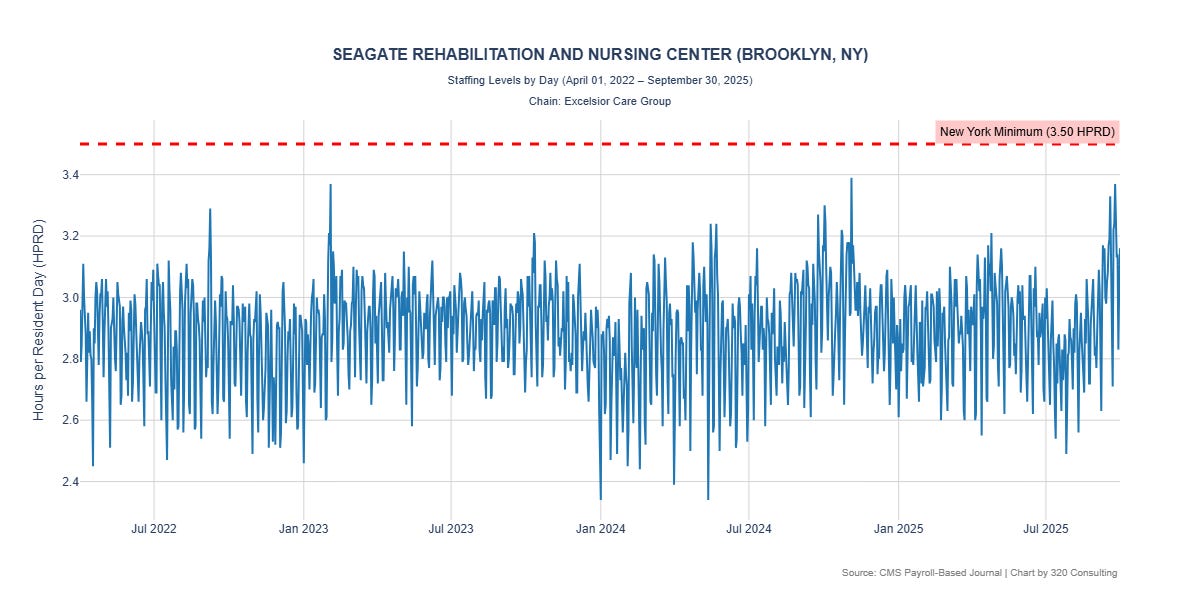
Seagate, one of 33 nursing homes affiliated with Excelsior Care Group, has been persistently understaffed for the better part of the last decade since CMS began collecting PBJ staffing data. Since 2017, in roughly 3,000 days, the facility has hit the 3.50 HPRD threshold just 21 days.1
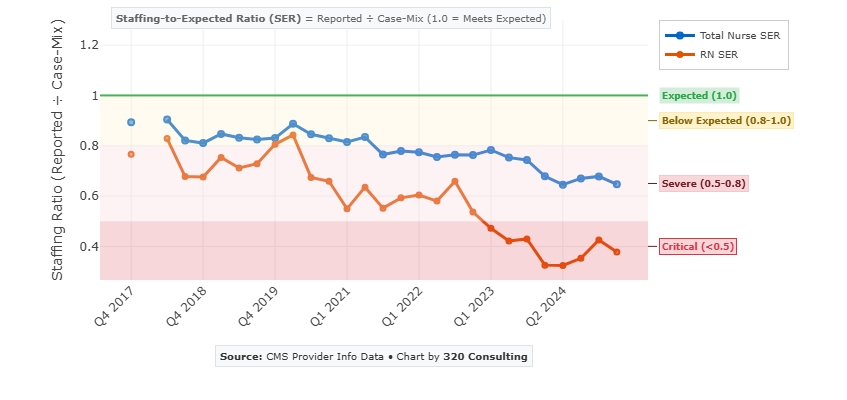
Seagate’s staffing shortfall is more striking when considering resident acuity. The facility’s Staffing-to-Expected Ratio—a back-of-the-envelope metric: Reported Staffing ÷ CMS Case-Mix (expected)—indicates that Seagate residents received 63% of their total staffing case-mix and 43% of their RN case-mix in Q3 2025. That is ... not sufficient!
I’ll refrain from speculating about the impact of staffing levels on the incident or on Seagate in general,2 but research consistently links low staffing to worse outcomes such as falls, pressure ulcers, infections, and resident-to-resident incidents. This fatality is a tragic edge case that warranted national press coverage, but the conditions that allowed for it are routine, enabling adverse outcomes that go unnoticed every day—at Seagate, and across many of the 15,000+ U.S. nursing homes.
Methodology and Notes
Sources: CMS Payroll-Based Journal Daily Nurse Staffing, CMS Provider Information, CMS Technical Users’ Guide, New York Nursing Home Minimum Staffing
Data archives joined via provider’s six-digit CCN.
CMS Provider Info files, unlike PBJ files, are published monthly. Each Provider Info file was matched to a PBJ quarter by aligning the ‘reported total staffing’ metric available in Provider Info with the same metric calculated from PBJ.
In 2024 CMS changed its staffing case-mix adjustment methodology to a model based on the Patient-Driven Payment Model (PDPM).
19 of those 21 days were in 2020 during the COVID-19 pandemic, when resident census was dropping faster than total staffing hours.
No posts
Comments
Nothing yet. Say the first thing.
Sign in to join the conversation.