
Unless you’ve been living under a rock, you should have heard about the AI hedge fund Situational Awareness blowing up. SA is led by Leopold Aschenbrenner, a 25-year-old former OpenAI researcher (quite a brilliant lad), who had a famous essay go viral for his insights on AI (worth a skim). But he ran into problems when many of the AI tickers started selling off since late June, and there was a legit narrative about the AI trade unwinding.
While the AI trade has many questions and friction points ahead, the distance between what actually happened and what everyone thinks happened is one of the most useful lessons the market has offered up in years. Honestly, I could see this hedge fund blowup as a story that lasts for years, if not decades.
The irony of this story is Leopold was indeed right about much of what he observed, noted and predicted in AI. His overall thesis was the AI buildout would demand an enormous expansion of chips, memory, data centers, and power, yet he lost money, and not because the idea was wrong.
He lost because being right was never the hard part.
The blowup, in numbers
The arc is almost too clean. Aschenbrenner’s fund (SA) reported a +439% net return through the first half of 2026 and swelled to roughly $45 billion in assets. Six days before the end, he sent investors a letter calling the July selloff a rare buying opportunity, inviting in fresh capital.
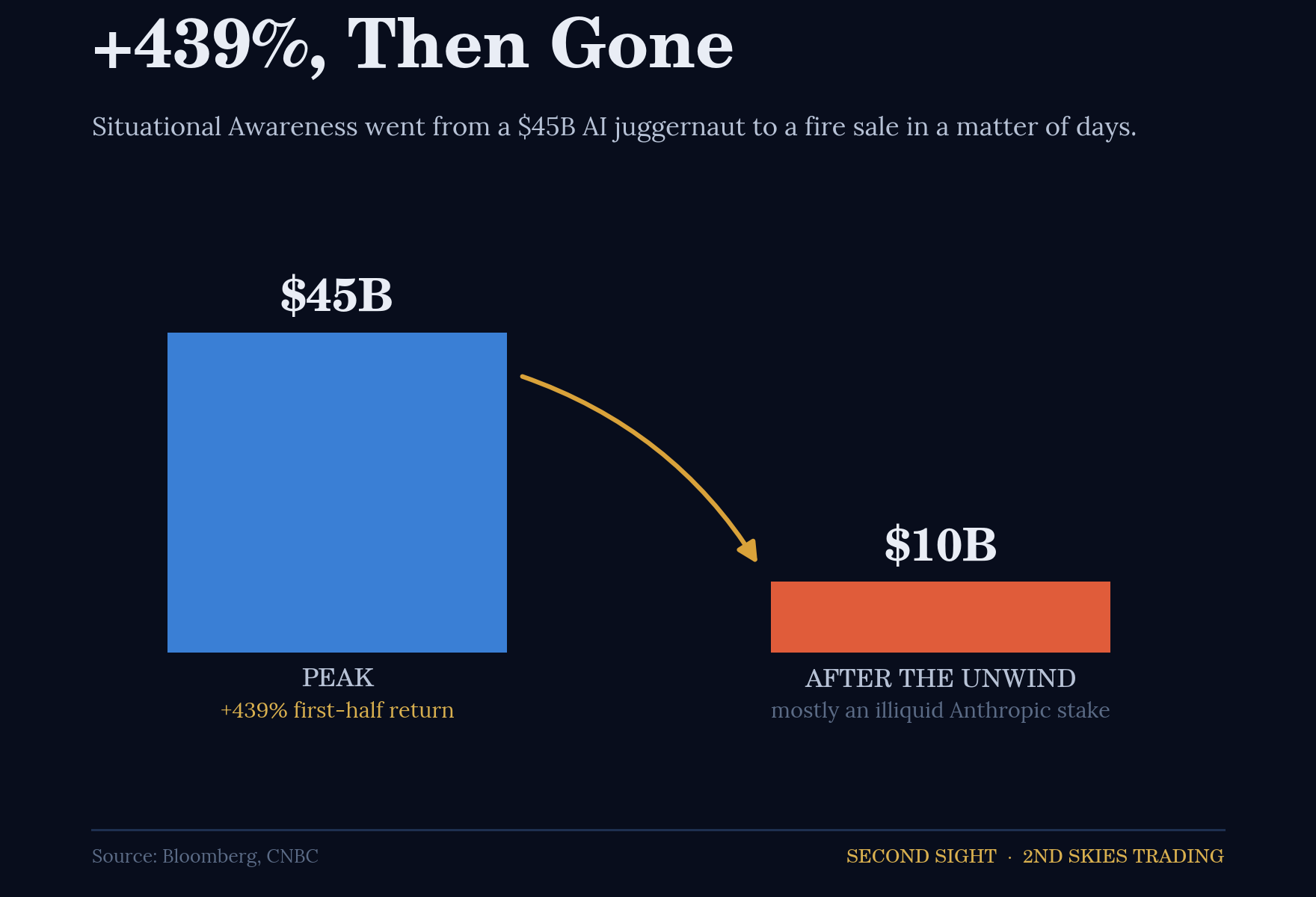
Sadly for Leopold, that capital never got the chance to work. Within days the fund was forced to sell its entire public equity book to Ken Griffin’s Citadel at a discount after prime brokers issued margin calls it couldn’t meet. Assets collapsed to around $10 billion with most of what’s left being a private stake in Anthropic that couldn’t be liquidated into the fire (yet). Three-quarters of the fund, gone in the time it takes to clear a trade.Chris’s note: Leopold is set to marry Avital Balwit, who happens to be the Chief of Staff for Dario Amodei, CEO of Anthropic.
SA’s leverage was the double edge sword Leopold fell upon. Leverage is both an accelerant on the way up, and on the way down. How much leverage did SA have? Approximately 4x leverage. And here’s the detail that matters most. His book was long the AI infrastructure winners across the board, with SanDisk, CoreWeave, Nebius, Bloom Energy, IREN while being short the software names he believed AI would hollow out. We’ve said many times leverage is a tool - used well, its great, used improperly, its a killer. It’s fair to say every bubble in existence has had high leverage, likely beyond the norm when they popped. The same story was true for Leopold. When the momentum reversed,
It wasn’t the thesis. It was the structure + leverage
At 4x leverage, a small decline doesn’t just hurt. It compels a response whether you want to or not. A modest drop in his positions meant he had to sell to bring his leverage back down. But his selling pushed those same prices lower across the AI trade, which meant he had to sell more, which pushed them lower still. His own attempts to stem the bleeding became a negative feedback loop and opened up the arteries. A fund that large doesn’t get to exit quietly. It becomes a market on its own, and the liquidation dominates the price action.
Worse, Wall Street is watching larger players like this, and when the rest of the street realizes there’s a wounded gazelle on the African savannah dressed as an over-levered seller, that seller stops being a participant and becomes an easy target for any lion’s in the area. The market smells blood and leans on the trade. His forced selling in software actually
This is the part worth sitting with, because it has nothing to do with whether AI is a good bet, or whether there are legit concerns about future capex. A perfectly correct thesis, expressed with enough leverage and concentration, still detonates on a small pullback which hits the tripwire. The idea was never the risk. The structure was.
The blind spot no bull market can teach you
Here’s where the story stops being about one fund and starts being about your own brain.
The brain builds its risk model out of lived experience, not out of things it has read, but out of things it has survived. Aschenbrenner built and scaled a $45 billion fund entirely inside a regime that only ever rewarded leverage and conviction. He has never managed money through a real, fund-threatening bear market. That isn’t a character flaw. It’s a data problem. Every drawdown he’d ever seen resolved upward. Every time he pressed harder, it worked. Nothing in his history could teach his nervous system what a one-way liquidation actually feels like, because he had never once been inside one (unless he was trading at 7 during the great financial crisis).
On top of the above, the early moves in his fund made it worse. His initial exposure leaned heavily on private, non-public positions, and illiquid marks don’t reprice the way public stocks do. So the volatility he felt was smoothed and artificially low. Thus, his risk instincts were calibrated to a world far gentler than the one he was actually exposed to. By the time the public market repriced him honestly, the lesson arrived fast and the bill arrived in the same instant.
This is what retail traders often miss when they pile into these levered funds (like South Korean’s found out with their leveraged fund industry). You can hold the correct view of the next day or decade and still be destroyed by the next six hours or 6 weeks. The market doesn’t settle up on your timeline, and unless you’re a larger player, it doesn’t reference you at all. Most of us are a non-reference point for the markets, so we have to play its game.
Experience is the only thing that installs the capacity to avoid these sinkholes of capital. You don’t learn what a bear market does to a levered portfolio by studying it. You learn it by surviving one, once (hopefully), and carrying the scar afterward as a never ending reminder. Aschenbrenner had the model, but he never bore the scar. I hope he comes out of this more the wiser and continues to bring his talents and insights into markets.
What the positioning actually says
The forced-liquidation story is, at its core, a positioning + leverage story, and price alone won’t tell it to you. The price action on the chart shows you a name went down. It doesn’t show you whether a wounded seller was being hunted, whether the flush is finished, or where the market is set up to absorb or amplify the next move. Positioning does. So let’s look at the three names that matter right now. SNDK via GammaLens
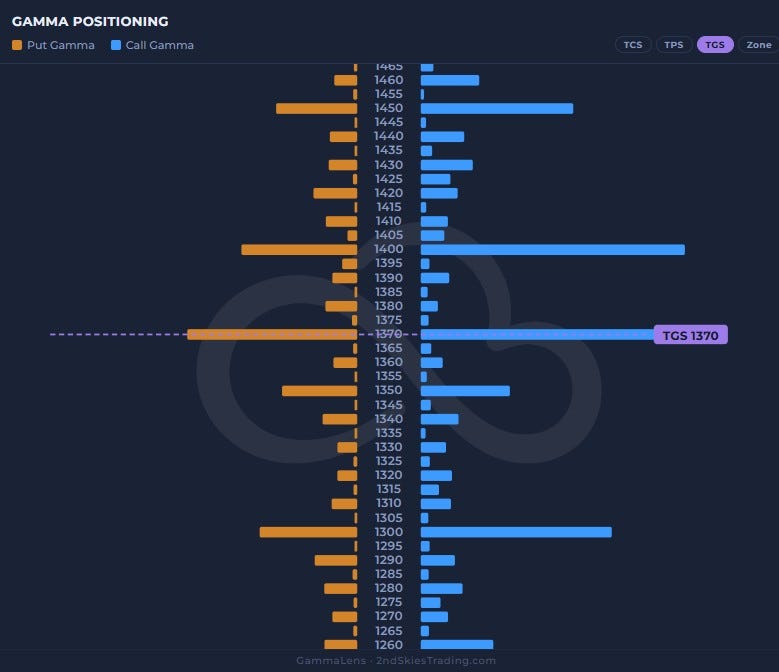
SanDisk was one of Situational Awareness’s concentrated longs and one of the forced-sale casualties. Now that a forced seller has been flushed out of the name, has dealer positioning stabilized, or is downside still being underpriced? How do you read the chart above?SMH via GammaLens
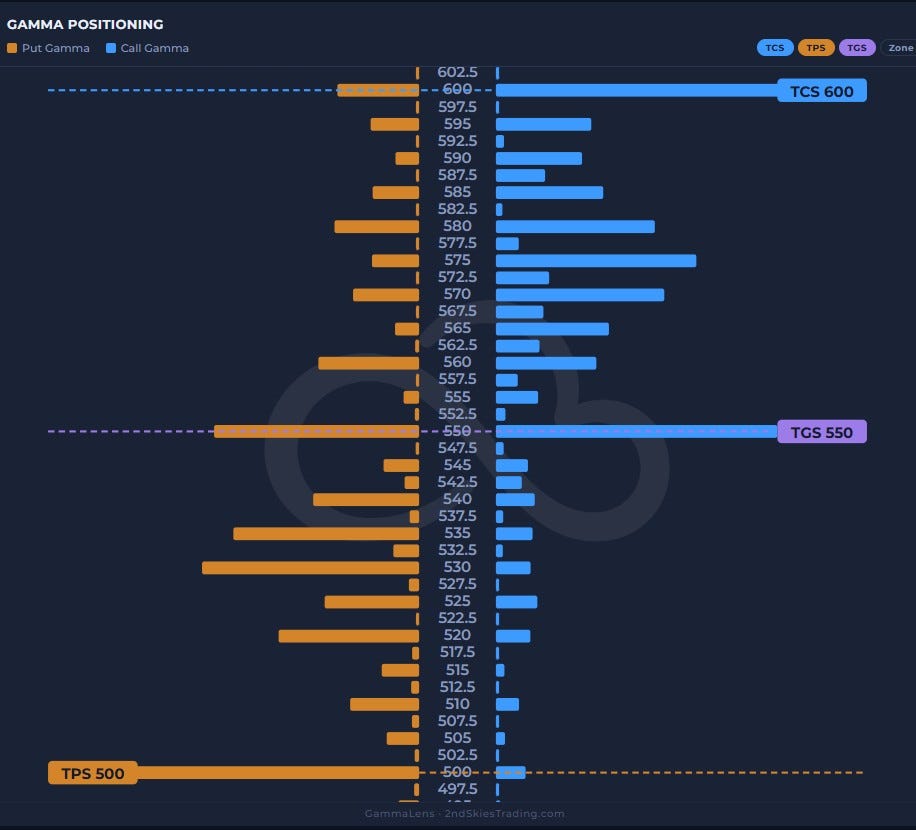
The complex-wide read as SMH was one of his larger positions. Looking at this chart above, do you see forced supply overhanging the whole complex waiting to be worked off?
Want to see these reads yourself? The GammaLens positioning above is live showing real-time gamma structure across 100+ tickers, with the put/call levels, pivots, and gamma magnets that tell you how the next move gets absorbed. We just opened a 14-day free trial on the full 2nd Skies Terminal suite.
The lesson worth keeping
Situational Awareness is not a verdict on AI. But it’s a clear case on leverage without experience.
Being right is not the same as surviving. The two feel identical right up until the moment they violently diverge, and the market chooses that moment, not you. The trader who lasts isn’t the one with the the sharpest thesis or the best system. It’s the traders who have positioned for the regime they might not survive, not just the one they already know. Aschenbrenner had a genuinely good map of the future. He just missed the part about the map and the terrain do not = the same thing. Sadly for him, the terrain is where you actually get liquidated.
— Chris,
“The positioning + flow don’t lie...but the brain might.”
Chris Capre · Founder, 2nd Skies Trading · MSc Neuroscience Candidate, University of Florida
Nothing here is financial advice.
No posts
Comments
Nothing yet. Say the first thing.
Sign in to join the conversation.