
“The key thing is fundamental structural reform, so that we have competition across institutions in different states, essentially introduce a market for those facilities supports separately from the grants, and then have the grants funded, the researchers funded, and the institutions then compete to bring the researchers to their institution to do the research…”
– Jay Bhattacharya, proposing a DEI program for underfunded universities
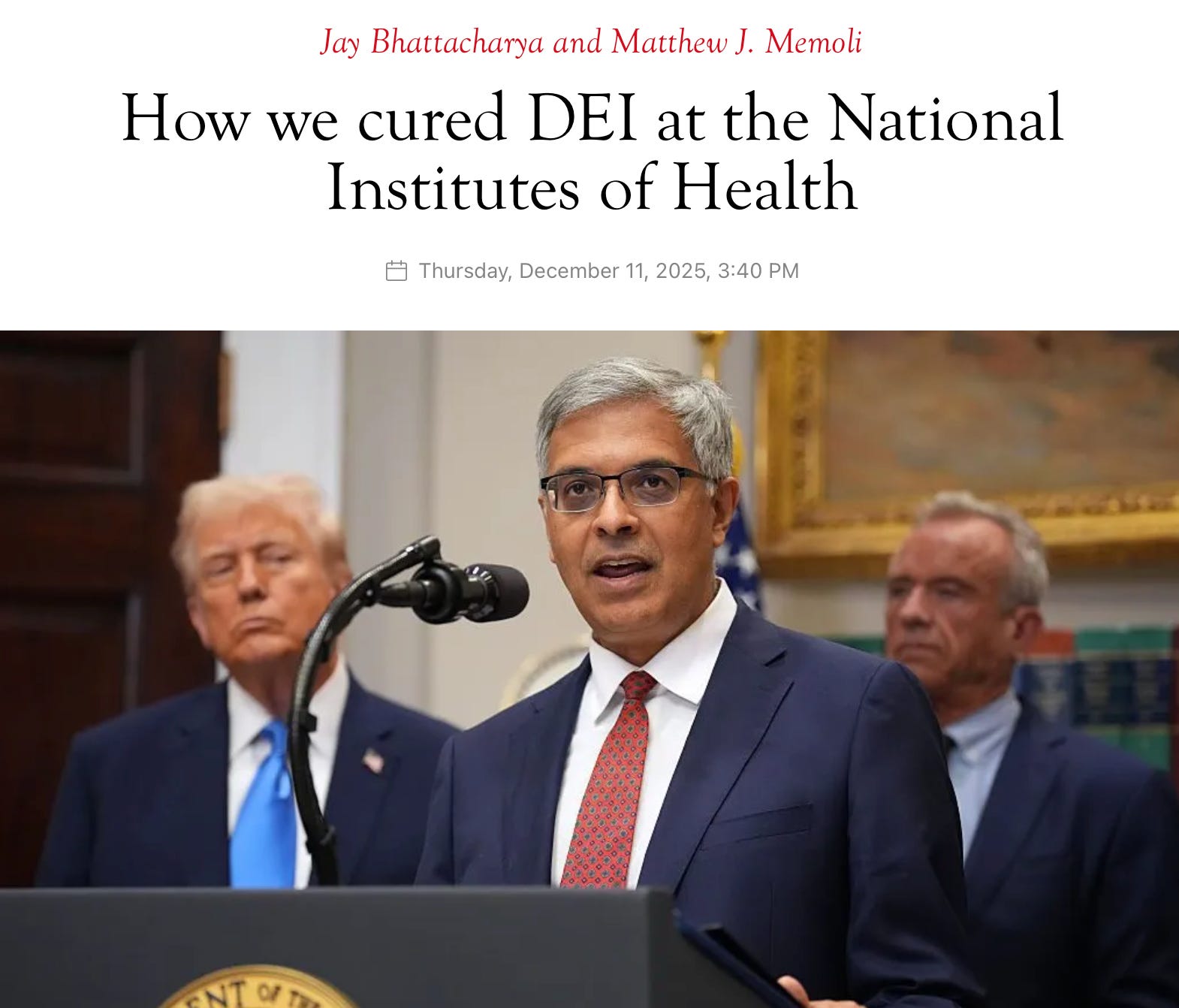
Welcome back to our fact check series, where we set the record straight on NIH Director Jayanta Bhattacharya’s lies, spoken at a March 17, 2026 Congressional hearing.
Today, we bring you part 8: examining whether Bhattacharya really is distributing funds more evenly across geography. (Spoiler alert! He’s not.) Despite Bhattacharya’s claimed interest in directing funding to underfunded states, Bhattacharya’s policies have actually reduced funding in these states. And even if he weren’t undermining his own stated goal, wouldn’t such a program be DEI? I guess he only wants to “cure” the NIH of DEI when it’s politically expedient.
In his opening remarks:
“We’ll also develop strategies for greater geographic distribution of funding, which I hope to have a chance to talk about some of these ideas.“
In response to Representative Aderholt on barriers that prevent rural universities from successfully competing for NIH funding:
“The key issue is about a third of our portfolio of extramural research goes to about 20 institutions.... But we have to make investments in those places outside of the top 20.“
In response to Representative Simpson:
“The key thing is fundamental structural reform, so that we have competition across institutions in different states, essentially introduce a market for those facilities supports separately from the grants, and then have the grants funded, the researchers funded, and the institutions then compete to bring the researchers to their institution to do the research. Essentially create a much more sort of competition friendly approach to where the research gets done.”
Bhattacharya glosses over the fact that the NIH has been successfully supporting scientists at less resourced organizations or in rural areas. The National Institute of General Medical Sciences Institutional Development Award (IDeA) program was mandated by Congress in 1993 to build research capacity in states with historically low NIH funding levels. The program has successfully built capacity in underfunded research states, such as Oklahoma and North Dakota. While Bhattacharya claims to want to enhance funding to these states, grant terminations that occurred under his watch have disproportionately impacted states eligible for the IDeA program. An analysis by the American Association of Medical Colleges found that grant terminations under Bhattacharya impacted IDeA states disproportionately, with a 19% drop on average in FY 2025 in IDeA states compared to a 16% drop in general. Because this analysis was conducted before grants were re-instated under Mass vs Kennedy/APHA vs NIH, and very few IDeA states opted into the lawsuit (only Delaware, Hawaii, New Mexico and Rhode Island), this disparity is likely larger.
Stay informed!
Read the full fact check on the 27UNIHTED website.
Follow us here or on Bluesky, Instagram, LinkedIn, or Facebook for up-to-date content on what’s happening inside NIH.
Look out for the next post in our fact check series on declining trust in the NIH.
Inform others! Share this post with your colleagues.
Call your members of Congress and urge them to enact protections for NIH, including saying no to Russell Vought’s proposed rule on financial federal assistance.
Help us stop Russell Vought from doing further damage (or at least pull him out from where he’s hiding in the shadows and give him the infamy he deserves!) by urgingCongress to impeach, convict and remove him from office.
Need more ideas? Check out our Advocacy Menu.
Through this blog series, recent and current NIH staff (in our personal capacities) are fighting for scientific integrity at the NIH, so science can continue to yield future treatments for our fellow Americans. In these blogs, we are highlighting when Bhattacharya flagrantly mischaracterized, obfuscated, or just plain lied about the state of NIH under oath to members of Congress during the March 17 House Appropriations Committee hearing.
In case you missed it, we recently covered NIH’s ability to spend 2026 funds, the harmful consequences of the rapid transition to multiyear funding, how discriminatory censorship of NIH grants is excluding many Americans from the benefits of science, political interference at the NIH, challenges facing the next generation of scientists, and disruptions in HIV research.
No posts
Comments
Nothing yet. Say the first thing.
Sign in to join the conversation.