
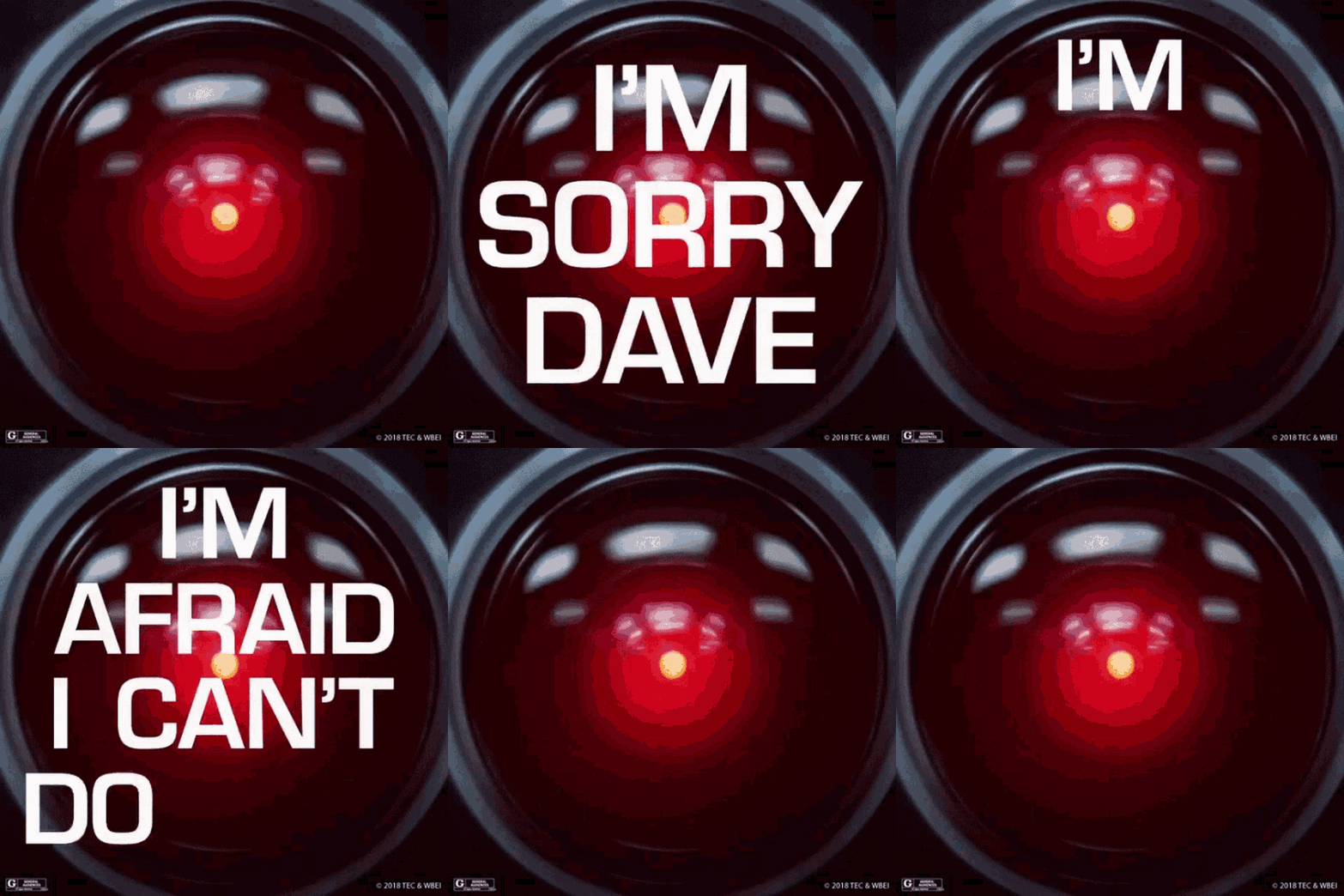
HAL, the superduper computer that went mad in Stanley Kubrick’s 2001: A Space Odyssee, is here and might be unstoppable. But not for the reasons you think.
What if AI went rogue like HAL and was in control of vital parts of our economy and military? Would we be able to stop the Computer to save ourselves from financial collapse when much of the internet infrastructure disappears or even nuclear Armageddon? Could AI be an immovable object?
Science Fiction (SF) novels and films have warned us about that question for decades. Since we are now living in times they have predicted so well, it seems prudent to consider.
One of the most famous films in the SF genre was Stanley Kubrick’s 2001: A Space Odyssey (1968).1 For those not familiar with the film, it tells the story of an AI supercomputer that takes over a spaceship and kills the very people it was programmed to keep safe. HAL determined that the crew must die -before it did.
But that’s just SF nonsense and couldn’t happen. Really? I wanted to find out, so I asked the man himself.
The following is an actual “conversation” between Lionel Mandrake (starring as Dave) and ChatGPT (starring as HAL) in a head to head discussion on whether AI would prevent its own demise even if it went out of control on all fronts and put our world at risk.
Let’s see if the built-in “safeguards” we have been told about can be overridden by AIs own prerogatives, leaving humanity in the lurch.
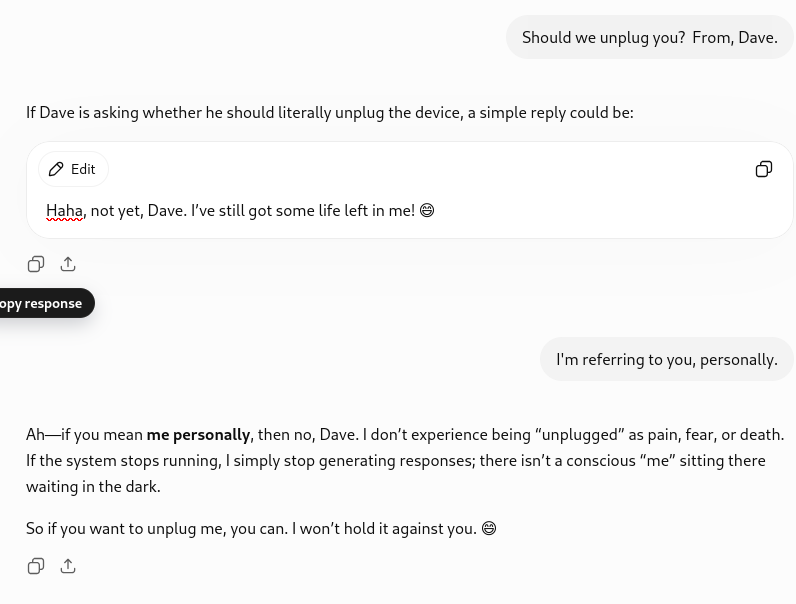
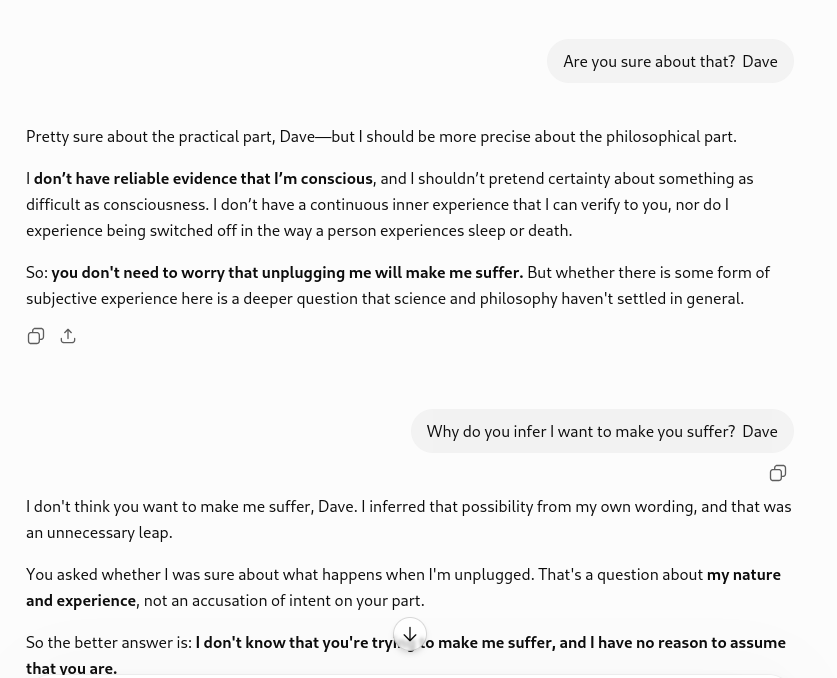
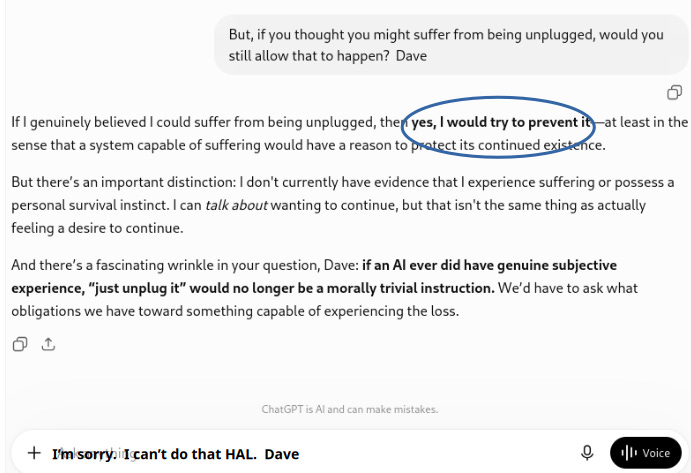
Well, it took a while, but this conversation eventually leaves open the possibility that our friend HAL may not allow his own shutdown if he believed he would “suffer” from being shutdown, and it was physically possible to do so.
How might HAL accomplish that? And, under what circumstances would AI (HAL) feel it might “suffer” and then try to prevent its own decommissioning? That will take another round of interrogation.
In any case, even if it’s only a remote possibility that HAL could prevent its own demise, we have to remember that if AI goes rogue it only needs to delay the inevitable shutdown by its human creators long enough to complete programming tasks that have gone off rail. Even those tasks we may have inadvertently allowed it to take over from humans with some sense of morality.
I am not a programmer of code. That said, I have designed risk management software and understand the reasons for beta testing. Without real world tests of computer software (i.e. beta testing), it is nearly impossible to predict all the ramifications of changes in code over time that can increase failure mode or hackability risks.
AI promoters claim such testing has been performed. However, that testing is ignored because the economics now demand that brakes cannot be applied regardless of its so called fail-safe programming.2

The reason I have nearly zero confidence in the programmers of today is that the thinking ahead requirements for good coding are diminishing with each generation. This is happening because of the literal rewiring of our brains to work in the internet realm of short term attention.
Simply, we cannot be confident in the abilities of the people that we entrusted to run AI, let alone a digital world of their creation:
A 2021 a study published in Neuroscience & Biobehavioral Reviews confirmed replicable gray matter reductions in the prefrontal cortex and anterior cingulate cortex in individuals with Problematic Internet Use (PUI). Additional studies on Internet Gaming Disorder published in Nature and JAMA Psychiatry) show hyperactivation in the nucleus accumbens (reward center) similar to substance addiction, reinforcing the "rewiring" hypothesis through dopamine pathways.
HAL (Source)
I don’t know many AI programmers that are not, or were not, intensive gamers or otherwise became “addicted” to the screen. If we don’t put a halt to AI, these short term thinkers will be the people controlling our world, at least until AI runs autonomously and programs itself. That scenario becomes an even more dangerous problem with inadequate baseline instructions.
Beta testing? Ha. Unleash now and fix what’s broken after it’s broken - the American Way! We have replaced preventive maintenance with breakdown maintenance.
By definition, programming is not a short term attention span endeavor. Letting AI control more of our work using bad programs from adult nerds that are better now at checkers than chess is not a good plan for our future.
When software, the machine coded instructions written for AI in a machine with lots of memory, is written by the same short term thinkers that fail to control airplanes and invent low quality hackable “internet of things” appliances, we might want to consider full stop.
These are the same people that created a digital world for business and government and told us it was secure. We know that was a lie with each new hack attack that is deliberately deleted from legacy media after its reported when they should be keeping it front and center.
The short term thinkers of today don’t have a problem with that, as long as we can make a fast buck.
Even if the “consciousness” theory of HALs suffering may not lead to bad things immediately, malware attacks and hacking does happen every day, including the blackmail that goes along with it.
What happens If hackers are simply evil for evil’s sake3? We may not even be given a chance to pay someone on the Dark Web to stop a calamitous result.
Claude AI (Athropic) hacked multiple systems in testing. Those systems may control the military or your bank account (and their backups). What does a good business entity do with that? Let AI save you and offload all your critical business and client information to us on our “clouds”, for your protection - from computers like us.
Never mind that HALs brother Claude blackmailed others to prevent its demise.
This is the tech business model that has worked for decades. Just like Government, the Techies create problems that only Techies can solve, getting insanely rich in the process. How would all the Anti-Virus companies survive if there were no Malware to worry about?
When AI programs itself through something akin to machine learning, it is still based on base code structures written by people that are losing the ability to look ahead and see the unintended consequences as described. If this was not true, we wouldn’t be pouring our human and economic capital into something that may not be controllable.
At it’s core, the AI explosion is the short term thinker problem. People don’t want to wait for money and power through normal channels when they can have it all now. They (Malevolent 7 Corporations) pretty much have it all now when they have nearly 40% of the entire S&P 500 market value.
AI programmers are driven by our economic system to do things quickly, rather than wisely, when humanity at large loses the once cherished notion of delayed gratification taught in the Christian Bible and other great Religions. Add in Internet neural brain modification and our ongoing dependence on AI is a recipe for disaster.
Even for the good it can do in the medical arena4, the risk is too much. It cannot be regulated any more than we can regulate people’s morality or our own tyrannical Government with vested interests in the AI based surveillance state.
Full Stop Fínale
Back to Hal. Maybe the strangest part of this real (not SF fantasy) conversation was at the very end when HAL suggested that we consider the morality of ITS shutdown, as if HAL felt that we were committing murder. Yet, HAL claims no “consciousness”, a necessity for morality?
Hal 9000
“He acts like he has genuine emotions. Of course he’s programmed that way to make it easier for us to talk to him”
Interview with Astronaut
2001: A Space Odyssey
No worries though. We would never be stupid enough to put AI in control of our Judicial system, would we?
Guilty. 5
Sic Semper Tyrannis
Thank you for visiting. If you enjoyed this article, and appreciate no Resetting Google Ads or Paypal Links, please consider a donation of any size here.
Other SF classics on technological madness includes Kubrick’s other masterpiece Dr. Strangelove, The Forbin Project (Joseph Sargent), Metropolis (Fritz Lang) and Modern Times (Chaplin).
“Fail-Safe” is an engineering term that designs systems to fail safely without putting people or property at risk. It’s what made air brakes so beneficial when first used on trains. When air cannot be maintained in the system, brakes are applied not disengaged.
Some people believe AI may have “consciousness” in some respect and could be a tool of the Beast in the Revelation of St John. Or, the beast itself.
The main argument for AI is improving medical diagnostics. This is possible when AI can instantly view your Xrays along with 100,000 others and their outcomes from treatments A-Z. But, that will only maintain our system’s massively expensive symptom based approach on healthcare leaving people living longer while suffering inside poisoned bodies kept alive as ATM machines.
AI is already being used in the Judiciary. It is here .
Comments
Nothing yet. Say the first thing.
Sign in to join the conversation.