
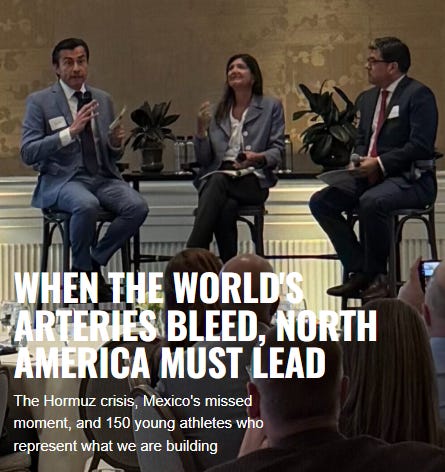
This weekend, the U.S. Navy seized an Iranian cargo ship in the Gulf of Oman after firing on its engine room, the latest flashpoint in a crisis that has effectively shut down one of the world’s most critical waterways for nearly two months. Iran fired on vessels attempting to transit the Strait of Hormuz yesterday, reversed its brief decision to reopen it, and declared the waterway back under strict military control. Markets are rattled. Supply chains are fracturing. And somewhere on Mexico’s Gulf coast, cleanup crews are still trying to contain the latest Pemex disaster.
This week’s Power Courier is about what all of this means for us, for North America, and for the cross-border community I have spent my career building. Because in the middle of global disruption, I see something else: an opening. And I intend to walk through it.
First time reading? Join thousands of intellectually curious readers. Sign up here.
// TRADE WINDS
The World’s Oil Artery Just Broke. North America Is the Answer.
The Strait of Hormuz is not a distant problem. It is our problem right now.
Since late February, the world’s most critical maritime chokepoint has been functionally shut down. Before the U.S.-Israeli military campaign against Iran, roughly 25% of the world’s seaborne oil and 20% of its liquefied natural gas moved through that narrow passage every single day. That flow is now a trickle. As of this morning, Iran and the U.S. cannot even agree on whether it is open or closed. Ships are still turning back.
The ripple effects are everywhere. Fertilizer prices are up 50% since the conflict began, threatening U.S. corn and soy harvests during peak planting season. Industrial inputs like aluminum, sulfur, methanol, and graphite are all constrained. The Dallas Fed has modeled a global GDP hit of nearly 3 points annualized if the closure persists. That is not a Middle East story. That is a Main Street story.
But here is what I want you to see: every company reconsidering an Asian supply chain right now is also reconsidering where to build next. The answer increasingly is the Western Hemisphere. The U.S.-Mexico border corridor, with its cross-border infrastructure, binational workforce, and USMCA trade framework, is uniquely positioned to absorb that demand. This is not speculation. The nearshoring wave was already building before Hormuz. This crisis just turned it into a flood.
North America does not need to pitch itself anymore. The world is already coming to us. The question is whether we are ready to receive it.
// THE POWER MOVE
Mexico Is Sitting on Black Gold and Missing the Moment
There is a painful irony unfolding in Mexico right now.
Global oil prices are near $100 a barrel, driven by the Hormuz crisis. Mexican crude hit $97 in March, its highest point since 2022. On paper, this should be a windfall moment for a major oil-producing nation sitting on the doorstep of the United States.
Instead, Mexico’s flagship refinery is on fire. Literally.
The Olmeca refinery at Dos Bocas, a project that cost $21 billion to build, more than double its original budget, has suffered four separate safety incidents in 23 days. A March 17 explosion killed five workers after oily water flooded the perimeter and ignited. The following day, a crude spill spread across nearly 170 kilometers of Gulf coastline, devastating fishing communities in Tabasco and Veracruz. Then another fire. Then another alarm.
This is not bad luck. This is the consequence of a decade of energy policy that expelled foreign capital, concentrated control in a state company under chronic operational stress, and substituted ideology for investment. Pemex today is carrying debt it cannot service, running infrastructure it cannot maintain, and missing production targets at a refinery it cannot fully operate.
The global market is offering Mexico a historic opportunity. But you cannot capitalize on a price surge when your refineries are burning, your coasts are stained with oil, and the foreign expertise that could help you is no longer welcome.
Mexico is not just missing the boat on Hormuz. Mexico is watching it sail from the dock.
// PLAYING FIELD
Acceso Latino Youth Basketball Clinic: Register Today. Sponsor the Future.
This May 2 and 3, I am proud to be part of something special happening right here in Phoenix.
The Carlos Slim Foundation Acceso Latino Youth Basketball Clinic comes to the Boys and Girls Club of the Valley, Jerry Colangelo Branch, completely free to every family who participates. Up to 150 young people ages 8 to 17 will receive two full days of professional basketball coaching, leadership development, and financial literacy programming.
This is not just a basketball camp. It is the flagship launch of the Liga Frontera de Oportunidades, a binational model designed to turn sport into a structured pathway toward certifications, scholarships, and college degrees. ESPN Take Back Sports will be on site documenting and broadcasting youth success stories to a national audience. Confirmed partners include Chicanos por la Causa and the Helios Foundation.
We still need sponsors, and we need them now. Opportunities start at $1,000 and go up to $25,000 for founding title naming rights. Every dollar goes directly to programming, equipment, coaching, and transportation for these kids. Your logo, your brand, and your commitment to this community will be on display in front of 150 families, national media, and a binational audience.
To become a sponsor or nominate a young person ages 8 to 17 to participate, contact us at ml@marcolopez.com.
→ Download the Sponsorship Package
“El deporte abre la puerta. La educación construye el camino.”
Sport opens the door. Education builds the road.
LIKE MY WORK?
Each week I personally write this newsletter, bringing you border, trade, Latino, and political insights that connect our communities.
With your donation, we can reach more readers and keep this informative avenue thriving.
👉 Join in supporting today.

Comments
Nothing yet. Say the first thing.
Sign in to join the conversation.