
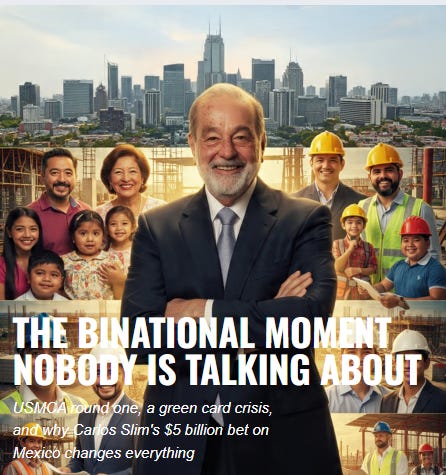
Washington in June really looks like. The second is a USCIS memo that is quietly dismantling a legal pathway millions of families have relied on for decades. The third is Carlos Slim’s annual press conference, where the most powerful private investor in Latin America sent a message that not enough people are paying attention to.
First time reading? Join thousands of intellectually curious readers. Sign up here.
When Carlos Slim speaks at his annual press conference, I pay attention. And this year, what he said deserves to be heard well beyond Mexico City.
On May 26, Slim held his traditional annual conference at the headquarters of Grupo Financiero Inbursa. For nearly two hours, he laid out his read on the Mexican economy with the directness that has defined his public voice for decades. The headline number was $5 billion. That is what his companies, Grupo Carso and América Móvil, plan to invest in Mexico this year across infrastructure, energy, and telecommunications. The announcement comes as Mexico reported record foreign direct investment of $23.59 billion in the first quarter of 2026, up 10.4% from the same period last year, despite trade tensions and uncertainty around the upcoming USMCA review.
Slim was equally direct about the threats. He identified the crisis at Pemex as Mexico’s biggest problem, pointing to falling output, a lack of investment, and a debt load approaching $85 billion. He also pushed back forcefully on the credit rating agencies. He called Moody’s recent downgrade of Mexico’s sovereign rating “irrational,” arguing the agency was measuring debt through an isolated metric rather than examining how those resources are being used and invested.
I have had the privilege of working alongside Carlos Slim through the Carlos Slim Foundation and the AccesoLatino program. What I have always respected about him is that his confidence in Mexico is not blind optimism. It is a practitioner’s conviction, rooted in decades of building institutions, creating jobs, and investing when others hesitate.
The lesson for anyone watching the Arizona-Mexico corridor is straightforward. When the most consequential private investor in Latin America doubles down on Mexico during a moment of uncertainty, that is not a gesture. That is a signal. At Intermestic Partners, we read that signal clearly, and we are building accordingly.
Introducing the border art collection
I have spent my entire career at the intersection of two nations. I have sat across from diplomats, negotiated trade agreements, managed the busiest land ports of entry in the world, and walked the same desert ground that millions of people have crossed in search of something better. The border is not an abstraction to me. It is home.
For years, the walls of my office have told that story. Now I want to share it.
This week I am launching my Border Art Collection, a curated set of works that reflect the depth, complexity, and humanity of the U.S.-Mexico relationship. These are not decorative pieces. Each one carries a history, a people, and a point of view. The collection begins with the piece I consider the most fitting for where we stand today: a striking oil portrait of José Doroteo Arango Arámbula, the man the world knows as Pancho Villa, El Centauro del Norte.
Painted in July 2023 by artist Rita Amaya, the original hangs in my office in Phoenix. Every U.S. and Mexican business leader, diplomat, and official who walks through that door sees it. No one needs it explained. Villa was a fronterizo, a man of the border, who governed and operated across two nations as if boundaries were merely suggestions. He remains the only Mexican commander in history to launch a military invasion of the United States, forcing an American military response in 1916. He is complicated, defiant, and impossible to ignore, which is exactly what the border has always been.
Professional poster prints are now available for your home, office, boardroom, or any space where the U.S.-Mexico relationship matters. Visit my website for details, and follow along as the collection grows.
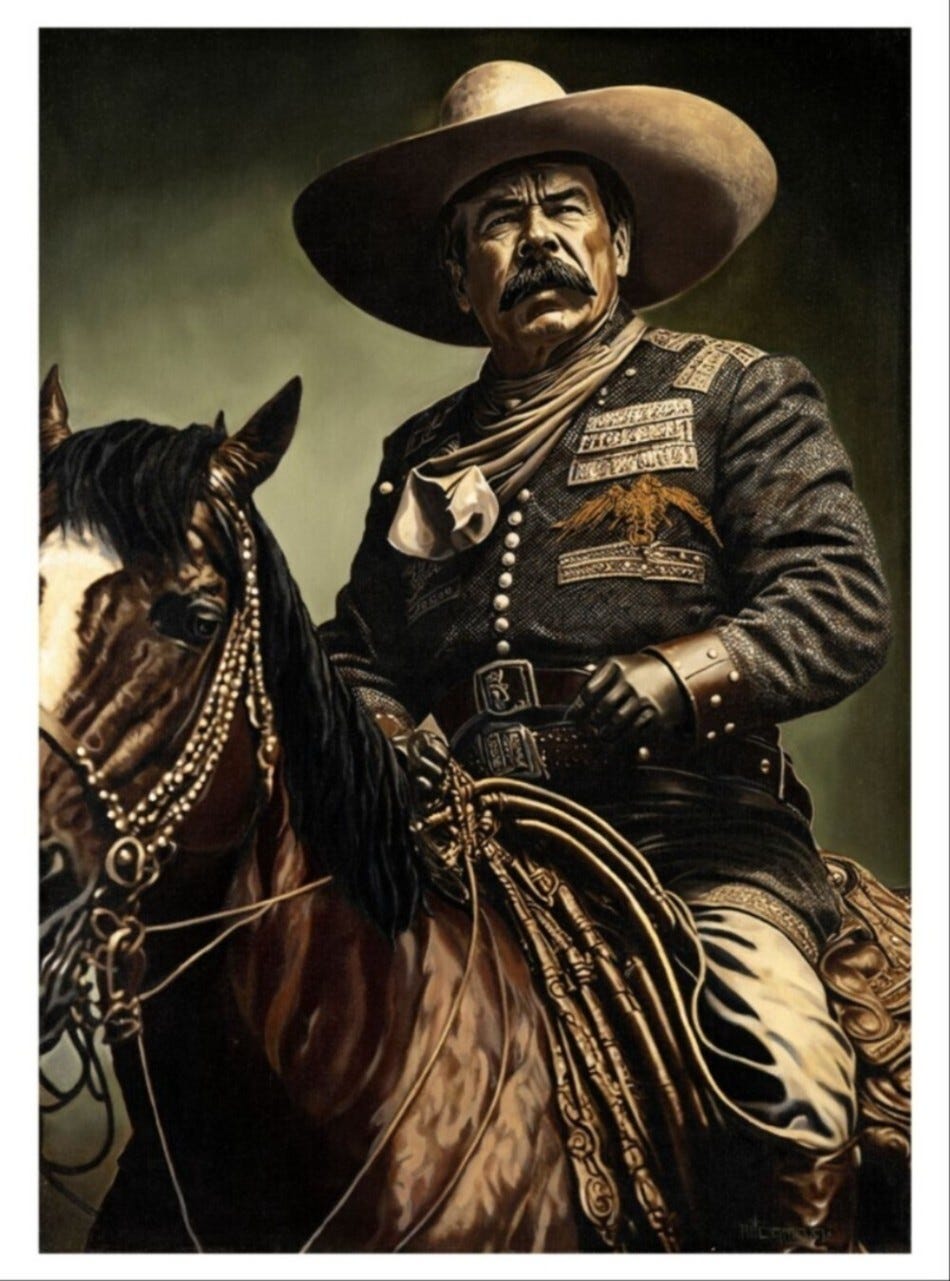
Pancho Villa - El Centauro del Norte
Born José Doroteo Arango Arámbula in Durango, Mexico, Villa commanded the largest military force of the Mexican Revolution, governed the border as if boundaries were suggestions, and remains the only Mexican commander to launch a military invasion of the United States.
Professional poster prints available now.
Shop now $25
This one hits close to home for a lot of families I know personally.
On May 21, USCIS issued Policy Memorandum PM-602-0199, and the title alone tells you everything about the intent behind it: “Adjustment of status is a matter of discretion and administrative grace, and an extraordinary relief.” The next day, the agency’s public announcement went even further, declaring that USCIS will grant adjustment of status only in extraordinary circumstances. In plain terms, that means millions of people living legally in the United States on temporary visas, students, workers, spouses of American citizens, who are in the process of becoming lawful permanent residents, may now be required to leave the country and apply from abroad.
Here is where it gets more complicated. The phrase “only in extraordinary circumstances” that appeared in the USCIS press release does not actually appear anywhere in the memo itself. USCIS issued conflicting messaging, which has created confusion and panic for applicants, employers, and practitioners. A partial walkback came almost immediately, carving out exceptions for people providing “economic benefit” or serving the “national interest,” but with no clarity on how those exceptions will actually be applied.
I spent 3 years working inside the federal immigration and border security apparatus. I managed a $13 billion budget and a workforce of 60,000 people. And I can tell you this: policy this consequential does not get rolled out this way by accident. What we are watching is deliberate disruption dressed up as legal housekeeping.
Ultimately, many people will have to decide whether to remain in the United States with their families while risking their immigration status, or leave to pursue lawful permanent residency with the possibility of never being able to return. For the 40 million Mexican-connected residents in this country, that is not an abstract legal question. That is a kitchen table conversation happening right now.
The first round is done. Now the real work begins.
On Friday, negotiators from the United States and Mexico wrapped up the first formal bilateral round of USMCA review talks in Mexico City. Automotive rules of origin, steel and aluminum, and economic security were on the table. Mexican Economy Minister Marcelo Ebrard and Deputy U.S. Trade Representative Jeffrey Gerrish led their respective teams. By all accounts, the atmosphere was constructive. Both sides described orderly progress. Round two is scheduled for June 16 and 17 in Washington, where agriculture and fair competition conditions get added to the agenda. A third round follows the week of July 20, back in Mexico City, with the goal of resolving pending issues before the formal Joint Review launches July 1.
What I take from this is something the official statements won’t say directly. The fact that these bilateral pre-rounds are happening at all, before the formal July 1 trigger, tells you both governments understand the stakes and want to arrive at that table with as much groundwork laid as possible. This is not routine diplomacy. This is two countries trying to lock in as much alignment as they can before the formal clock starts.
I also want to flag something that deserves more attention. Canada is not at this table. These are bilateral rounds between the U.S. and Mexico only. The trilateral architecture of USMCA is, for now, a bilateral conversation. What that means for the long-term integrity of the agreement is a question no official is eager to answer publicly.
From where I sit, at the intersection of trade, border infrastructure, and binational investment, the Arizona-Mexico corridor has everything to gain from a strengthened USMCA and everything to lose from a prolonged negotiating standoff. At Intermestic Partners, we are watching these rounds closely because the outcomes will shape the investment environment for everything we are building along this corridor for years to come.
Round two is six weeks away. Stay close.
Never miss a beat from headlines to deep dives.
Comments
Nothing yet. Say the first thing.
Sign in to join the conversation.