
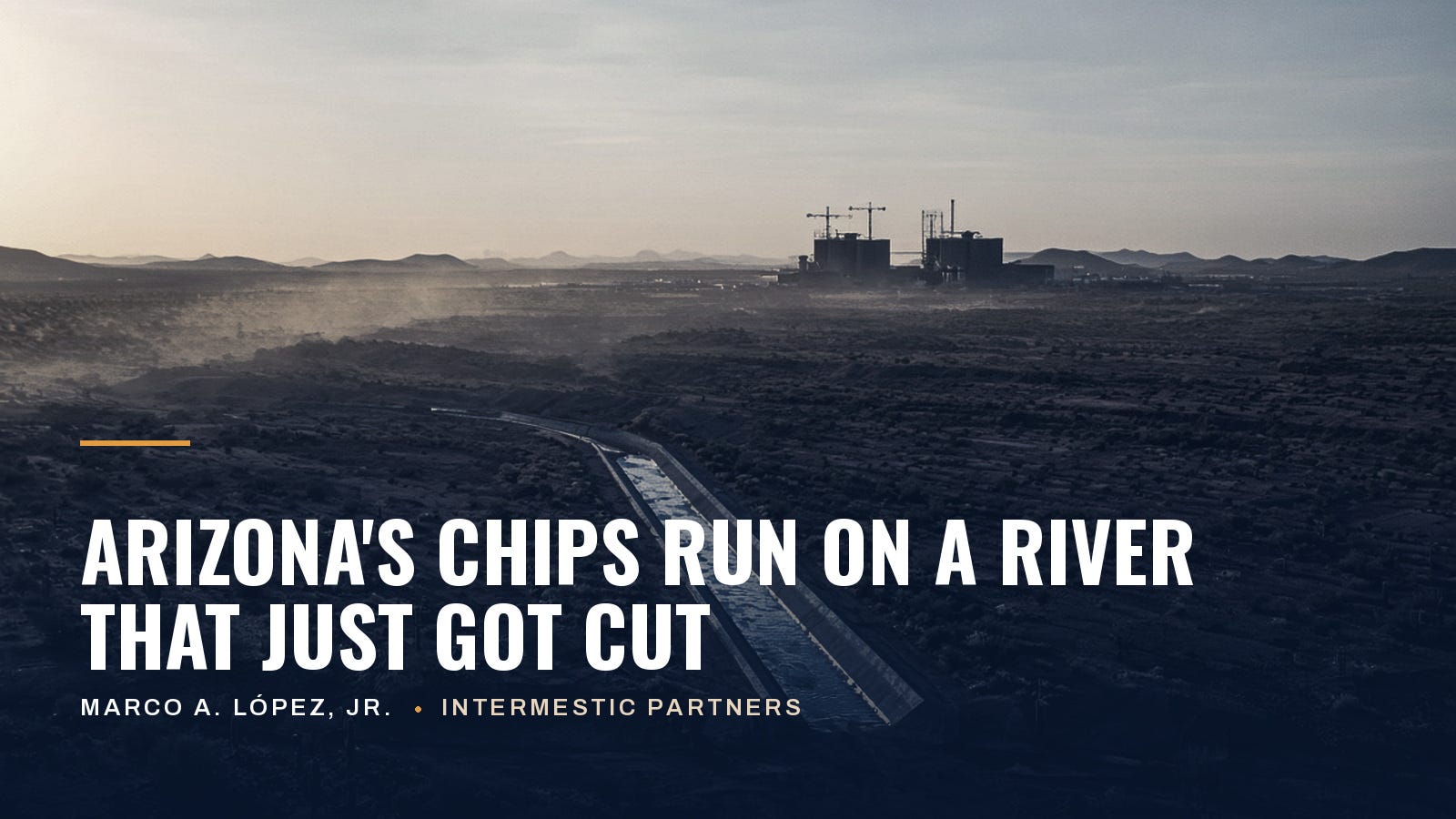
On July 31 the Bureau of Reclamation released its final framework for operating the Colorado River after this year, and the shape of it tells you everything. The first two years adopt the reductions the Lower Basin states had proposed for themselves, then the rules get revised at two year intervals through 2036, and the Upper Basin faces no mandatory cuts at all. Under the worst case, the federal government could cut Arizona, California and Nevada by as much as 40 percent. DLA PiperNPR
Arizona’s leadership called that unacceptable and said it would devastate the state economy. They are not wrong. But the reaction has been almost entirely about the unfairness of the split, and almost not at all about what Arizona should do with the water it still has. That second question is the one that decides the next decade.
This is not new, and it is not an accident of hydrology. It is a bargain we made. To get congressional approval for the Central Arizona Project in the 1968 Colorado River Basin Project Act, Arizona agreed that water delivered through the CAP canal would be junior in priority to California’s. We bought the canal with our place in line. Every shortage since has been paid for out of that agreement first, which is why CAP agricultural users in Pinal County lost their supply years before anyone in Los Angeles noticed a difference. arizona
So when the framework lands on the Lower Basin, it lands on Arizona twice. Once as a state, and again as the junior user inside the state.
Meanwhile Arizona spent four years selling itself to the world as the center of American semiconductor manufacturing, and it worked. The analysis of TSMC’s first three fabs projected roughly 6,000 direct high technology jobs, more than 20,000 accumulated construction positions, $1.4 billion in tax revenue to the state over 13 years and $32.9 billion in economic output. Intel is expanding in Chandler. Amkor is building in Peoria. The supplier base is following. Ahwatukee
Every one of those jobs implies a family, and every family implies a house, in a metro that was already short on both water certainty and housing supply. That is the collision. Not chips against water. Chips, housing and water all drawing on the same shrinking account at the same moment.
Here is what I tell clients who ask whether Arizona is still a safe place to put a plant. The fabs are the efficient users, and the numbers are not close.
TSMC’s first Phoenix fab runs on about 4.75 million gallons a day and its in house system recycles roughly 65 percent. The reclamation plant it broke ground on is designed for near zero liquid discharge, targeting 85 to 90 percent, which would drop that fab’s outside demand below 1.2 million gallons a day. All three fabs together would need 17.2 million gallons a day before recycling. That is real water. It is also water that comes back. AZBEX
Now set that against agriculture. Irrigation still consumes about 74 percent of Arizona’s available water supply, and land in the Phoenix Active Management Area historically used an average of 3.8 acre feet per acre every year. Alfalfa does not recycle. It transpires and it is gone, and a meaningful share of it leaves the state as hay bound for dairy herds overseas. barchart
I am not making an argument against farming. Rural Arizona is real, the families in it are my neighbors, and a state that cannot feed itself has traded one vulnerability for another. I am making an argument against the way we measure.
That is the metric we do not use and should. Not gallons per day, which tells you nothing about what the gallons produce. Jobs and economic output per acre foot, tracked publicly, by sector.
Run that number honestly and it also disciplines the industry I am defending. A semiconductor fab scores well because it employs thousands of people permanently and reclaims most of what it draws. A hyperscale data center is a different animal, with very low on site water use but an enormous electricity appetite that pushes water demand upstream to power generation, and a fraction of the permanent headcount. Arizona is currently siting both under the same permissive framework and calling them both technology investment. They are not the same thing and our water policy should stop pretending otherwise. Windows Forum
The chip story gets the headlines. Housing is where the water math turns into a household budget.
The state’s own model of the Phoenix AMA projects 4.86 million acre feet of unmet groundwater demand over 100 years, which meant subdivisions outside a designated provider’s service area could no longer get a certificate of assured water supply based on groundwater. In April a Maricopa County judge ruled that the Department of Water Resources acted illegally when it changed that policy in 2023, a decision that had left builders holding thousands of lots they could not develop. asuArizona Capitol Times
So the rule that governs whether Arizona can build houses is now contested in court while demand climbs. No builder can price land against that. Uncertainty is itself a cost, and it lands on the buyer.
There is a functioning answer already on the books. Under the Ag to Urban program, the first issuance of groundwater savings credits supported 825 new homes and cut water use on that land by 80 percent, saving more than 437 million gallons a year against its historic agricultural use. Up to 384,000 acres in the Phoenix and Pinal AMAs are eligible, representing enough conserved water to support over one million new homes. Arizona Governorbarchart
That is the largest untapped water supply in Arizona and it does not require a single new dam, canal or desalination plant. It requires paying farmers fairly for a voluntary transition and processing the paperwork faster than 45 business days.
Now the part almost nobody in Phoenix is tracking. Minute 323, the binational agreement that sets Mexico’s share of shortage and the water that keeps the delta alive, expires on December 31, 2026, the same day the domestic rules expire, and no successor has been signed. Mexico is guaranteed 1.5 million acre feet a year under the 1944 treaty and has been giving up roughly 5 percent at the first shortage tier. BASINBASIN
Every acre foot of the pain Arizona is arguing about upstream has a proportional counterpart in Mexicali and San Luis Río Colorado, and a share of Tijuana’s drinking water moves through American infrastructure to get there. This is one river with one accounting problem and two governments.
It is also where the cheapest new supply is. Wastewater reuse in the Mexicali Valley, desalination on the Gulf of California with exchange agreements upstream, and shared storage have been studied for a decade and never financed. A binational water and energy corridor with Sonora is a faster path to new supply than any interstate settlement, and considerably faster than the Supreme Court.
Adopt jobs and output per acre foot as a published state metric and apply it to every industrial siting decision, fabs and data centers alike.
Fund Ag to Urban like the strategic asset it is, with real money for the transition and a processing timeline measured in weeks.
Settle the assured water supply framework in statute this session so housing can be planned rather than litigated.
Treat water reuse as semiconductor infrastructure and make it eligible for the same public financing tools that brought the fabs here in the first place.
Send Arizona to the table on the Minute 323 successor with a proposal, not a grievance, and put shared supply projects on it.
I grew up on this border and I have spent my career on the seam between these two countries. Every durable solution I have seen ran through both of them. Water will not be the exception.
A shorter version of this argument first appeared at marcolopez.com.
Marco A. López, Jr. is Founder and CEO of Intermestic Partners.
Comments
Nothing yet. Say the first thing.
Sign in to join the conversation.