
Digital Asset Market:
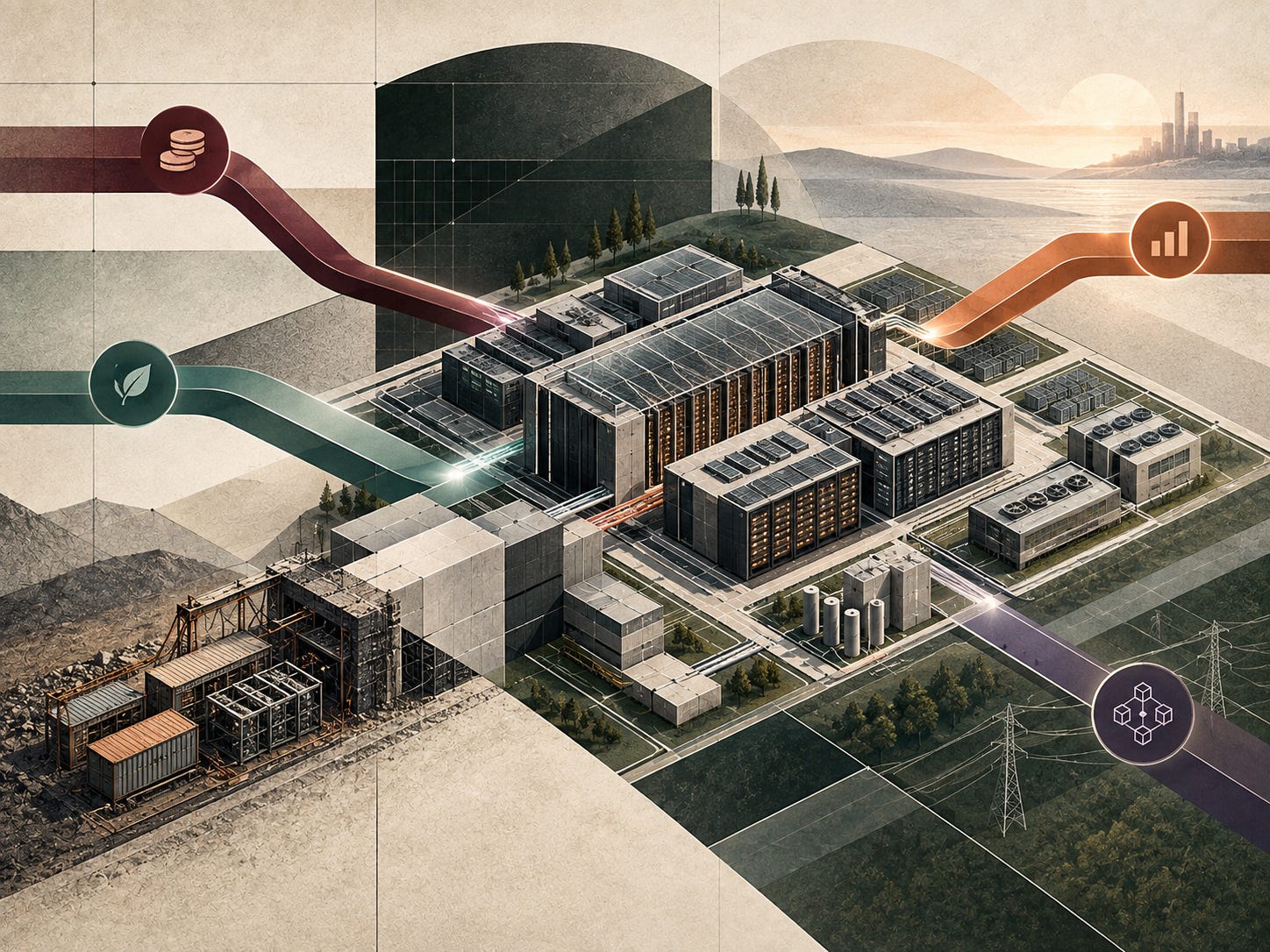
Bitcoin is trading near $63,222 and Ethereum near $1,625, with both assets softer on the day as the market waits for Wednesday’s CPI print. Bitcoin has held above the late-June stress zone, but the flow backdrop has weakened again: a live institutional ETF tracker shows roughly $148.8 million of net outflows across tracked U.S. crypto ETFs over the last 24 hours. That suggests regulated demand is still present at a structural level, but it is no longer strong enough to offset macro caution on its own.The more interesting digital-asset story is the convergence between crypto infrastructure and AI infrastructure. Riot Platforms jumped after announcing a $9.1 billion, 20-year computing agreement with Anthropic, reinforcing the shift by miners toward monetizing power, land, and data-center capacity rather than relying exclusively on block rewards. That matters because the same balance-sheet and infrastructure assets that once supported mining are increasingly being underwritten against AI workloads, potentially changing the earnings profile of listed crypto infrastructure companies even while spot-token demand remains selective.
Macroeconomics:
The macro setup is being defined by an awkward combination of higher oil, firmer yields, and an inflation report due Wednesday. The U.S. dollar edged higher as the 10-year Treasury yield moved to roughly 4.73%, with markets reacting to stalled U.S.-Iran negotiations and renewed concern that elevated energy prices could keep inflation pressure alive. Brent briefly traded above $90 before easing back below that level, leaving the inflation channel materially more restrictive than it looked a week ago.That puts Wednesday’s CPI print in a high-leverage position. A softer number would give rates and risk assets room to look through the latest oil move, while another upside surprise would validate the market’s higher-for-longer repricing and raise the probability of a September hike. The key point is that financial conditions are being tightened from two directions at once: energy is rebuilding inflation risk while Treasury yields are already near the upper end of this year’s range.
Know someone who needs to see this? Forward it before the market moves.
Equities:
U.S. equities are weaker today, with SPY near $769.92 and QQQ near $717.13. The Nasdaq underperformance is important because the market remains heavily dependent on AI and semiconductor leadership, while elevated yields are again raising the discount-rate hurdle for long-duration growth. Intel’s decision to expand its planned stock sale to $20 billion adds another reminder that the AI buildout is increasingly capital-intensive, even as AI-linked demand continues to support infrastructure spending.At the same time, Nvidia is pushing the AI financing cycle deeper into institutional capital markets. The company announced partnerships with Apollo, BlackRock, Blackstone, Brookfield, Goldman Sachs, and KKR aimed at mobilizing more than $500 billion for AI infrastructure. The strategic shift is significant: AI compute is increasingly being packaged and financed like infrastructure rather than treated purely as corporate capex, which opens a new channel for private credit, structured finance, pensions, sovereign wealth, and alternative asset managers to participate in the buildout.
The Fed and US Treasury:
Treasury supply is becoming the immediate stress test for rates. The Treasury is selling $125 billion of debt this week, including $58 billion of 3-year notes Tuesday, $42 billion of 10-year notes Wednesday, and $25 billion of 30-year bonds Thursday. Barron’s reported that the 3-year is expected to clear around 4.3%, the highest level since early 2025, while inflation and geopolitical uncertainty could make demand less reliable than in recent auctions.The timing matters because auction demand is being tested just before CPI. A weak 10-year or 30-year auction paired with a hot inflation print would reinforce the long-end selloff and increase pressure on AI multiples, credit spreads, mortgages, and crypto liquidity. TLT is slightly higher today, but that modest bid does not change the broader constraint: the market is still demanding substantial compensation to own duration.
Geopolitical:
The geopolitical story is broader than Hormuz this week. Houthi forces killed six people in a missile attack on a commercial vessel near the Bab el-Mandeb strait, marking the first fatal maritime attack in the latest escalation and raising renewed concern around Red Sea shipping. The same regional conflict is also touching Saudi oil infrastructure and Yemeni ports, which means the risk is spreading across multiple energy and trade chokepoints rather than remaining concentrated in one strait.For institutional markets, that broadening matters because Bab el-Mandeb is a Suez-linked trade route rather than simply an oil-export corridor. Continued attacks can push more vessels around the Cape of Good Hope, extending transit times, tightening vessel capacity, and raising freight and insurance costs across energy and container shipping. Hormuz remains relevant in the background, but the more useful framing now is a wider Middle East maritime-risk premium that affects global logistics, not just crude.
AI is becoming a financing market, not just an equity trade
Nvidia’s $500 billion infrastructure initiative is the more consequential AI story than another day of chip-stock volatility. The market is starting to treat compute capacity as an institutional asset class that can support private credit, securitization, pension capital, and infrastructure-style underwriting. That changes the AI cycle because the constraint is shifting from whether hyperscalers want more GPUs to whether the capital markets can finance the enormous buildout at acceptable returns. The participation of Apollo, BlackRock, Blackstone, Brookfield, Goldman Sachs, and KKR gives the theme much deeper financing capacity, but it also introduces stricter underwriting around utilization, collateral value, customer concentration, and residual technology risk. We think this is where the next phase of AI gets more institutional and less thematic. The winners will be assets that can prove durable cash flows and financeability rather than simply exposure to compute demand.
Crypto infrastructure is being repriced around power and compute
Riot’s long-term Anthropic agreement is a useful signal for the digital-asset sector because it reframes mining infrastructure as a broader compute and energy asset. The economics of a mining company become materially different when power access, land, cooling, and grid connections can be sold into AI workloads under long-duration contracts rather than monetized only through volatile Bitcoin block rewards. That creates a potential valuation bridge between crypto infrastructure and data-center infrastructure, particularly for operators with low-cost power and existing interconnection capacity. It also makes Bitcoin miners more sensitive to AI demand, financing conditions, and infrastructure execution than to Bitcoin price alone. Our read is that this convergence will become one of the more important institutional themes in digital assets over the next 12 to 24 months. The sector is starting to compete for capital on infrastructure economics rather than crypto beta alone.
CPI now has more leverage because oil and yields moved first
Wednesday’s inflation print arrives after both crude and Treasury yields have already moved higher, which changes the asymmetry around the release. A soft print can unwind part of the recent inflation premium, but it now has to overcome oil near $90 and a 10-year yield around 4.7% before financial conditions feel meaningfully easier. A hot print would be more disruptive because it would confirm the same message already being sent by energy and the bond market. That is why tomorrow matters more for the long end than for the Fed’s immediate policy rate. From here, we would treat Treasury auction demand and CPI together as the confirmation point for whether the current risk rally still has room to extend. If both disappoint, the market’s hurdle rate rises again across AI, crypto, credit, and venture portfolios.
Happy Trading!
The 1Konto Team
1Konto powers institutional finance with a unified platform for trading, settlement, and credit across stablecoins, fiat, and digital assets. Through 1KPrime, clients gain access to deep liquidity, real-time cross-border settlement, and integrated Bitcoin-backed credit facilities, all supported by trusted custody infrastructure. From treasury management to automated capital deployment, 1Konto enables the next generation of global financial operations with the security, efficiency, and transparency institutions require.
Contact us today to learn how we can support your trading, settlement, and capital needs.
Not Financial Advice Disclaimer
Comments
Nothing yet. Say the first thing.
Sign in to join the conversation.