
The Same Door: Two Pipelines of Money, One Washington, and America's Foster Children
A ten-part investigation into how foreign governments and America's largest foster-care Medicaid contractor buy influence through the same Washington firms — and why no database on earth shows you the whole picture.
By PMC Intelligence Desk | August 01, 2026
What this investigation does not show
Honesty first, because it is the whole point. Over six months, this investigation assembled a forty-node network of filings connecting foreign influence money to the American child-welfare industry. Here is what the record does not contain, stated as plainly as anything else in this series:
No money moves from any Chinese-linked entity to Centene Corporation. Not one dollar, in any filing, in any direction.
No lobbyist ever worked for the China-United States Exchange Foundation and Centene at the same time. We checked every name. The one apparent match was a computer error — a substring of a different person's surname.
No coordination between the foreign-influence pipeline and the domestic Medicaid pipeline appears anywhere in the record.
No crime is alleged. Every activity described in this series — every foreign agent registration, every lobbying contract, every dollar — is registered, disclosed, lawful conduct.
No conspiracy is claimed. What this series documents is structure: two unrelated rivers of money that pass through the same narrow set of doors, carried in several cases by the same people, with no rule requiring anyone to notice.
If the story were a secret plot, the filings would not exist. The story is that the filings do exist, in public, scattered across five databases that never talk to each other — and that when you put them side by side, the same signatures start appearing on both sides of the ledger.
Part 1 — The Same Door
Start with a number that should not exist: zero.
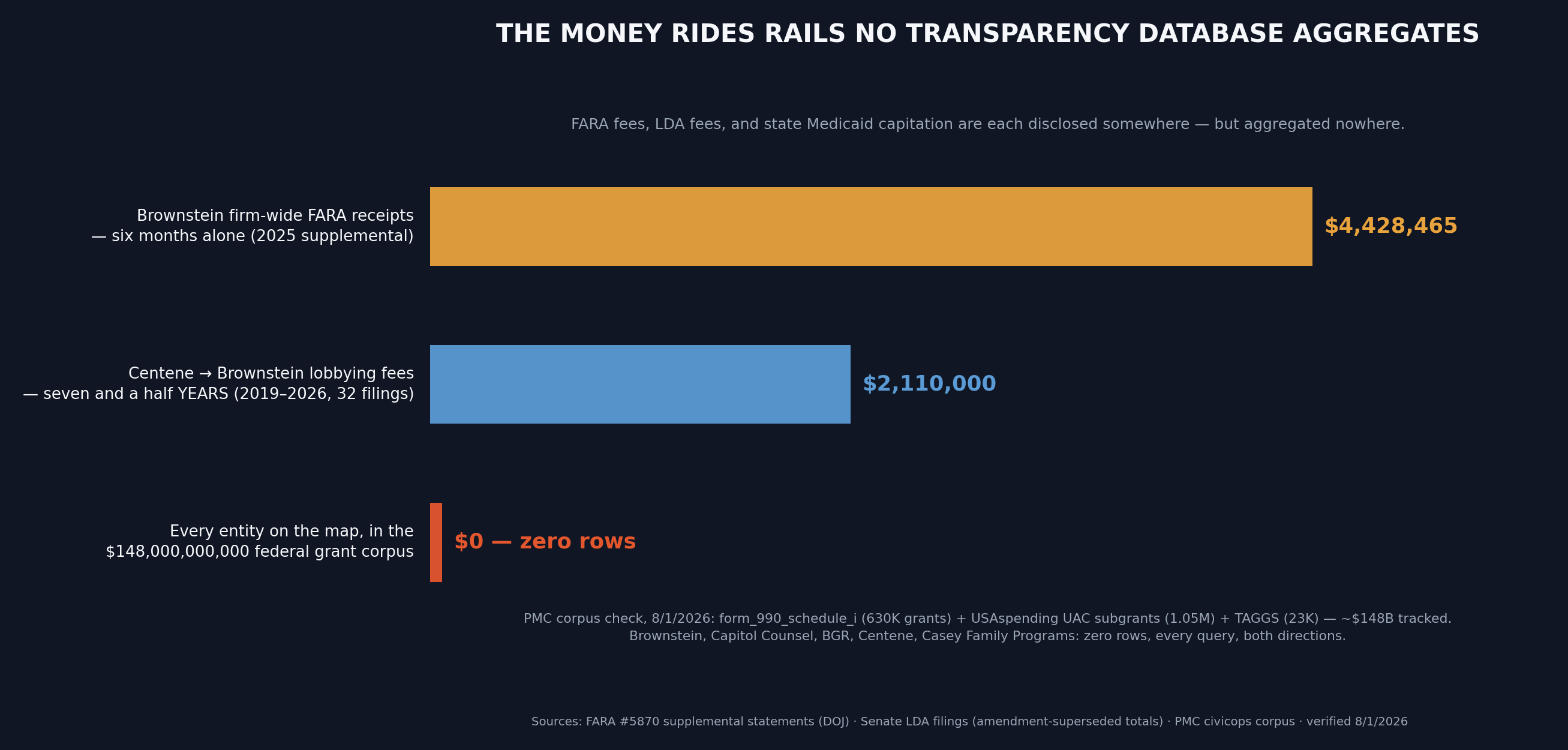
Project Milk Carton maintains a corpus of roughly $148 billion in tracked federal grant money — 630,000 nonprofit grant records, over a million federal subgrant rows, 23,000 HHS grant actions. On August 1, 2026, we queried that corpus for every entity in this investigation: Brownstein Hyatt Farber Schreck, the largest lobbying firm in Washington by revenue. Capitol Counsel LLC. BGR Group. Centene Corporation, the largest Medicaid managed-care company in America. Casey Family Programs, the largest operating foundation in child welfare.
Zero rows. Every query, both directions.
None of the money in this story travels on rails that federal grant-transparency infrastructure was built to watch. It travels on three other rails instead: foreign-agent fees disclosed to the Justice Department under FARA; lobbying fees disclosed to Congress under the Lobbying Disclosure Act; and state Medicaid capitation— the per-child monthly payments states make to managed-care companies — disclosed, when it is disclosed at all, in state contract files that ten different state agencies blocked our attempts to retrieve. Each rail is individually visible. No system aggregates them. That is the door this series walks through, ten times, from ten angles.
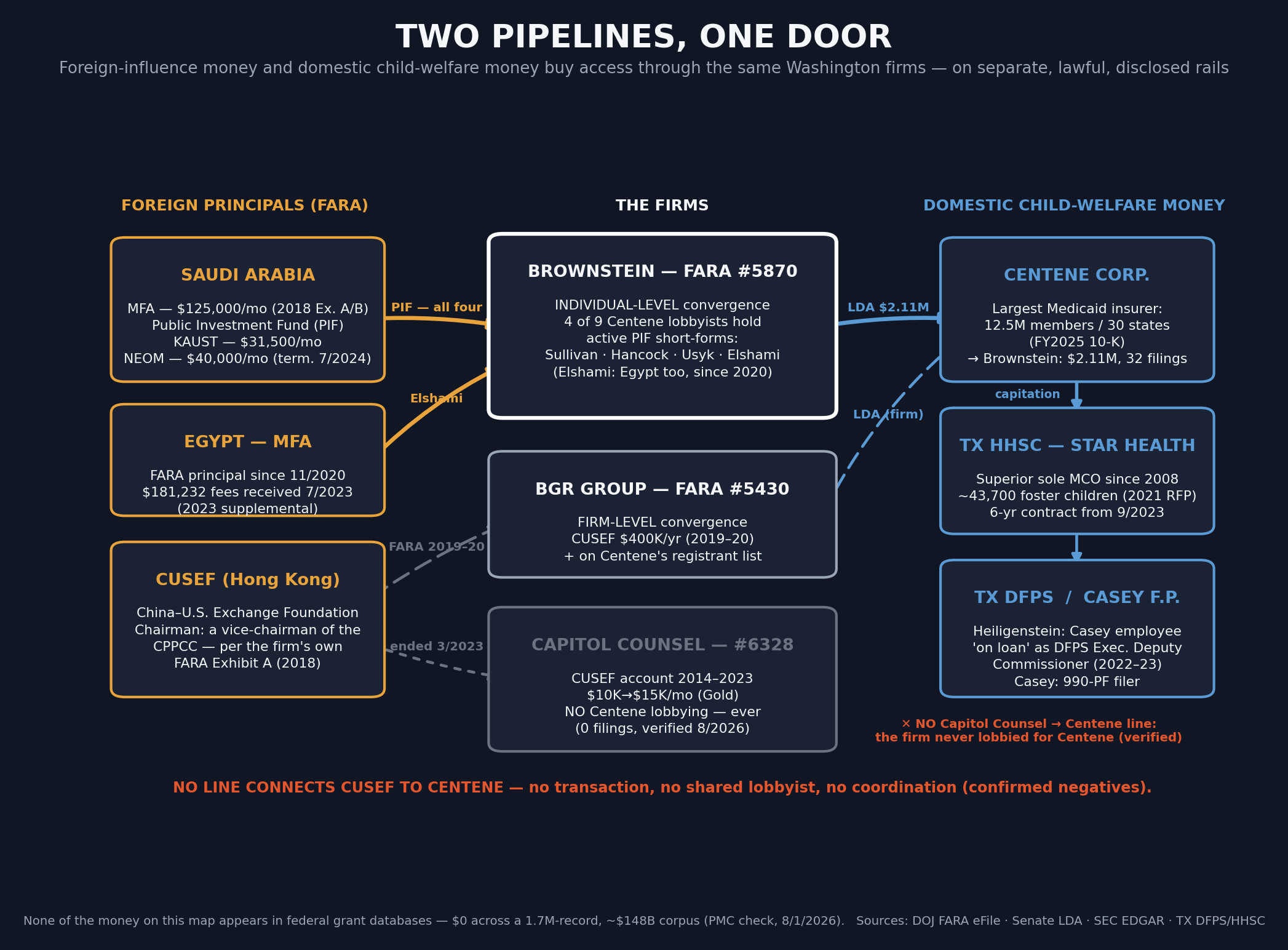
The architecture, in one paragraph. On one side: foreign principals — Saudi Arabia's Ministry of Foreign Affairs and sovereign wealth fund, Egypt's Ministry of Foreign Affairs, and, historically, a Hong Kong foundation called the China-United States Exchange Foundation whose chairman, according to a lobbying firm's own Justice Department filing, serves as a vice-chairman of the Chinese People's Political Consultative Conference. On the other side: the child-welfare economy — Centene, whose Texas subsidiary has been the sole Medicaid managed-care contractor for every child in Texas foster care since 2008; the Texas agencies that hire it; and the private foundation whose employee sat, "on loan," in the number-two seat of one of those agencies. In the middle: three Washington firms. At two of them, the connection is firm-level only. At one — Brownstein — it is personal: four of the nine lobbyists on Centene's current team are themselves registered foreign agents.
Two pipelines. One door. The next nine parts walk through it.
A reader's guide to the three disclosure regimes— because the entire story lives in the gaps between them.
FARA— the Foreign Agents Registration Act of 1938 — requires anyone doing political or advocacy work in the United States on behalf of a foreign principal to register with the Justice Department. A firm registers once and receives a number (Brownstein is #5870; Capitol Counsel is #6328; BGR is #5430); each foreign client becomes a "foreign principal" under that number; and each individual human doing the work files a "short-form registration statement" naming which principals they personally serve. The contracts themselves — the engagement letters with the monthly fees — get filed as "Exhibit A/B," and the money actually received is reported twice a year in "supplemental statements." It is, on paper, the most detailed influence-disclosure system in the world. In practice, most of it lives in scanned PDFs, behind endpoints that failed us for days at a stretch, and nothing in it links outward to any other database.
The LDA— the Lobbying Disclosure Act of 1995 — covers domestic lobbying. Firms file quarterly "LD-2" reports per client: income to the nearest $10,000, issue areas, the bills discussed, and the named lobbyists, each with their prior government "covered positions" disclosed. It lives in a Senate-run database that has never heard of FARA. The same human being can appear in both systems simultaneously, and no page anywhere puts the two entries side by side.
Capitation is the third regime and barely a disclosure regime at all. When a state hands its Medicaid population to a managed-care company, it pays a negotiated amount per member, per month. For a sole-source foster-care contract, that means the entire pediatric-Medicaid economics of a state's most vulnerable children reduces to one contract in one state filing cabinet. Some states publish it. Some publish redacted versions. Ten of the states we swept for this series blocked automated retrieval of even the public paper.
Money that moves as grants— the federal government's default rail for social spending — lands in USAspending, in TAGGS, in nonprofit Schedule I filings, and eventually in corpora like ours. Money that moves as fees and premiums does not. Everything in this series was structured, lawfully, as fees and premiums. Hold that thought through all ten parts.
Part 2 — The Same Signature
The strongest finding in this investigation is not a theory. It is a set of names appearing on two different federal disclosure forms at the same time.
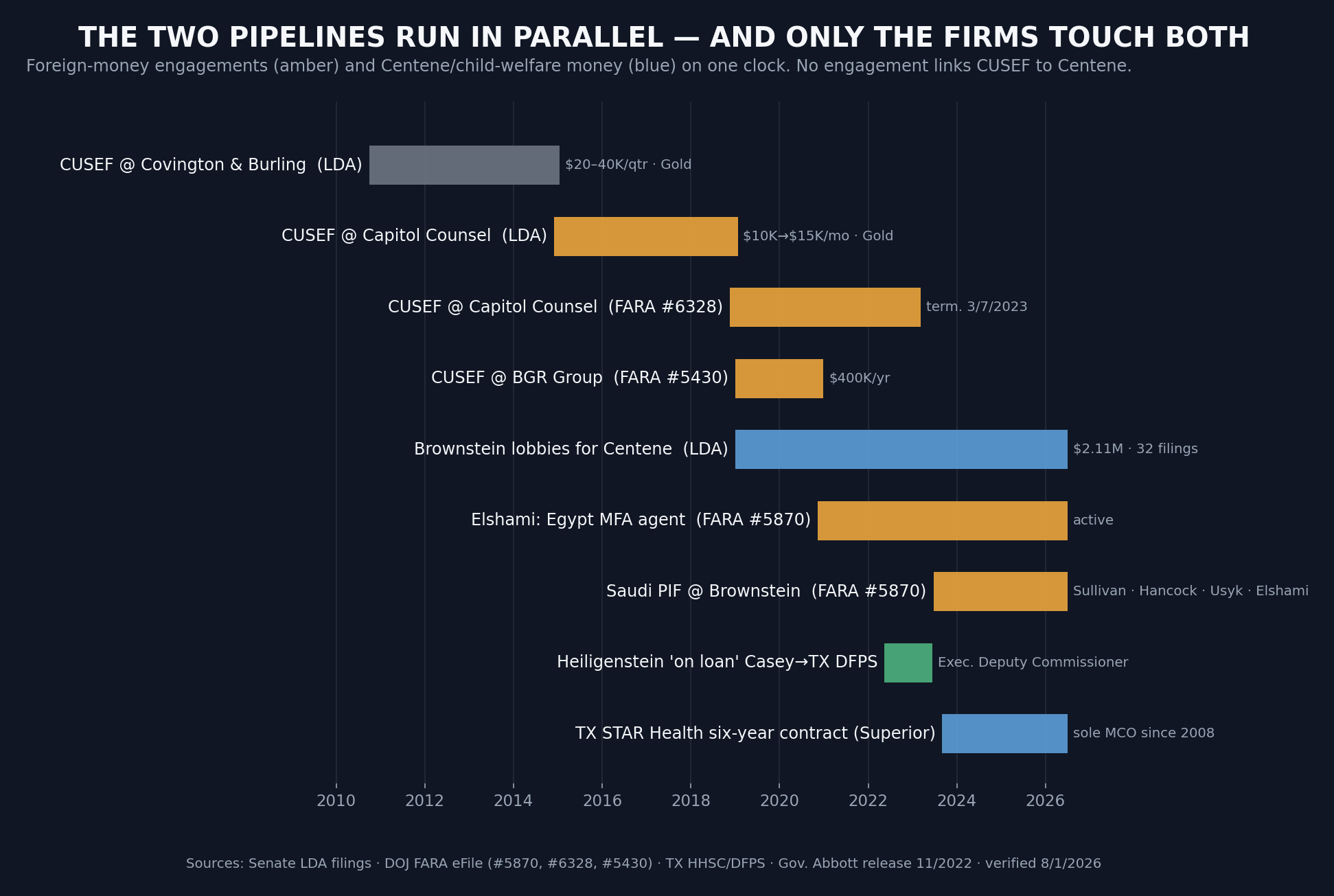
Since the first quarter of 2019, Brownstein Hyatt Farber Schreck has lobbied Congress for Centene Corporation. The engagement is disclosed in32 consecutive quarterly filings totaling $2,110,000through mid-2026 — we recomputed that figure from the raw filings, using amendment-superseded totals, on August 1, 2026. Nineteen Brownstein lobbyists have appeared on those filings over the years. The subject matter, per the most recent filing: the Affordable Care Act, Medicare Advantage, Medicaid, artificial intelligence in healthcare, implementation of P.L. 119-21, and long-term-care pharmacy contracts.
Brownstein is also FARA registrant #5870 — a foreign-agent registration opened in 2008 that currently carries ten active foreign principals, including Saudi Arabia's Ministry of Foreign Affairs (a client since 2016, at $125,000 per month under the 2018 exhibit on file with the Justice Department), Saudi Arabia's Public Investment Fund, King Abdullah University of Science and Technology ($31,500 per month), and Egypt's Ministry of Foreign Affairs (a principal since November 2020; the firm's 2023 supplemental statement records $181,232 in fees received from Egypt in a single entry that July). In one recent six-month reporting period, the firm's FARA receipts across all foreign principals totaled $4,428,465— six months of foreign-government fees, more than double what Centene has paid the firm in seven and a half years.
Who lobbies for Centene at Brownstein? Over seven and a half years, nineteen different lobbyists have cycled through the account. The recent core is nine names, and their disclosed pedigrees read like a map of the health-policy establishment: Sullivan, the former Senate Finance staff director (Part 3); Elshami, the former Speaker's chief of staff; Usyk, with staff history in two Senate offices; Hancock, formerly counsel in a Senate office, who joined the account in late 2025; and Emily Felder, who has appeared on 29 of the 32 filings and whose career runs through the federal Medicaid agency itself The quarterly fee has been steady and unremarkable — $60,000 to $80,000 a quarter, a modest line in the ledger of a firm this size. Which is itself worth noticing: the sums that buy a permanent, senior, bipartisan presence around Medicaid policy are small. Influence in this market is not expensive. It is merely continuous.
And the firm's foreign-agent bench is not a separate wing staffed by specialists. Brownstein's 33 active short-form registrants include a former United States Senator from Arkansas, a former United States Senator from Alaska, and a former chairman of the House Foreign Affairs Committee. Foreign representation at this level is a partners' practice, woven through the same roster that serves the domestic clients.
Now put the two rosters side by side.
Of the nine lobbyists named on Centene's four most recent quarterly filings, four hold active foreign-agent registrations under #5870: Russell Sullivan, Harold Hancock, Andrew Usyk, and Nadeam Elshami. We pulled each of their individual short-form registration statements from the Justice Department's document system. All four name Saudi Arabia's Public Investment Fund as a foreign principal. Usyk also serves Egypt's foreign ministry and South Korea's embassy; Elshami serves Egypt's embassy and, until recently, Kazakhstan's.
Elshami is the longest thread. A former chief of staff to the Speaker of the House, he has been a registered foreign agent for Egypt since November 9, 2020— the same day Brownstein registered Egypt's foreign ministry as a principal — and he appears on every one of the 32 Centene filings, from the first quarter of 2019 to the present. That is roughly five and a half years in which the same person has been, simultaneously and continuously, a registered agent of a foreign government and a registered lobbyist for the company that manages Medicaid coverage for more of America's foster children than any other.
Alfred Mottur ran a parallel track earlier: a Brownstein foreign-agent short-form on file since September 22, 2016— the same day the firm registered Saudi Arabia's Ministry of Foreign Affairs — while lobbying for Centene from 2019 to 2023.
Investigation data visualization
Two things make this pattern remarkable, and the second matters more than the first.
First: it is completely legal. FARA and the LDA are separate statutes with separate filing systems. Nothing prohibits one person from registering under both. Each of these individuals disclosed exactly what the law requires, where the law requires it.
Second: no one is required to put the two disclosures on the same page. The Justice Department's FARA database does not know what the Senate's lobbying database contains. A state Medicaid agency evaluating a managed-care contractor has no reason to consult either. The aggregation you just read — same person, same firm, same time window, foreign ministry on one form and foster-care contractor on the other — exists nowhere in any government system. We had to build it by hand.
And one more null, because the negatives are the credibility: we swept federal campaign-finance records for every Brownstein employee against Centene's corporate PAC for the 2022–24 cycles. Zero contributions. The money relationship runs firm-to-client in fees — not employee-to-PAC in donations. The system is cleaner than a cynic would guess, and that is precisely what makes the structure itself the story.
Part 3 — Fourteen Years, Then the Other Chair
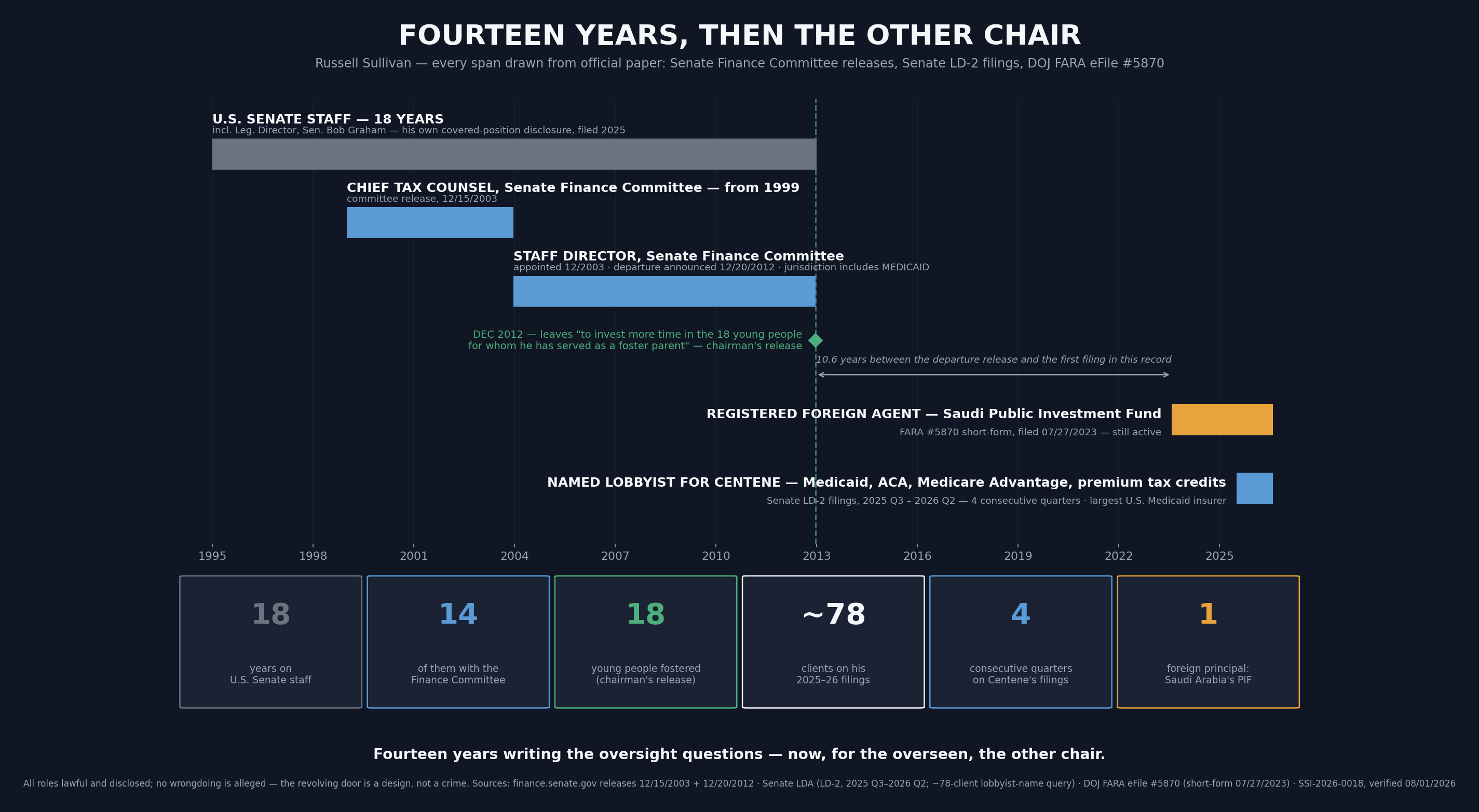
Russell Sullivan spent eighteen years on the staff of the United States Senate, fourteen of them with the Finance Committee — the committee with jurisdiction over Medicaid. The committee’s own releases record the arc: Chief Tax Counsel from 1999; named Democratic Staff Director in the release of December 15, 2003; departure announced December 20, 2012. When he left, the chairman’s release noted he was leaving in part “to invest more time in the 18 young people for whom he has served as a foster parent.”
Read that again. The man who ran the staff of the committee that oversees Medicaid is also, personally, a serial foster parent — and his firm biography today lists him as finance chair of the Congressional Coalition on Adoption Institute (the firm’s own account of its shareholder; board roles are attributed, not independently confirmed). There is no allegation in this paragraph. There is a biography that places one person at every altitude of the child-welfare system: the committee room, the foster home, the nonprofit board — and now, the lobbying engagement.
Because in the third quarter of 2025, Sullivan’s name appeared for the first time on Brownstein’s quarterly lobbying filings for Centene — per its own FY2025 10-K the largest Medicaid health insurer in the country, and, through its Texas subsidiary Superior HealthPlan, the sole managed-care contractor for Texas foster children since 2008. He has been on every Centene filing since: four consecutive quarters through mid-2026. The disclosed subject matter sits squarely inside his old committee’s jurisdiction — in the most recent filing’s own words: “Issues related to ACA, Medicare Advantage, and Medicaid; Issues related to Artificial Intelligence in healthcare; P.L. 119-21 (H.R. 1): One Big Beautiful Bill implementation; Healthcare premium tax credits; Pharmacy contracts for long term care (LTC).” His own filing discloses the covered positions: “Staff Director, Senate Finance Committee; Chief Counsel, Senate Finance Committee; Leg. Director, Sen. Bob Graham.” (One minor source discrepancy, preserved rather than resolved: the 2003 committee release styles his earlier post “Chief Tax Counsel,” while his own covered-position disclosure reads “Chief Counsel.” Both are primary sources; we print both.)
And since July 27, 2023, Sullivan has held an active foreign-agent short-form registration under Brownstein’s FARA registration, No. 5870, naming Saudi Arabia’s Public Investment Fund as his foreign principal. The services, in his own form’s words: “Education and advocacy before the U.S. federal government involving Public Investment Fund transactions.”
(A note on our own record, in the interest of the candor this series promises: an earlier phase of this investigation described Sullivan as a firm-level overlap only — “not personally FARA-registered.” That was true of the data then available. The Justice Department’s short-form registry, pulled and re-verified twice on August 1, 2026 — down to the PDF of the registration statement itself — shows the 2023 registration above. We correct our own earlier finding here, in print, because that is what we would demand of anyone else.)
The Centene engagement is one line in a much larger book. Senate lobbying records for 2025–26 name Sullivan on filings for roughly 78 clients — overwhelmingly tax-policy work for blue-chip corporate America: energy majors, hotel and casino operators, asset managers, an aerospace conglomerate, pharmaceutical companies, universities. Buried in the list are two smaller names that rhyme with his biography: an adoption attorneys’ association and an early-childhood education consortium, both on tax matters. The picture that emerges is not a health-care specialist but something more valuable — a former committee staff director whose practice spans everything his old committee touches, with Medicaid’s largest insurer as one client among many. That is what fourteen years of committee knowledge converts to, at market rates.
His federal campaign giving completes the pattern — and we state it carefully, because it is lawful political activity and this publication takes no position on any candidate or party. In the FEC’s deduplicated processed data (via api.open.fec.gov, retrieved August 1, 2026), Sullivan’s direct personal giving totals $88,175 across the 2022, 2024, and partial 2026 cycles — and it is genuinely bipartisan and jurisdiction-patterned: modest checks to members of both parties whose careers run through the tax-writing and health-jurisdiction committee rooms — Ron Wyden ($1,000), Chuck Grassley ($1,500), John Thune ($1,500), Richard Neal ($3,000), Jodey Arrington ($1,000), Michelle Fischbach ($2,000) — alongside the single largest standing item, his own firm’s political action committee: $27,500 over the three cycles, in payroll-style increments of $416.66 a month. That is not an accusation; bipartisan giving by senior lobbyists is ordinary Washington practice. It is context: jurisdiction-targeted, both sides of the aisle, the same committee rooms he once staffed.
And the record now extends into the Centene era. His dated 2025–26 giving — all within the partial 2026 cycle — includes: Adrian Smith, $1,000 (March 5, 2025); the “Nicole for New York” committee, $1,000 (March 7, 2025); Michelle Fischbach, $1,000 (March 31, 2025); Chuck Fleischmann, $1,500 (April 2, 2025); Richard Neal, $1,000 (May 1, 2025); Jon Husted, $1,000 (June 30, 2025); the Graham Majority Fund, $3,500 (June 30, 2025 — one contribution routed through a joint fundraising committee, counted once); and the DSCC, $1,000 (January 14, 2026); alongside a handful of smaller contributions preserved in the case file. We print the dates because the dates are the record — Sullivan’s name first appears on a Centene quarterly filing for the third quarter of 2025, and several of these checks precede that quarter. The record establishes a span, not a sequence, and we claim nothing about order or intent.
The revolving door is legal. The question this part leaves with the reader is narrower and harder: when the person who spent fourteen years writing the oversight questions now sits on the other side of the witness table — for the company being overseen, while also registered to a foreign sovereign wealth fund — who, exactly, is left in the building who knows what he knows and works for the public?
The revolving door is legal. The question this part leaves with the reader is narrower and harder: when the person who spent fourteen years writing the oversight questions now sits on the other side of the witness table — for the company being overseen, while also registered to a foreign sovereign wealth fund — who, exactly, is left in the building who knows what he knows and works for the public?
Part 4 — The Account That Moved
This is the chapter where our investigation broke its own best lead — twice. We are publishing the breaks, because they are the method.
In December 2014, a lobbyist named Martin Gold left Covington & Burling for Capitol Counsel LLC. Gold is one of the most respected Senate proceduralists of his generation — counsel to two Senate majority leaders, author of the standard manual on Senate procedure. At Covington, he had carried a client account called the China-United States Exchange Foundation — CUSEF — a Hong Kong foundation founded and chaired by Tung Chee-hwa, Hong Kong’s first post-handover chief executive. Covington’s original 2010 registration listed a colleague alongside him, but Gold is the only lobbyist named on every one of the firm’s eighteen quarterly reports for the account (Senate LDA database, 2010–2014).
The account moved with him. Covington filed its termination for CUSEF in January 2015; Capitol Counsel filed its new registration the same month, effective December 2014, sole lobbyist: Martin Gold. The engagement letter — which sits in the public record because Capitol Counsel later attached it to a Justice Department filing — is dated December 15, 2014, effective December 1, and countersigned by CUSEF’s executive director, Alan Wong, on December 16, 2014: $10,000 a month, raised to $15,000 by oral agreement in 2017, for services including “dissemination within Congress of materials generated or sponsored by CUSEF,” organization of and participation in CUSEF’s former-Members-of-Congress activities, coalition building with the U.S. Association of Former Members of Congress, and “advocacy, as directed” (FARA Reg. #6328, Exhibit A/B filed Dec. 10, 2018; fee change per Exhibit B filed Nov. 19, 2018).
For four years this was ordinary domestic lobbying, disclosed under the LDA like any trade association. Then, on November 19, 2018, Capitol Counsel re-registered the same engagement under the Foreign Agents Registration Act, closing out the LDA registration in the same window. Its own FARA Exhibit A discloses why the account warrants that statute’s scrutiny: CUSEF’s chairman “serves as Vice Chair of the Chinese People’s Political Consultative Conference” — the top political advisory body of the People’s Republic of China. That is the firm’s own characterization, on its own federal form. (Precision matters here: the CPPCC is not the United Front Work Department, and this series will not use labels the filings do not support.) The CUSEF registration ran until March 7, 2023, when the firm filed the amendment terminating it — “ceased its representation of: China-United States Exchange Foundation (China),” in the filing’s own words — the same day Gold’s own foreign-agent status ended.
Who did the CUSEF work at Capitol Counsel? The Justice Department’s files name the China-era agents: Gold himself, whose 2018 short-form describes “periodic fact-finding meetings with Members of Congress on issues affecting U.S.-China Relations” and “periodic travel by former Members of Congress to China”; and a handful of colleagues, among them a firm principal named Allegra Han, who filed more foreign-agent short-forms under this registration than anyone else — four, though they span the firm’s Turkish and China principals alike — and whose 2019 filing describes her CUSEF role in one sentence: “Help organize travel by former Members of Congress to China for exchange programs regarding US-China relations.” Han is, by the paper, the registration’s most prolific filer; by the open web, she barely exists — a name on the firm’s team roster with no individual bio page, no recoverable career history, a near-zero public footprint that our file logs as an honest gap rather than an insinuation. Her foreign-agent status ended in May 2022.
And Capitol Counsel was never CUSEF’s only door. The Justice Department’s bulk files show the foundation ran parallel FARA representation through the communications firm BLJ Worldwide from 2010 to 2023, Wilson Global Communications from 2018 to 2023, and — from 2019 to 2020 — BGR Group, the firm this series reaches in Part 6. Former Members of Congress traveling to China, materials disseminated inside Congress, coalition work with the former-Members association: the engagement letters describe a patient, decade-long, entirely disclosed program of relationship-building aimed at the American legislative class. Whether one finds that sinister or ordinary is a judgment; what it is, on paper, is thorough.
Now, the two breaks.
Break one. An earlier network analysis in this investigation identified Capitol Counsel as the structural center of gravity of the whole map, on the premise that the firm simultaneously held the CUSEF foreign-agent account and an active lobbying registration for Centene. So, we checked every name: all twenty-one individuals who ever filed foreign-agent short-forms under Capitol Counsel’s registration, against every Centene lobbying filing by any firm, ever. Zero true matches. The single apparent hit — “Han” — turned out to be a computer matching the substring inside “Hancock,” a different person at a different firm.
Break two, and it is bigger. When we went to document level, the premise itself failed: Capitol Counsel has never filed a single lobbying report for Centene. Not one, ever. We queried the Senate’s system by firm, by firm ID, and in reverse through Centene’s complete registrant list — twenty-two registrations long, including the company’s own in-house lobbying operation, Capitol Counsel absent. The “same firm holds both accounts” claim that anchored our network’s center of gravity is false, and we found that out by trying to prove it.
What remains at Capitol Counsel, then, is exactly this: a firm that carried a CCP-linked-by-its-own-filing foreign account for eight years across two disclosure regimes — and no documented connection to Centene or to child welfare at all. We could have buried that. Instead it is the headline of this part, because an investigation that cannot kill its own findings cannot be trusted with anyone else’s.
The convergence story this series tells does not run through Capitol Counsel. It runs through the firm in Part 2 — where it is not a premise but a set of signatures — and through the firm in Part 6, where the paper does connect.
Investigation data visualization
Part 5 — Four Hats
Hat one: United States Representative from Louisiana, and twice a Ways and Means subcommittee chairman — the Subcommittee on Oversight across the 112th and 113th Congresses (2011–2015), then the Subcommittee on Tax Policy in the 114th (2015–2017), per the committee’s own activity reports (H. Rept. 112-750, H. Rept. 113-723, H. Rept. 114-887). Ways and Means is the House committee with jurisdiction over much of federal health policy; the Health Subcommittee gavel itself, for the record, was never his — those chairs were Wally Herger, Kevin Brady, and Pat Tiberi across the same years.
Hat two: registered foreign agent. Boustany filed foreign-agent short-forms under Capitol Counsel’s FARA registration in February 2018 and again in July 2020 — the filings sit in the Justice Department’s document inventory — serving the U.S.-China Transpacific Foundation, a China-registered principal at the firm, with his second stint terminating in November 2020. The Transpacific engagement’s hallmark, per the filings: organizing congressional travel to China.
Hat three: partner at Capitol Counsel — the firm of Part 4.
Hat four: APCO Worldwide. In October 2021 the global public-affairs firm announced Boustany as one of six senior leaders joining its Geo-Commerce team — in the same release that launched APCO’s Global China Practice, an expansion the firm framed around China, supply-chain, and national-security expertise. APCO’s own bio page lists him as a member of the firm’s International Advisory Council — and, in the same sentence, as “a partner with Capitol Counsel, LLC.” Hats three and four, worn at once, on the firm’s own website.
State the negative as prominently as the pattern, per this series’ rules: Boustany never lobbied for Centene or for any Medicaid managed-care company. The cross-check in Part 4 covered him by name; zero filings. A former Ways and Means subcommittee chairman who becomes a registered foreign agent for a China-linked foundation is a striking biography — but on these documents, his China work and the child-welfare economy never touch.
Why include him, then? Because the network analysis in this investigation scored Boustany as the single most connected person on the map — the human bridge between the foreign-influence cluster and the health-policy world, by career rather than by contract. He is what the revolving door looks like when it spins all the way around: committee gavel to foreign principal, without breaking a single rule. The system did not fail. The system has no rule to fail.
Part 6 — The Working Group
If Brownstein is where the convergence becomes personal, BGR Group is where it stays institutional — and BGR is the one firm where both accounts verifiably ran under one roof at the same time.
The fee is not “reported.” It is contracted, and the contract is public. On March 1, 2019, BGR Government Affairs, LLC filed its Exhibit A/B to FARA registration #5430, naming the China-United States Exchange Foundation as its foreign principal. The filed agreement states the terms in its own words: “an annual professional fee of USD$400,000.00,” paid in monthly payments, expenses reimbursed only with CUSEF’s advance authorization, quarterly invoicing beginning May 1, 2019. The scope, also verbatim: BGR “will serve as a liaison for CUSEF in Washington D.C.” and provide “strategic advice and government relations assistance with respect to US-China relations,” including contact “with members of Congress and their staff and executive branch officials.” And on the same form, BGR answered the five foreign-control questions about its new principal: supervised, no; owned, no; directed, no; controlled, no; financed by a foreign government, foreign political party, or other foreign principal — yes. The Justice Department’s bulk foreign-principal data records the engagement running from 2019 to 2020, parallel to Capitol Counsel’s own CUSEF registration, which ran until 2023.
The Medicaid side grew stronger under verification, not weaker. Senate lobbying filings show BGR Government Affairs has lobbied for Centene Corporation continuously since the fourth quarter of 2017 — an unbroken run of quarterly reports through Q2 2026, the most recent quarter on file, at $80,000 to $90,000 per quarter, just over $3.05 million in disclosed fees across 36 filings, retrieved by direct query of the Senate lobbying database on August 2, 2026. This is not a historical account; as of the latest filing, Centene is a current BGR client. And the disclosed subject is not generic: Medicaid is named in every single quarter, beginning with “strategic guidance and counsel on ACA reform and Medicaid.” Lay the two spans side by side and the overlap is total: through 2019 and 2020, the same firm was simultaneously a registered foreign agent for CUSEF and a registered federal lobbyist — on Medicaid, by its own disclosures — for the nation’s largest Medicaid insurer. Same roof, same quarters, both on the public record.
And here this series owes its own draft a correction, because publishing the breaks is the method: an earlier version placed BGR’s Medicaid working group “in the same era” as the CUSEF account. The record says otherwise. BGR announced its Medicaid Working Group on September 26, 2025 — five years after the CUSEF registration closed, but squarely inside the still-running Centene engagement. Per BGR’s own announcement, the group is led by Marvin B. Figueroa — who joined the firm in February 2025 from the U.S. Department of Health and Human Services, where, per BGR’s own welcome post, he served in the Office of Intergovernmental and External Affairs reporting directly to the Secretary, after helping lead the Medicaid expansion that covered 500,000 more Virginians as the Commonwealth’s Deputy Secretary of Health and Human Resources — and James Williams. (BGR’s public materials state no prior federal role for Williams, and this series therefore claims none.) The offering to clients is explicit and, again, entirely legal: someone who helped run the program’s federal machinery, now available to help you navigate it “across Congress, the executive branch, and the states.”
Why do “working groups” matter? Because they are the influence industry’s most efficient product. A lobbying filing discloses a client and a fee. A working group discloses nothing, because it is not a registrable activity — it is a firm convening former officials, current clients, and subject-matter experts around a policy area, generating relationships and consensus positions that no statute requires anyone to report. When the conveners include people who recently ran the program being discussed, the group functions as a shadow policy shop: the expertise of government, privatized, meeting on no public calendar. Nothing in this paragraph is specific to BGR; it describes a standard Washington product. The reason it appears in this series is the roof it shared.
So at BGR the two pipelines genuinely shared a roof — and for two full years, a calendar: a foreign principal that BGR’s own FARA exhibit discloses as financed by a foreign government, foreign political party, or other foreign principal on one side, and the nation’s largest Medicaid insurer on the other. No shared lobbyist between the two accounts appears in the filings we retrieved — the convergence is firm-level, and this series will not claim a millimeter past it. But firm-level is not nothing. A firm is a profit pool, a conflicts-check process, a partnership that eats from every account. The LDA asks a firm to disclose each client. It does not ask — no law asks — what it means when the client list itself becomes the pattern.
Part 7 — The Boardroom
The revolving door does not only spin at the staff level. It sits on the board.
Centene’s own proxy statements disclose its directors, and for nearly two decades those filings included two of the most senior figures in American health politics: a former U.S. Secretary of Health and Human Services and a former House Majority Leader.
The Gephardt thread has a verified Washington echo elsewhere in this investigation’s files: when Capitol Counsel’s FARA registration #6328 was first opened in November 2015, its founding foreign principal was the Republic of Turkey — through Gephardt Group Government Affairs LLC, the former Majority Leader’s firm, which subcontracted the work. That filing is on the Justice Department’s public record and we have read it. A former congressional leader’s firm routing a foreign government’s account through the same boutique that would later carry CUSEF is not a scandal; it is the ordinary plumbing of influence Washington — which is the point this part exists to make. The people who govern the largest foster-care Medicaid contractor and the people who carry foreign sovereigns’ Washington accounts are not two worlds. They are one professional class, and the proxy statements and FARA files are its two mirrors.
(Both directorships are disclosed, lawful, and unconnected to any foreign account in our record. No director of Centene appears anywhere in any FARA filing we retrieved. State the negative; move on.)
Part 8 — The State That Didn't Ask
Between 2021 and 2025, state after state settled with Centene over allegations that its pharmacy-benefit operations had overcharged their Medicaid programs. By March 2025, according to a stockholder proposal printed in Centene’s own 2026 proxy statement, more than twenty states had settled, for a combined total exceeding one billion dollars. The count comes from the proposal’s proponent, not from Centene — but it does not stand alone. KFF Health News, surveying the settlements that same month, counted “at least 20 states” and more than $1 billion, with California’s $215 million the largest disclosed. And Centene’s own financial tables, reprinted in the same proxy, record a $1.264 billion PBM legal settlement expense booked in 2021 — the company’s own number for what it set aside to resolve the claims. Centene settled without admitting liability, as is standard; the settlements are facts, the allegations remain allegations, and this series reports both as exactly that.
The mechanics of the allegations matter to child welfare specifically, so take one paragraph to understand them. A Medicaid managed-care company often runs its own pharmacy middleman — a pharmacy benefit manager — inside the corporate family. The state pays the health plan; the health plan pays its affiliated PBM; the PBM pays pharmacies. The settlements addressed allegations that the layers in the middle-retained spreads and fees that should have flowed back to state Medicaid programs. For a foster-care population — children with psychotropic prescription rates far above their peers — pharmacy dollars are not a side pocket; they are core program money. When a state settles such claims, it is recovering money that was budgeted for the healthcare of, among others, children in state custody.
One state stands out for what did not happen there: Missouri — the state where Centene is headquartered. No Missouri settlement appears anywhere in the public record: not in the state-by-state tallies reporters assembled in 2022, not in the March 2025 survey that named Georgia and Florida as the only unresolved states, and not on the Missouri Attorney General’s own website, where a search for “Centene” returns no results at all. And the personnel fact is real: Chris Koster, Missouri’s Attorney General for eight years, 2009 to 2017, joined Centene as a senior vice president in February 2017 — the month after leaving office — and serves today as the company’s Secretary and General Counsel, at total compensation of $6.5 million for 2025, per Centene’s own proxy statements.
Our case notes flagged that shape — the home state that never asked, and the home state’s former chief law-enforcement officer on the payroll — as this part’s premise. It is exactly the kind of shape this series exists to test. So we tested it. This is another chapter where the investigation broke its own lead, and we publish the break, because the method is the story.
Here is what the test found. Missouri could not have brought the claim its neighbors brought — for a reason that has nothing to do with who was hired. Missouri does not run Medicaid pharmacy through managed-care plans at all. The state’s own program notice reads: “Effective October 1, 2009, the MO HealthNet Managed Care health plans will no longer be providing pharmacy services for their members. Pharmacy claims for all MO HealthNet Managed Care members will be processed by the MO HealthNet Fee-for-Service Pharmacy Program.” Every Medicaid pharmacy claim in Missouri — including for members of Centene’s own Missouri plan — is paid directly by the state. The settlements in more than twenty states were about spreads allegedly retained inside the managed-care pharmacy layer. In Missouri, for the entire relevant period, that layer did not exist. There was nothing in the middle to overcharge.
So the insinuation dies, and we print the death certificate. No allegation of illegality attached to any of this before; no institutional suspicion survives now — Missouri’s silence is evidence of nothing except its own Medicaid plumbing, which, as it happens, is the exact design that removes the layer the other twenty states had to claw back. What survives is smaller, and it needs no insinuation to matter: the door itself. A state’s chief legal officer for eight years walked, within a month, into the executive ranks of the largest Medicaid managed-care insurer in the country, headquartered in his state. That is not an accusation. It is the same structural fact this series documents in every chapter, and the question it raises is the series’ question — who is left to ask, when everyone who knows how to ask has been hired? — asked here with one honest amendment: sometimes, when you run the answer down, the state didn’t ask because there was nothing to ask about. We held that standard to Missouri. It binds us first.
Part 9 — On Loan
This is the part closest to Project Milk Carton’s mission, and every predicate in it was verified against official or press-primary sources on August 1–2, 2026.
First, the agency. In fiscal 2022 — the year at the center of this part — the Texas Department of Family and Protective Services held legal responsibility for 38,294 children over the course of the year, 21,583 of them in its custody on a single day, August 31, by the state’s own data book. (Both numbers have fallen sharply since: by fiscal 2025, 27,343 and 17,623.) It is the agency that investigates abuse reports, removes children, licenses placements, and has answered, since 2011, to federal-court oversight in long-running litigation over the safety of children in its permanent care. Honesty requires the current posture of that oversight, because it has been turbulent: in October 2024 the Fifth Circuit removed the district judge who had presided since the case was filed, citing her demeanor toward the state’s lawyers, and reversed the contempt fines she had imposed; the full appeals court declined to rehear that decision in February 2025; the Supreme Court declined review in October 2025; and as of March 2026, litigation over the state’s compliance with the remedial orders continues at the district-court level, court-appointed monitors still in place. The oversight survived. The judge did not.
What that oversight was finding is also in the Supreme Court's record. In the brief urging the Court to take the case, amici for the children — among them the Texas State Employees Union, the union of the agency's own workforce, filed on the children's side — cited the court-appointed monitors' findings that, over one four-month review period, the state fully complied with the two remedial orders at issue, the ones governing abuse-and-neglect investigations, in no more than 45 percent of the cases reviewed (Br. of Foster Care Advocacy Center et al. as Amici Curiae, M.D. v. Abbott, No. 24-1168, at App.21a). And when Texas moved in February 2024 to be relieved of a long list of the remedial orders (ECF No. 1518), the amici noted what that motion did not say: it made no claim of compliance with those two (Br. at n.7).
The agency’s Executive Deputy Commissioner is the operational number two: the seat where policy becomes practice. Whoever holds it shapes how the agency buys, measures, and manages everything around its children — including, structurally if not contractually, the environment in which the state’s foster-care health program operates.
Anne Heiligenstein ran that agency — the Texas Department of Family and Protective Services, the agency that holds legal custody of every child in Texas foster care — as Commissioner from 2008 to 2011. After leaving, she became a “Texas Strategic Consultant” for Casey Family Programs, the Seattle-based foundation that describes itself as “the nation’s largest operating foundation focused on safely reducing the need for foster care.”
In May–June 2022, with DFPS under a federal court’s scrutiny, Texas brought Heiligenstein back — as Executive Deputy Commissioner, the agency’s number-two seat. Here is the detail that makes this part: she remained a Casey Family Programs employee while serving. The Texas Tribune reported in October 2022 that she was “still an employee of Casey”; a November 2022 Governor’s office release announcing her elevation described her as on “loan” until June 2023 and thanked Casey Family Programs “for making Anne available.”
Sit with the structure. A private foundation’s employee occupied the second-highest seat of a state agency that held legal responsibility for more than 38,000 children that fiscal year — on loan, like equipment. Who paid her salary during those months? What did the loan agreement say about conflicts, about recusal, about what information flowed back? We do not know — and that is not rhetoric. Public information requests drafted under the Texas Public Information Act, seeking the loan agreement or MOU, the compensation arrangement, and any conflict-of-interest screens, are prepared and await submission to DFPS and to the Texas Health and Human Services Commission. This article will be updated with what Texas produces — or with the fact that it produced nothing.
The Medicaid context makes the question concrete. Throughout Heiligenstein’s on-loan tenure, the state’s foster-care health program — STAR Health — was operated, as it has been continuously since 2008, by a single managed-care company: Superior HealthPlan, a Centene subsidiary, covering roughly 43,700 foster children per the state’s 2021 procurement documents. As of May 2026, HHSC's preliminary monthly enrollment data puts the STAR Health caseload at roughly 22,200 — Superior still the program's sole MCO — a smaller population than the RFP anticipated, each figure pinned to its own date. The 2021–22 re-procurement of that contract, which produced a new six-year term commencing September 2023, ran during exactly the period Casey’s employee sat in the agency’s leadership. Our second Texas records request seeks the RFP evaluation and scoring records for that award.
What STAR Health actually is deserves a paragraph, because most Americans — most Texans — have never heard of the program that insures every child the state removes from a home. When Texas takes conservatorship of a child, that child’s healthcare does not go through ordinary Medicaid. It goes through STAR Health, a single statewide managed-care program created in 2008 — the first of its kind in the nation, by Centene’s own account the founding contract of its foster-care line of business. One company processes the claims, builds the provider network, manages the psychotropic-medication utilization reviews, and holds the medical records continuity for children who may move placements a dozen times. There are real clinical arguments for a single statewide plan: a foster child who changes homes should not change insurers. But the same design concentrates the entire program — every incentive, every denial, every network gap — into one contract, renewed sole-source or re-procured against thin competition, between one agency and one company, for eighteen years and counting. Centene’s SEC filings confirm the spine: Superior, sole STAR Health provider since 2008; new six-year contract commenced September 2023.
The two Texas Public Information Act requests this investigation has prepared ask for narrow, concrete paper. From DFPS: the loan agreement or memorandum of understanding covering Heiligenstein’s 2022–23 service, the compensation arrangement — who actually paid her — and any conflict-of-interest screens or recusal records. From HHSC: the 2021 STAR Health request for proposals, the evaluation and scoring records behind the award, and the executed contract. Both letters pre-commit to the statute’s timelines and cite the specific provisions that make “why do you want it” an impermissible question in Texas. If the agencies produce the paper, this part gets a sequel. If they claim exceptions, the claimed exceptions will themselves be reported.
State the limits, as our own case file demands: there is no Casey–Centene contract in our record; Casey is a 990-PF foundation whose grants do not appear in the federal nonprofit grant corpus at all (we checked — zero rows in 630,000); and no document we hold says Casey influenced the STAR Health procurement. The link is policy-structural: the same foundation whose senior people move between its payroll and the public child-welfare agencies it works alongside had an employee inside the Texas agency whose children are the covered lives of the nation’s flagship sole-source foster-care Medicaid contract. An earlier phase of this investigation computed a revolving-door rate for that circulation; the computation’s underpinnings are not in our verified record, so the number does not appear in this article. The pattern that is in the record — named, dated, and sourced — is the one this part describes.
Texas law has a name for the thing our records requests are probing. Chapter 572 of the Government Code — “Personal Financial Disclosure, Standards of Conduct, and Conflict of Interest” — says in its standards-of-conduct section, § 572.051(a)(3), that a state officer or employee should not “accept other employment or compensation that could reasonably be expected to impair the officer’s or employee’s independence of judgment in the performance of the officer’s or employee’s official duties.” The chapter’s revolving-door section, § 572.054, restricts officials on their way out — former regulators appearing before their old agencies. The direction Heiligenstein traveled — into an agency’s leadership while employed elsewhere — is the direction the statute addresses least directly. Whether anything here touched Chapter 572 is precisely what the documents will show, one way or the other.
Part 10 — The Money You Can't Follow
End where Part 1 began: with the zero.
Every entity on this series' map — the lobbying firms, the insurer, the foundation — returns$0 across the $148 billion federal grant corpus this organization maintains. That is not because the money does not exist. The money is enormous. It is because every dollar in this story rides one of three rails that no transparency system aggregates:
FARA fees. Disclosed to the Justice Department in PDFs — engagement letters, supplemental statements — that no API fully exposes. We retrieved seventeen of them by hand for this series; several endpoints failed for days; one exhibit we needed simply was not among the retrievable documents.
LDA fees. Disclosed to Congress quarterly, in a database that does not know FARA exists. It took manual cross-matching to discover that four names appear in both systems at once.
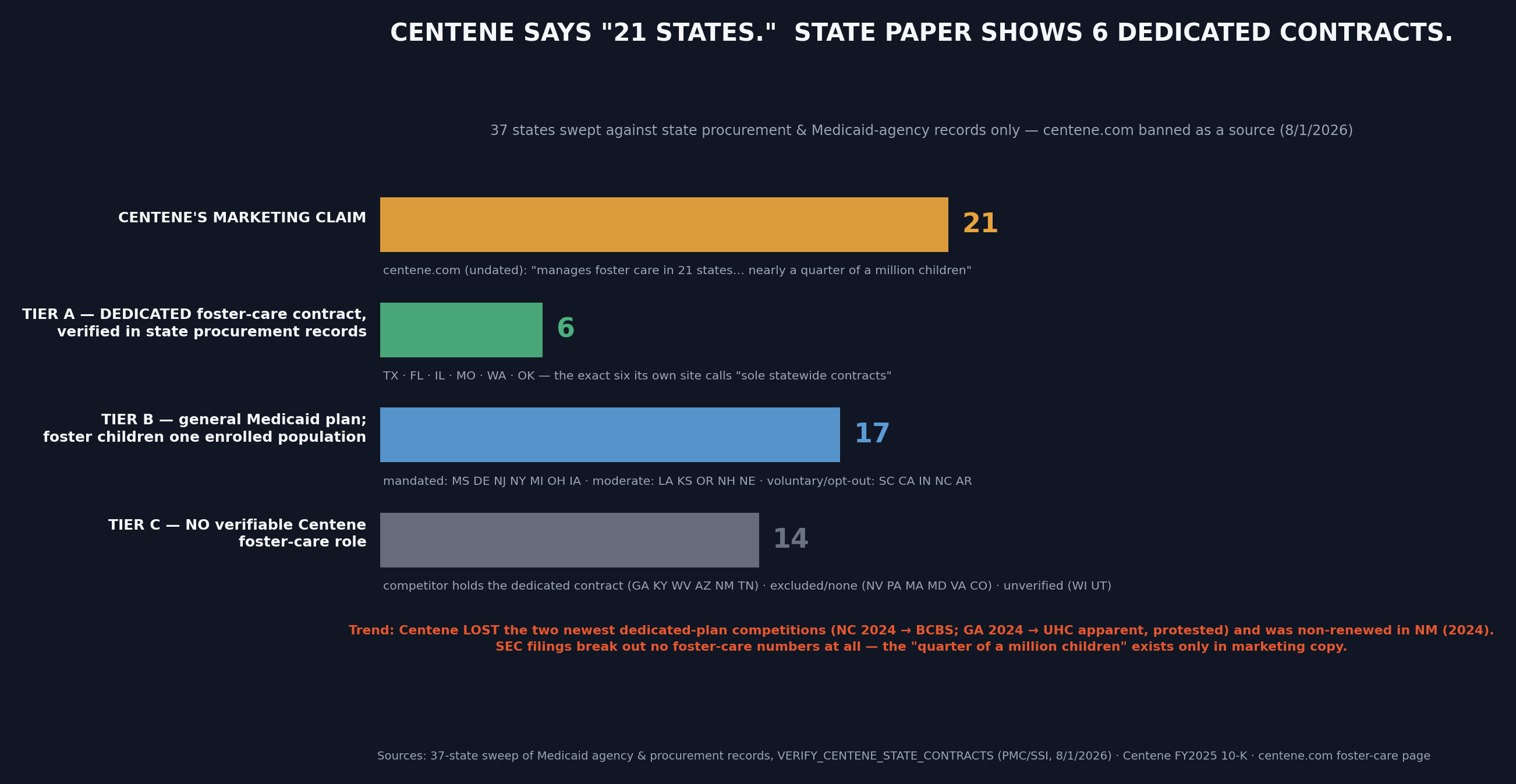
State capitation. The largest child-welfare money flow in America — the per-member monthly payments that make foster-care Medicaid a business — is disclosed only in state contract files. When we swept37 states 'procurement and Medicaid records to test Centene's own claim of managing foster care in "21 states," we could verify dedicated foster-care contracts in exactly six (Texas, Florida, Illinois, Missouri, Washington, Oklahoma — the same six its marketing calls "sole statewide contracts"). Foster children appear as an enrolled population under general Centene plans in roughly seventeen more, on terms ranging from contract-mandated to opt-in. In fourteen, the dedicated contract belongs to a competitor or Centene has no verifiable role. The "21 states" is not reconstruct able from public records — and ten state agencies bot-blocked or otherwise failed our attempts to retrieve public contract paper while we tried. The count of states that obstructed retrieval of public documents about foster children's health care is itself a finding of this series.
The state sweep produced findings Centene's investor materials will not show you. The foster-care specialty-contract market is genuinely contested: on dedicated contracts, the state-verified scoreboard reads Centene 6, Aetna 3 (Kentucky, West Virginia, and Ohio's behavioral specialty), Blue Cross plans 2 (North Carolina's new Children & Families plan and Tennessee), with single dedicated contracts at Amerigroup/UnitedHealth (Georgia, in transition and under protest), Presbyterian (New Mexico), and Mercy Care (Arizona). And the recent trend runs against the incumbent: Centene lost both of the newest dedicated-plan competitions it contested— North Carolina's 2024 award went to Blue Cross, Georgia's 2024 notice of intent went to UnitedHealthcare with Centene's subsidiary scored unsuccessful and protesting — and New Mexico declined to renew in 2024. Meanwhile Centene's SEC filings, for all their hundreds of pages, break out no foster-care membership number and no foster-care state count at all— the "nearly a quarter of a million children" exists only on an undated marketing page. A company can be simultaneously the dominant incumbent, a declining competitor, and financially invisible on the very population that anchors its public story. Only state-by-state paper shows you all three at once — which is presumably why nobody assembles it.
Name the states that made assembly hardest, for the record: agencies in Texas, Georgia, Louisiana, Kansas, Colorado, New Hampshire, New York, New Jersey, Massachusetts, and Wisconsin blocked, CAPTCHA-walled, or otherwise failed our retrieval of public contract and program documents during this sweep, forcing citations to dated archive snapshots and adding three more formal records requests (New Jersey, Georgia, Wisconsin) to the stack this investigation now has pending.
And where the trail runs into private philanthropy, it goes fully dark: donor-advised and fiscal-sponsor structures in this space report hundreds of millions of dollars to hundreds of unnamed recipients. [PRE-PUBLISH VERIFY: Tides/Arabella figures from the 990s before ship — and hold them, as the case file requires, at "undisclosed, unknown," nothing stronger.] Casey Family Programs, as a private operating foundation, files a form whose grant detail never enters the databases built to track nonprofit money at all.
None of this is hidden. All of it is invisible. Those are different things, and the difference is the finding.
So this series ends not with an accusation but with three questions any legislature — state or federal, either party's, which is why we can ask them — could answer tomorrow:
Why do FARA and the LDA not share a join key? One person registered under both statutes at once should be one query, not a research project.
Why is a foundation's loan of an employee into a state agency's leadership not a disclosable event— with the agreement, the compensation source, and the conflict screens filed somewhere a citizen can read?
Why is the sole-source health contract for a state's entire foster-care population— the single largest child-welfare money flow there is —harder to retrieve than a foreign government's lobbying invoice?
The children in these programs did not choose any of this architecture. The least the architecture owes them is a light switch.
What happens next
If you have worked inside any of the systems this series describes — a state Medicaid agency, a managed-care organization, a child-welfare agency, a firm on either side of the disclosure regimes — and you hold documents that would correct, sharpen, or extend this record, Project Milk Carton accepts tips through its website. We verify before we publish, we state what we cannot verify, and as Parts 3 and 4 demonstrate, we print our own corrections at the same volume as our findings.
The door is still open. We intend to keep standing in it.
Try It Yourself: A Fifteen-Minute Civics Exercise
Everything in this series came from records you are already allowed to read. Here is how to stand where we stood — and what to ask once you have.
1. Pull a foreign lobbying file. Start at the Justice Department’s FARA page (justice.gov/nsd-fara) and follow the link to the eFile search at efile.fara.gov. Search any registered firm. You will get PDFs — engagement letters, supplemental statements, fee schedules. You may also get intermittent errors; we did. That is part of the exercise.
2. Pull a domestic lobbying file. Go to lda.gov and search the registrations and quarterly activity reports. Same firm, if you like.
3. Now try to connect them. Notice there is no link, no shared identifier, no button that shows you a person’s FARA and LDA registrations side by side. What took you two searches and a legal pad is the join key Question 1 asks about. You have just reproduced our method.
4. Read a foundation’s public filing. ProPublica’s Nonprofit Explorer (projects.propublica.org/nonprofits) posts Forms 990 free. Open any large foundation’s filing and find Schedule F, the foreign-grants schedule. Check whether the “Name of organization” column is filled in. The blank is legal. The blank is also the point.
5. Follow a federal grant. USAspending.gov tracks federal awards to the recipient level — this is the rail that does work, and it is why our $148 billion corpus exists. Then remember what you learned in steps 1–4: none of the money in this series rides it.
6. Ask your own state for the contract. Every state has a public-records law. Write to your state’s Medicaid agency and request the current managed-care contract covering children in foster care, including the per-member per-month payment rates. It is public paper about public money spent on children in public custody. If the portal blocks you, the form 404s, or the answer never comes — you have just reproduced our other finding. We would like to hear about it either way.
7. Ask your legislators the three questions above. State or federal, either party — the questions belong to no platform, which is why anyone can ask them. Find your U.S. representative at house.gov/representatives/find-your-representative and your senators at senate.gov; your state legislature’s website has its own member directory. Copy the questions verbatim. They fit in one email.
8. If you find something, tell us. Tips come through projectmilkcarton.org. We verify before we publish, and we print our corrections at the same volume as our findings.
None of this requires a subpoena, a badge, or a law degree. It requires an afternoon. The records belong to you; the only question this series cannot answer is whether anyone will come read them.
Project Milk Carton is a 501(c)(3) transparency organization. This exercise, like this series, concerns systems — not candidates, parties, or elections — and asks you to take no position on any of them.
If you enjoyed this work and feel encouraged by independent investigations like this, please consider becoming a paid subscriber to The Constitutional Republic on Substack or donate at
Project Milk Carton Inc. Your gift keeps our site alive, spotlighting high-risk children!
Your support helps us continue:
investigative reporting
public records research
educational transparency projects
community outreach
and future investigations like this series
Most importantly, please share this article.
Independent journalism survives when ordinary people help spread information powerful institutions would prefer remain ignored, misunderstood, or buried beneath complexity.
Because silence protects systems.
Informed communities protect children.
ALL paid subscriptions are tax deductible Project Milk Carton | 501(c)(3) | EIN: 33-1323547
Sources & Methods
Every factual claim in this series traces to a primary source retrieved and preserved on or before August 1, 2026: Justice Department FARA eFile records (registrations #5870, #6328, #5430 — rosters, exhibits, short-form statements, supplemental statements, and bulk data files), the Senate Lobbying Disclosure database (complete Brownstein–Centene and Capitol Counsel filing sets, with amendment-superseded income totals), SEC EDGAR (Centene FY2024/FY2025 10-Ks, FY2025 Exhibit 21 subsidiary list, 2026 proxy), Texas DFPS/HHSC public pages and the Governor's office, a 37-state sweep of state Medicaid agency and procurement records, official Senate Finance Committee releases, and Project Milk Carton's civicops corpus (form990schedule_i, USAspending UAC subgrants, TAGGS, FEC bulk data). Where a claim rests on press reporting or on an entity's own marketing, the text says so in line. Items marked [PRE-PUBLISH VERIFY] are holds, not facts. The complete verification log — including the findings of ours that failed re-verification, which we corrected above in print — is preserved in case file SSI-2026-0018.
Project Milk Carton is a 501(c)(3) transparency organization. This series reports on systems, not candidates; it takes no position on any election, candidate, or party. All conduct described is lawful and disclosed unless expressly stated otherwise — and nothing in this series alleges otherwise.
Project Milk Carton
501(c)(3) Nonprofit • projectmilkcarton.org • t.me/ProjectMilkCarton
Comments
Nothing yet. Say the first thing.
Sign in to join the conversation.