
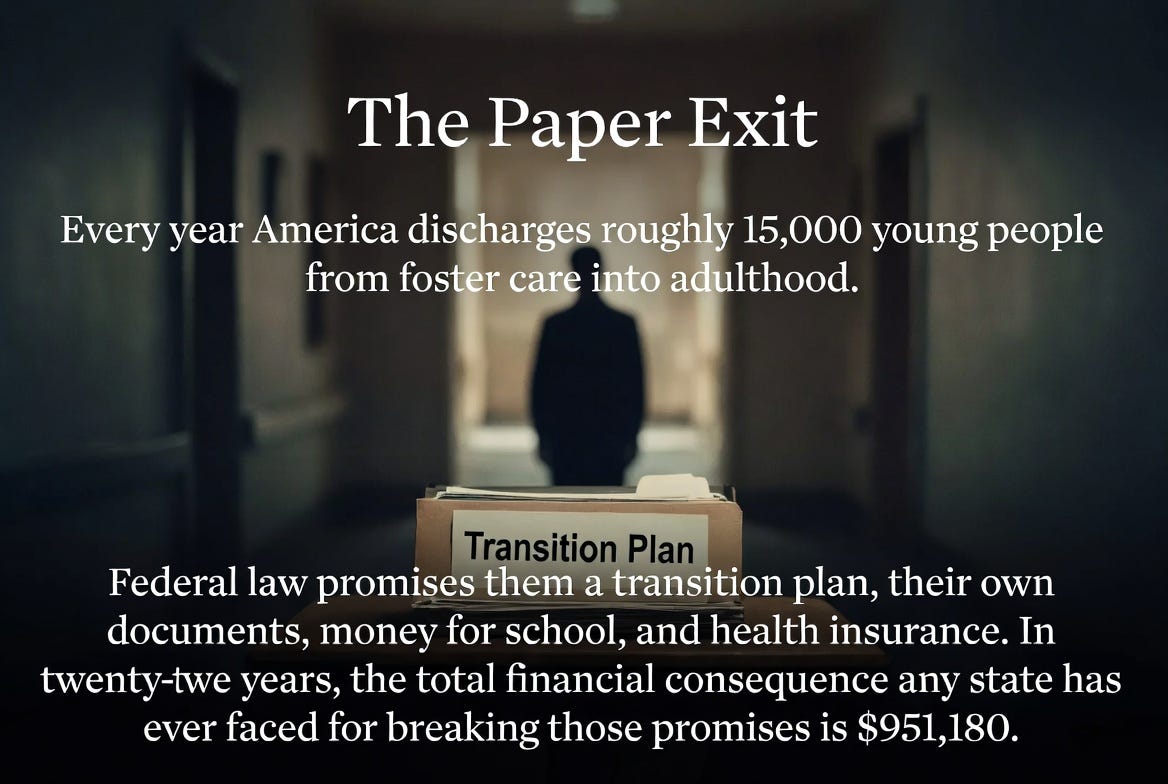
The Paper Exit
Every year America discharges roughly 15,000 young people from foster care into adulthood. Federal law promises them a transition plan, their own documents, money for school, and health insurance. In twenty-five years, the total financial consequence any state has ever faced for breaking those promises is $951,180.
Project Milk Carton — Investigation | July 28, 2026
In 2015, the federal government fined Arkansas $15,468.
That sentence deserves a moment, because it is a historic event. The National Youth in Transition Database — the data system Congress ordered so the country would finally know what happens to foster youth after they age out — carries a penalty provision, 45 C.F.R. § 1356.86: a state that fails to comply can lose 1 to 5 percent of its federal Chafee allotment. In the program's entire history, that penalty has been assessed exactly once. Arkansas, 2015, $15,468, upheld by the HHS Departmental Appeals Board in Decision No. 2664 — and not for failing any young person. For a data-file error.
The other enforcement instrument is older and bigger. The Child and Family Services Review is the federal government's audit of every state child-welfare system, including the "independent living" outcomes owed to older youth. In roughly twenty-five years of CFSRs, no state has ever passed — a fact the Government Accountability Office told Congress in 2004 and the Congressional Research Service has repeated since; the Department of Health and Human Services' own policy library hosts a document titled, plainly, "No States Have Ever Passed CFSR." The review carries financial penalties too. In a quarter century they have been actually withheld once: Idaho, $935,712, November 2022 — and only because Idaho conceded outright that it had failed to complete its improvement plan (DAB No. 3110). Every other state, every cycle, rolls its penalties into a "program improvement plan" where they are suspended, and then suspended again.
Add it up. Two enforcement events. $951,180, total, ever — against a program that now sends states roughly $186 million every year for transition-age foster youth, in a system that discharged 15,379 young people to "emancipation" in FY2024 alone.
This investigation spent the last week reading the primary record behind that arithmetic: the GAO's 2025 reports on unspent Chafee funds and former-foster-youth Medicaid, the HHS Inspector General's 2024 evaluation of exit documents, the federal allotment tables, the National Youth in Transition Database outcome files, the state-by-state data assembled in the Annie E. Casey Foundation's Fostering Youth Transitions series, seven active federal lawsuits, the pending bills in both chambers, and — where the paper trail runs through our own house — Project Milk Carton's grant and missing-children databases. Here is what the record shows:
The money goes back. While 44 percent of foster youth report homelessness by age 21, states returned an average of about $8.4 million a year in unspent Chafee and Education and Training Voucher funds in FY2018–FY2022 — roughly $42 million over five years, by our arithmetic on GAO's average. In FY2022 alone, 12 of 51 jurisdictions returned Chafee money, 28 of 51 returned ETV money, about $8.9 million combined — and roughly $670,000 of returned money was permanently lost to the Treasury that year, per ACF officials. During the pandemic, when Congress added roughly $400 million in supplemental funds, about $50 million of it went unused.
The documents don't come. The HHS Office of Inspector General's 2024 evaluation found that 54 percent of foster children aged 14–17 had no documented credit check from even one bureau — a check federal law requires annually — and 78 percent of files lacked all three required bureau checks. In New Hampshire, plaintiffs' expert evidence in a certified federal class action puts it more bluntly: about 75 percent of adolescent foster children lacked a transition plan at all.
The enforcement doesn't exist. One NYTD penalty ever. One CFSR withholding ever. The GAO's sole recommendation from its 2025 unspent-funds report — that ACF document a plan for its regional offices to talk to states that persistently send money back — was still listed as open on GAO's public tracker when we pulled it this week. HHS concurred and expects to finish in FY2026.
The safety net has a geography. Former foster youth are entitled to Medicaid to age 26 — the same principle that lets other young adults stay on a parent's plan. In 2023, California had 26,544 former foster youth enrolled. The District of Columbia had 66. DC's own guidance for youth leaving care states, verbatim: "There is no automatic renewal for Medicaid coverage once you leave care" — for an eligibility category with no income test.
And no bill fixes it. The House passed a genuinely significant package, the Fostering the Future Act, by voice vote on May 19, 2026. As of this writing it has sat in the Senate Finance Committee for ten weeks without action. More structurally: we read every pending bill touching these mandates, and not one creates an enforcement, audit, or penalty mechanism for the transition-plan and exit-document requirements. The only bill that amends those subsections directly — the Informed Foster Youth Act — adds new documents to the checklist and no consequence for ignoring the checklist.
The law here is not vague. It is a list. What it has never had is anyone whose job is to check the list. This is the record.
I. The list Congress wrote
Three provisions define what an aging-out foster youth is owed.
The John H. Chafee Foster Care Program for Successful Transition to Adulthood, 42 U.S.C. § 677, is the money: a capped entitlement — about $140.9 million in state allotments in FY2025 — for services that help youth 14 and older move to adulthood: housing help, employment help, education help, life-skills work, connections to caring adults. Riding alongside it is the Education and Training Voucher program — about $42.6 million in FY2025 — which pays up to $5,000 a year toward college or vocational training. That cap was set in 2001. Congress raised it — to $12,000, temporarily, from October 2020 through September 2022, in the Supporting Foster Youth and Families through the Pandemic Act (Division X of the Consolidated Appropriations Act, 2021) — and then let it snap back. The $5,000 cap has never been permanently increased in twenty-five years, a period over which published tuition and rent did not stand still.
The transition plan, 42 U.S.C. § 675(5)(H), added in 2008: during the 90 days before a youth ages out, the caseworker must help build a "personalized" plan, "as detailed as the child may elect," covering housing, health insurance, education, mentoring, workforce supports, and employment services.
The exit documents, 42 U.S.C. § 675(5)(I), added in 2014: a youth who ages out after at least six months in care "is not discharged from care without" — the statute's own words — a copy of their birth certificate, Social Security card, health insurance information, medical records, and a driver's license or state ID. Separately, § 675(5)(K) requires annual credit checks for every foster child 14 and older, with help resolving any inaccuracies — because foster children, whose Social Security numbers pass through many hands, are targets for identity theft.
Congress also built the option of extended foster care to 21 (the Fostering Connections Act of 2008), with federal Title IV-E money to pay for it, and a data system — NYTD — to measure the outcomes. On paper, the architecture is complete: money, a plan, documents, an extension, a scoreboard.
Now watch each piece in operation.
II. The money nobody spent
Start with the finding that organized this investigation. In 2025, GAO published its review of the Chafee program (GAO-25-107154). Its central numbers, verified against the report text:
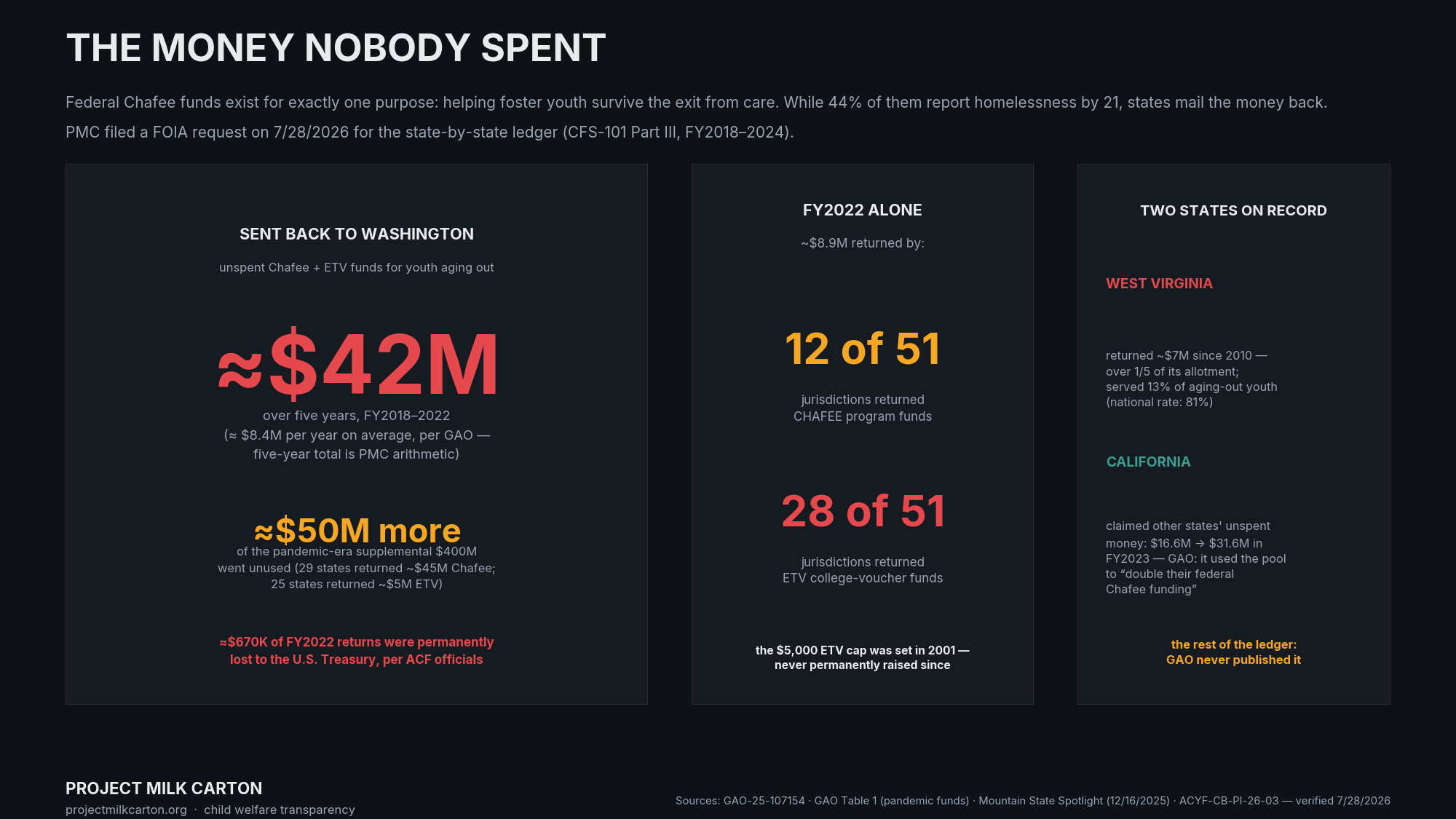
The returned money is not an accounting rounding error; it is services not delivered. And the state-by-state pattern behind the averages is the part the public cannot see: GAO did not publish which states returned what. Only two states are on the record. West Virginia is one, and only because journalists dug it out: Mountain State Spotlight reported in December 2025 that the state has returned nearly $7 million since 2010 — more than a fifth of everything it was allotted from 2010 to 2023 — while serving 13 percent of its aging-out youth with Chafee services from 2018 to 2023, against 81 percent nationally. West Virginia youth who did get services averaged 1.3 of them; the national average is 5.2.
California is the other, from the opposite direction. GAO records that California used the redistribution process — applying for the money other states sent back — to go from $16.6 million to $31.6 million in FY2023: in GAO's words, to "double their federal Chafee funding." The redistribution pool is a zero-sum ledger. Every dollar California claimed was a dollar some other state's foster youth never saw, returned by an agency that did not spend it.
The ETV numbers make the underspending concrete. More than 14,000 vouchers are awarded nationally each year, per CRS — in a system that has well over 100,000 youth in the eligible age range. A ten-state Urban Institute study found only 11 percent of eligible youth attended college with an ETV, and the average award was $3,313 — a third below even the 2001 cap. On the federal ledger, the smallest lines are their own commentary: the Virgin Islands' entire FY2025 ETV allotment is $2,988 — less than one voucher — and the seven tribes that operate their own Chafee programs split $123,000, nine-hundredths of one percent of the program, for a population every disparity statistic in child welfare runs through.
There is a document that would open the whole ledger: the CFS-101 Part III, the annual expenditure report every state files with ACF. GAO saw that data. The public has never had it. On July 28, 2026, Project Milk Carton filed a FOIA request with ACF for every state's CFS-101 Part III for FY2018–FY2024, along with the returned-funds compilations behind GAO's averages and every state application for redistributed funds since 2023. We will publish what comes back.
III. The exit, and the twelve months after
How many young people does this reach? In FY2024, per preliminary AFCARS data, 15,379 youth exited foster care to "emancipation" — aged out, no family — out of 176,730 total exits: about 9 percent of everyone who left care. The preliminary FY2025 count is similar (15,030 of 169,927). The count has fallen from the ~20,000-a-year levels of the 2010s — partly a real success of extended foster care, and partly, advocates caution, an artifact of youth who exit through other statuses and never enter the emancipation count.
What happens to them next is not a matter of anecdote. It is the entire purpose of NYTD, the federal outcome survey, and its most recent full cohort report — young people who were in care at 17, surveyed again at 19 and 21 — reads as follows, alongside the general-population comparisons in the federal and Midwest Study literature:
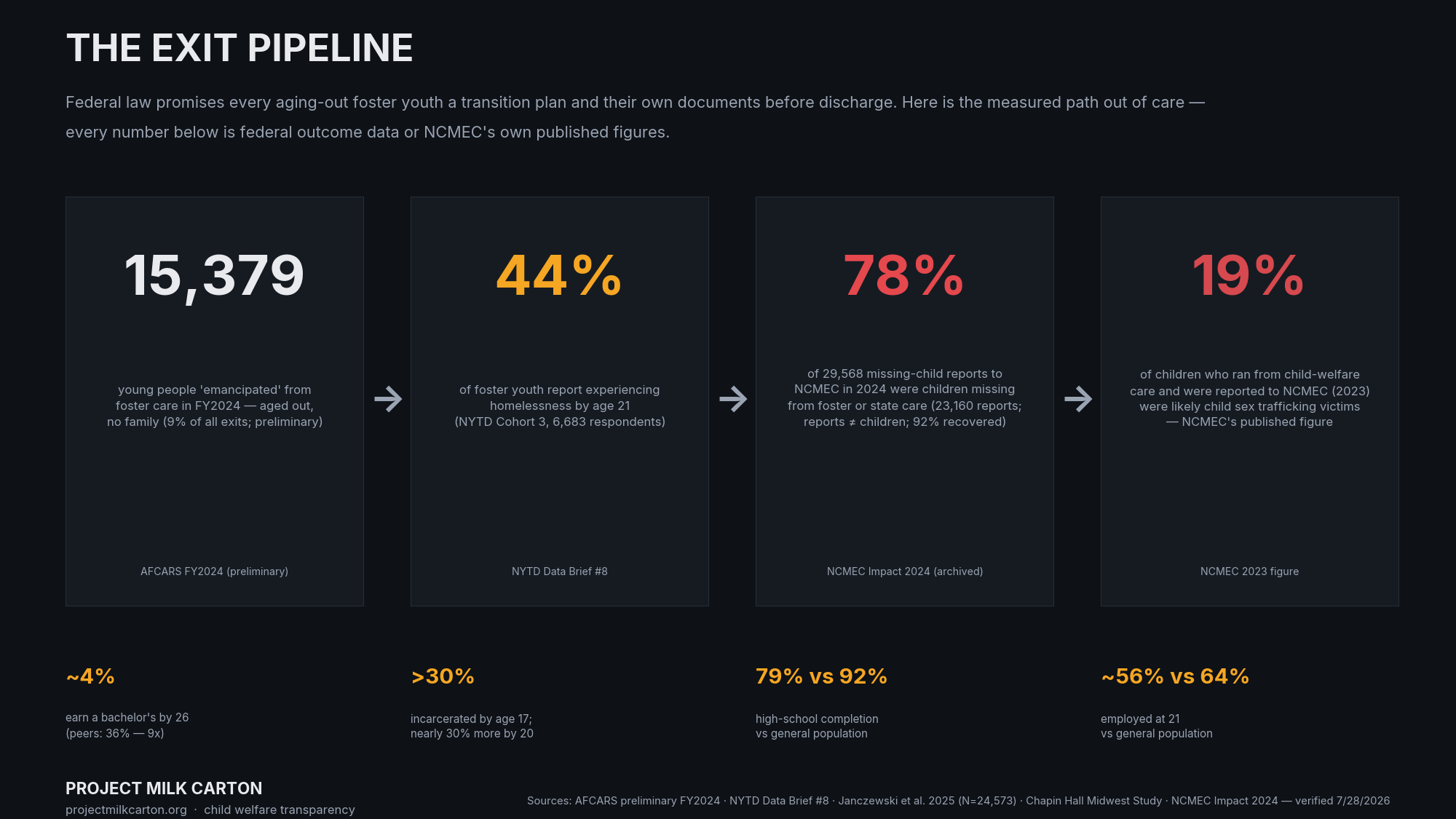
The Midwest Study — the field's landmark longitudinal cohort — found that by age 26, 74.2 percent of the young men and 42.8 percent of the young women who had aged out had been incarcerated at some point in their lives.
And there is a darker pipeline in the federal numbers, which runs directly through this organization's mission. The National Center for Missing & Exploited Children's 2024 impact data: of 29,568 missing-child cases reported to NCMEC that year, 92.3 percent were endangered runaways — and 23,160 reports, 78 percent of the total, were children missing from foster care or other state care. (Honesty note: NCMEC counts reports, not distinct children, and reports that 92 percent of those children were recovered.) In 2023, NCMEC's published figure was that 19 percent of children who ran from child-welfare care and were reported to it were likely victims of child sex trafficking; its current page says 17 percent. A 2024 Maryland study found 76 percent of identified youth trafficking victims had prior child-welfare involvement. Project Milk Carton's own database currently tracks 7,303 missing-person cases, with California leading at 1,002 — 653 of them teenagers — figures we cite as cases in PMC's database, which includes long-term cases, not as an annual count.
Aging out is the on-ramp to every one of those statistics. The transition plan and the exit documents are the guardrails Congress bolted onto the on-ramp. Which brings us to whether the guardrails exist.
IV. The folder that isn't there
In September 2024, the HHS Office of Inspector General published an evaluation — OEI-07-22-00510 — of one of the simplest mandates in the statute: the annual credit checks required for every foster child 14 and older. The findings, from FY2021 case files:
54 percent of foster children aged 14–17 had no documented credit check from any of the three bureaus — not one, ever.
78 percent of files lacked the complete set of all three required bureau checks.
Among 17-year-olds — the group about to age out, for whom the check matters most — 66 percent had none.
Of the children who were checked, 4 percent had credit reports that existed when they shouldn't have — the classic flag for identity theft. Assistance in resolving them, the OIG found, was "rarely" documented.
The OIG made three recommendations to ACF. As of this investigation, all three remain open.
That is the measured compliance rate for the easiest item on the list — the one a caseworker can complete from a desk. For the transition plan itself, the best evidence in the country right now comes from federal litigation. In B.D. v. Ayotte in New Hampshire — a class action certified in September 2024 on behalf of adolescent foster children — plaintiffs' expert evidence describes a system in which roughly 75 percent of adolescent foster children lacked a transition plan, more than half lacked a current case plan of any kind, and 12 percent had timely case-plan updates. (A bench trial was scheduled for February 3, 2026; the outcome was not yet in the public record we reviewed.)
The statute says a youth "is not discharged from care without" the birth certificate, the Social Security card, the ID, the medical records, the insurance information. There is no federal audit of whether that sentence is honored — none. No state publishes a compliance rate for it. The OIG's credit-check evaluation is the closest the federal government has ever come to opening the folder, and the folder was more than half empty.
V. Twenty-five years of consequences: the ledger
Here is the complete enforcement history of the federal transition-age mandates, as far as this investigation could establish it — and we looked for more:
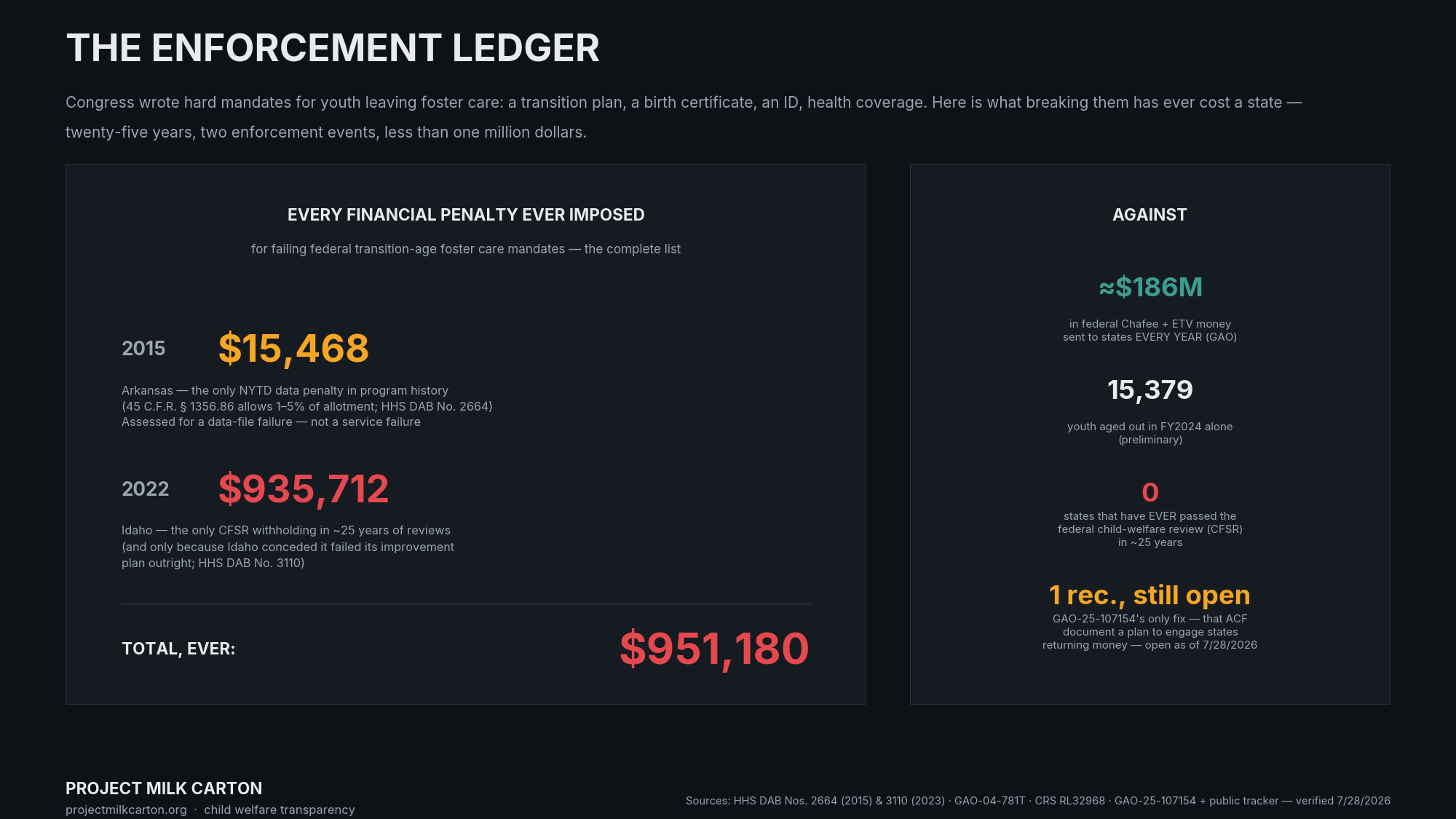
Against that: roughly $186 million a year in Chafee and ETV money, per GAO; 15,379 emancipations in FY2024; and a returned-funds ledger averaging $8.4 million a year that produced, as its entire enforcement response, one GAO recommendation — that ACF document a plan for regional offices to engage the states sending money back. HHS concurred. GAO's tracker showed the recommendation still open when we pulled it on July 28, 2026; HHS expects completion in FY2026 — which will be roughly eighteen months from report to plan, for a plan to have conversations.
The pattern extends to the newest tool. In 2019, HUD created a voucher program specifically for youth aging out — now officially named the Melania Trump Foster Youth to Independence Program — to attack the 44-percent homelessness number directly. In seven years, per the National Low Income Housing Coalition's 2026 Advocates' Guide, it has distributed about 7,000 vouchers — against 15,000–17,000 youth aging out every year. The bottleneck, notably, has not been congressional appropriations but uptake: the program depends on local public housing agencies electing to participate, under caps and utilization gates. A tool that exists, funded, and reaches a fraction of one year's cohort over seven years, is the enforcement story in miniature: the machinery runs only where someone volunteers to run it.
VI. Health insurance to 26 — if you know, and if you stay put
The Affordable Care Act's most popular idea — young adults stay covered to 26 — has a foster-care counterpart: former foster youth are categorically eligible for Medicaid to age 26, no income test. Congress even fixed the program's worst defect: under the SUPPORT Act, for any youth who turned 18 on or after January 1, 2023, the coverage is mandatory in every state, including states they move to. (For the older cohort — youth who aged out before 2023 — coverage still generally stops at the state line unless the new state took up a waiver; that gap self-extinguishes in January 2031 as the cohort ages past 26.)
So the law, prospectively, is good. The delivery is a natural experiment in what happens when a benefit depends on the state remembering to enroll you. GAO's 2025 review (GAO-25-107286) counted at least 112,000 former foster youth enrolled nationally in 2023 across 46 states and DC — with four states excluded for unreliable data, and New York's count excluding New York City. The range:
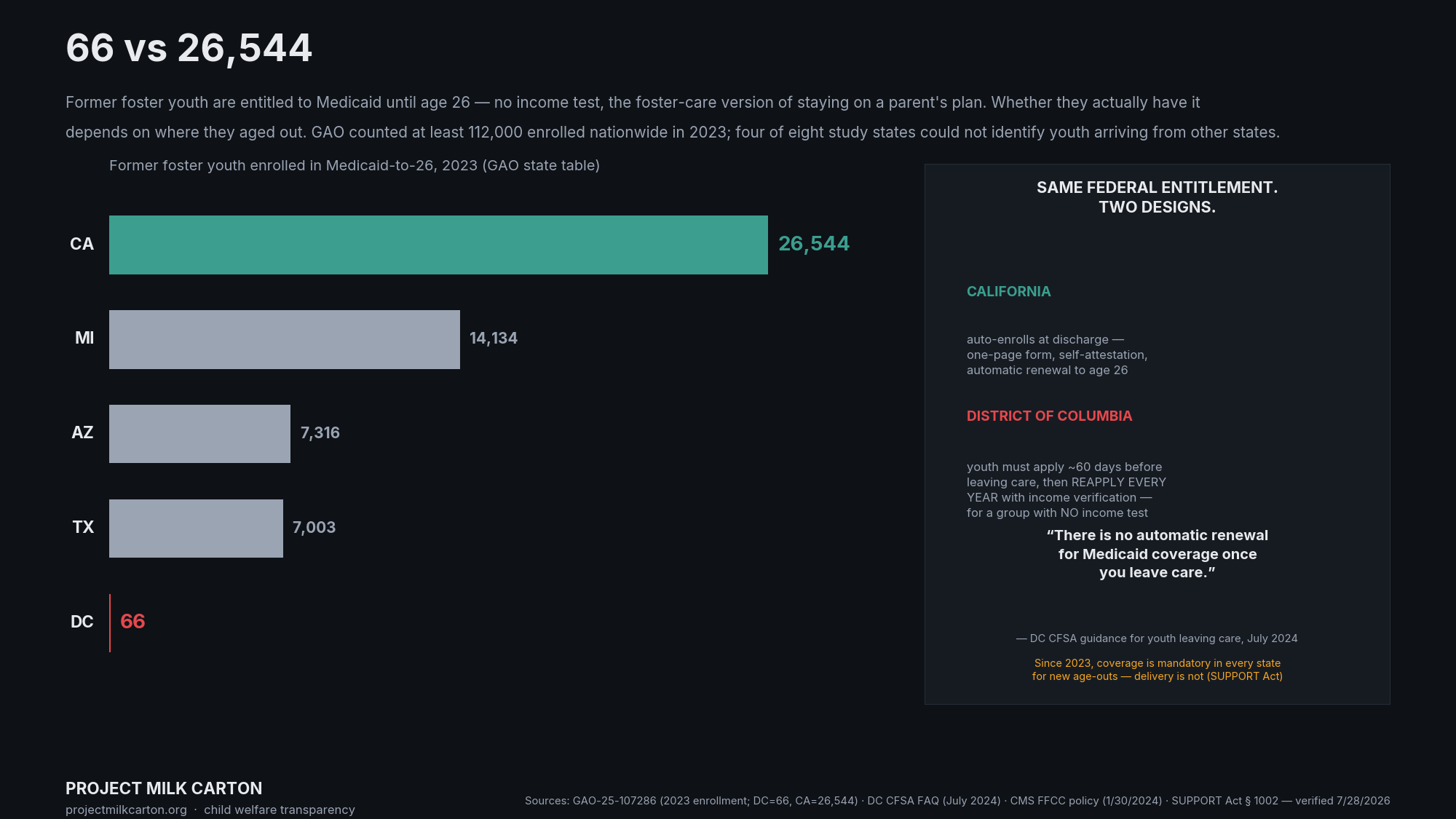
Sixty-six. GAO's highlights page says "fewer than 70"; the state table says 66. And the District's own July 2024 guidance for youth leaving care removes any mystery about the mechanism, in one verbatim sentence: "There is no automatic renewal for Medicaid coverage once you leave care." An annual income-verified reapplication, imposed on an eligibility group that has no income test, on young people the government itself just finished failing to hand a birth certificate — our analysis, and we label it as such, is that this paperwork architecture sits in obvious tension with federal renewal regulations that require states to renew from available data before demanding forms. Whatever the legal characterization, the arithmetic is not in dispute: the same federal entitlement produces 26,544 covered young people under one state's defaults and 66 under another's.
GAO's structural finding matched: all eight states it studied auto-transition youth who age out in-state — but four of the eight had no way to identify an eligible youth arriving from another state unless the youth already knew the rule and self-reported. A benefit whose delivery depends on a homeless 19-year-old knowing an interstate Medicaid provision is a benefit that was designed to be underused.
VII. The states that opted out, and the scorecard
Extended foster care to 21 is the single intervention with the strongest evidence behind it — and it is optional. Fourteen states have never adopted the federal Title IV-E extension: Alaska, Delaware, Georgia, Iowa, Kansas, Mississippi, Missouri, Montana, New Jersey, Oklahoma, South Dakota, Utah, Vermont, and Wyoming. (Fairness note: several of these, notably Georgia and New Jersey, run state-funded extended care outside the federal program; "no IV-E extension" is not always "no program." Thirty-six states, DC, Puerto Rico, and nine tribes have taken the federal option.)
Cross that list against the state-level NYTD outcomes assembled in the Annie E. Casey Foundation's Fostering Youth Transitions 2023 (the FY2021 cohort at age 21), and the geography of the aging-out crisis emerges. Deriving "experienced homelessness since 17" as the complement of stable housing, the worst states are Idaho (~73%), Alaska (~70%), South Dakota (~67%), Montana (~57%), New Hampshire (~56%), Oklahoma (~55%), and Kansas (~50%) — with the caveat, which we flag rather than bury, that several of those are small-sample states. The pattern holds anyway: nine of the twelve worst housing outcomes belong to states that either never adopted the IV-E extension or adopted it late. At the other end: Puerto Rico reports 99 percent stable housing, Illinois 86, Connecticut, Maryland and New Jersey 85.
Two other columns from the same scorecard:
Incarceration by 21: Colorado 67%, Wyoming 62%, Idaho 61%, North Dakota 58%, Ohio and Louisiana 56%, DC and Tennessee 54%.
Education financial aid actually reaching youth (the ETV proxy): 12 percent nationally — and at the bottom, Kentucky at 0 percent, Massachusetts at 1, Wisconsin and Mississippi at 3, against Nevada's 53 and Maryland's 41. Kentucky, per the federal reporting year in Casey's compilation, delivered education financial aid to effectively none of its transition-age cohort — while the national ledger returned $8.4 million a year.
West Virginia deserves its own line, because it is the one state whose returned-money and service numbers can be laid side by side, thanks to Mountain State Spotlight: nearly $7 million returned since 2010; 13 percent of aging-out youth served versus 81 percent nationally; 1.3 services per served youth versus 5.2. That is what "unspent funds" means at ground level.
VIII. The courts: enforcement by any other door
If the executive branch will not enforce the mandates, can young people? Seven active or recently resolved federal cases now carry the aging-out docket, and we pulled each one:
Read the column of outcomes and a doctrine emerges. Whether the transition-plan and exit-document provisions — § 675(5)(H) and (I) — can be enforced by an individual young person under 42 U.S.C. § 1983 is, as far as our search could determine, an unlitigated question: no court has ruled either way. The closest appellate analog, 31 Foster Children v. Bush (11th Cir. 2003), held neighboring case-plan provisions not privately enforceable, and the Supreme Court's most recent word (Medina, 2025, following Talevski, 2023) describes private enforceability of spending-clause statutes as "atypical." So plaintiffs' lawyers route around the statute: they win on substantive due process — the state took custody, so the state owes shelter — and on the ADA, while the statutory claims are dismissed. The mandates Congress wrote specifically for these young people are not being vindicated in court. They are being bypassed in court, by lawyers who have concluded the Constitution is a more reliable instrument than the statute written for the purpose.
That is the judicial mirror of the $951,180 ledger: the exit mandates are law that neither the agency nor, in practice, the courthouse enforces.
IX. Congress, ten weeks and counting
The current Congress has more foster-youth legislation moving than any in a decade — which makes what is missing from all of it the finding.
The Fostering the Future Act (H.R. 7432) passed the House by voice vote on May 19, 2026 — genuine, bipartisan, and substantive. The package folded in a housing title (its original name was the Foster Youth Housing Opportunity Act), an increase in the ETV cap from $5,000 to $12,000 (absorbing H.R. 7463 — the first permanent increase since 2001, if enacted), legal services for foster youth, a Chafee modernization title, provisions for expectant and parenting youth, and workforce-training vouchers with eligibility extended to older kinship and adoption exits. It was received in the Senate on May 20 and referred to the Finance Committee. As of this writing — ten weeks later — the Senate has taken no action. Senate members have moved pieces separately: a housing counterpart in late June, a "Fresh Starts" bill, a workforce/ETV bill, a discussion draft. None has moved past introduction.
And one bill speaks directly to the exit documents: the Informed Foster Youth Act (S. 4556), which would amend § 675(5)(I) itself — adding an annual free credit report, and guaranteeing the birth certificate, Social Security card, and state ID for youth 14 and up. We read the bill text against the enforcement question this article documents. It adds documents to the list. It creates no audit of whether the list is honored, no penalty for ignoring it, and no private right of action — nothing Arkansas-2015 about it, even. Neither does any other pending bill in either chamber. Congress is, in 2026, still legislating on the assumption that the problem is the list, when twenty-five years of evidence — a 54-percent missing-credit-check rate, a 75-percent missing-transition-plan rate in the one state where sworn expert evidence exists, $951,180 in total consequences — says the problem is that no one checks the list.
(Compliance note: Project Milk Carton reports the status of legislation as a factual matter and takes no position for or against any bill or any member of Congress.)
X. What would checking the list look like?
This is a transparency organization, so we end where a transparency organization should: with the specific, obtainable documents that would convert this article's findings from aggregate to accountable, and what we have done about them.
The state-by-state returned-funds ledger exists. Every state files a CFS-101 Part III expenditure report with ACF every year. GAO read them; the public never has. PMC filed a FOIA request with ACF on July 28, 2026 for every state's Part III, FY2018–FY2024, the returned-funds compilations behind GAO's $8.4-million-a-year average, and every application for redistributed funds since 2023.
The enforcement history can be confirmed in one paragraph. We have found exactly one NYTD penalty in the program's history. PMC sent a press inquiry to ACF's Office of Communications on July 28, 2026 asking three questions on the record: whether any NYTD penalty besides Arkansas 2015 has ever been assessed; whether the GAO-recommended regional-office plan has been documented; and whether ACF will publish state-level returned-funds data. We will publish the response in full.
The exit-document compliance rate is measurable. The OIG measured the credit checks. No one has measured the birth certificates, Social Security cards, and IDs — the items the statute says a youth cannot be discharged without. A state-by-state case-file review on § 675(5)(I), modeled on OEI-07-22-00510, is the single evaluation most obviously missing from the federal shelf.
Method and honesty notes. All figures above trace to the primary documents listed below, fetched and archived during this investigation; where a number is our derivation (the ~$42 million five-year total; homelessness as the complement of stable housing in state scorecards) we say so in line. Small-sample state figures are flagged. NCMEC figures count reports, not distinct children. AFCARS FY2024–25 exit counts are preliminary. PMC's missing-children database figures are cumulative case counts, not annual incidence. Where the public record ran out — the Ocean S. class-certification posture, the outcome of the New Hampshire trial — we say that too, rather than guess.
If you enjoyed this work and feel encouraged by independent investigations like this, please consider becoming a paid subscriber to The Constitutional Republic on Substack or donate at
Project Milk Carton Inc. Your gift keeps our site alive, spotlighting high-risk children!
Your support helps us continue:
investigative reporting
public records research
educational transparency projects
community outreach
and future investigations like this series
Most importantly, please share this article.
Independent journalism survives when ordinary people help spread information powerful institutions would prefer remain ignored, misunderstood, or buried beneath complexity.
Because silence protects systems.
Informed communities protect children.
ALL paid subscriptions are tax deductible Project Milk Carton | 501(c)(3) | EIN: 33-1323547
Sources
GAO-25-107154, Foster Care: Additional Actions Needed to Help States Use Chafee Program Funds (2025) — returned-funds findings; California redistribution; open recommendation (tracker pulled 7/28/2026)
GAO-25-107286 — former foster youth Medicaid enrollment, 2023 state table (DC: 66; CA: 26,544)
GAO-04-781T; CRS Reports RL32968, IF11070, IF11010 — CFSR history; Chafee program structure; former-foster-youth Medicaid
HHS OIG evaluation OEI-07-22-00510 (Sept. 5, 2024) — credit-check findings
HHS Departmental Appeals Board, Decision No. 2664 (2015, Arkansas NYTD penalty); Decision No. 3110 (2023, Idaho CFSR withholding)
ACYF-CB-PI-26-03 (FY2025 Chafee/ETV allotments); ACYF-CB-PI-21-04 (pandemic ETV cap)
Supporting Foster Youth and Families through the Pandemic Act, Div. X, Consolidated Appropriations Act, 2021
NYTD Data Brief #8 (Cohort 3 outcomes at 21); Janczewski et al., Child Abuse & Neglect (2025), PMID 40273653 (NYTD incarceration analysis, N=24,573); Chapin Hall, Midwest Evaluation of the Adult Functioning of Former Foster Youth
AFCARS preliminary data, FY2024–FY2025 (exit counts)
Annie E. Casey Foundation, Fostering Youth Transitions 2023 (state NYTD scorecard) + state profiles
Urban Institute multi-state ETV study (voucher take-up and average award)
CMS, Former Foster Care Children group policy deck (Jan. 30, 2024); DC CFSA FAQ for youth leaving care (July 2024); 42 C.F.R. § 435.916
Mountain State Spotlight (Dec. 16, 2025) — West Virginia Chafee returns and service rates
NCMEC, 2024 impact data (archived capture) and 2023 trafficking figure
National Low Income Housing Coalition, 2026 Advocates' Guide (FYI voucher totals)
Court records: Ocean S. v. LA County, 2:23-cv-06921 & 9th Cir. No. 25-1354; Wyatt B. v. Kotek, 6:19-cv-00556; D.S. v. DCYF, 2:21-cv-00113; B.D. v. Ayotte, 1:21-cv-00004; Keira M. v. Quin, 3:25-cv-00566; Jonathan R. v. Morrisey (4th Cir. No. 25-1232); Elisa W. v. NYC; 31 Foster Children v. Bush, 329 F.3d 1255 (11th Cir. 2003)
Congress.gov / govinfo bill records: H.R. 7432 (House passage 5/19/2026), H.R. 7463, S. 4556, S. 4854, H.R. 8498
Project Milk Carton databases: `missing_children` (case counts as of 7/28/2026); IRS Form 990 Schedule I corpus (transitional/independent-living grant flows)
Full dig package with source archive: projectmilkcarton.org/aria_reports/investigations/CHAFEE_aging_out_deep_dig_package_2026-07-28.md
Project Milk Carton is a 501(c)(3) child welfare transparency organization. We report how systems perform; we do not support or oppose candidates or parties.
Comments
Nothing yet. Say the first thing.
Sign in to join the conversation.