
This is Part 3 of a five-part Project Milk Carton investigation. Part 2 examined what happened when these systems were put to work — and the researchers behind some of the field’s most influential models. [Read Part 2 here.]

Part 2 ended with a question that moves this investigation out of the laboratory and into the ledger.
Who sold these systems?
Who paid for them?
And what publicly supported infrastructure sits underneath them?
The commercial engine of the field’s first wave was Eckerd — legally Eckerd Youth Alternatives, Inc., doing business as Eckerd Connects, EIN 59-2551416, of Clearwater, Florida — which marketed Rapid Safety Feedback nationally with its for-profit partner MindShare Technology.
Eckerd is not a church basement.
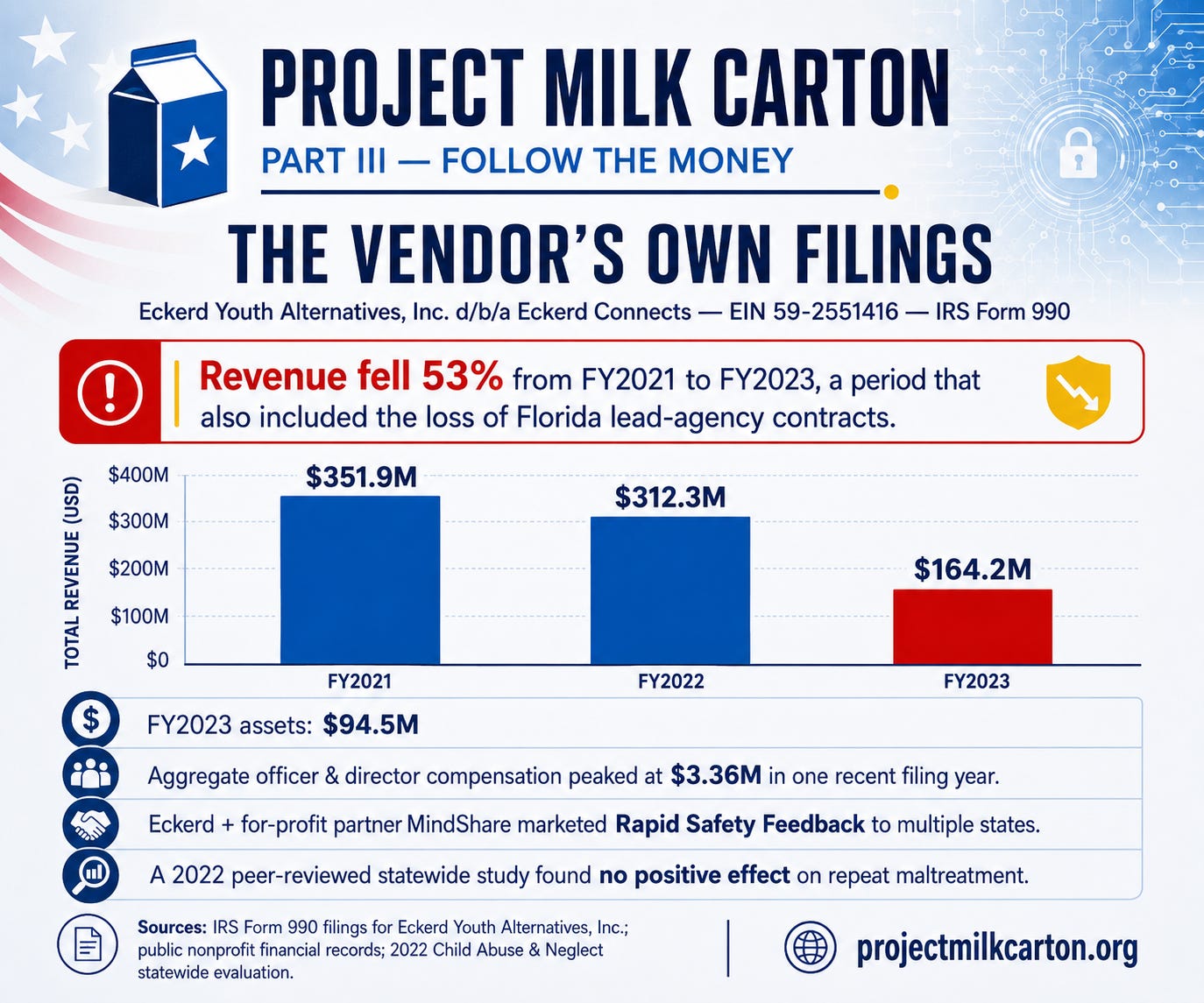
Its own Form 990 filings show approximately $351.9 million in revenue in FY2021, $312.3 million in FY2022, and $164.2 million in FY2023, with approximately $94.5 million in assets reported for FY2023.
Aggregate officer and director compensation peaked at approximately $3.36 million in one recent filing year.
That is a revenue decline of roughly 53 percent from FY2021 to FY2023.
The decline occurred during a period that also included the loss of Florida lead-agency child-welfare contracts. We do not attribute the entire revenue decrease to those contract losses; the filings establish the financial decline, while the contracting record supplies important context.
Eckerd had previously held the kind of major lead-agency child-welfare contracts capable of making it a substantial government vendor.
And Rapid Safety Feedback was not merely an internal experiment.
Eckerd and MindShare marketed it.
They took it to other jurisdictions.
They sold a safety product.
Rapid Safety Feedback’s origin story, as marketed, came from Hillsborough County, Florida.
After RSF launched there, Eckerd reported that no child receiving its in-home services died from abuse.
That is a powerful statistic.
It is not, by itself, a controlled evaluation.
It is a count of deaths within a particular client population, without a comparison group capable of establishing that the predictive tool caused the result.
That distinction matters when a safety claim becomes part of a product’s reputation.
A 2022 peer-reviewed statewide evaluation published in Child Abuse & Neglect tested Rapid Safety Feedback under broader real-world conditions.
The study found no evidence that the system reduced subsequent severe maltreatment.
By then, versions or adaptations of Rapid Safety Feedback had already reached multiple jurisdictions, including Ohio, Indiana, Maine, Louisiana, Tennessee, Connecticut, Oklahoma, and Alaska.
Illinois had also purchased the system through the sole-source contract examined in Part II.
There, 369 children under age nine received scores of 100 percent probability of death or serious injury, while the system failed to identify some of the highly publicized cases in which children later died.
Illinois shut it down.
There is one more public record involving Eckerd that deserves careful treatment.
In February 2024, Florida’s Second District Court of Appeal issued its decision in McGee v. Eckerd Youth Alternatives, Inc. d/b/a Eckerd Connects, No. 2D22-4080.
The appeal was brought by the personal representative of the estate of Kwon McGee, a deceased minor.
The published appellate disposition is a per curiam affirmance.
It does not state the underlying facts of the case.
For that reason, Project Milk Carton does not characterize the nature of the trial-court claims or use the case as evidence that Rapid Safety Feedback caused, contributed to, or failed to prevent any particular event.
The case exists in the public record.
That is what we can establish.
And that is where we leave it.
Because the larger money question is not confined to one vendor.
It reaches Washington.
There is no dedicated federal child-welfare line item called “predictive analytics” in the funding provisions examined here.
That does not mean federal money is absent from the infrastructure beneath these systems.
The distinction is important.
A predictive model is one thing.
The administrative and information architecture capable of supplying data to analytical tools is another.
And federal child-welfare funding can help pay for portions of that underlying architecture.
Title IV-E provides federal financial participation for qualifying administrative expenditures associated with state child-welfare programs.
Under the applicable federal rules, the federal government generally participates at 50 percent for allowable administrative expenditures, subject to eligibility requirements, cost allocation, and other conditions.
That is very different from saying:
“The federal government pays half the cost of every risk-scoring algorithm.”
We cannot establish that.
Whether the development, maintenance, staffing, or operation of a particular predictive model was claimed as a federally reimbursable administrative expense has to be established from the actual financial records of the jurisdiction involved.
The funding mechanism nevertheless matters because Title IV-E supports portions of the administrative environment in which modern child-welfare systems operate.
Then there is CCWIS — the Comprehensive Child Welfare Information System framework.
CCWIS regulations govern federally supported child-welfare information systems and contemplate extensive electronic exchange of information among child-welfare agencies and other public systems.
Qualifying CCWIS project costs may receive 50 percent federal financial participation.
Qualifying non-CCWIS automated child-welfare system costs may also receive federal matching under the applicable rules.
So the important distinction is not that Washington offers an extraordinary match exclusively for one favored class of modern system.
It does not.
The important point is that federal child-welfare dollars can participate in building and maintaining substantial portions of the information infrastructure used by state agencies.
That infrastructure can include case-management systems, interfaces, data exchanges, reporting functions, and other administrative technology.
Think of it as the plumbing.
A predictive model may sit at the faucet.
But the model is far less useful without reliable data underneath it.
CCWIS rules contemplate exchanges across public systems, and jurisdictions seeking federal participation in major automated child-welfare projects use the Advance Planning Document process to describe proposed systems, upgrades, costs, schedules, and related plans.
The Children’s Bureau reviews those planning documents as part of the federal funding and oversight process.
What those regulations do not establish is that every Medicaid record, behavioral-health record, benefits record, court record, or other dataset used by a predictive model was connected with federal dollars.
That has to be proven jurisdiction by jurisdiction.
The same rule applies to the models themselves.
Federal support for an information system does not automatically establish federal financing of every analytical product later connected to that system.
But existing integrated infrastructure can make later analytical projects substantially easier to build because agencies may not need to reconstruct the entire information environment from scratch.
And that creates an unusual oversight problem.
The federal government can participate in financing and reviewing pieces of child-welfare information infrastructure without necessarily conducting an independent review of every predictive model later connected to that infrastructure.
The architecture can receive scrutiny.
The algorithm may not.
That creates an accountability gap between oversight of information infrastructure and oversight of the analytical models that may later make use of it.
And in 2026, that distinction became even more important.
On May 28, the Administration for Children and Families posted funding opportunity HHS-2026-ACF-ACYF-CA-0037.
The notice was modified June 12.
This time, predictive analytics was not merely something potentially operating above federally supported infrastructure.
Predictive analytics was the point of the federal program itself.
Washington put $6 million behind it.
But before we read that funding notice line by line, there is another question that cannot be separated from the technology.
What happens when the data being scored can function as a proxy for disability?
That is where Part IV begins.
By now, you may have identified a tool.
You may know who built it.
You may have found an evaluation or learned whether the system is still operating.
Now follow the money.
Start with:
“[tool name] contract”
“[vendor name] child welfare contract”
“[vendor name] [your state]”
“[agency name] predictive analytics contract”
“[agency name] risk assessment procurement”
Search:
“[your state] procurement portal”
Then look for the tool, vendor, developer, or contractor.
If you find a contract, save:
the contract number
vendor name
amount
effective dates
amendments or renewals
description of the work
If the procurement system is difficult to search, try Google:
“[vendor name]” site:.gov contract
You are looking for one document that connects the government agency to the company, university, nonprofit, or contractor behind the system.
Search:
“[agency name] federal funding child welfare”
“[agency name] Title IV-E”
“[agency name] CCWIS”
You are not trying to prove that Washington paid for the model unless the records actually establish that.
Ask the narrower question:
What federally supported systems or infrastructure surround it?
Look for references to:
Title IV-E
CCWIS
child-welfare information systems
Advance Planning Documents or APDs
federal matching
system modernization
data integration
If you cannot establish that federal money funded the predictive model itself, write:
Not established.
That is not a failure.
That is evidence discipline.
Search:
“[vendor name] contracts”
“[vendor name] government contracts”
“[vendor name] child welfare”
If the vendor is a nonprofit, also search:
“[vendor name] Form 990”
If it is a private company, look for government contracts, procurement records, federal awards, and subcontracting records.
The goal is simple:
Who paid whom, how much, and for what?
Add this to the note you started in Parts I and II:
Tool:
Agency:
Vendor/developer:
Contract amount:
Contract dates:
Funding source listed:
Federal funding mentioned:
CCWIS or Title IV-E mentioned:
Documents saved:
What is still unclear:
Do not turn an unanswered question into a conclusion.
If the record does not establish something, mark it:
Not established.
Find one document showing who paid for the system, infrastructure, or people behind the tool.
Save the document.
Save the link.
Save the date.
The paper trail is getting longer.
This installment is built on Eckerd Youth Alternatives, Inc. Form 990 filings, EIN 59-2551416; public nonprofit financial records; the 2022 Child Abuse & Neglect study examining a statewide implementation of Eckerd Rapid Safety Feedback; the published appellate disposition in McGee v. Eckerd Youth Alternatives, Inc., No. 2D22-4080; federal regulations governing Title IV-E administrative expenditures and child-welfare information systems; the CCWIS regulations in 45 C.F.R. Parts 1355 and 1356; and federal and state records concerning child-welfare information-system funding and planning.
Where the record requires qualification, we have done so:
Eckerd’s reported revenue fell substantially between FY2021 and FY2023, a period that also included the loss of Florida lead-agency child-welfare contracts. We do not attribute the full revenue decline to any single cause.
A 2022 peer-reviewed statewide evaluation of Rapid Safety Feedback found no evidence of reduced subsequent severe maltreatment. We do not characterize that study as the only independent evaluation ever conducted unless a comprehensive literature review establishes that claim.
McGee v. Eckerd Youth Alternatives, Inc. was decided by Florida’s Second District Court of Appeal on February 7, 2024. The published disposition is a per curiam affirmance and does not set out the underlying facts. We therefore do not characterize the nature of the trial-court claims without reviewing the underlying record.
Figures from an earlier records pull stating that Eckerd received $35.2 million in federal HHS awards in 2019 and $14.6 million in 2025 could not be independently reverified during this investigation. Those figures are therefore omitted from the body of this installment.
Title IV-E and CCWIS funding can support qualifying administrative and information-system expenses. That does not establish that federal dollars paid for every predictive model or every data connection discussed in this series. Financing of a particular model must be established from the jurisdiction’s actual claims, expenditures, contracts, and planning documents.
Current regulations provide 50 percent federal participation for qualifying CCWIS and non-CCWIS project costs, subject to applicable requirements and cost allocation. Earlier language suggesting a substantially lower federal match for legacy systems has been removed.
Project Milk Carton is a 501(c)(3) transparency and public-data organization. This article is public-record research, not legal advice.
Corrections: If any figure or citation here is wrong, we will say so, prominently.
The Number That Knocks — Part IV: Disability and the Federal Check
Civil-Rights Complaints, Disability Bias Research, and Washington’s New $6 Million Predictive-Analytics Program
Once it is published we will link it here.
If you enjoyed this work and feel encouraged by independent investigations like this, please consider becoming a paid subscriber to 17sog.substack.com here on Substack, or donate at Project Milk Carton Inc.
Your gift keeps our site alive, spotlighting high-risk children! You can also donate at https://t.co/PvtnrODkNz
Your support helps us turn information into action for children and families by:
keeping high-risk and missing children visible
identifying gaps in the systems responsible for protecting them
giving families and communities clear, usable information they can act on
supporting education, outreach, and practical community-based solutions
maintaining the public-data and OSINT work that makes this accountability possible
building tools and resources designed to help communities protect children before they disappear into a system
Most importantly, please share this article.
Independent journalism survives when ordinary people help spread information powerful institutions would prefer to remain ignored, misunderstood, or buried beneath complexity.
Because silence protects systems.
Informed communities protect children.
ALL paid subscriptions are 100% tax deductible
Project Milk Carton | 501(c)(3) | EIN: 33-1323547
No posts
Comments
Nothing yet. Say the first thing.
Sign in to join the conversation.