
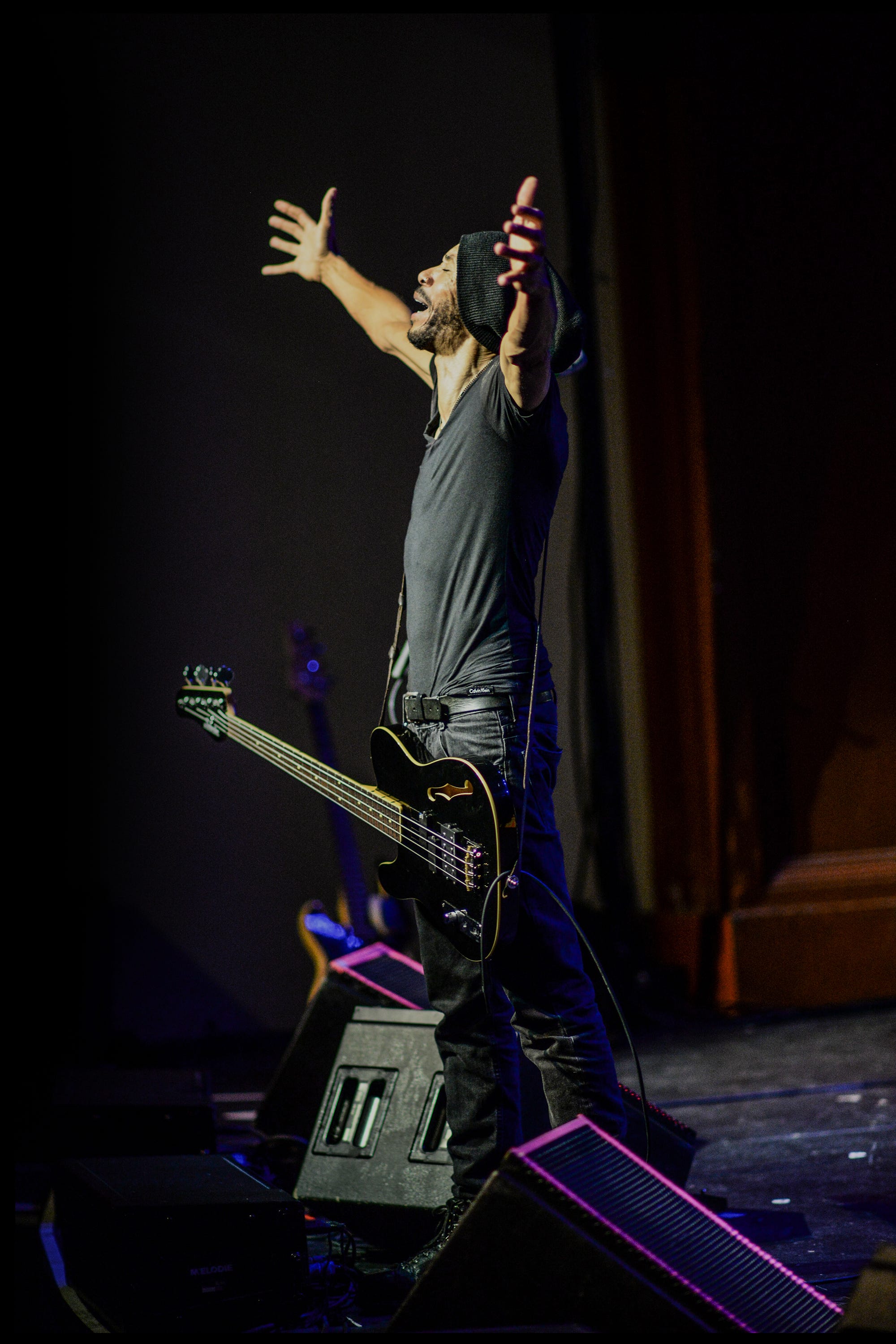
Then there is Dug Pinnick.
Dug does not simply “have a tone.” Dug has weather. Dug has architecture. Dug has that enormous, growling, spiritual earthquake of a bass sound that feels like somebody plugged a church organ into a tube amp, fed it through a freight train, and then asked it to sing harmony.
For decades, the King’s X bassist and vocalist has occupied a strange and beautiful place in the bass universe. He is not just the low end. He is not just the singer. He is not just the foundation. In King’s X, Dug Pinnick is the floor, the ceiling, the smoke, the sermon, the streetlight, and the cracked pavement underneath your boots.
So when Schecter entered Dug’s world, they were not just building another artist model.
They were trying to bottle thunder.
And thunder is not easy to put in a bass case.
Signature instruments are often sold like magic keys.
Buy this bass and sound like this artist.
But Dug Pinnick is one of those rare players who proves the opposite. You could hand Dug a pawnshop bass, a practice amp, and a cable held together with electrical tape, and within three notes you would still know it was him.
That is the real challenge of building for Dug.
You are not trying to create his identity. He already has one of the strongest identities in rock bass. You are trying to create a tool that does not get in the way of it.
That matters.
Dug’s tone has always lived in contradiction. It is heavy but open. Distorted but musical. Aggressive but warm. Huge but never lazy. It growls, but it still speaks. It can sit underneath Ty Tabor’s guitar, lock with Jerry Gaskill’s drums, and still somehow feel like another rhythm guitar, another voice, and another emotional layer of the song.
That is the King’s X trick.
Three musicians. Ten sounds. One planet.
Dug’s bass has to do several jobs at once. It has to hold the root. It has to roar. It has to cut. It has to support those impossible vocal harmonies. It has to work in a trio where there is nowhere to hide. And most importantly, it has to survive being Dug Pinnick’s right hand.
Because Dug does not play like he is asking permission.
He plays like the song owes him money
Schecter has always had a certain attitude baked into its DNA.
The company was born in California in the late 1970s as a parts and repair operation before evolving into a full instrument brand known for bold guitars, artist models, custom shop work, and hard-rock credibility. It is a company comfortable with players who do not fit politely inside vintage museum glass.
That makes the Dug/Schecter relationship feel natural.
Dug was never going to be the perfect match for a polite, coffee-table bass. His sound needed something black, direct, stripped down, and dangerous-looking — a bass that looked like it might not say much until you turned it on, and then immediately lowered the property value of the room.
That is where the Baron-H comes in.
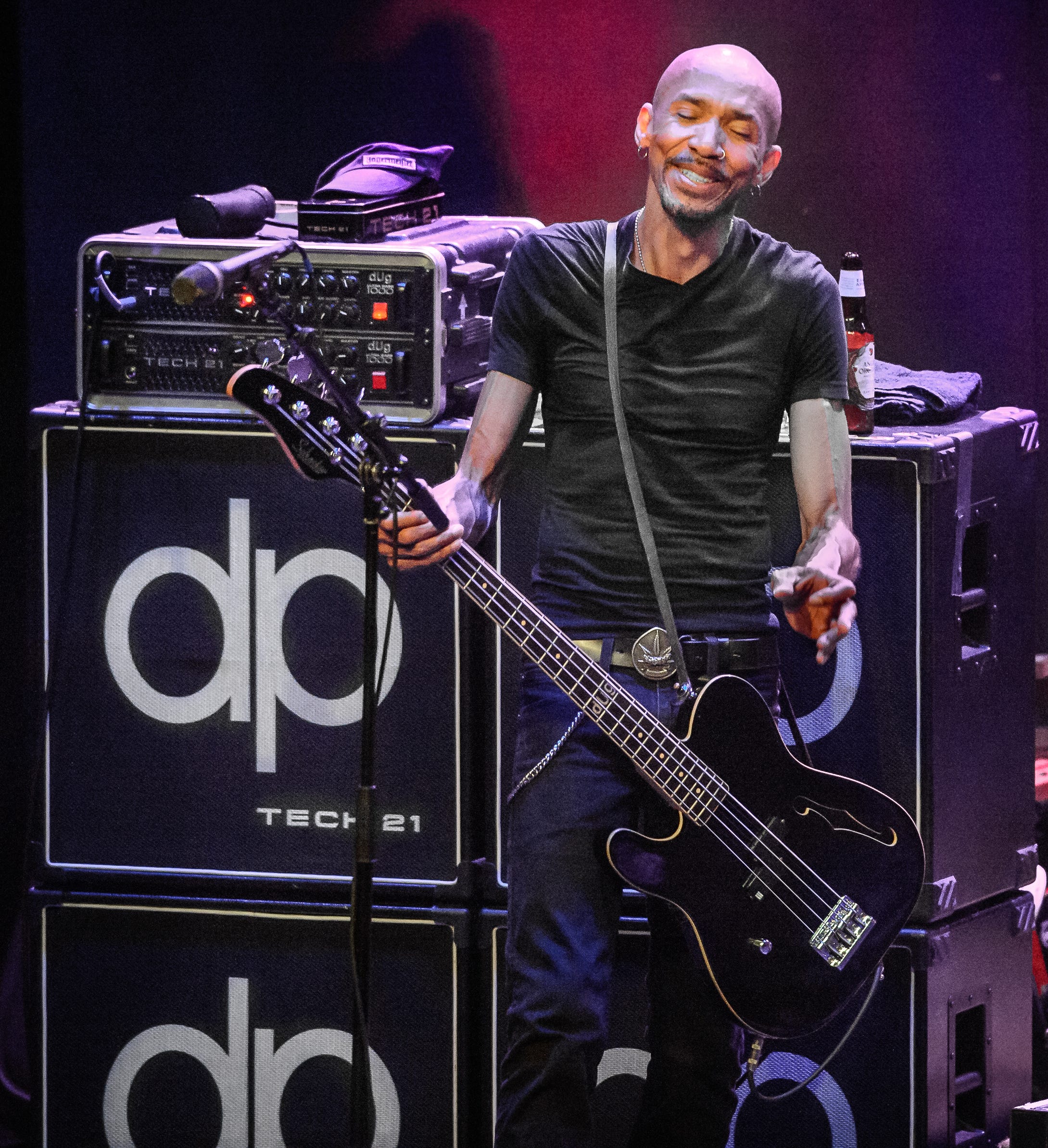
The Schecter dUg Pinnick Baron-H Bass is a beautiful contradiction.
At first glance, it has an almost classic shape. Single cutaway. Semi-hollow flavor. A single f-hole. Gloss black finish. Cream binding. Chrome hardware. It has a little old-school elegance in the outline.
But then you look closer and realize this thing is not here to play jazz brunch.
The Baron-H is brutally simple in the best possible way: mahogany body, maple neck, rosewood fingerboard, 35-inch scale, 22 frets, a Seymour Duncan Pro Active APB-1 pickup, and one control: volume.
That is it.
No forest of knobs. No onboard spaceship. No five-band “please rescue my bad tone” control center.
Just plug in, turn up, and either you have something to say or you do not.
There is something very Dug about that.
The single pickup is important. Dug’s sound has never been about polite options. It is about commitment. The Baron-H does not feel like a bass designed for someone who wants to spend twenty minutes deciding between “modern slap bridge tone” and “vintage passive neck warmth.” It feels like a bass built for someone who already knows where the fight is.
One pickup. One volume. One decision.
Go.
Why the Baron-H Makes Sense for Dug
The Baron-H gives Dug the kind of platform his tone needs: mass, resonance, attack, and simplicity.
The mahogany body contributes weight and warmth. The longer 35-inch scale helps keep the low end tight and authoritative. The Seymour Duncan Pro Active APB-1 gives the instrument the aggressive split-coil punch needed for Dug’s distorted, muscular approach.
And the single f-hole gives the bass a visual personality that feels oddly perfect: a little hollow, a little haunted, a little classic, a little mean.
That is Dug all over again.
He has always been connected to older musical DNA — gospel, soul, blues, classic rock, funk — but he filters it through a modern wall of sound. The Baron-H looks like a vintage idea that got raised in a warehouse full of amplifiers.
It does not try to be futuristic.
It tries to be inevitable.
The Left-Handed Truth
One of the beautiful things about Dug’s signature world is that left-handed players are not treated like an afterthought.
Dug is a left-handed player, and Schecter has offered left-handed versions of his signature instruments. That matters more than people realize. In the bass world, left-handed players have spent decades hearing some version of: “We might have one in sunburst in seven months.”
Dug’s relationship with Schecter quietly pushes back against that.
The Baron-H and DP-12 are not just regular basses flipped for convenience. They are connected to a player whose whole physical relationship with the instrument is left-handed. For lefty players, that is not a small detail. That is representation in wood, strings, and black paint.
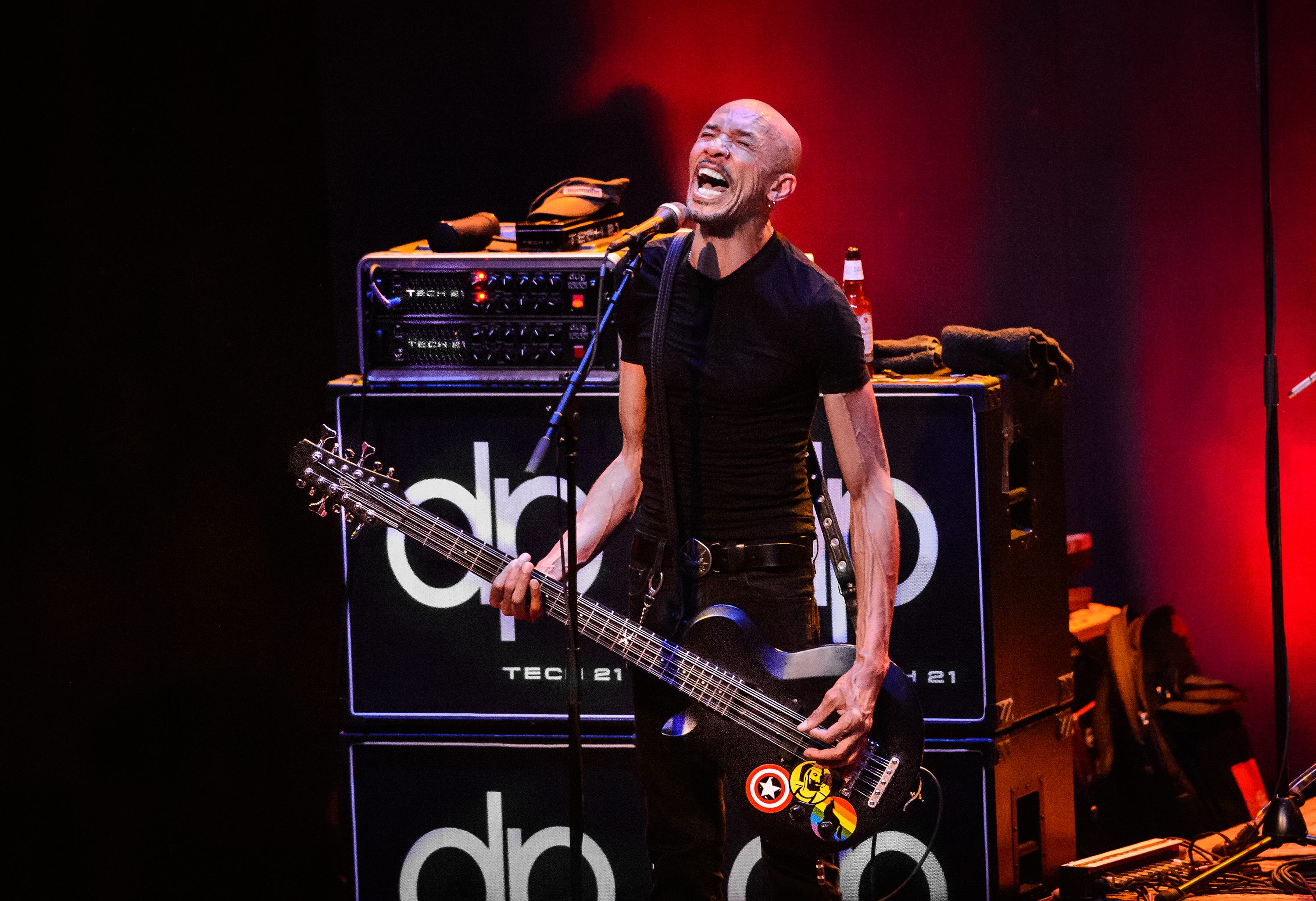
If the Baron-H is Dug’s black thunder machine, the Schecter dUg Pinnick DP-12 is the thunderstorm with a choir inside it
.
The DP-12 is Dug’s 12-string signature bass, and for anyone unfamiliar with 12-string basses, let us clear something up right away.
This is not a 12-string guitar.
This is not a novelty.
This is not a bass for people who think four strings are too emotionally stable.
A 12-string bass is usually built in four courses, with each main bass string paired with two higher octave strings. In simple terms, your E, A, D, and G become giant, shimmering, piano-like clusters. Every note becomes a small army.
When played clean, it can sound wide and orchestral.
When played with drive, it can sound like a rhythm guitar, bass guitar, and angry cathedral all arriving at the gig in the same van.
And Dug Pinnick is one of the few hard rock bassists who made that sound part of a real musical language.
Not a gimmick.
A language.
Dug and the 12-String Bass: The Low End Learns to Fly
Dug’s use of 12-string bass is part of what made King’s X sound so massive for a trio.
In a three-piece band, space is both a gift and a problem. There is freedom, but there is also exposure. When the guitar steps into a riff or a chordal part, the bass has to decide: do I stay traditional and leave air, or do I fill the horizon?
Dug found a third answer.
He made the bass bigger without making it stupid.
The 12-string allowed him to occupy a space between bass and guitar. It added chime, growl, width, and that almost spiritual upper-octave shimmer that became part of the King’s X atmosphere. The sound could be heavy, but it could also glow. That is the key. Dug’s 12-string tone was never just “more strings equals more noise.”
It was more emotional information.
You hear the root, but you also hear the overtones blooming above it. You hear the grind, but also the shimmer. It is low end with a halo and a bad attitude.
That is a rare combination.
The Schecter DP-12: Built for the Wall
The Schecter dUg Pinnick DP-12 takes that idea and makes it available as a production signature instrument.
The specs tell part of the story: mahogany body, maple neck, ebony fingerboard, 34-inch scale, 22 extra-jumbo frets, Grover tuners, Diamond Custom Bass bridge, Seymour Duncan Pro Active APB-1 pickup, and an active Seymour Duncan 2-band EQ.
But specs alone never tell the whole truth.
The real point is that Schecter built a bass that acknowledges Dug’s 12-string sound as a serious part of bass history. That matters. The 12-string bass has often lived on the edge of the instrument world — adored by some, misunderstood by many, and ignored by people who think bass should stay in its assigned lane.
Dug never cared much for lanes.
The DP-12 is not simply “Dug’s weird bass.” It is a recognition that his approach deserves its own machine.
A 12-string bass is physically demanding. The neck is wider. The tuning is more complex. The string tension is no joke. The player has to control more sound, more overtones, and more potential chaos.
In the wrong hands, it can become mud with jewelry.
In Dug’s hands, it becomes a wall with windows.
From Custom Legend to Production Reality
Before the Schecter DP-12, Dug was already strongly associated with custom 12-string basses, including his Yamaha 12-string instruments. That history is important because the Schecter model did not appear out of nowhere. It arrived as part of a longer story — Dug’s ongoing search for instruments that could handle the size of the sound in his head.
The DP-12 has often been discussed in connection with Dug’s earlier custom Yamaha 12-string basses, and that makes sense. The goal was not to reinvent Dug’s relationship with the instrument. The goal was to carry it forward in a form that other players could actually reach.
That is the best kind of signature instrument.
Not a museum replica.
Not a celebrity sticker.
A doorway.
Some brands might have tried to make Dug’s signature models too fancy.
Some might have overdesigned them.
Some might have tried to smooth out the rough edges and make everything more commercially polite.
Schecter leaned into the truth: Dug’s basses should look direct, dark, strong, and stage-ready.
The Baron-H and DP-12 are not boutique furniture pieces. They are working instruments for big sounds. They look like tools, not trophies. And that fits Dug perfectly because Dug has never been about gear snobbery for its own sake.
His whole career sends the same message: the music comes first, the feel comes first, the song comes first, and the tone has to tell the truth.
That is why his signature models are interesting. They are not trying to impress you with unnecessary decoration. They are trying to survive the job.
The Spiritual Side of Heavy
One of the mistakes people make with Dug Pinnick is reducing him to “distorted bass guy.”
That misses the deeper story.
Yes, the tone is huge. Yes, the bass can sound like a mountain learning to speak. But Dug’s real power is not volume. It is emotion. His sound carries pain, joy, gospel memory, rock defiance, funk movement, and human survival.
That is why his bass tone feels different.
It is not just heavy.
It is lived-in.
When Dug plays, you are hearing decades of musical experience: Sly Stone, Hendrix, gospel harmony, hard rock, soul, blues, progressive rock, and the strange chemistry of three musicians in King’s X who somehow made complexity feel human.
So when Schecter builds a Dug Pinnick bass, they are not just making a machine for distortion.
They are making a machine for testimony.
That is the word.
Testimony.
Dug’s bass does not just support songs. It testifies inside them.
The Baron-H and DP-12: Two Sides of Dug
The beauty of Dug’s Schecter signature instruments is that they represent two sides of the same artist.
The Baron-H is the direct punch.
The DP-12 is the expanded universe.
The Baron-H says: here is the root, here is the growl, here is the note, deal with it.
The DP-12 says: here is the root, the octave, the shimmer, the wall, the choir, the building, the parking lot, and possibly your missing dental work.
One is a stripped-down weapon.
The other is a controlled explosion.
Together, they show why Dug Pinnick is such an important bass figure. He is not locked into one idea of what bass should be. He understands that the bass can be foundation, melody, texture, distortion, atmosphere, rhythm guitar, emotional center, and lead voice — sometimes all before the first chorus.
Why This Relationship Matters
The Dug Pinnick/Schecter relationship matters because it respects the weirdness.
And in music, weirdness is sacred.
Every major shift in instrument history begins with someone asking the wrong question in the right way.
What if the bass was distorted?
What if the bass could sing?
What if a trio could sound like five people?
What if the low end could shimmer?
What if the “support instrument” became the storm?
Dug Pinnick spent his career answering those questions without making a big speech about it. He just played. Night after night, record after record, riff after riff, he showed that the bass could be heavier, wider, more emotional, and more central than people expected.
Schecter’s signature models give physical form to that philosophy.
They are not just Dug basses.
They are evidence.
Evidence that tone can become identity.
Evidence that an artist can bend an instrument category around his own musical truth.
Evidence that sometimes the most important gear is not the gear that gives you more options, but the gear that removes excuses.
Final 123 Bass Nation Low-End Thought
Dug Pinnick’s Schecter basses are not polite instruments.
Good.
Polite was never the point.
The Baron-H and DP-12 exist because Dug’s sound needed tools that could match its size, honesty, and danger. The Baron-H gives you the black, stripped-down growl. The DP-12 gives you the huge, chiming wall of low-end electricity. Both instruments point back to the same truth:
Dug Pinnick did not become important because he followed the bass rules.
He became important because he made the bass sound like Dug Pinnick.
And that is the highest achievement any player can reach.
Not sounding expensive.
Not sounding fashionable.
Not sounding like the catalog promised.
Sounding unmistakably, dangerously, beautifully like yourself.
That is the real signature model.
The instrument comes later.
123 Bass Nation
Comments
Nothing yet. Say the first thing.
Sign in to join the conversation.